
If you searched for 5-HTP for sleep because the serotonin-to-melatonin pathway diagram in a podcast or brand article made the logic sound airtight, you deserve a straight read, especially if you take any antidepressant or migraine medication.
Quick Answer: should you try 5-HTP for sleep
For adults with mild, non-clinical sleep complaints who are not on any serotonergic medication, 100 to 300 mg of third-party-tested 5-HTP 30 to 60 minutes before bed is a thin-evidence trial. For anyone on an antidepressant, migraine drug, or other serotonergic agent, it is not a candidate at all.
- Best for: healthy adults with mild subjective sleep complaints and no psychiatric or migraine medication, who buy from a brand publishing a Peak X-free Certificate of Analysis.
- Not ideal for: anyone on an SSRI, SNRI, MAOI, tricyclic antidepressant, tramadol, a triptan, St John's wort, lithium, or dextromethorphan. Also not ideal for pregnant or nursing people, or anyone whose sleep problem is loud snoring with witnessed pauses (that is a sleep clinic question).
- Do first: CBT-I, light exposure timing, caffeine cutoff, and a clinician conversation if mood symptoms are part of the picture. The first-line treatment for chronic insomnia per AASM is CBT-I, not a precursor amino acid.
- Decision shortcut: if you take any prescription medication that touches mood, pain, or migraine, skip 5-HTP entirely and look at glycine, magnesium glycinate, or low-dose melatonin instead. If you do trial it, start at 100 mg, single-variable, two weeks, with the clinician informed.
What 5-HTP actually is
5-HTP is 5-hydroxytryptophan, the immediate metabolic precursor to serotonin. The serotonin pathway is short and worth walking through because it is the entire reason this supplement has a marketing story.
Tryptophan → 5-HTP → serotonin (5-HT) → N-acetylserotonin → melatonin.
The first step is catalyzed by tryptophan hydroxylase (TPH) and is the rate-limiting step of serotonin synthesis. The second, 5-HTP to serotonin, is catalyzed by aromatic L-amino acid decarboxylase (AADC), which is fast and unregulated. Once serotonin is made, the pineal gland acetylates and methylates it overnight in response to circadian darkness signals to produce melatonin.
Supplemental 5-HTP bypasses the regulated tryptophan hydroxylase step entirely. It crosses the blood-brain barrier freely via the large neutral amino acid transporter (unlike serotonin itself) and is converted by AADC wherever AADC is expressed. That includes the brain, but also the gut, where enterochromaffin cells produce most of the body's serotonin.
This is the central biochemical reality most consumer articles elide. Most of the serotonin produced from oral 5-HTP is made in the periphery, not the brain. Peripheral serotonin has cardiovascular and gastrointestinal effects (nausea is the most common dose-limiting side effect). It is the reason older anti-Parkinson combinations paired 5-HTP with carbidopa, a peripheral AADC inhibitor, to push more conversion into the central nervous system. Carbidopa is prescription-only and is not how the supplement market uses 5-HTP.
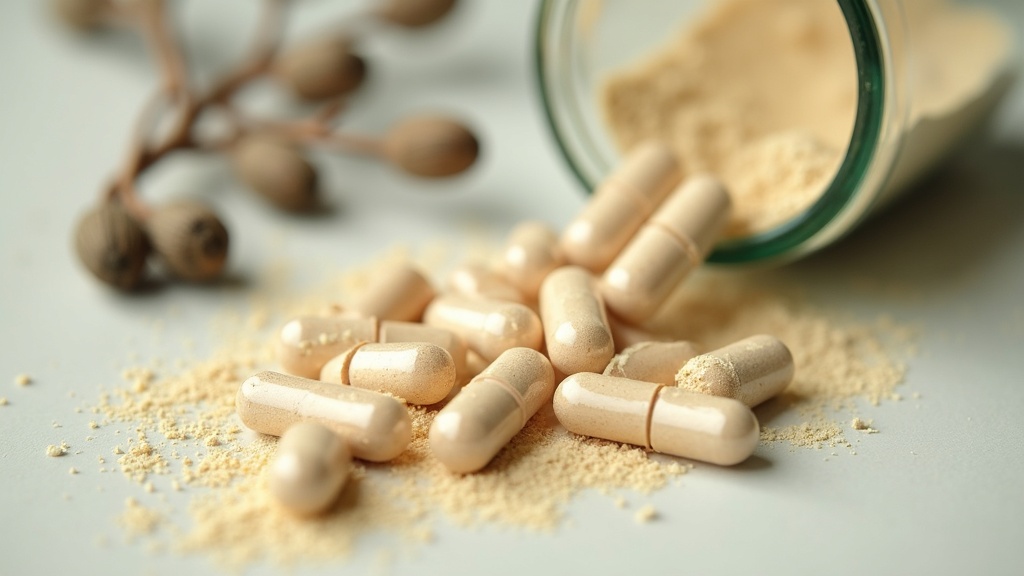
5-HTP is extracted commercially from the seeds of Griffonia simplicifolia, a West African woody climber whose seeds contain roughly 7 to 20 percent 5-HTP by weight.
The mechanism: why the pathway argument is real but incomplete

The mechanism logic for 5-HTP and sleep has three threads.
Thread one: substrate availability for melatonin synthesis. If pineal melatonin synthesis were substrate-limited, raising the upstream serotonin pool could raise overnight melatonin output. The honest issue: pineal melatonin synthesis is regulated primarily by circadian darkness signals and the rate-limiting enzyme AANAT, not by substrate availability at the population level. Substrate may matter in specific deficient states. It is rarely the bottleneck in a healthy adult.
Thread two: REM sleep architecture. Wyatt and colleagues in 1971 reported that L-5-hydroxytryptophan altered REM sleep architecture in healthy volunteers, with effects on REM latency and total REM time. The sample was small and the polysomnography of the era is not what we would run today, but the pharmacology is consistent with serotonergic input to brainstem sleep circuitry from the dorsal raphe and locus coeruleus.
Thread three: sleep continuity in older clinical observation. Soulairac and Lambinet in 1977 published clinical observations of 5-HTP for sleep disorders with reported improvements in onset and continuity at 100 to 200 mg. These were uncontrolled or weakly controlled observations by today's bar.
The mechanism is real. It is also incomplete, because raising whole-body serotonin synthesis has many downstream effects (mood, gut motility, vascular tone, platelet function) that are where the side-effect profile and drug interactions live. The pathway story is the easiest part of 5-HTP to tell honestly. The trial evidence is the hardest.
What the trials actually show
Most of the controlled 5-HTP literature is for depression, not sleep, and the depression literature is older and small. The 2002 Cochrane review by Shaw and colleagues examined tryptophan and 5-HTP for depression and concluded the evidence base was suggestive of antidepressant effect but limited by trial quality, small samples, and the 1989-90 contamination scare that froze most US research.
For sleep specifically, the human RCT cupboard is bare. The references most cited are the Wyatt 1971 polysomnography study and the Soulairac 1977 clinical observations, both small and both from a methodological era that predates modern sleep trial design. The Birdsall 1998 narrative review is a thoughtful summary of the pharmacology, not an RCT.
There is no modern, well-powered, placebo-controlled RCT of 5-HTP for clinical insomnia or for primary sleep complaint with validated polysomnographic or actigraphic endpoints. None. The 2025 sleep medicine guideline literature does not include 5-HTP as a recommended intervention for any sleep diagnosis.
The honest framing: 5-HTP has a coherent biochemical mechanism, weak old human evidence in mild depression with sleep symptoms as a secondary endpoint, essentially no modern sleep-specific RCT evidence, and a serious safety profile that almost every other sleep supplement does not carry. That is a very different value proposition from melatonin, glycine, or magnesium.
The dose-trial-to-supplement gap also bites: the few trials that reported sleep effects used 100 to 200 mg in older protocols, and most current capsules deliver 50, 100, or 200 mg, so a label-following user often lands at the low end of an already thin-evidence window.
The Peak X contamination story
This is the part of the 5-HTP story most articles omit, and it matters.
In 1989-90 the United States experienced an outbreak of Eosinophilia-Myalgia Syndrome (EMS), a rare and sometimes fatal multisystem inflammatory illness traced to contaminated L-tryptophan from a single Japanese manufacturer using a flawed fermentation process. The FDA recalled L-tryptophan, and 5-HTP, a near neighbor in the same pathway, became the workaround the supplement market migrated to. EMS caused dozens of deaths and thousands of cases of severe illness.
5-HTP itself was not the cause of the 1989-90 outbreak. But subsequent analytical chemistry on commercial 5-HTP identified an analog impurity, dubbed Peak X, in some batches. Klarskov and colleagues in 1999 characterized Peak X impurities in commercially marketed 5-HTP and reported case-associated contaminants chemically related to the original EMS-implicated species. The concern is not theoretical: there are case reports of EMS-like illness associated with 5-HTP use that map onto Peak X exposure.
The practical implication is unambiguous. Buy 5-HTP only from manufacturers that publish a Certificate of Analysis confirming Peak X testing and absence. Generic Amazon 5-HTP without published quality testing is the wrong product to put in your body. Brands historically associated with cleaner supply chains include Doctor's Best (which has used tested 5-HTP from a specific Italian Griffonia supplier), NOW Foods, and a small number of practitioner-channel brands. The premium for tested material is a few dollars per bottle. The contamination history is documented. The testing exists. Buy tested material or do not buy.
SEROTONIN SYNDROME: the interaction that defines the safety profile
This is the single most important section of this article. Read it twice if you take any prescription medication that touches mood, pain, or migraine.
Serotonin syndrome is a potentially fatal pharmacologic emergency caused by excessive serotonergic activity in the central nervous system. The Boyer and Shannon 2005 NEJM review defines the syndrome as a triad: mental status changes (agitation, confusion, hallucinations), autonomic instability (hyperthermia, tachycardia, hypertension, sweating), and neuromuscular hyperactivity (clonus, hyperreflexia, rigidity, tremor). Severe cases progress to seizures, rhabdomyolysis, disseminated intravascular coagulation, and death. Onset is typically within hours of a serotonergic combination starting or a dose change.
5-HTP is a direct serotonin precursor. Adding it to any other serotonergic agent is additive serotonergic load. The clinically relevant categories per the Drugs.com 5-HTP monograph are:
- SSRIs: fluoxetine, sertraline, citalopram, escitalopram, paroxetine, fluvoxamine. Contraindicated.
- SNRIs: venlafaxine, duloxetine, desvenlafaxine, levomilnacipran. Contraindicated.
- MAOIs: phenelzine, tranylcypromine, isocarboxazid, selegiline. Absolute contraindication. MAOIs prevent the breakdown of serotonin and combining with 5-HTP can be rapidly fatal. There is no scenario in which a person on an MAOI should take 5-HTP.
- Tricyclic antidepressants: amitriptyline, nortriptyline, imipramine, clomipramine. Contraindicated.
- Triptans (migraine): sumatriptan, rizatriptan, eletriptan, zolmitriptan, naratriptan, frovatriptan. Contraindicated.
- Tramadol. Contraindicated.
- Dextromethorphan (common cough suppressant in over-the-counter cold medications). Contraindicated.
- St John's wort. Contraindicated.
- Lithium, linezolid, methylene blue. Contraindicated.
The list above is not exhaustive. The clinician check before starting 5-HTP must be a full medication review including over-the-counter cold and cough products.
If you are on any antidepressant, the answer is no. Not "take a lower dose." Not "wait two hours after your SSRI dose." Not. The safer interventions for sleep on an antidepressant are sleep hygiene, CBT-I, low-dose melatonin (0.3 to 1 mg), magnesium glycinate, glycine, and a conversation with the prescriber. None of those carry the serotonin syndrome risk that 5-HTP carries.
If you have taken 5-HTP and start to develop agitation, confusion, racing heart, high fever, muscle stiffness, twitching, or sweating within hours of starting, stop the supplement and get to an emergency department. Serotonin syndrome is a clinical diagnosis and a medical emergency.
Dose, timing, and the format question
If you have read the previous sections and you are still a candidate (no serotonergic medications, no pregnancy, no relevant chronic condition), the dose conversation is short but requires care.
Trial-cited doses for sleep range from 100 to 300 mg taken 30 to 60 minutes before bed. Start at 100 mg. The dose-response curve for serotonin synthesis is not linear, and side effects (nausea, GI upset, vivid dreams) become more common above 200 mg in many users.
Do not stack 5-HTP with high-dose vitamin B6 in the same pill. B6 (pyridoxine) is the cofactor for the AADC enzyme that converts 5-HTP to serotonin, and most AADC activity sits in the periphery. A capsule that combines 100 mg of 5-HTP with 50 mg of B6 pushes more conversion into the peripheral compartment and less into the brain. If you want B6 in your regimen, take it at a different time of day at a modest dose (10 to 25 mg of P-5-P).
Cycle rather than take indefinitely. Receptor downregulation with chronic precursor loading is a theoretical concern that has not been cleanly resolved in the literature. Use short defined trials (two to four weeks), not indefinite nightly use. If a two-week trial does not produce a felt benefit, the molecule is not your lever.
Actionable takeaway: if you trial 5-HTP, use an immediate-release 100 mg capsule from a brand with a Peak X-free Certificate of Analysis, 30 to 60 minutes before bed, single-variable, for two weeks, with a clinician informed.
Where 5-HTP sits relative to standard of care
5-HTP is not in standard sleep medicine guidelines. The AASM 2021 guideline on chronic insomnia names cognitive behavioral therapy for insomnia (CBT-I) as first-line and recommends specific pharmacologic agents (eszopiclone, zolpidem, suvorexant, low-dose doxepin, ramelteon) as adjuncts where indicated. 5-HTP appears on none of these lists.
Cardiology and psychiatry practice tends to be quietly anti-recommending of 5-HTP, primarily because the patient populations these specialties manage are heavily medicated with serotonergic drugs and the interaction risk dominates the modest mechanistic upside. The mechanism logic is real but the safety profile is not optional reading. The same pathway-precursor logic could be applied to melatonin itself, which is the actual circadian sleep signal and has a far cleaner safety profile, broader trial evidence, and no serotonin syndrome risk. See the melatonin deep dive for the cleaner version of the precursor argument.
FAQ
Is 5-HTP safe to take with an SSRI?
No. This is the single most important answer in this article. 5-HTP plus any SSRI carries a real serotonin syndrome risk, and the same applies to SNRIs, MAOIs, tricyclics, triptans, tramadol, St John's wort, lithium, and dextromethorphan. Per the Drugs.com 5-HTP monograph, the interaction is documented and clinically meaningful. If you are on any medication for mood or migraine, do not take 5-HTP.
Does 5-HTP help with sleep specifically?
The mechanism (5-HTP becomes serotonin becomes melatonin) is biochemically coherent, and small older studies reported effects on REM latency and subjective sleep onset. There is no modern, well-powered, placebo-controlled RCT of 5-HTP specifically for clinical insomnia. The honest read is plausible mechanism, weak old evidence, no guideline endorsement.
What is Peak X and should I worry about it?
Peak X is an analog impurity identified in some commercial 5-HTP batches, chemically related to contaminants implicated in the 1989-90 L-tryptophan EMS outbreak. The risk is small but real, and the mitigation is straightforward: buy 5-HTP only from brands that publish a Certificate of Analysis confirming Peak X testing and absence.
Should I take 5-HTP with vitamin B6 in the same pill?
No, not at a high B6 dose in the same pill. B6 is the cofactor for the AADC enzyme that converts 5-HTP to serotonin, and most AADC activity is in the periphery. Combining the two in one capsule pushes more conversion outside the brain, where the side-effect profile lives. If you want B6 in your regimen, take it at a different time of day at a modest dose.
Is there a safer alternative for sleep with the same pathway logic?
Yes. Melatonin itself is the actual sleep signal and bypasses the serotonin step entirely. Low-dose melatonin (0.3 to 1 mg) is the cleaner version of the precursor argument. Glycine at 3 grams pre-bed and magnesium glycinate are other low-risk options. None carry the serotonin syndrome interaction profile.
Conclusion: the bottom line on 5-HTP for sleep
The realistic frame for 5-HTP is this. It is a real serotonin precursor with a coherent biochemical pathway to melatonin, very thin modern sleep-specific RCT evidence, a documented Peak X contamination history that demands third-party testing, and a serotonin syndrome interaction profile that disqualifies anyone on SSRIs, SNRIs, MAOIs, tricyclics, triptans, tramadol, St John's wort, lithium, or dextromethorphan. For a narrow population of healthy adults on no serotonergic medication with mild non-clinical sleep complaints who buy from a Peak X-tested brand, 100 to 300 mg pre-bed for a two-week trial is a defensible experiment. For most readers, the safer and equally evidence-defensible options are CBT-I, low-dose melatonin, glycine, and magnesium glycinate.
The pathway story is the easiest part of 5-HTP to tell honestly. The safety story is what most consumer articles get wrong. If you remember nothing else from this piece, remember the interaction list and the Peak X testing requirement.
For the framework we use to evaluate every supplement we recommend, see How We Review Supplements. For the full author background and the rest of the cognitive and mood-pathway deep dives, see the Maria Rodriguez author profile. If mood symptoms are part of the picture and you are weighing supplement options carefully alongside clinician care, the broader read is in Best Supplements for Depression.
Next steps:
- If you take any antidepressant, migraine medication, tramadol, lithium, or St John's wort, do not start 5-HTP. Consider the melatonin deep dive for a cleaner precursor-pathway option.
- If you are not on a serotonergic medication and want to trial 5-HTP, buy a 100 mg immediate-release capsule from a brand publishing a Peak X-free Certificate of Analysis. Start single-variable for two weeks with a clinician informed.
- If sleep complaints persist beyond a clean sleep-hygiene and supplement plan, the AASM guideline first-line is CBT-I, not a precursor amino acid. Speak with a sleep medicine clinician.
This article is for informational purposes and not medical advice. 5-HTP can cause life-threatening serotonin syndrome when combined with SSRIs, SNRIs, MAOIs, tricyclic antidepressants, triptans, tramadol, St John's wort, lithium, dextromethorphan, or other serotonergic agents, per the Drugs.com 5-HTP monograph. 5-HTP is not recommended in pregnancy or lactation due to limited safety data and the centrality of the serotonin pathway in fetal development. If you develop agitation, confusion, racing heart, high fever, muscle stiffness, twitching, or sweating within hours of taking 5-HTP, stop the supplement and seek emergency care. If you are in crisis with thoughts of self-harm, contact the 988 Suicide and Crisis Lifeline in the US or your local emergency services.
Reviewed by Maria Rodriguez, MS Nutrition Science, focused on cognitive and mood biochemistry.
