
Affiliate disclosure: this article contains affiliate links. As an Amazon Associate, UsefulVitamins.com earns from qualifying purchases at no extra cost to you.
Before you buy
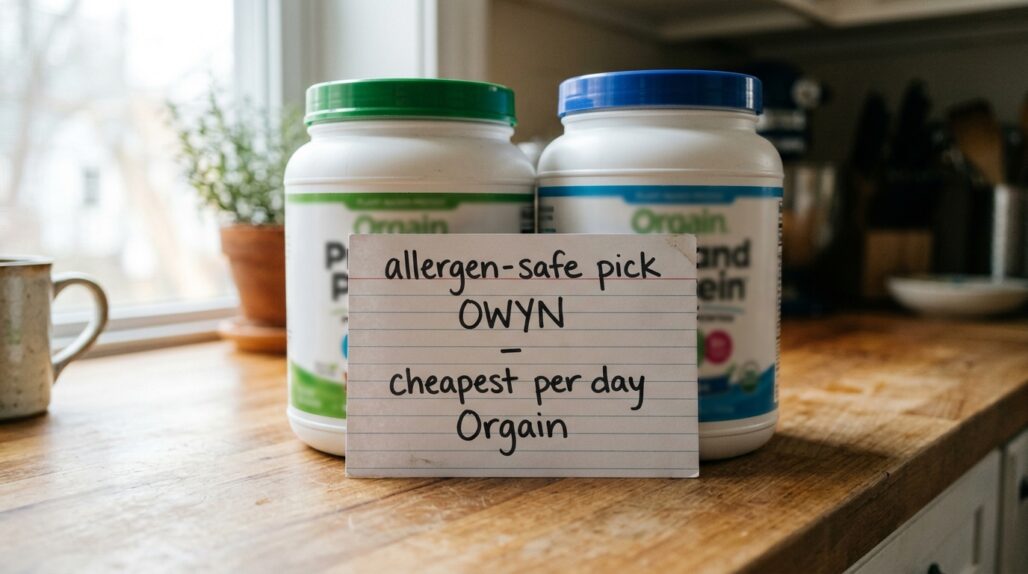
People search "OWYN vs Orgain" expecting a close fight between two plant proteins. It is not that even. These powders answer two different questions, and picking the wrong one wastes money or, in one case, can land an allergic person in the ER.
OWYN sells one thing above all: it is free of all top 9 FDA major allergens – milk, eggs, fish, shellfish, tree nuts, peanuts, wheat, soy, and sesame. Orgain sells reach and price. It is the organic plant protein stacked in Costco, Target, and most grocery stores, usually for less per serving.
The decision comes down to a single question. If you or someone in your house has a food allergy, that settles it – OWYN. If allergens are a non-issue and you just want a decent, cheap organic protein, Orgain is the obvious default. The rest of this comparison is about the gray zone in between, where the heavy-metals data and the per-serving math actually matter.
What each one is and what is inside
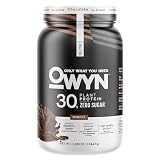
OWYN ("Only What You Need") is built around a pea, pumpkin seed, and chia blend. A two-scoop serving delivers 20g of protein, plus a small greens blend (kale, spinach, broccoli), monk fruit, and a probiotic strain. There is no soy, no dairy, no nuts, and the brand carries an allergen-friendly designation tied to its manufacturing controls, per the OWYN chocolate product page.
Orgain's Organic Plant-Based Protein uses pea, brown rice, and chia (some versions add mung bean), with 21g of protein per scoop, prebiotic fiber, and a creamer base of acacia and sunflower oil. It is USDA Organic, Non-GMO, gluten-free, and kosher, per the Orgain product page.
Here is the catch most reviews skip: Orgain is not allergen-free. It is made without soy and dairy ingredients, but it is not produced in a top-9-allergen-free facility, and that distinction became a real-world problem (more on the recall below).
Both hit the same protein target, both lean on pea as the base, and both add chia. On the label, they look like cousins. The differences that matter are off the front panel.
Protein and amino profile
On protein-per-scoop, this is close to a tie. Orgain edges OWYN 21g to 20g, but Orgain reaches that with a slightly bigger scoop, so it is not a meaningful gap.
Both blends cover all nine essential amino acids, which is the thing pea protein alone is weak on. Pea runs low in methionine; adding chia, pumpkin, brown rice, or mung bean rounds out the profile. For everyday muscle maintenance and a protein-forward smoothie, either covers the basics.
If you are training hard and chasing leucine for muscle protein synthesis, note that OWYN lists about 1.7g of leucine per serving, which is solid for a plant blend. Orgain does not headline its leucine number as prominently, and plant proteins generally sit below whey on leucine density. For the bigger picture on how much protein you actually need day to day, the NIH Office of Dietary Supplements protein overview is the cleaner reference than any brand's marketing.
| Spec | OWYN Plant Protein | Orgain Organic Plant-Based |
|---|---|---|
| Protein per serving | 20g (2 scoops) | 21g (1 scoop) |
| Protein base | Pea, pumpkin seed, chia | Pea, brown rice, chia (some mung bean) |
| Top 9 allergen free | Yes | No (made without soy and dairy only) |
| USDA Organic | No | Yes |
| CR lead test result | OWYN Pro Elite – best plant pick, ~88% of CR concern level (standard 20g powder not separately tested) | 143% of CR concern level |
| Servings per tub | ~28 | ~20 |
| Approx. price | ~$45 | ~$28 to $38 |
The heavy-metals question
This is where the two products separate, and it is the part worth slowing down for.
Plant proteins absorb heavy metals from soil more readily than whey does. Consumer Reports' 2025 testing of 23 protein powders found plant-based products averaged roughly nine times the lead of dairy-based ones, and nearly all plant powders it tested came back elevated, per the Consumer Reports lead investigation. The Clean Label Project's 2024-25 protein study reached a similar conclusion – plant and organic powders carried more lead and cadmium than whey, and "organic" did nothing to lower the metals (USDA Organic tests pesticides, not lead).
So how did these two do? OWYN Pro Elite was the standout plant-based pick in Consumer Reports' set, landing around 88% of CR's daily level of concern – low enough that CR did not flag it for daily use. Note that CR's clean result is specifically for OWYN's Pro Elite line, not every OWYN powder, so if lead is your reason to buy, choose the Pro Elite. Orgain's Organic Plant-Based (Vanilla Bean) came in at 143% of CR's level of concern, which led CR to suggest capping it at roughly 4.75 servings a week rather than a daily scoop.
A few honest caveats. These are single-sample results, not a guarantee for every batch, and a powder's metal content can vary by harvest and flavor. Orgain has stated it tests ingredients and finished product for heavy metals and that levels stay below food-safety thresholds. The Prop 65 limit CR and Clean Label Project benchmark against is deliberately conservative and sits well below federal limits, a point industry groups have raised repeatedly. None of these powders is "poison." But if minimizing lead is your priority, the published data tips clearly toward OWYN among plant options. If that is your main concern, our roundup of the lowest heavy-metal protein powders on Amazon goes deeper across brands.
The allergen recall Orgain reviews ignore
If you have a food allergy, this section is the whole article.
In December 2024, Orgain voluntarily recalled a single batch of its 30g Protein Organic Plant-Based Powder in Chocolate after possible undeclared peanut residue – about 6,276 tubs – following one reported allergic reaction. The FDA classified it among its most serious recall tiers because undeclared peanut can cause a severe reaction in sensitive people.
To be fair: it was one lot, the recall was voluntary, and Orgain reported finding no production discrepancy on review. This was not a pattern, and it does not make Orgain unsafe for the general shopper. Plenty of people use it daily without issue.
But it illustrates exactly why OWYN's allergen-free manufacturing exists. Orgain's "without soy and dairy" label is not the same as cross-contact protection. A shared facility can still introduce peanut or tree nut traces. OWYN's whole model is built to prevent that. For a peanut- or nut-allergic household, "made without" is not good enough – "made in a top-9-free facility" is the standard you want. That is OWYN, full stop.
Taste, texture, and added greens
Taste is subjective, but a few patterns hold up across reviews.
Orgain mixes thinner and sweetens with stevia, which some people read as a mild aftertaste. Its texture is light and it blends easily into water or a smoothie. OWYN is creamier and a touch sweeter, using cane sugar and monk fruit, and it carries a faint earthiness from the pumpkin and greens blend.
Both fold in a small "superfoods and greens" amount. Treat that as a rounding error, not a reason to buy – the gram weight is too low to count as your vegetable serving. Chocolate flavors in both run a little grittier than vanilla, and as a side note, chocolate plant powders tend to test higher for cadmium than vanilla, so the vanilla version is the marginally safer flavor pick in either brand.
Cost per serving
On raw price, Orgain is cheaper, and it is not close when Orgain goes on sale. At its regular ~$33 to $38 for 20 servings, Orgain is roughly $1.65 to $1.90 a shake. It frequently drops under $1.25 a serving with Amazon coupons or Subscribe and Save, and Costco's larger superfoods tub pushes it lower still. Check current price before you assume.
OWYN runs around $45 for a 28-serving tub, or roughly $1.60 a serving at full retail, with about 15% off on subscription. So at list price they are surprisingly close per shake – but Orgain's discount floor is much deeper. One note on which OWYN to buy: the SKU we link is OWYN's Pro Elite line (about 32g protein, 0g sugar), which is the version Consumer Reports actually tested clean for lead, so its servings and price per tub differ a little from the everyday 20g powder described above.
The honest read: if cost per gram of protein is your only metric, Orgain wins, especially on sale. You are paying OWYN's premium for the allergen-free guarantee and the cleaner lead result, not for more protein. Whether that premium is worth it is entirely about your needs, not the nutrition panel. If you are weighing meal-replacement-style options too, our take on whether Huel is worth it and the cheaper Huel alternatives on Amazon covers the next tier up.
Our picks


As an Amazon Associate, UsefulVitamins.com earns from qualifying purchases at no extra cost to you.
UsefulVitamins is reader-supported. We may earn a commission on purchases made through links on this page, at no extra cost to you.
For the allergen-safe, lowest-lead plant protein, OWYN is the pick. For the cheapest organic plant protein that is fine for most people, Orgain is the value default – lean toward the vanilla flavor and don't run it as your only daily protein source if you want to play the heavy-metals odds conservatively.
FAQ
Is OWYN or Orgain better for someone with a peanut allergy? OWYN, without question. It is made free of all top 9 allergens including peanuts and tree nuts. Orgain is made without soy and dairy but is not allergen-free, and one Orgain chocolate batch was recalled in 2024 over possible peanut residue.
Which has less lead, OWYN or Orgain? In Consumer Reports’ 2025 testing, OWYN Pro Elite was the best-performing plant protein at about 88% of CR’s level of concern, while Orgain came in at 143% (CR tested the Pro Elite line, not every OWYN powder). These are single-sample results and can vary by batch, but the published data favors OWYN.
Do OWYN and Orgain have the same amount of protein? Almost. Orgain delivers 21g per scoop, OWYN delivers 20g per two-scoop serving. The difference is too small to matter for most goals.
Is Orgain safe to drink every day? For most healthy adults, occasional to regular use is fine. Because of its lead result, Consumer Reports suggested limiting the tested Orgain to about 4.75 servings a week rather than daily. Vanilla flavors generally test lower for metals than chocolate.
Why is OWYN more expensive than Orgain? You are paying for allergen-free manufacturing and the cleaner heavy-metal profile, not more protein. Per serving at full price they are close, but Orgain discounts far deeper.
Are either of these third-party certified for purity? Neither carries a sport certification like NSF Certified for Sport in their standard powder lines as of writing. OWYN’s strongest external signal is its Consumer Reports lead result; verify current certification status on each brand’s site before buying.
The verdict
This is a needs match, not a head-to-head winner. OWYN is the answer if you have a food allergy or want the plant protein with the best published lead result – that combination is its entire reason to exist, and it earns the premium for the people who need it.
Orgain is the answer if you are healthy, allergen-unconcerned, and want organic plant protein for the least money. It is everywhere, it is cheap on sale, and it is perfectly good for daily smoothies – just favor vanilla and treat the heavy-metals data as a reason not to make it your only protein. If you are also taking medications, run anything new past our drug and supplement interaction guide before adding a daily powder.
Your next step: decide which question you are actually answering – allergy safety, lowest lead, or lowest price – then buy the one that wins that question, not the one with the prettier label.
This article is for general information and is not medical advice. Supplement formulas, prices, and test results change; verify current details with the brand and your own doctor before starting any new product, especially if you are pregnant, nursing, allergic, or taking medication.
Reviewed by the UsefulVitamins Editorial Team.
