
Affiliate disclosure: this article contains affiliate links. As an Amazon Associate, UsefulVitamins.com earns from qualifying purchases at no extra cost to you.
Most adults fall well short on fiber. US intakes average around 17 g a day against an adequate intake of roughly 25 g for women and 38 g for men, per a StatPearls clinician guide on dietary fiber. A supplement helps close that gap. The catch is that "fiber" is not one thing, and psyllium and inulin sit at opposite ends of the soluble-fiber spectrum.
What "gut health" actually means here, and why the two fibers split the job
When people say gut health they usually mean two separate things: moving things along on a comfortable schedule, and keeping the bacteria in the colon happy. Psyllium is built for the first. Inulin is built for the second.
Psyllium is a gel-forming, barely fermented fiber that holds water and bulks the stool. It is mechanical. Inulin is a highly fermentable prebiotic that your colon bacteria eat, producing short-chain fatty acids and gas as a byproduct. It is microbial.
That single difference, fermentability, drives every trade-off below, from how fast you feel them to how much wind you can expect. Neither is a better fiber in the abstract. They answer different questions.
Psyllium: the gel-forming regulator (strong human evidence)
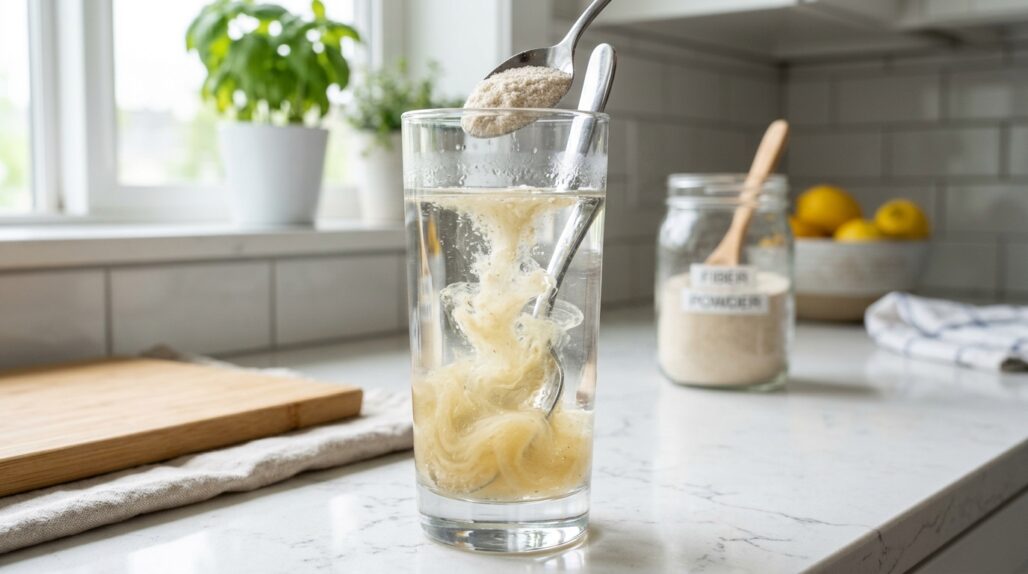
Psyllium husk comes from the seeds of Plantago ovata. In water it forms a thick, viscous gel that resists fermentation, so it travels most of the way through the gut intact. That gel is the whole mechanism.
In the colon the gel adds bulk and holds water, which is why psyllium works as a two-way stool normalizer. A broad review and meta-analysis of psyllium describes it softening hard stool in constipation and firming loose stool in diarrhea, at doses of roughly 7 to 15 g a day taken with meals.
The evidence here is genuinely strong, mostly human randomized trials rather than test-tube or animal work:
- Regularity: psyllium reliably increases stool frequency and water content and is more effective than wheat bran for chronic constipation.
- Cholesterol: the gel binds bile acids, and meta-analyses show meaningful drops in LDL and total cholesterol, with one summary calling the effect comparable to doubling a statin dose in people already on one.
- Blood sugar: the same viscous gel slows carbohydrate absorption. In type 2 diabetes trials, psyllium lowered fasting glucose and HbA1c versus placebo.
That last point is real but cuts both ways, which matters for the safety section. Evidence grade for psyllium: high, built on repeated human RCTs and meta-analyses.
Inulin: the prebiotic that feeds your bacteria (good but narrower evidence)
Inulin is a chain of fructose units (a fructan) pulled mostly from chicory root. Your own enzymes cannot break it down, so it reaches the colon undigested and your bacteria ferment it. That fermentation is the point.
In a placebo-controlled crossover randomized trial of inulin-type fructans, 16 g a day for six weeks produced a clear bifidogenic effect, with the biggest gains in Bifidobacterium adolescentis, plus significant rises in total short-chain fatty acids, acetic acid and propionic acid. Notably, butyric acid did not rise significantly in that study, a useful reminder that "more SCFA" is not automatic across every acid.
So inulin does what a prebiotic is supposed to do. The honest caveats:
- The microbiome shifts are modest. In that trial inulin explained only about 1.5% of total microbiota variation. It nudges the ecosystem, it does not rebuild it.
- The endpoints are surrogate. Most inulin trials measure bacteria and SCFA, not how you feel or a hard health outcome. Those bridges are plausible but not the same as proof.
Evidence grade for inulin: moderate. The prebiotic and SCFA effects are well supported in humans; the downstream "and therefore you will be healthier" claims are softer.
Head-to-head: regularity vs microbiome, and the gas you pay for it
Here is the core difference. Psyllium gives you mechanical regularity with very little gas because it is barely fermented. Inulin gives you a fed microbiome precisely because it is heavily fermented, and that fermentation produces gas. You do not get the prebiotic effect without some wind, and you do not get psyllium's calm gut with much of a prebiotic effect.
| Factor | Psyllium | Inulin |
|---|---|---|
| Best for | Regularity, stool form, cholesterol and glucose support | Feeding beneficial bacteria, raising short-chain fatty acids |
| Evidence | High: repeated human RCTs and meta-analyses | Moderate: human RCTs for bacteria and SCFA, softer on outcomes |
| Onset | Often within a few days for regularity | Bacterial shifts over weeks; gas can show up the first day |
| Typical dose | About 5 to 15 g a day with plenty of water | Start 2 to 3 g a day, build slowly toward 5 to 10 g |
| Main downside | Must take with enough water; can blunt nearby medication absorption | Gas and bloating, especially at higher doses or in IBS and SIBO |
On speed, psyllium usually shows up faster for the thing people care about, which is going to the bathroom. The NHS guidance on constipation notes that adding fiber and fluids can help within a few days, though sometimes it takes a couple of weeks. Inulin's headline benefit is slower and quieter, since growing a bacterial population and shifting SCFA takes weeks even when the gas arrives on day one.
Who should pick which
Pick psyllium if you are dealing with constipation, loose stools, irregularity, or you want a fiber that also chips away at LDL cholesterol and post-meal glucose. It is also the safer default if you are gas-averse or have a touchy gut, because low fermentation means low wind.
Pick inulin if your gut is already regular and your actual goal is the microbiome: more Bifidobacteria, more short-chain fatty acids, a prebiotic to pair with a varied diet. You should be willing to tolerate some bloating during the ramp, and willing to back off if it gets uncomfortable.
If you genuinely cannot decide, default to psyllium. It has the stronger evidence, the wider benefit, and the gentler side-effect profile, so it is the better single pick for most people. For the right person, though, inulin's prebiotic angle is exactly what they came for.
Which to buy
The pick follows the verdict. Grab psyllium if regularity and stool form lead your list, inulin if microbiome feeding is the goal, and a blended fiber if you want both in one scoop. Prices shift, so treat any figure as "around that as of writing; check current price."


As an Amazon Associate, UsefulVitamins.com earns from qualifying purchases at no extra cost to you.
Some links below are affiliate links. If you buy through them we may earn a commission at no extra cost to you, and it never changes our verdict.
To match a dose to your body weight and current intake, our fiber target calculator is a quick gut check before you buy. For broader options, see our roundups of the best fiber supplements and, if regularity is the whole point, the best fiber for constipation. For the wider picture of pre- and probiotics, our guide to the best supplements for gut health puts these fibers in context.
Can you take both together?
Yes, and the pairing is logical: psyllium handles mechanical regularity while inulin feeds the bacteria. They work on different parts of the gut, so it is not redundant.
There is a neat bonus. In a small MRI and in-vitro study of psyllium and inulin coadministration in IBS, adding psyllium to inulin cut colonic gas production from about 3145 mL down to 618 mL. The researchers think psyllium's gel slows the bacteria's access to the inulin, so you keep some prebiotic effect with less wind. That is a real, if early, reason the two can complement each other.
The safety note, because gut supplements still carry real cautions:
- Ramp inulin slowly. Gas is dose-dependent. Start at 2 to 3 g a day and add 1 to 2 g a week. Sudden jumps and high doses are what cause the misery.
- IBS and SIBO are the big exceptions. Inulin is a high-FODMAP fructan. In a sensitive gut, even 4 g daily worsened symptoms in trial data, and in SIBO a fermentable substrate can feed bacteria in the wrong place. If that is you, lean on psyllium and treat inulin with caution or skip it.
- Mind your medications around psyllium. Because the gel can trap drugs, the standard advice from a psyllium interactions reference is to take oral medications at least 2 hours before or after, longer for levothyroxine.
- Talk to a clinician if you take diabetes or blood-thinning drugs. Psyllium can add to glucose-lowering effects, and anticoagulants are flagged for possible interaction. Do not start or stop a prescription on your own; let a professional adjust it.
- Persistent symptoms need a workup. New constipation, blood in stool, or stubborn bloating are reasons to see a doctor, not to buy more fiber.
FAQ
Is psyllium or inulin better for the microbiome? Inulin, clearly. It is the fermentable prebiotic that feeds Bifidobacteria and raises short-chain fatty acids in human trials. Psyllium is only lightly fermented, so its job is regularity, not microbiome feeding.
Why does inulin cause so much gas? Because your colon bacteria ferment it, and gas is the byproduct. That is the same process that makes it a prebiotic. The gas is dose-dependent, so a slow ramp and a smaller dose reduce it.
Can I take inulin if I have IBS? Be careful. Inulin is a high-FODMAP fructan, and even small doses can worsen bloating and pain in IBS. Psyllium is usually the better-tolerated choice, and adding it can blunt inulin’s gas if you do combine them. Check with a clinician first.
How long until I notice a difference? Psyllium often improves regularity within a few days. Inulin’s bacterial and SCFA shifts build over several weeks, though the gas can appear the very first day.
Do I need to drink extra water with these fibers? Yes, especially with psyllium. It needs water to form its gel, and taking it dry can be uncomfortable or risky. Inulin needs less, but more fluid still helps as you increase fiber.
Can these replace fiber from food? No. Treat them as a top-up toward the roughly 25 to 38 g daily target. Whole foods bring a mix of fibers and nutrients a single supplement cannot match.
The bottom line
These two fibers are not really rivals; they do different jobs. Psyllium is the stronger, safer all-rounder for regularity, stool form, and a cholesterol and glucose nudge, with the best human evidence and almost no gas. Inulin is the prebiotic, the one that actually feeds your bacteria and lifts short-chain fatty acids, if you can handle the wind.
Pick psyllium if regularity and a gentle gut lead your list. Pick inulin if microbiome feeding is the goal and you will ramp slowly. And yes, you can take both, since psyllium covers transit while inulin feeds the bugs, with psyllium even taking the edge off inulin's gas. Start inulin low, add water, separate psyllium from your meds, and skip or minimize inulin if you have IBS or SIBO.
This article is for general information and is not medical advice. Talk to a qualified clinician before changing your supplements, especially if you take prescription medication or have a diagnosed gut condition.
Reviewed by the UsefulVitamins Editorial Team.
