
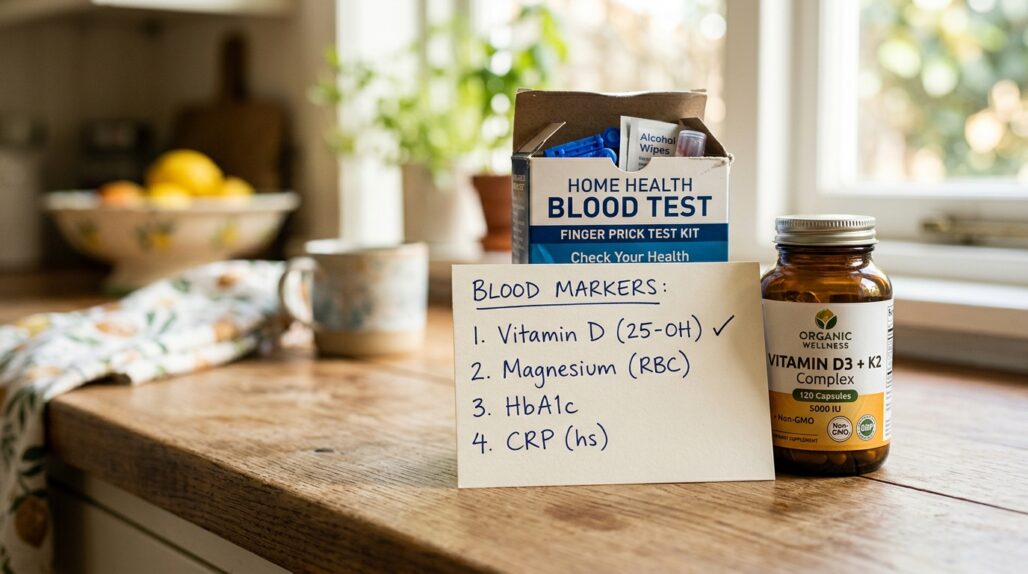
Affiliate disclosure: this article contains affiliate links. As an Amazon Associate, UsefulVitamins.com earns from qualifying purchases at no extra cost to you.
Which tests are worth asking for when you're always tired
Fatigue is one of the most common reasons people visit a doctor, and it is also one of the least specific. Low iron looks like an underactive thyroid, which looks like a vitamin D dip, which looks like poor sleep. You cannot tell them apart by how you feel. That is the whole problem with reaching for a random energy supplement: you are treating a guess.
A handful of blood tests sort most of it out. They are inexpensive, widely available, and they point you at the real gap instead of a marketing claim. The goal here is not to diagnose yourself. It is to walk into a doctor's visit (or read an at-home result) knowing which numbers matter and what they mean.
Four markers do most of the work for everyday tiredness: ferritin, vitamin D, vitamin B12, and TSH. A fifth, fasting glucose, is worth adding if you have other risk signs. Below is each one, why it earns a spot, and whether you can screen for it at home or should ask your doctor.
A quick reminder before the list. At-home finger-prick kits are screening aids, not a clinical diagnosis. They are processed in CLIA-certified labs and correlate well with a venous draw, but collection technique and timing add noise, and any abnormal or decision-changing result should be confirmed with a doctor-ordered lab test. Use them to decide whether you need a conversation, not to replace one.
Start with the free step before any test or pill
Here is the unglamorous part. A large share of "always tired" traces back to things no blood test will fix and no capsule will undo.
Short or broken sleep is the obvious one. So is a week of skipped meals, heavy alcohol, a recent cold or flu, a new stressor, or simply doing too much. Before you spend a cent on testing or supplements, give the basics a fair two-week run: a consistent sleep window, real meals with iron-rich and protein-rich food, water, and a few days that are genuinely lighter than your norm.
For iron specifically, food is a reasonable first move if you are not clearly deficient. Red meat, lentils, beans, tofu, and leafy greens all contribute, and pairing plant iron with a source of vitamin C helps absorption. This is not a substitute for testing when something feels off, but it is the cheapest experiment you can run, and it sometimes makes the whole question moot.
If two honest weeks of better sleep and food change nothing, that is your signal to test rather than keep guessing.
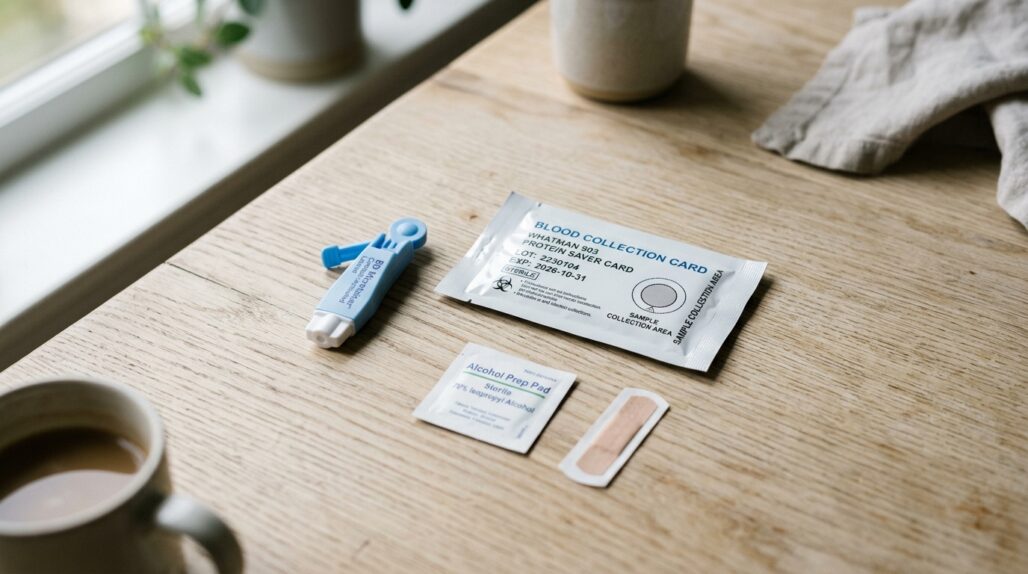
Ferritin: the single most useful fatigue marker
If you check one thing, check ferritin. It measures your stored iron, and it drops before a standard hemoglobin reading does, which means you can feel wiped out while a basic anemia screen still looks fine.
According to the NHLBI's overview of iron-deficiency anemia, low iron causes fatigue, dizziness, and breathlessness, and the workup includes a complete blood count, hemoglobin, and ferritin. Typical lab reference ranges run roughly 20 to 200 ng/mL for women and 40 to 300 ng/mL for men, though labs vary.
One catch worth knowing. Ferritin is an acute-phase reactant, which means inflammation, infection, or recent illness can push it up and mask a real shortage. If you were sick when you tested, the number may read higher than your true stores. That is one reason a doctor often looks at ferritin alongside a full blood count rather than alone.
At home or ask your doctor? Ferritin is one of the more reliable finger-prick markers, so an at-home iron or ferritin kit is a sensible screen. But if it comes back low, the cause matters more than the number, so loop in a doctor before committing to months of iron. For more on the gap between a "normal" and a genuinely comfortable ferritin, see our piece on how to read your ferritin result.



As an Amazon Associate, UsefulVitamins.com earns from qualifying purchases at no extra cost to you.
Some links on this page are affiliate links. If you buy through them we may earn a small commission at no extra cost to you. It does not change what we recommend.
Vitamin D: common, easy to test, easy to fix
Low vitamin D is widespread, especially in winter, in northern latitudes, in people who cover up or stay indoors, and in those with darker skin. It can contribute to tiredness and low mood, and it is one of the simplest gaps to confirm and correct.
The test measures 25-hydroxyvitamin D, written 25(OH)D. Per the NIH Office of Dietary Supplements vitamin D fact sheet, levels below 12 ng/mL (30 nmol/L) are deficient, around 20 ng/mL (50 nmol/L) is adequate for most people's bone and general health, and above 50 ng/mL (125 nmol/L) may start to cause harm.
You will see "optimal" ranges of roughly 40 to 60 ng/mL promoted in functional-medicine circles. Treat that as opinion, not clinical consensus. The same NIH source notes that an optimal 25(OH)D concentration has not been established, and the Endocrine Society does not even recommend routine testing in healthy people. Standard guidance and the functional view disagree, so we show both rather than pretending the higher target is settled.
At home or ask your doctor? Vitamin D is one of the best at-home markers – dried blood spot kits track venous results closely. If you correct a low level, re-test at about three months, since vitamin D moves slowly.

Vitamin B12: don't skip it if you're at higher risk
B12 deficiency can cause fatigue, brain fog, and, left long enough, nerve problems. It is easy to miss because the symptoms creep in.
The NIH Office of Dietary Supplements B12 fact sheet notes that most labs flag deficiency below roughly 200 to 250 pg/mL, and that a borderline-low total B12 can be confirmed with a methylmalonic acid (MMA) test, which rises when B12 is functionally short even while the headline number still looks low-normal.
Some people carry real risk and should be more proactive: vegans and long-term vegetarians, adults over about 60, people on long-term metformin or acid-reducing medication, and anyone with absorption issues. If that is you, B12 belongs on the list.
At home or ask your doctor? Total B12 appears on many at-home panels, but a borderline result is genuinely hard to interpret on your own. If you are in a higher-risk group or your level lands in that low-normal grey zone, this is a marker to take to a doctor, who can order MMA if needed.
TSH: rule the thyroid in or out
An underactive thyroid is a classic cause of fatigue that also tracks with weight gain, cold intolerance, and hair thinning. The screening test is TSH (thyroid-stimulating hormone), and a high TSH points toward an underactive gland.
Cleveland Clinic lists the usual TSH reference range as about 0.3 to 4.0 mIU/L and notes that fatigue, weight change, and temperature sensitivity are exactly the symptoms that justify checking it. Interpreting a borderline or "subclinical" result, and deciding whether to treat, is a doctor's call, not a self-diagnosis.
At home or ask your doctor? At-home thyroid panels exist and can screen TSH, but thyroid results genuinely need clinical context, including a repeat test and sometimes T4 and antibodies. If TSH is your suspicion, a doctor-ordered panel is the cleaner route.

Fasting glucose: the optional fifth marker
If your fatigue runs alongside a rising waistline, a family history of type 2 diabetes, or sugar crashes after meals, add a fasting glucose or A1C to the draw. Blood sugar that sits in the prediabetes range can quietly drag on energy.
The CDC puts the prediabetes A1C range at 5.7 to 6.4 percent (diabetes at 6.5 percent or above), and the matching fasting glucose range is 100 to 125 mg/dL, with diabetes at or above 126 mg/dL fasting. Many cases of prediabetes respond well to weight, movement, and diet changes, which is reason enough to know the number. A diagnosis here is a doctor decision, not something to read off a home strip.
How the markers compare at a glance
The table sums up where each marker sits, the rough standard range, and whether home screening makes sense. Ranges vary by lab and are for orientation, not diagnosis.
| Marker | Standard reference range | Why it matters for fatigue | Home vs doctor |
|---|---|---|---|
| Ferritin (iron stores) | ~20-200 ng/mL women, ~40-300 ng/mL men | Drops before anemia shows; top cause of tiredness | Home screen ok, confirm low results with a doctor |
| Vitamin D 25(OH)D | Deficient under 20 ng/mL, adequate ~20+, high over 50 | Common, seasonal, linked to low energy | Reliable at home; re-test at 3 months |
| Vitamin B12 | Deficient under ~200-250 pg/mL | Fatigue, brain fog, nerve issues if long-standing | Doctor if borderline or higher-risk group |
| TSH (thyroid) | ~0.3-4.0 mIU/L | High TSH suggests an underactive thyroid | Doctor panel preferred for context |
| Fasting glucose | Normal under 100, prediabetes 100-125 mg/dL | Prediabetes can sap energy quietly | Doctor confirms; lifestyle often reverses |
Test, act, then re-check the same number
Testing is only half the loop. If a marker comes back low and you fill the gap, the honest question is whether the number actually moved, or whether you just spent three months on a capsule that did nothing.
So pick the one marker you acted on and re-test it on a schedule: about 8 to 12 weeks for iron or B12, and around 3 months for vitamin D, which is also roughly the window the NHLBI describes for oral iron to rebuild stores. Compare the new value to the old one before deciding to continue, change the dose, or stop.
To keep that loop from slipping, log the result somewhere you will see it and set a reminder for the re-test. You can use StackMyMed (our own free app) to record the number and ping you when it is time to re-check, or do the same thing with a note in your phone and a calendar reminder. The tool does not matter; closing the loop does. And any decision to start, change, or stop a supplement or medication still belongs with your doctor or pharmacist.
If you want help choosing what to take once a gap is confirmed, our guides to supplements for chronic fatigue and energy and fatigue support sort the evidence-backed options from the noise. If you already take thyroid or iron medication, also read our note on how iron and thyroid meds interact, since timing and dosing matter there.
See a doctor if any of these apply
This article is educational, not a diagnosis. Some fatigue needs a clinician now, not a finger-prick kit and a vitamin.
Make a doctor's appointment, and do not wait on supplements, if your tiredness comes with any of the following:
- Unexplained weight loss without trying.
- Breathlessness, a racing heart, or chest discomfort.
- Very heavy periods or any sign of blood loss, including blood in your stool, which can drive iron deficiency and needs the cause found.
- Fatigue that lasts more than 2 to 3 weeks despite better sleep and food, or that is getting steadily worse.
These point to causes that an at-home panel cannot settle. A doctor can run the right confirmatory tests and look for what is behind the number.
FAQ
Can I just take a multivitamin and skip the blood test? You can, but you are guessing. Fatigue has too many possible causes to treat blindly, and a multivitamin will not fix a real iron, thyroid, or blood-sugar problem. Testing the four high-yield markers first tells you whether a supplement is even the right tool.
Are at-home blood tests accurate enough to act on? For screening, the better ones are useful: they run samples in CLIA-certified labs, and finger-prick results correlate closely with a venous draw for markers like vitamin D and ferritin. But they are aids, not diagnoses. Confirm any abnormal or decision-changing result with a doctor-ordered lab test.
Which single test should I get if I can only do one? Ferritin. Low iron stores are the most common and most fixable cause of everyday tiredness, and ferritin drops before a standard anemia test catches it.
Should I stop my supplements before testing? For these markers, taking your usual iron, D, or B12 will raise the reading, which can hide a true gap or look like success that is not real. Ask the lab or your doctor about timing. High-dose biotin in particular can skew some lab assays, so mention it.
How soon should I re-test after starting a supplement? Re-check the specific marker you treated at about 8 to 12 weeks for iron or B12, and around 3 months for vitamin D. Sooner than that and the number may not have had time to move.
My results were all normal but I’m still exhausted. Now what? That is common and worth taking seriously. Normal labs point you back to sleep, stress, mood, and recovery, and toward a doctor who can look further. Persistent fatigue with normal basic bloods is a reason to keep investigating, not to stack more pills.
The bottom line
Persistent tiredness is a symptom, not a diagnosis, and no supplement can outrun a guess. Before you buy anything, get ferritin, vitamin D, B12, and TSH checked on one draw, and add fasting glucose if you carry the risk signs. Run the free two weeks of better sleep and food first, since that alone resolves a fair share of cases.
If a marker is low, fix the actual gap, then re-test that one number in 8 to 12 weeks (about 3 months for vitamin D) to confirm it moved. And if your fatigue comes with weight loss, breathlessness, heavy bleeding, or it drags past 2 to 3 weeks, see a doctor rather than reaching for another bottle. Test, understand, act, re-check.
This article is for education only. It is not medical advice and does not diagnose any condition. At-home tests are screening aids, not a substitute for clinical testing. Talk to a doctor or pharmacist before starting, changing, or stopping any supplement or medication.
Reviewed by the UsefulVitamins Editorial Team.
