
Affiliate disclosure: this article contains affiliate links. As an Amazon Associate, UsefulVitamins.com earns from qualifying purchases at no extra cost to you.
Your blood result is in ng/mL, but your supplement is in mcg or IU. Convert the dose here.
What a vitamin D blood test actually measures
The test almost always measures 25-hydroxyvitamin D, written as 25(OH)D. This is the form your liver makes after your skin or your diet supplies vitamin D, and it is the one that circulates long enough to reflect your overall status. It is the standard marker because it tracks both what you make from sun and what you take in.
There is a second test, 1,25-dihydroxyvitamin D, the active hormone form. It is not the right test for everyday "am I low" questions, because it can read normal even when stores are empty. If a lab slip says 1,25, that is usually ordered for a specific kidney or calcium problem by a doctor, not for routine screening.
Results in the United States come back in ng/mL. Much of the rest of the world reports nmol/L, and the conversion is simple: multiply ng/mL by 2.5. So 20 ng/mL is 50 nmol/L, and 30 ng/mL is 75 nmol/L. If your number looks oddly large, check the units before you read anything into it.
One more framing point worth holding onto. A blood level is a snapshot of your stores, not a diagnosis on its own. If you want the longer background on the vitamin itself, our complete guide to vitamin D covers food sources, sunlight, and dosing in more depth than a results page can.
The standard reference range, and what each number means
The most widely cited cut points come from the NIH Office of Dietary Supplements, which follows the Food and Nutrition Board at the National Academies. Here is how those bands read once you convert them to ng/mL.
| 25(OH)D level | Standard category (NIH) | What it usually means |
|---|---|---|
| Below 12 ng/mL (under 30 nmol/L) | Deficient | Linked to bone problems over time; this band warrants action and often a doctor’s input. |
| 12 to 20 ng/mL (30 to 50 nmol/L) | Potentially inadequate | Some people are short here; a modest daily dose usually moves it up. |
| 20 to 50 ng/mL (50 to 125 nmol/L) | Sufficient for most | Considered adequate for bone and general health for most adults. |
| Above 50 ng/mL (over 125 nmol/L) | Possible harm | NIH notes adverse effects become possible; higher still can mean toxicity. |
A few things stand out once you sit with that table. First, the "sufficient" band is wide, from 20 all the way to 50 ng/mL. By this standard, 21 ng/mL is not a problem to chase. Second, more is not better. The same source that defines "low" also flags that going past 50 ng/mL can start to carry risk rather than extra benefit.

The optimal-vs-normal debate, and how to read it fairly
Here is where readers get whiplash. Many functional-medicine practitioners and some labs say the "sufficient" floor of 20 ng/mL is too low, and they prefer a target of roughly 40 to 60 ng/mL. You will see this called an "optimal" range.
That number is not invented out of thin air. It traces back to the 2011 Endocrine Society guideline, which set sufficiency at 30 ng/mL and named 40 to 60 ng/mL as a preferred range for people being treated for deficiency. So there is a published basis for the higher target.
But it is important to be clear about what kind of claim that is. The 40 to 60 ng/mL "optimal" range is an opinion-level target, not settled clinical consensus. It sits alongside the standard sufficiency floor of 20 ng/mL; it does not replace it, and it does not make the standard range wrong. The two simply answer slightly different questions, and the higher one rests on weaker evidence for everyday adults.
How weak? In 2024 the same Endocrine Society updated its position and now suggests against routine 25(OH)D screening in healthy adults, and against chasing a specific blood target, because the panel could not find evidence that a defined "optimal" number prevents disease. That is a notable reversal from one of the bodies that popularized the higher target.
So read your result like this. If you are below 20, the standard range and the functional view agree: you are low. Between 20 and 50, you are in the standard sufficient zone, and the case for pushing toward 40 to 60 is a preference, not a requirement. Treat any single "optimal range" claim, including ours here, as opinion shown beside the standard band, and let your own context and your doctor break the tie.
Why your level might be low, or high
Low 25(OH)D is common and rarely mysterious. The usual drivers are limited sun exposure, especially in winter or at higher latitudes; darker skin, which makes less vitamin D for the same sun; older age; covering skin or consistent sunscreen use; obesity, since vitamin D is stored in fat and less circulates; and gut conditions that cut absorption, such as celiac or Crohn disease. The NHS lists similar risk groups and recommends a year-round supplement for people in them.
A genuinely high result is far less common from food or sun, because the body self-limits what it makes from sunlight. High 25(OH)D almost always comes from supplements, usually large unsupervised doses taken for months. The risk is not the vitamin itself but the calcium it drives up. The NHS warns that long-term excess causes hypercalcaemia, which can weaken bones and strain the kidneys and heart. That is the real reason "more is better" thinking backfires.

What to do about a low number
If your result is low and you are an otherwise healthy adult, the fix is usually unremarkable. NIH sets the adult RDA at 600 IU a day, rising to 800 IU after age 70, and the tolerable upper limit at 4,000 IU a day for adults. A practical, common range to raise a low level is 1,000 to 2,000 IU of vitamin D3 daily, which sits comfortably under that ceiling.
Two details help the dose work:
- Take it with a meal that has some fat. Vitamin D is fat-soluble, and a trial by Dawson-Hughes and colleagues found dietary fat increased D3 absorption. The evidence is modest and meal-timing studies are mixed, but pairing the capsule with food costs nothing and is reasonable.
- Consider D3 over D2. D3 (cholecalciferol) tends to raise and hold 25(OH)D better than D2 (ergocalciferol) for most people. We compare the two in our piece on vitamin D bioavailability, D2 vs D3.
What about vitamin K2? The idea is that K2 helps direct calcium to bone rather than arteries, so D3 plus K2 products are popular. The honest grade: this is biologically plausible and has some supportive human data, but it is not proven to be necessary at the modest doses most people take. If you choose a combined product, fine; do not feel you are missing out if you take plain D3.
To match a dose to your specific result and weight, our vitamin D dose calculator gives a starting estimate. It is a starting point, not a prescription, and it is no substitute for your doctor's read if your level is far outside the standard range.


As an Amazon Associate, UsefulVitamins.com earns from qualifying purchases at no extra cost to you.
Some links in this section are affiliate links. If you buy through them we may earn a small commission, at no extra cost to you. It does not change which products we recommend.
The three picks above cover the practical loop: an at-home 25(OH)D test to get or confirm your number, plain vitamin D3, and a D3 + K2 option if you prefer the combined form. If you would rather compare brands first, see our roundup of the best vitamin D supplements.
The re-test checkpoint
Vitamin D status moves slowly, so do not re-test next week and read meaning into a small wobble. A reasonable plan: start a steady daily dose, then re-test 25(OH)D at about 3 months. That window is long enough for the new intake to settle into a fresh steady level. The goal of the re-test is simple. You want to confirm the dose actually moved your number into the standard sufficient range and did not overshoot it.
This is exactly the kind of test-act-recheck loop that is easy to start and easy to forget. One low-tech option is to write the result and the re-test date in your phone notes or set a calendar reminder. If you would rather keep it in one place, you can log the result in StackMyMed (our own free app), add your D3 dose, and set a 3-month re-test reminder, so when the next number comes back you can see whether the supplement actually moved it. Either way, the point is the follow-up, not the tool. Any change to dose based on a worrying result is a doctor conversation, not an app decision.

A note on at-home tests
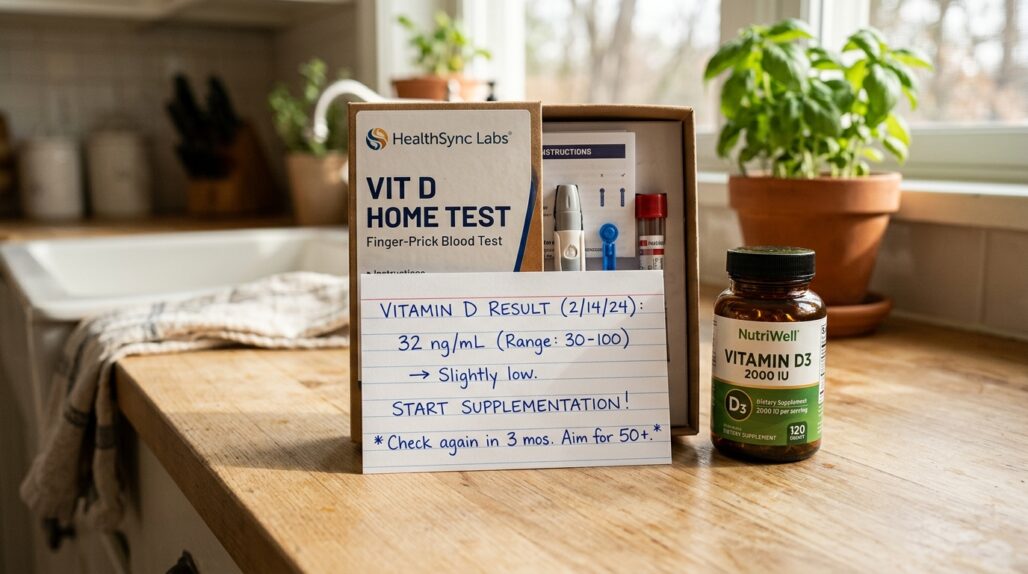
At-home finger-prick vitamin D kits are convenient, and the better ones run your sample through a CLIA-certified lab, the same federal standard that governs clinical labs. They are good enough for screening and for tracking your own trend over time.
What they are not is a clinical diagnosis. An at-home result is a screening aid, not a substitute for a doctor-ordered test. Collection technique, timing, and the lab method can all nudge a number. If a home result is very low, very high, or would change a real decision, confirm it with a standard clinic draw before acting on it.
When to see a doctor
Most low vitamin D results are handled with diet, sun, and a sensible supplement. Some are not. Treat these as reasons to involve a clinician rather than to self-manage:
- A very low result paired with bone pain, muscle weakness, or frequent fractures.
- Signs that can point to high calcium from too much vitamin D: nausea, vomiting, constipation, excessive thirst or urination, or confusion.
- A high result in someone taking large unsupervised doses over months.
- Low vitamin D alongside a known gut, kidney, or parathyroid condition, or in pregnancy, where dosing should be individualized.
Do not try to fix a far-out-of-range level by megadosing on your own. That is the path to hypercalcaemia, and it is the one scenario where a vitamin D supplement can genuinely cause harm.
FAQ
Is 30 ng/mL a good vitamin D level? By the standard NIH range, anything from 20 to 50 ng/mL is sufficient for most people, so 30 sits comfortably inside it. Functional-medicine targets of 40 to 60 ng/mL are higher, but that is a preference rather than proven consensus.
How long does it take to raise a low vitamin D level? Plan on months, not days. A steady daily dose usually settles into a new blood level over roughly 8 to 12 weeks, which is why a 3-month re-test is the common checkpoint.
Can I take too much vitamin D? Yes. The adult tolerable upper limit is 4,000 IU a day, and sustained excess can raise blood calcium to harmful levels. The NHS advises not exceeding 100 micrograms (4,000 IU) a day without medical supervision.
Do I need vitamin K2 with my D3? It is optional. The K2 rationale is plausible and has some human data, but it is not proven necessary at typical doses. Plain D3 is fine for most people, and a D3 + K2 product is a reasonable choice if you prefer it.
Should healthy adults even test their vitamin D? The 2024 Endocrine Society guideline suggests against routine screening in healthy adults, since a specific target has not been shown to prevent disease. Testing makes more sense if you have risk factors or symptoms, and the decision is worth discussing with your doctor.
Are at-home vitamin D tests accurate? The better kits use CLIA-certified labs and are reliable enough for screening and tracking. They are a screening aid, not a diagnosis, so confirm any extreme or decision-changing result with a clinic test.
The bottom line
Read your vitamin D result against the standard range first: under 20 ng/mL is low, 20 to 50 is sufficient for most people, and over 50 starts to carry risk. The 40 to 60 ng/mL "optimal" target is an opinion-level goal that sits beside the standard band, not above it, and the body that popularized it has since pulled back from chasing any fixed number. If you are low, a modest daily D3 dose with a fatty meal is the usual fix, then re-test at about 3 months to confirm it worked. And if a result is far out of range or comes with symptoms of high calcium, that belongs with a doctor.
This article is educational and is not medical advice or a diagnosis. At-home tests are screening aids, not clinical diagnosis. Talk to a doctor or pharmacist before starting, stopping, or changing any supplement or medication, especially in pregnancy or with a kidney, calcium, or parathyroid condition.
Reviewed by the UsefulVitamins Editorial Team.
