
Affiliate disclosure: this article contains affiliate links. As an Amazon Associate, UsefulVitamins.com earns from qualifying purchases at no extra cost to you.
Search "hangover supplement" and you get two names that people treat as rivals. They are not really competing on the same field. One is a genetically engineered bacterium you drink before you start, the other is a flavonoid-plus-amino-acid capsule stack you take with your last drink and again in the morning. They target different molecules in different organs, which means the useful question is not "which is better" but "which mechanism do you actually believe in."
We wrote this the way we would explain it to a cousin heading to a wedding weekend: what each product literally contains, what has and has not been published, and where the money goes.
Before you decide
Skip both if you are pregnant or breastfeeding, if you have liver disease of any kind, or if you take disulfiram or metronidazole, where alcohol plus the drug is already a medical problem. Anything that changes how acetaldehyde clears is the wrong thing to experiment with when a prescription is already acting on that pathway.
Skip both if what you actually want is permission to drink more. The National Institute on Alcohol Abuse and Alcoholism is blunt about this in its hangover fact sheet, which states there is no cure for a hangover other than time and that none of the remedies circulating online have been scientifically proven effective. Neither company disputes that framing. ZBiotics says in its own FAQ that the product does not affect intoxication and does not shield you from the health effects of alcohol.
That caveat matters more than the marketing does. Ethanol and the acetaldehyde produced from it are both classified as carcinogenic to humans, a point WHO Europe sets out plainly. A supplement that makes tomorrow morning easier does not make last night safer, and nobody has shown otherwise. None of this is medical advice; if you have a liver condition or take daily medication, this is a conversation for your doctor, not a comparison page.
This article is for the reader who is going to drink socially anyway, a handful of times a year, and wants to spend money on the option with the least fiction attached.
What you're actually buying
ZBiotics Pre-Alcohol is a small liquid shot. The label ingredient list is short: water, natural flavors, potassium sorbate, sodium chloride, and Bacillus subtilis ZB183. Retail listings put the bottle at 0.47 fl oz, roughly 14 ml. The entire product is one engineered organism plus the water it lives in, which is unusual honesty in a category built on twelve-ingredient blends.
ZB183 is B. subtilis modified to constitutively express an acetaldehyde dehydrogenase enzyme, the same class of enzyme your liver uses. The company's argument is that your liver handles acetaldehyde well and your gut does not, so acetaldehyde accumulates in the intestine and leaks outward. The shot is meant to seed a temporary enzyme-producing population there. You take it before your first drink because spores need time to germinate.
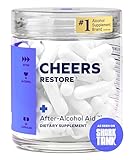
Cheers Restore is the opposite design philosophy. A dose is three capsules, and the formula centers on dihydromyricetin (DHM) plus L-cysteine, with milk thistle, prickly pear, ginger, B vitamins and electrolytes around it. Cheers markets 1,200 mg of DHM per dose, which would be at the high end of anything sold in this category, though that figure comes from the brand's marketing rather than a label we could read. We could not read the full Supplement Facts panel from a text source, so we are not quoting milligram figures for the cysteine or the botanicals here; treat those amounts as unconfirmed until you read the bottle.
If the probiotic side of this is new territory for you, our explainer on prebiotics, probiotics and synbiotics covers why a spore-forming organism behaves so differently from a refrigerated Lactobacillus product.
Head-to-head: gut-side enzyme versus liver-side flavonoid
Here is the honest state of the evidence, and it is the reason this page exists.
ZBiotics has published real science, just not the science you would want. The mechanism paper appeared in PLOS ONE in 2024: a study by the company's own scientists describing how they integrated an aldehyde dehydrogenase gene from Cupriavidus necator into the hag locus and got robust expression after germination. In gut-simulated fluid the engineered strain cleared more than 99% of acetaldehyde against 16.5% for the unmodified control, roughly 41-fold faster. That is a strong in vitro result and the study is in vitro from end to end: all work was done in gut-simulated fluid, with no in vivo or human testing.
Safety has separate published support. A 90-day repeat-dose oral toxicity study in Wistar rats, run to OECD guidelines and published in the Journal of Toxicology in 2019, found no test-item-related effects on body weight, haematology, organ weights or histopathology at doses up to 10^11 CFU/kg/day. Good safety data. Not efficacy data, and not human data.
Cheers points to a study conducted for its granted patent, reporting that users felt over 50% better across eight symptoms. A study run to support a patent filing is not the same thing as a peer-reviewed randomised placebo-controlled trial, and we could not locate one published under the Cheers formula. The DHM ingredient itself has a registered human trial, but it is a Phase I dose-escalation study for alcohol-associated liver disease sponsored by the University of Southern California, listed as not yet recruiting. Liver disease is a different endpoint from Saturday morning.
We searched the public trial registry for studies sponsored by either company. Neither appears. As of August 2026, the count of published controlled human hangover trials is zero for ZBiotics and zero for Cheers.
The one component here with any direct human hangover signal is cysteine. A 2020 randomised double-blind trial in Alcohol and Alcoholism found that an L-cysteine-containing vitamin supplement dosed at 1,200 mg was associated with lower hangover, nausea and headache scores versus placebo, on the authors' correlational analysis rather than a straight group comparison, with a lower 600 mg dose helping stress and anxiety measures. Nineteen male participants, one alcohol dose, one site. Encouraging, small, and not a reason to declare the question settled. If you want the wider picture on cysteine-family compounds and the liver, our comparison of NAC and glutathione walks through what those trials actually measured.
The broadest look at this whole category came from Addiction in 2022. A systematic review of 21 randomised placebo-controlled hangover trials covering 386 participants rated every efficacy outcome as very low quality, with no two studies testing the same intervention. Hovenia dulcis extract, a DHM-containing botanical, was among the seven interventions showing a statistically significant effect. The authors still concluded that only very low quality evidence supports recommending anything.
The numbers side by side

| Spec | ZBiotics Pre-Alcohol | Cheers Restore |
|---|---|---|
| Format | Liquid shot, about 0.47 fl oz | 3 capsules per dose |
| Active | Engineered B. subtilis ZB183 expressing acetaldehyde dehydrogenase | DHM plus L-cysteine; Cheers markets 1,200 mg DHM per dose, not printed on the product page we could read |
| Target site | Gut lumen | Liver and systemic antioxidant pathways |
| When to take | Before the first drink | After your last drink or before bed |
| CFU per serving | Not published on the product page | Not applicable |
| Other listed ingredients | Water, natural flavors, potassium sorbate, sodium chloride | Milk thistle, prickly pear, ginger, B vitamins, electrolytes; amounts not confirmed here |
| Peer-reviewed mechanism data | Yes, in vitro (PLOS ONE 2024) | Ingredient-level only, not formula-level |
| Published safety study | Yes, 90-day rat study (2019) | None located |
| Controlled human hangover trial | None published | None published; a patent-linked internal study is cited |
| Registered trial on record | None found | None by the company; a USC DHM liver trial is registered |
| Price | About $36 per 3-pack as of August 2026 | About $35 per 12-dose pack as of August 2026 |
Price per night: the honest math
ZBiotics sells a 3-pack for about $36 as of August 2026, which is about $12 a night. Subscribe and save takes 20% off, but as of August 2026 that option is attached to the larger multi-packs rather than the 3-pack, so treat $12 as the entry price and any lower per-bottle number as conditional on committing to recurring multi-pack shipments. At $12 a night, a supplement you take four times a year costs you about $48 annually, and a supplement you take every Friday costs you over $600.
Cheers Restore runs about $35 for 12 doses as of August 2026, or roughly $2.92 per dose. That is close to a quarter of the ZBiotics per-night cost. The catch is that a Cheers dose is three capsules and Cheers directs a single dose after your last drink or before bed, so a 12-dose pack is 36 capsules covering twelve nights, not twelve weeks.
Neither number is unreasonable for an occasional purchase. Both become expensive fast if this turns into a weekly habit, and a weekly habit is the pattern where the alcohol itself is the real health line item.
Worth naming the cheap comparator: plain water plus an electrolyte packet costs about a dollar and has an obvious mechanism for the dehydration part of a hangover. We looked at whether the branded versions justify their markup in our review of DripDrop.
Who should pick ZBiotics (and who should pick Cheers)
Pick ZBiotics if you value mechanistic clarity and you are comfortable paying a premium for it. You are buying one organism doing one job, with a published in vitro result and a published animal safety study, and you can read both papers yourself in an afternoon. It also suits people who forget to take things in the morning, since the entire protocol is a single shot at the start of the night.
Pick Cheers if the price per night matters, if you want cysteine in the mix, or if you would rather have a broader formula covering electrolytes and B vitamins alongside the DHM. The nightly cost is low enough that a one-pack trial is a cheap experiment on yourself.
Pick neither if you are a once-or-twice-a-year drinker. At that frequency the expected benefit of any of this is smaller than the effect of one extra glass of water per drink and an earlier finish.
One practical note for the probiotic side: ZB183 is a spore former, which is why the shot is shelf stable at room temperature and does not need refrigeration. That distinction trips people up constantly, and we unpacked it in our guide to shelf-stable versus refrigerated probiotics.
What to look for when buying
Check whether the evidence cited is about the product or about an ingredient. Most hangover brands link to studies on a molecule, not on the thing in the bottle. Ingredient-level evidence tells you a mechanism is plausible; formula-level evidence tells you the product works, and the second one is much rarer.
Check whether a cited study is peer reviewed and independent. A study conducted to support a patent filing has a defined purpose and is not the same as a registered, blinded trial with a pre-declared endpoint.
Check that milligram amounts are printed per serving rather than hidden in a proprietary blend, and check what a serving is. A three-capsule serving is a different economic proposition from a one-capsule serving when you are comparing bottle prices.
Check the timing instruction before you buy. A product taken before drinking and a product taken after drinking cannot be swapped, and buying the wrong one for your habits guarantees you never use it properly.
Check the refund policy. In a category with this little human data, a money-back guarantee is doing real work.


As an Amazon Associate, UsefulVitamins.com earns from qualifying purchases at no extra cost to you. We only recommend products supported by published research or third-party testing.
FAQ
Can I take ZBiotics and Cheers together?
Nothing in either ingredient list obviously conflicts, and the timing does not overlap, since one goes before the first drink and the other with the last. Neither company has published a study on the combination, so you would be running an experiment with two variables and about $15 a night. We would not.
Does ZBiotics have any human data at all?
Not for hangover outcomes. The published record is a 2024 PLOS ONE mechanism paper conducted in vitro and a 2019 90-day oral toxicity study in rats. The company's safety position also rests on GRAS self-affirmation. No controlled human efficacy trial has been published or registered as of August 2026.
Is 1,200 mg of DHM a lot?
It is high relative to competing products, which is the point Cheers makes. Whether high is better is unestablished, because there is no published dose-response study in humans for hangover endpoints. The registered DHM human trial is a Phase I safety and dose-escalation study in alcohol-associated liver disease, a different question entirely.
Will either one lower my blood alcohol or keep me from getting drunk?
No, and ZBiotics states this directly in its own materials. Acetaldehyde is downstream of ethanol; clearing it faster in the gut does not change how intoxicated you get, and neither product claims it does.
Is the genetically engineered part a safety problem?
The published toxicology does not suggest one. The 90-day rat study found no test-item-related changes at doses far above a human serving, and B. subtilis has a long history in fermented foods. If genetic engineering in a consumed product is a line you do not want to cross, that is a values call rather than a data call, and Cheers does not involve one.
What actually helps a hangover, then?
Time, water, food, and less alcohol. The 2022 Addiction review found the entire pharmacological literature on hangover to be very low quality, and NIAAA says the same thing more bluntly. Everything else in this article is a wager on a plausible mechanism.
The bottom line
ZBiotics and Cheers are solving different halves of the same problem, and both are asking you to fund the gap between a plausible mechanism and a proven outcome. ZBiotics has the cleaner story and the better-documented safety file, along with a per-night price roughly four times higher. Cheers is cheaper, contains the one ingredient in this fight with a small randomised human hangover trial behind it, and leans on an internal patent study rather than published independent work.
If you want the single most defensible sentence on this page: as of August 2026 neither product has a published controlled human hangover trial, and any article telling you one of them is clinically proven is describing a study that does not exist. Buy on mechanism preference and price, keep expectations modest, and remember that the only intervention with a strong evidence base here is drinking less.
