
If you’re searching for the best probiotics for IBS, you’re probably not looking for vague promises – you want fewer flare-ups, less bloating, and more predictable digestion. The good news is that research suggests certain probiotic strains (not just any probiotic) may help IBS symptoms like gas, abdominal pain, and irregular stools, especially when taken consistently for 4-8 weeks. This article breaks down which strains have the best evidence, what dose actually matters, and how to choose a product that fits your IBS subtype and diet.
Affiliate disclosure: this article contains affiliate links. As an Amazon Associate, UsefulVitamins.com earns from qualifying purchases at no extra cost to you.
Summary / Quick Answer: Best probiotics for IBS (what to buy and why)
The best probiotics for IBS are typically strain-specific, multi-strain formulas (often Lactobacillus + Bifidobacterium) taken daily at 10+ billion CFU, for at least 4-8 weeks.
Here’s a fast, practical shortlist based on strain evidence and real-world usability:
| Best for | What to look for on the label | Why it matters for IBS |
|---|---|---|
| IBS with bloating and gas | Multi-strain Lactobacillus + Bifidobacterium | Trials often show better bloating relief vs single strains |
| IBS-D (diarrhea-predominant) | Lactobacillus rhamnosus GG and/or Lactobacillus plantarum | Research suggests benefits for diarrhea and bloating in some IBS-D cases |
| IBS-C (constipation-predominant) | Bifidobacterium-heavy blends | Some evidence supports stool frequency and comfort |
| Sensitive stomachs | Shelf-stable, acid-resistant strains; start low dose | Tolerance often improves when you titrate slowly |
For a product-by-product view, see this site’s best probiotics comparison.
Best probiotics for IBS: the strains that actually show results
A common frustration with probiotics is that two bottles can look identical – “50 billion CFU,” “gut support,” “daily balance” – yet work very differently. That’s because IBS research is strain-specific. In other words, “Lactobacillus” isn’t one thing, and neither is “Bifidobacterium.”
IBS affects roughly 10-15% of people worldwide, and bloating is reported by up to 90% of patients in some surveys. Studies and reviews generally find probiotics can help a meaningful subset of people with IBS, especially for bloating and overall symptom scores, but results vary by strain and IBS subtype. Consumer-facing summaries from outlets like Healthline’s evidence-informed probiotic guide align with the broader clinical takeaway: choose strains with human trial data, not just a high CFU number.
Strains with the most consistent IBS relevance
Below are strains commonly discussed in IBS research and clinical practice, along with the “why” in plain terms.
| Strain (examples) | What it may help | Notes for choosing |
|---|---|---|
| Lactobacillus rhamnosus GG (LGG) | Diarrhea tendency, bloating for some | Often used at around 10B CFU; commonly found as a single-strain product |
| Lactobacillus plantarum | Bloating, gas; sometimes IBS-D symptom scores | Frequently positioned as “bloating-focused”; look for strain ID when possible |
| Bifidobacterium longum / bifidum | Abdominal discomfort, bloating; overall symptom relief | Also found in fermented foods, but supplements give consistent dosing |
| Bifidobacterium lactis (ex: Bi-07) | Bloating and abdominal distension in some trials | Usually included in multi-strain blends |
| Lactobacillus acidophilus | Often part of multi-strain IBS formulas | Rarely the “hero” alone; more useful in a blend |
Why multi-strain often beats single-strain
Think of IBS like a neighborhood problem, not a single broken pipe. You may have motility changes, visceral sensitivity, immune signaling, and gut-brain stress responses happening together. A multi-strain formula can cover more “jobs” at once: short-chain fatty acid production, barrier support, and competition with gas-producing microbes.
Practical takeaway:
- If your main symptoms are bloating and gas, starting with a multi-strain product is often a reasonable first move.
- If your IBS pattern is clearly IBS-D, a targeted single strain like LGG may be worth trying first.
If you want a structured way to test changes (one variable at a time), follow a stepwise plan like this gut health supplement protocol.
How to choose a probiotic for your IBS subtype (IBS-D, IBS-C, IBS-M)
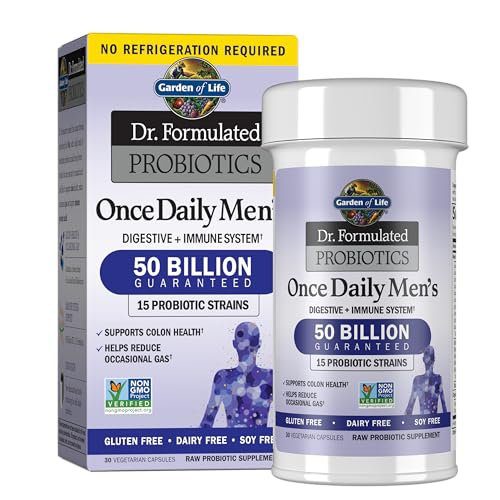
Garden of Life Probiotics for Men, Dr Formulated 50 Billion CFU 15 Probiotics for Digestive Health + Organic Prebiotic Fiber, Colon & Immune Support, Daily Gas Relief, Shelf Stable, 30 Capsules
Garden of Life Probiotics for Men, Dr Formulated delivers 50 billion CFU from 15 strains in 30 shelf-stable vegetarian capsules with organic prebiotic fiber for digestive health, gas relief, colon and immune support. Tailored for men with Lactobacilli and Bifidobacteria strains in a once-daily delayed-release format. User feedback notes less bloating and balanced digestion, though specific review counts and third-party testing data are limited.
Most “probiotic disappointment” happens because the product doesn’t match the IBS pattern. IBS isn’t one condition. It’s a cluster of symptoms that can lean toward diarrhea (IBS-D), constipation (IBS-C), or mixed (IBS-M). The same probiotic can feel helpful for one person and useless (or even gassy) for another.
Here’s a practical way to match your probiotic choice to your symptom pattern.
Step 1: Identify your dominant pattern
Use your last 2-4 weeks as your guide.
- IBS-D: urgency, loose stools, frequent stools, post-meal runs
- IBS-C: hard stools, infrequent stools, straining, incomplete emptying
- IBS-M: swings between both patterns
- Bloating-forward IBS: distension is the main complaint, regardless of stool pattern
Step 2: Match the strain “direction” to your pattern
This table is not a guarantee, but it’s a better starting point than guessing.
| IBS pattern | Often a better starting direction | What to avoid at first (if you’re very sensitive) |
|---|---|---|
| IBS-D | Strain-targeted options like L. rhamnosus GG; some L. plantarum products | High-prebiotic “gut cleanse” blends that can increase gas |
| IBS-C | Bifidobacterium-forward multi-strain blends; steady daily use | Jumping to very high CFU immediately |
| IBS-M | Multi-strain formula; track stool changes weekly | Changing products too quickly |
| Bloating-forward | Multi-strain + careful dosing; consider synbiotics only if tolerated | Large inulin doses on day one |
Step 3: Decide if you should try a synbiotic (probiotic + prebiotic)
Synbiotics combine probiotics with prebiotic fibers that feed them. For some people, that’s helpful. For others with IBS, certain prebiotics can increase gas, especially early on.
If you’re doing low-FODMAP or you know fibers trigger symptoms, start with:
- a probiotic-only product, or
- a synbiotic with small prebiotic amounts and a slow ramp-up
For timing and tolerance tips, see probiotic dosage and timing.
Dose, timing, and what to expect in the first 8 weeks
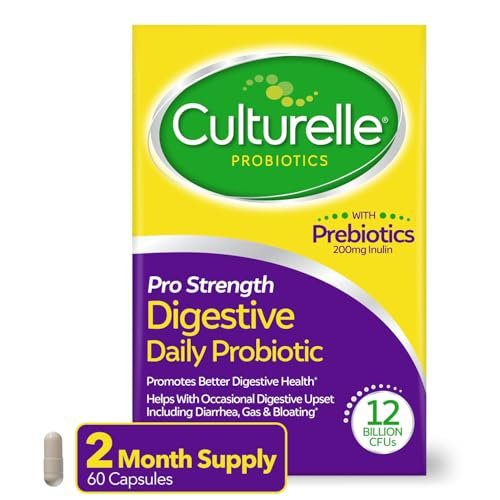
Culturelle Daily Probiotic Capsules For Men & Women, Most Clinically Studied Probiotic Strain, Digestive & Gut Health, Supports Occasional Diarrhea, Gas & Bloating, 1 Month Supply, 30 CT
Culturelle Daily Probiotic delivers 10 billion CFUs of Lactobacillus rhamnosus GG, the most clinically studied probiotic strain, in a 30-capsule monthly supply designed to reduce occasional gas, bloating, and diarrhea while supporting gut balance. The strain survives stomach acid to reach the intestines where it works, and the formula requires no refrigeration.
Many people quit probiotics too early or take them in a way that makes side effects more likely. The most useful mindset is this: probiotics are more like “training a routine” than taking a painkiller. You’re trying to shift the gut environment gradually.
What dose is “enough” for IBS?
A common evidence-based starting point is 10 billion CFU per day, especially when the strains are well-studied and designed to survive stomach acid. Higher CFU is not automatically better. In practice, quality and strain identity matter more than chasing the biggest number on the label.
Use this as a simple dosing ladder:
- Days 1-7: 1/2 dose (or every other day) if you’re sensitive
- Weeks 2-4: full label dose daily
- Weeks 4-8: continue if you see improvement; reassess if you don’t
If your product contains a prebiotic (like inulin), ramping slowly matters even more.
Best time of day to take probiotics
Most people do well with probiotics:
- with a meal, or
- right after a meal
Food buffers stomach acid and may improve survival for some strains. The “perfect timing” is less important than consistency.
If you’re also taking antibiotics, timing becomes more important. Use this guide on probiotics antibiotic timing so you don’t accidentally cancel out your effort.
What changes should you expect (and when)?
A realistic timeline looks like this:
| Timeframe | What you might notice | What it means |
|---|---|---|
| First 3-7 days | Mild gas or gurgling | Often a temporary adjustment, especially with synbiotics |
| Weeks 2-4 | Slightly less bloating or discomfort | Early responders often notice “lighter” digestion |
| Weeks 4-8 | More stable stool pattern, fewer bad days | This is the window many studies use for outcomes |
Stop and reassess if you get:
- worsening pain,
- fever, blood in stool, or
- persistent diarrhea or constipation that’s clearly new
Those are not “normal detox symptoms.” They’re reasons to talk with a clinician.
A quick quality checklist before you buy
Use this label checklist to avoid low-signal products:
- Strain listed (example: Lactobacillus rhamnosus GG, not just “Lactobacillus”)
- CFU at expiration (not only “at time of manufacture”)
- Storage instructions you can actually follow
- Third-party testing or clear quality standards when available
For people whose main complaint is distension, pairing probiotics with other options can help. This guide on supplements for bloating lays out evidence-informed add-ons like peppermint oil and targeted fibers.
Common misconceptions that keep people from finding the right probiotic
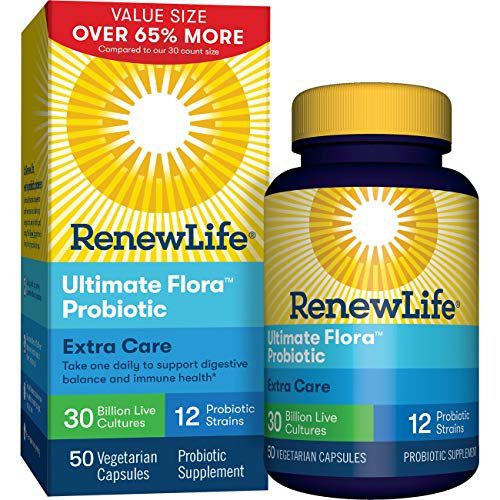
Renew Life Extra Care Ultimate Flora Probiotic Supplement, 30 Billion, 50 Vegetarian Capsules
Renew Life Extra Care Ultimate Flora Probiotic Supplement delivers 30 billion CFU from 12 strains across Bifidobacterium, Lactobacillus, and Lactococcus genera in 50 vegetarian capsules. The delayed-release capsules target intestinal delivery to support digestive health and balance for IBS concerns like bloating and discomfort. One capsule daily provides higher potency than many standard probiotics.
IBS is already unpredictable. Misleading probiotic advice makes it worse. Let’s clear up the most common myths that cause wasted money and unnecessary flare-ups.
Myth 1: “Higher CFU always works better”
A 100-billion-CFU product can still be a poor match if the strains aren’t the right ones, or if they don’t survive digestion. Many people do better with 10-30 billion CFU of strains that have human trial support than with mega-dose generics.
Actionable takeaway:
- Prioritize strain ID + survivability over max CFU.
Myth 2: “All probiotics help IBS”
IBS outcomes vary by:
- strain,
- dose,
- duration,
- IBS subtype,
- and even diet pattern (like low-FODMAP).
That’s why two people can take “a probiotic” and get opposite results. Consumer roundups such as BBC Good Food’s probiotic supplement review highlight product differences, but for IBS, strain matching matters even more.
Actionable takeaway:
- If you try a probiotic for IBS, treat it like a 4-8 week trial with tracking.
Myth 3: “Probiotics should work immediately”
Some people feel better quickly, but many don’t. IBS symptom scores in clinical trials are often measured after 4-8 weeks. If you quit after 5 days, you might only be seeing the adjustment period.
Actionable takeaway:
- Commit to a minimum 4-week trial, unless symptoms worsen.
Myth 4: “Probiotics replace IBS diet and lifestyle tools”
Probiotics can be supportive, but they rarely replace:
- a low-FODMAP trial (when appropriate),
- adequate soluble fiber,
- stress and sleep support,
- and medical evaluation for red flags.
If you want a structured way to stack interventions without doing too much at once, revisit the gut health supplement protocol and implement changes stepwise.
Myth 5: “If one probiotic fails, probiotics don’t work for me”
Not necessarily. It may mean:
- wrong strain,
- too much prebiotic,
- too high a starting dose,
- or not enough time.
Actionable takeaway:
- Change one variable at a time: strain family, dose, or prebiotic content.

Taking this alongside other products? StackMyMed (our companion app) logs your full stack, finds the optimal timing for each dose, and flags interactions, so you are not tracking it all by hand.
Conclusion: a practical way to find your best-fit probiotic
The best probiotics for IBS are rarely the flashiest label. They’re the ones with strain-specific evidence, a realistic daily dose (often 10B+ CFU), and a plan you can follow long enough to judge results. For many people, a multi-strain Lactobacillus + Bifidobacterium blend is a smart starting point for bloating and overall symptom relief. For IBS-D, targeted strains like L. rhamnosus GG (and sometimes L. plantarum) may be a better first trial.
Next step: pick one product style, run a 4-8 week trial, and track symptoms weekly. If you want help comparing options, start with the best probiotics comparison and then dial in your routine using probiotic dosage and timing.
As an Amazon Associate, I earn from qualifying purchases. Product recommendations are based on real reviews and independent research.
