

If you have been comparing collagen tubs on Amazon and seeing Sports Research consistently land on the "best value" lists and wondering whether the cost savings come with a quality tradeoff, the short answer is: Sports Research delivers the same core hydrolyzed bovine collagen as the mainstream premium brands at roughly 25 to 35 percent less per gram, with genuine third-party testing behind the lower price. The value pitch is real, not a race-to-the-bottom cost cut. The tradeoff is not quality; it is retail presence, NSF Sport certification, and the brand polish you get from the premium tier. You will also get a plain-English look at the brand's structure, how its research-support holds up, and which three SKUs from its lineup are worth the consideration.
Affiliate disclosure: this article contains affiliate links. As an Amazon Associate, UsefulVitamins.com earns from qualifying purchases at no extra cost to you.
Summary / Quick Answer: is Sports Research the real value pick?
Yes for the bovine unflavored SKU, which matches premium-tier grass-fed quality at a meaningful discount. Yes with caveats for the marine and flavored variants. No if banned-substance screening is a priority. Here is the honest break-down.
Best fit for Sports Research
- Cost-per-gram optimizers who want grass-fed quality without paying brand premium
- Daily Amazon users who do not care about retail shelf availability
- Anyone new to collagen wanting to commit to 8 to 12 weeks of testing without overspending
Not ideal for
- Competing athletes who need NSF Certified for Sport screening
- Buyers who specifically want retail shelf convenience (Target, Whole Foods, CVS)
- Anyone expecting premium-tier flavor engineering in the flavored SKUs
Decision shortcut
- Best value pick: Collagen Peptides Unflavored
- Marine variant at value pricing: Sports Research Marine Collagen
- Flavored at value pricing: Collagen Vanilla (accept mild-sweetener aftertaste)
What Sports Research is known for
Sports Research launched in the mid-2010s as an Amazon-native direct-to-consumer supplement brand, building its position on Amazon reviews and competitive pricing rather than retail placement or celebrity endorsement. The brand sits in the value-quality tier: cheaper than Vital Proteins, Momentous, or Bulletproof, but decisively above the Amazon-generic no-name suppliers whose testing and sourcing are opaque.
The core collagen line is grass-fed pasture-raised bovine hydrolysate, third-party tested for heavy metals, non-GMO verified. Sports Research publishes certificates of analysis and maintains a consistent product spec across batches. The bovine peptide profile is a generic type I and III hydrolysate at a molecular weight typical of the category (2-5 kDa range).
Two distinctions worth calling out. First, Sports Research also sells a marine collagen variant from wild-caught fish, which sits in the same value-tier positioning relative to the marine category (lower cost per gram than Vital Proteins Marine or boutique alternatives). Second, Sports Research is not NSF Certified for Sport. If you compete in NCAA, USADA-tested, or WADA-tested sports and random drug screening is a variable, Sports Research is the wrong choice regardless of price.
The brand's growth has been steady rather than explosive. No celebrity ambassadors, no mainstream retail-shelf saturation, no Nestlé-scale corporate backing. The business model depends on Amazon reviews holding up over time and the product spec staying consistent.
Actionable takeaway: Sports Research is a quality-tier product sold at value-tier pricing. The cost difference versus Vital Proteins is not buying you less quality; it is buying you less brand.
What makes Sports Research "value"
When a brand positions as value, the honest question is where the cost savings come from. For Sports Research, two real things:
Lower distribution and marketing overhead. Sports Research does not pay for Target shelf space, Jennifer Aniston endorsement contracts, or Nestlé-scale supply-chain integration. The brand sells mostly through Amazon and its own website, which keeps the retail margin stack short. That margin difference is meaningful and is the biggest single reason the per-gram price comes in lower.
No certification premiums. Sports Research is not NSF Certified for Sport. NSF testing is expensive (six-figure annual costs for ongoing compliance) and brands that carry the certification pass that cost through to consumers. If you do not need the certification, you are not paying for it.
More features are not always more useful. Vital Proteins has broader retail distribution and mainstream brand recognition. Momentous has NSF Certified for Sport. Both have real value for their target buyer. But if you are buying collagen for daily personal use and you are sensitive to cost per gram, you are paying for features you do not benefit from when you choose the premium-tier brand instead of Sports Research.
The quality floor at Sports Research is solid. Third-party heavy-metal testing, grass-fed pasture-raised sourcing, non-GMO verification, molecular-weight profile typical of the category. The weaknesses are on the edges: less mainstream brand trust for new buyers who are not Amazon-native, no NSF cert for athletes who need it, no retail flavor engineering at Vital Proteins polish level. None of those are quality failures; they are feature tradeoffs.
Actionable takeaway: The value pitch is structural, not compromised. You pay less because less cost is being added to the product, not because less quality is being delivered.

What the research shows for collagen (not brand-specific)
No head-to-head trial has compared Sports Research against Vital Proteins or any other specific brand at equivalent doses. The available evidence supports hydrolyzed bovine collagen as a category, at specific dose ranges, for specific outcomes.
In Proksch et al. 2014 (PMID 24401291), 114 women aged 45 to 65 took 2.5g of VERISOL branded bovine collagen peptides daily for 8 weeks. Eye wrinkle volume dropped by roughly 20 percent versus placebo, with procollagen type I up 65 percent and elastin up 18 percent in measured skin biopsies. VERISOL is Gelita's branded fraction, not Sports Research's peptide, so this supports the general collagen peptide category.
In a companion trial, Proksch et al. 2014 (PMID 23949208) tested 69 women aged 35 to 55 on 2.5g or 5g of bovine collagen hydrolysate daily for 8 weeks. Skin elasticity increased by up to 30 percent in the 5g arm. Again, general bovine hydrolysate, not a specific brand.
For joint outcomes, Clark et al. 2008 (PMID 18416885) studied 147 athletes on 10g of bovine collagen hydrolysate daily for 24 weeks and reported significant reductions in activity-related joint pain. Sports Research at 11g per single-scoop serving lands comfortably in this dose range.
Actionable takeaway: The clinical evidence base supports hydrolyzed bovine collagen at 2.5 to 10g daily for skin and joint outcomes. Sports Research delivers that form, at those doses, at a lower price per gram than premium alternatives. The research does not care which brand you buy; it cares about dose, form, and consistency.
Is it worth the price?
The math is straightforward. Sports Research Collagen Peptides Unflavored typically runs $0.28 to $0.38 per gram at Amazon retail. Vital Proteins runs $0.42 to $0.50 per gram for an equivalent-quality single-ingredient SKU. At a 10g daily dose over 30 days, that is $84 to $114 per month for Sports Research versus $126 to $150 for Vital Proteins. Annualized, the gap is roughly $400 to $500.
Whether that gap is "value" or "false economy" depends entirely on what you would use the extra $400-500 for. If you genuinely care about retail convenience or brand trust as a first-time collagen buyer, the premium might be worth it. If you are Amazon-native, price-sensitive, and committed to a long-term routine, Sports Research is the better pick.
The real question is not whether Sports Research is good, it is, but whether you are paying a brand premium for benefits you are not actually capturing. For most daily Amazon-shopping collagen users, the answer is yes, and Sports Research is the honest value pick.
Actionable takeaway: The Sports Research Unflavored SKU is the cost-per-gram floor for quality-tier grass-fed bovine collagen on Amazon. Anything meaningfully cheaper sacrifices testing or sourcing. Anything meaningfully pricier is charging brand premium.
Our picks from the Sports Research lineup
If the value proposition fits your shopping pattern, these are the three SKUs worth ranking.
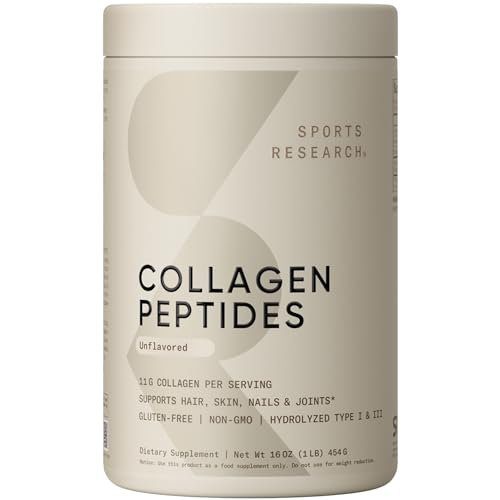
Sports Research Collagen Peptides – Hydrolyzed Type 1 & 3 Collagen Powder Protein Supplement for Healthy Skin, Nails, & Joints – Easy Mixing Vital Nutrients & Proteins, Collagen for Women & Men
Core value pick with 11g per single-scoop serving of grass-fed pasture-raised bovine hydrolysate, cost per gram that undercuts Vital Proteins by 25 to 35 percent.
Sports Research Collagen Peptides – Hydrolyzed Type 1 & 3 Collagen Powder Protein Supplement for Healthy Skin, Nails, & Joints* – Easy Mixing Vital Nutrients & Proteins, Collagen for Women & Men
Flavored variant of the core bovine formula with natural vanilla, same grass-fed hydrolysate base, priced well below Vital Proteins Vanilla for a similar flavor profile.
FAQ
Is Sports Research the same quality as Vital Proteins? For the core grass-fed bovine hydrolysate product, essentially yes. Same amino-acid profile, similar molecular weight range, same third-party testing category. The price difference is brand and distribution, not quality.
Is the marine collagen tested for mercury? Yes. Sports Research publishes certificates of analysis covering heavy metals including mercury, lead, cadmium, and arsenic. Hydrolyzed fish collagen from skin tends to be low in mercury because mercury accumulates in muscle tissue, not skin.
Does it taste different from Vital Proteins? The unflavored SKUs are flavor-comparable at the stir-in level. Both are close to neutral. The Sports Research Vanilla is slightly sweeter in finish than Vital Proteins Vanilla. Unflavored-to-unflavored, most blind-taste comparisons cannot reliably distinguish them.
Can I take Sports Research during pregnancy? Collagen peptides have a long general safety record, but pregnancy-specific guidance should come from your OB-GYN. Sports Research does not specifically market against pregnancy use but does not make pregnancy-specific claims either. Standard supplement caution applies.
Why does the Sports Research marine have a fishy taste when Vital Proteins Marine does not? The processing differs slightly between brands. Sports Research uses a slightly less aggressive deodorization process, which some users describe as a faint fishy aftertaste in cold unflavored water. In coffee, smoothies, or any flavored context, the difference is usually imperceptible.
Tracking a protocol like this? Our companion app, StackMyMed, lets you log doses, schedule them, and check interactions across everything you take — alongside, never instead of, your clinician’s guidance.
Conclusion: the bottom line on Sports Research
Sports Research is the honest value pick in the quality-tier grass-fed bovine collagen category. The price savings are structural (less distribution, no NSF cert premium, no celebrity endorsement costs), not quality compromises. For a cost-sensitive Amazon-native daily user, it is the smarter purchase than Vital Proteins at roughly 25 to 35 percent less per gram for the same core molecule.
The limits are real: no NSF Certified for Sport, less mainstream retail presence, slightly less-polished flavored SKUs. For a specific buyer profile, those matter and the premium brand is the right choice. For most users, Sports Research delivers the same outcome for meaningfully less money.
Next steps
- See the full roundup: Best Collagen Peptides in 2026: 8 We'd Actually Buy (and 3 to Skip)
- Thinking about marine vs bovine: Marine vs. Bovine Collagen: Which One Is Actually Better for Skin?
As an Amazon Associate, I earn from qualifying purchases. Product recommendations are based on real reviews and independent research.
