

If you have been noticing the mirror changes that tend to show up in your early 40s, thinner skin on the backs of your hands, slower wound healing, a subtle loss of that bounce in the face, the short answer on collagen is: it is one of the few supplements with direct placebo-controlled trial evidence in women exactly your age, but it is a skin and joint tool, not a menopause treatment. The real gap to close is expectation, not biology. Collagen will not address hot flashes, mood changes, or libido. It can measurably help skin wrinkle volume, dermal matrix density, and joint pain at the doses used in published trials. You will also get a straight look at what actually changes biologically at 40-plus, what the research shows, and which three products most closely match the trial protocols.
Summary / Quick Answer: does collagen actually help women 40+?
Yes, for skin and joint outcomes, with modest effect sizes over 8 to 12 weeks at doses between 2.5g and 10g daily. No, for hormone-driven menopause symptoms. Here is the honest break-down.
Best fit for collagen after 40
- Women who want visible skin changes over 8 to 12 weeks with daily dosing
- Women managing joint stiffness or post-exercise recovery discomfort
- Anyone willing to treat this as a long-term routine, not a quick fix
Best research-match pick
- VERISOL-formulated hydrolyzed bovine peptides at 2.5g daily, the exact protocol from the Proksch 2014 trial (PMID 24401291) on women aged 45 to 65
Skip if
- You expect collagen to behave like HRT or replace anything your doctor prescribes
- You want relief from hot flashes, night sweats, mood changes, or libido shifts (collagen does not address hormonal symptoms)
- You expect dramatic or overnight changes (the trial timeline is 8 weeks minimum)
Decision shortcut
- Skin-focused with evidence-matched dosing: VERISOL-formulated peptides, 2.5g daily, 8 to 12 weeks minimum
- Skin plus joint and bone support: bovine hydrolyzed peptides, 5 to 10g daily, ongoing
- Clean-label simplicity: single-ingredient grass-fed bovine, 10g daily
What actually changes at 40+: estrogen, fibroblasts, and collagen loss
The biology is worth understanding because it shapes realistic expectations. Three things shift in the decade around menopause.
Dermal fibroblast activity drops. Fibroblasts are the cells in the middle layer of your skin that produce new collagen. Estrogen is a direct signaling molecule for fibroblast activity, so when estrogen declines (perimenopause to post-menopause), fibroblasts slow down collagen synthesis. Skin does not stop making collagen, it just makes less of it per year than before.
Existing collagen degrades faster than it gets replaced. Collagen has a natural turnover rate at every age. In your 20s, synthesis keeps pace with breakdown. In your 40s and 50s, synthesis falls behind. The net result is a gradual loss of total collagen density in skin, which shows up visibly as thinner skin, more visible wrinkles, and slower wound healing.
Bone density inflects. Bone is not just calcium, it is a calcium-reinforced collagen matrix. Post-menopausal bone density loss is primarily driven by declining estrogen, and collagen loss is part of that picture. Hip fracture risk starts climbing in the late 50s for exactly this reason.
None of this means collagen supplementation "reverses" these processes. It means you are supporting the raw material pool that your skin and joints draw from. Whether that translates to measurable visible change depends on dose, duration, and, honestly, individual biology.
Actionable takeaway: Expect collagen to slow, not reverse. Think of it like daily maintenance rather than repair. The effect sizes in the published trials are meaningful but modest, which is exactly what a "maintenance" intervention should look like.

What the research actually shows (the VERISOL trial)
This section is where the evidence gets specific. There are dozens of collagen peptide trials, but a few stand out for the 40-plus demographic.
In Proksch et al. 2014 (PMID 24401291), 114 women aged 45 to 65 took 2.5g of VERISOL bovine collagen peptides daily for 8 weeks. Eye wrinkle volume dropped by roughly 20 percent versus placebo. Skin biopsies showed a 65 percent increase in procollagen type I and an 18 percent increase in elastin, both measured against pre-treatment baselines. This is the most-cited collagen peptide trial in the exact demographic you are reading this article about.
In a companion study, Proksch et al. 2014 (PMID 23949208) tested 69 women aged 35 to 55 on 2.5g or 5g of bovine collagen hydrolysate daily for 8 weeks. Skin elasticity improved by up to 30 percent in the 5g arm versus placebo. The dose-response signal here is useful: the higher dose produced a larger effect, suggesting 2.5g is the floor, not necessarily the ceiling.
On the joint side, Clark et al. 2008 (PMID 18416885) studied 147 athletes taking 10g of bovine collagen hydrolysate daily for 24 weeks and reported significant reductions in activity-related joint pain. The sample skews younger than our target demographic, but joint-pain physiology in active 40-plus women often mirrors the patterns seen in athletes, so the mechanism evidence transfers reasonably well.
The real question is not "does collagen work" but "does it work for me, at a dose I will actually take, within a timeline I can commit to." The answer is: at 2.5 to 10g daily for 8 to 12 weeks, the odds favor measurable skin change. At lower doses or shorter timelines, expect less.
Actionable takeaway: If you want to match the protocol with the strongest evidence in your age range, VERISOL-branded hydrolyzed bovine peptides at 2.5g daily for 8 weeks is the closest fit. If you want broader joint and skin coverage, 5 to 10g daily of any quality hydrolyzed bovine peptide is defensible.
Realistic expectations: what collagen does and does not do
This is the section where we say the quiet part out loud. Collagen is a supplement with useful, modest, specific effects. It is not HRT. It is not a menopause treatment. It is not a miracle.
Collagen does not replace hormone therapy. If hot flashes, night sweats, mood shifts, sleep disruption, or vaginal dryness are on your list, those are estrogen-driven symptoms and collagen has no mechanism to address them. Talking to a doctor about HRT is a separate conversation, and one that this article does not substitute for.
Collagen does not cure wrinkles, restore youth, or reverse aging. The Proksch trials measured a 20 percent reduction in wrinkle volume, not elimination of wrinkles. The skin still ages. The rate slows, the density improves, the visible texture gets better at the margins. People expecting to look 10 years younger at the 8-week follow-up will be disappointed, and the studies do not claim anything close to that.
Collagen does not prevent or treat osteoporosis. It may support bone collagen matrix integrity as part of a broader approach that includes weight-bearing exercise, adequate calcium and vitamin D, and medical evaluation if you have risk factors. Collagen alone is not a bone-health strategy.
Collagen is not an overnight product. The published trials run 8 weeks minimum. Some users report subjective skin changes at 4 to 6 weeks. Joint-pain improvements in the Clark trial were measured at 24 weeks, not at the 2-week mark.
VERISOL is legitimate for skin outcomes, but the tradeoff is the trials only measure what they measure. Skin hydration, wrinkle volume, elasticity, procollagen synthesis, dermal density. Nothing about hormonal symptoms, mood, energy, or general vitality. Those claims belong to different supplement categories, and any collagen marketing that reaches toward them is stepping outside the evidence.
Actionable takeaway: Set expectations at "measurable support" rather than "transformation." At the trial protocols, you can expect modest visible improvement in skin, modest joint pain reduction, and a feeling of investment in your long-term tissue health. Everything beyond that belongs in a conversation with a clinician.
How to read a collagen label after 40
Three label checks save you from paying for wrong things.
Look for "hydrolyzed" or "collagen peptides." These are the forms used in the trials. If the label says "collagen protein" or just "gelatin," you are buying a cooking ingredient, not the form in the published skin RCTs.
Check the daily dose. The VERISOL trial used 2.5g daily. Broader bovine peptide trials use 5 to 10g. If a product uses a proprietary blend that does not disclose the collagen dose, keep shopping. Specific daily grams matter for matching trial protocols.
Check for named peptide variants if you want research-match dosing. VERISOL, Peptan, CH-Alpha, and BODYBALANCE are branded peptide fractions with specific RCT evidence. If you see "VERISOL" on the label and the serving size matches 2.5g, you are within a handful of percent of the actual Proksch 2014 protocol. Generic hydrolyzed collagen at equivalent doses will probably work similarly, but the evidence base is tied to the specific variants.
Grass-fed, pasture-raised, third-party tested, non-GMO: all nice to have, none of them are the variables the trials controlled for. They matter for supply-chain quality and contaminant risk rather than clinical outcome.
Actionable takeaway: Hydrolyzed bovine, 2.5 to 10g daily, ideally a named trial-tested peptide variant if you want a research-match routine. Everything else on the label is secondary.
Our picks: 3 collagens that fit the research
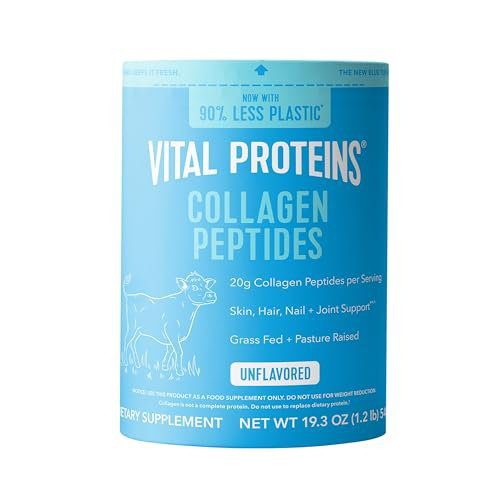
Vital Proteins Collagen Peptides Powder – Grass Fed Collagen Peptides for Hair, Nail, Skin, Bone & Joint Health, Unflavored, 27 Servings
Most-familiar collagen pick with 20g per two-scoop serving, grass-fed bovine hydrolysate, and the consistent manufacturing record that makes it the default 40-plus starter.
![Sparkle Wellness VERISOL Bioactive Hydrolyzed Collagen Peptides | Collagen Powder Supplement with Vitamin C & Hyaluronic Acid for Hair, Skin, and Nail Health | Skin Boost Plus (No Flavor) [30-Serves]](https://usefulvitamins.com/wp-content/uploads/2026/04/amazon-B0772F771W.jpg)
Sparkle Wellness VERISOL Bioactive Hydrolyzed Collagen Peptides | Collagen Powder Supplement with Vitamin C & Hyaluronic Acid for Hair, Skin, and Nail Health | Skin Boost Plus (No Flavor) [30-Serves]
Research-match pick using VERISOL-branded bioactive collagen peptides, the specific hydrolysate variant used in the Proksch 2014 eye-wrinkle trial on women aged 45 to 65.
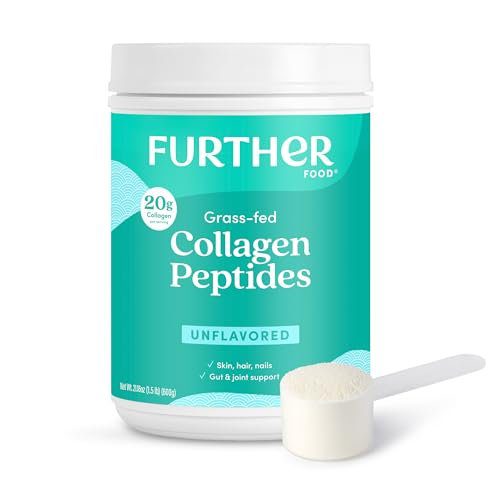
Further Food Unflavored Collagen Peptides Powder – 100% Grass-Fed, Hydrolyzed Type 1 & 3, 20g of Collagen per Serving, Supports Skin, Hair, Nails & Joints, 21.16 Oz
Clean-label pick with 10g per serving grass-fed pasture-raised bovine hydrolysate, single-ingredient formulation, and no added flavoring, sweetener, or fillers.
FAQ
Is collagen safe to take during menopause?
For most healthy women, yes. Collagen peptides have a long safety record at typical daily doses of 2.5 to 20g. The exception is people with known allergies to the source (bovine, fish, or chicken) and people with specific kidney issues who should check with a clinician before adding any protein supplement. If you are taking any prescription medication, mention collagen to your doctor to rule out interactions.
Will collagen help with hot flashes?
No. Hot flashes are driven by estrogen fluctuation and temperature-regulation pathways, and collagen has no mechanism to address either. If hot flashes are a priority, that is a conversation with a clinician about HRT or non-hormonal options, not a supplement-aisle decision.
Can I take collagen with HRT or other supplements?
Generally yes, but always confirm with your prescriber. Collagen is an amino-acid source and has no known interactions with hormone therapy. It pairs reasonably with vitamin C (which supports collagen synthesis) and with vitamin D and calcium for bone-health protocols.
How long until I see results?
The Proksch trials measured skin outcomes at 8 weeks. Some users notice hydration or subjective skin-feel changes at 4 to 6 weeks. Visible wrinkle and elasticity changes typically need 8 to 12 weeks of consistent daily use. Joint-pain improvements in the Clark trial were measured at 24 weeks, so longer is required for that outcome.
Does it matter what time of day I take collagen?
Not meaningfully for skin outcomes. The trial protocols typically had participants take collagen in the morning with a glass of water or coffee, but the evidence that timing changes outcomes is thin. Consistency (taking it every day) matters more than the specific hour.
Does collagen cause weight gain?
Not at typical supplemental doses. 10g of collagen is about 40 calories of protein. If you are drinking it in addition to your usual caloric intake and you are sensitive to small surpluses, that is a factor, but for most users the caloric load is negligible.
Can I take too much?
Doses above 15 to 20g daily do not show additional benefit in the skin-outcome literature. The upper limit on tolerability is usually GI-related (mild bloating) rather than toxic. Stay in the 2.5 to 10g range unless you have a specific reason to go higher.
Conclusion: the bottom line on collagen after 40
Collagen supplementation in women 40-plus has direct, placebo-controlled trial evidence for skin wrinkle volume, dermal matrix density, and elasticity at doses between 2.5g and 10g daily over 8 to 12 weeks. The VERISOL peptide variant has the strongest match to the trial protocols in this age range. The effect sizes are modest but real, which is honest and useful rather than disappointing.
Collagen does not replace hormone therapy. It does not address hormonal symptoms. It does not reverse aging. What it does, consistently in the trials, is add a measurable amount of visible and measured support to the raw material your fibroblasts draw from. For a daily routine that costs less than a cup of coffee, that is a reasonable trade.
Any supplement category that gets marketed this aggressively deserves skepticism. Collagen earns a limited qualified yes in this demographic because the trial evidence actually exists, which cannot be said for most wellness-marketing products. Just buy the form that matches the trials, dose consistently, and treat it like a long-term maintenance routine rather than a fix.
Next steps
- Start here for the foundation: Peptides Explained: The Honest 2026 Guide to What Works, What's Hype, and What's Risky
- See our full product roundup: Best Collagen Peptides in 2026: 8 We'd Actually Buy (and 3 to Skip)
- If you are also interested in topical peptides: Copper Peptides (GHK-Cu) Explained: Why Every Skincare Brand Is Suddenly Obsessed
As an Amazon Associate, I earn from qualifying purchases. Product recommendations are based on real reviews and independent research.
