
If you searched for GABA supplement evidence, you have probably already noticed that the sleep aisle is full of bottles named after the brain's main calming neurotransmitter and the reviews are split between "this saved my anxiety" and "this is sugar pills with extra steps." You deserve a straight answer on whether oral GABA actually reaches the brain.
Quick Answer: is GABA worth the bottle
For adults with mild, transient stress or pre-sleep mental arousal, 100 mg of PharmaGABA 30 to 60 minutes before bed is a low-stakes trial with modest subjective signal in small RCTs, but it is not a treatment for clinical anxiety or insomnia, and the evidence that oral GABA crosses the blood-brain barrier in meaningful concentrations is genuinely contested.
- Best for: adults with stress-flavored pre-sleep mental arousal who have already addressed evening light, caffeine timing, and alcohol exposure and want to test one low-risk amino acid before reaching for something stronger.
- Not ideal for: anyone with diagnosed generalized anxiety disorder, panic disorder, or chronic insomnia (those belong with a clinician and guideline-recommended care), anyone on a benzodiazepine, Z-drug, or other sedating prescription, and anyone using alcohol as a sleep aid.
- Do first: evening light hygiene, a caffeine cutoff by early afternoon, and one consistent sleep window. If a sleep complaint has lasted more than 3 months and is interfering with daytime function, the door is cognitive behavioral therapy for insomnia (CBT-I), not an amino acid.
- Decision shortcut: if you choose to trial GABA, buy a labeled PharmaGABA product (fermented from Lactobacillus hilgardii) at 100 mg per dose with a published Certificate of Analysis. Two-week trial. If subjective evening tension and sleep onset do not move, GABA is not your lever.
What GABA actually is
GABA, gamma-aminobutyric acid, is the primary inhibitory neurotransmitter in the mammalian central nervous system. It is synthesized in neurons from glutamate by the enzyme glutamic acid decarboxylase (GAD) and acts at two receptor families that matter for the sleep and anxiety conversation.
GABA-A receptors are ionotropic chloride channels and they are the receptors benzodiazepines, Z-drugs (zolpidem, eszopiclone), barbiturates, alcohol, and propofol all act on through positive allosteric modulation at distinct binding sites. When GABA binds the GABA-A receptor, chloride flows in, the neuron hyperpolarizes, and excitability drops. This is the inhibitory tone that dampens cortical arousal.
GABA-B receptors are metabotropic G-protein-coupled receptors that produce slower inhibitory effects, and they are the target of baclofen, an antispasticity prescription.
Endogenous GABA is everywhere it needs to be: synthesized in the neurons that release it, packaged into vesicles, released into synapses, and quickly cleared by GAT-1 and other transporters. The supplement question is not whether GABA matters in the brain, it clearly does. The supplement question is whether GABA you swallow can reach those receptors at all.
The blood-brain barrier debate

The classical view is that GABA, as a small but highly polar amino acid, does not cross the blood-brain barrier (BBB) in pharmacologically meaningful amounts. The BBB tight junctions exclude most polar molecules unless a specific transporter handles them, and the transporters that move GABA across the BBB are limited and may move net GABA out of the brain rather than in. This is the textbook line still taught in most pharmacology curricula and it is the reason GABA is sometimes called "useless as a supplement" by skeptics.
The contrarian view comes from the Boonstra 2015 review of neurotransmitters as food supplements, which concluded that "results regarding the effects of oral GABA intake on relaxation and sleep are mixed, and there is insufficient evidence to support either claim." The review acknowledged a small set of human studies with subjective signal and noted three possible mechanisms: limited but non-zero BBB transport in specific contexts, a peripheral mechanism through GABA receptors on the enteric nervous system and vagus nerve that signal upward to the CNS, and indirect effects on glucose, insulin, or growth hormone that might produce the subjective relaxation users describe.
The Knudsen 2008 review of BBB GABA transporters described the transport machinery in more detail and found that net flux is complex and condition-dependent. Inflammation, stress, and disease states can change BBB permeability, and the steady-state assumption that "GABA does not cross the BBB" may overstate the case in a healthy adult at rest.
So the honest framing is not "GABA cannot cross the BBB." It is closer to "direct BBB transport of oral GABA into the central nervous system at supplement doses is limited at best, and most of the felt effect, if there is one, is likely peripheral." That distinction matters for what we expect a GABA supplement to do.
The peripheral mechanism
If oral GABA does most of its work below the neck, what is it doing? GABA receptors are not confined to the brain. They are expressed on the enteric nervous system (the gut's intrinsic neural network), on the vagus nerve afferents that carry visceral signals from the gut to the brainstem, on pancreatic beta cells, and on immune cells.
Vagal afferents are the most plausible signaling route. The vagus nerve carries information from the gut to the nucleus tractus solitarius in the brainstem, which projects to the locus coeruleus, the parabrachial nucleus, and onward to the amygdala and prefrontal cortex. A peripheral GABA signal at vagal afferents can plausibly produce a top-down quieting of arousal circuits without any GABA molecule having to cross the blood-brain barrier itself. This is the same general gut-to-brain signaling architecture that explains psychobiotic effects and some of the calming responses to slow breathing and certain food fibers.
Mechanistically, this hits a real signaling pathway in a way that should produce a small subjective effect on pre-sleep arousal. The trials are consistent with that small effect, not with a benzodiazepine-like sedation. The dose-response is shallow, and the effect size in PharmaGABA RCTs is modest, which is what we should expect from a peripheral signal rather than direct CNS occupancy.
What the trials actually show
The strongest published evidence is for PharmaGABA, a GABA produced by fermentation of Lactobacillus hilgardii, a strain used in traditional kimchi production. PharmaGABA is the form most studied in Japanese RCTs and the form behind most of the brand claims you see on US supplement labels.
The Yoto 2012 trial randomized 30 adults to a 100 mg dose of PharmaGABA, 100 mg of L-theanine, or placebo before a mental arithmetic stressor. The PharmaGABA arm showed a reduction in subjective stress on a visual analog scale and changes in EEG alpha and beta power consistent with a relaxed but attentive state, with a small effect size and a sample size that limits how confident we can be in the generalizability. The trial measured subjective and EEG outcomes, not polysomnographic sleep architecture.
The Abdou 2006 trial measured a 100 mg PharmaGABA dose in a small sample (n under 15 per arm) and found increases in EEG alpha and decreases in beta during a stressor task, plus immunoglobulin A changes the authors interpreted as a stress-related immune signal. The trial is small, single-site, and funded in part by a PharmaGABA manufacturer.
The Boonstra 2015 review tabulated the published human studies and concluded that the evidence base is small, the endpoints are mostly subjective, and the funding source is concentrated in companies with a commercial interest in PharmaGABA's success. None of this invalidates the signal, but it is the right context for a reader deciding whether to commit to a habit.
The dose that produced the EEG and subjective effects in the lead trials was 100 mg. Most commercial GABA supplements on Amazon are dosed at 500 to 750 mg per serving, which is not a tested dose for a tested outcome. The dose-trial-supplement gap here runs the opposite direction from many other supplements: the bottles overshoot the studied dose rather than underdose it, which raises a different question about whether more GABA peripherally just means more glucuronide metabolites and not more central effect.
Forms on the market
The retail GABA category has a wider spread of products than the evidence base warrants. Triage briefly.
PharmaGABA is the fermented form most studied. If you are going to experiment, this is the defensible choice. The brand names you see on US shelves often source from the same Japanese manufacturer. Look for "PharmaGABA" or "naturally fermented GABA from Lactobacillus hilgardii" on the label.
Synthetic GABA is chemically synthesized rather than fermented. Whether it is biochemically equivalent to PharmaGABA in terms of peripheral signaling is unsettled. The published RCTs used PharmaGABA, so the cleanest position is to match the trial form when you can.
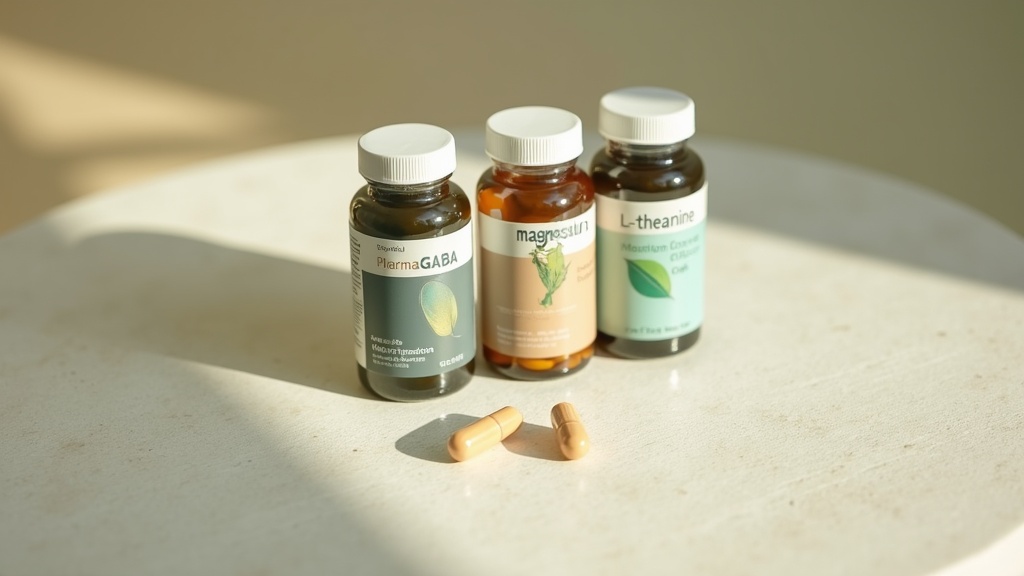
L-theanine combinations stack GABA with theanine to lean on theanine's better-established calming evidence. The combo is reasonable, but it makes a single-variable trial impossible. Run them separately if you want to know what is working.
L-glutamine and glutamic acid are sometimes sold as "GABA precursors" because GAD makes GABA from glutamate. The pathway is real but the rate-limiting step is GAD activity, not substrate availability. Eating more glutamate or glutamine does not meaningfully increase brain GABA in healthy adults.
Picamilon is a Russian prescription product that links GABA to niacin via an amide bond, with the niacin half intended to ferry the molecule across the BBB. The pharmacology is interesting and outside the scope of a supplement aisle conversation. The FDA issued warning letters in 2015 declaring picamilon an unapproved new dietary ingredient and adulterant in supplements, and it should not be present in any product sold as a US dietary supplement. If you see picamilon on a US label, that label is breaking US law.
Phenibut is a Russian prescription anxiolytic with documented dependence, severe withdrawal, and overdose risk. It is structurally a phenyl analog of GABA with a different and much more powerful pharmacology, not a simple GABA supplement. Phenibut has been the subject of multiple FDA actions and case-series literature describing withdrawal that requires medical management. Do not use phenibut as a self-directed supplement. This is not a hedge. It is a categorical line.
Honest interactions and safety
For PharmaGABA at the 100 mg dose, the safety profile in the published short-term trials is uneventful. The interactions worth naming come from the receptor pharmacology, even if direct CNS occupancy is modest.
Benzodiazepines and Z-drugs. Per the Drugs.com GABA monograph, additive effects at the GABA-A receptor site are a theoretical concern when combining oral GABA with benzodiazepines (alprazolam, lorazepam, clonazepam, diazepam), Z-drugs (zolpidem, eszopiclone, zaleplon), barbiturates, or anesthetic agents. Even if BBB penetration is limited, additive peripheral and central signaling cannot be ruled out, and the combination belongs in a conversation with the prescribing clinician.
Alcohol is a positive allosteric modulator at GABA-A. Stacking oral GABA with alcohol as a sleep aid is the worst version of this trial because the alcohol confounds the read on whether GABA is doing anything and amplifies sedative risk.
Sedating prescriptions more broadly (sedating antihistamines, sedating antidepressants such as trazodone and mirtazapine, opioid analgesics, gabapentin and pregabalin) warrant the same clinician-review caution.
Pregnancy and nursing. PharmaGABA has not been adequately studied in pregnancy. The conservative position is to avoid during pregnancy and nursing absent a specific clinician recommendation.
A supplement brand can look impressive on a label and still miss the basics. With GABA, the basics are the form (PharmaGABA), the dose (100 mg, not 750 mg), and the absence of picamilon or phenibut in any product marketed in the US.
When GABA is the wrong tool
If anxiety is severe enough that it limits work, relationships, or daily function, the more honest first step is an evaluation by a primary care clinician or psychiatrist, not a 100 mg amino acid. The guideline-grade interventions for generalized anxiety disorder and panic disorder are CBT and SSRIs or SNRIs, with botanicals and amino acids as possible adjuncts after the main intervention is in place.
If sleep is short, restless, or unrefreshing for more than 3 months, occurs at least 3 nights a week, and interferes with daytime function, that is chronic insomnia disorder. The AASM 2021 guideline names CBT-I as first-line treatment. CBT-I outperforms every supplement currently on the US market for chronic insomnia outcomes at 6 and 12 months.
If anxiety arrives with palpitations, weight loss, heat intolerance, or tremor, that is a thyroid workup, not an amino acid. If anxiety arrives with persistent low mood, anhedonia, and early-morning waking for more than 2 weeks, that is a depression screen. None of those scenarios are solved by an oral GABA capsule.
For more on what UV considers honest "evidence-backed adjunct" framing across the anxiety and sleep aisles, see our roundups on the best supplements for anxiety and the best magnesium for sleep.
Actionable takeaway: if you decide on a GABA trial, run PharmaGABA 100 mg, 30 to 60 minutes before bed, single variable, for two weeks. No alcohol, no other new supplements in that window. If your subjective evening tension and time-to-sleep do not move, GABA is not your lever and the next conversation is not a different amino acid, it is the basics or a clinician.
FAQ
Does oral GABA cross the blood-brain barrier?
Direct BBB transport of oral GABA at supplement doses is limited, and most pharmacology textbooks still teach that meaningful CNS entry does not occur. The published RCTs at 100 mg PharmaGABA show small subjective and EEG effects that are more consistent with a peripheral, vagal-afferent signaling route than with direct central receptor occupancy.
Is PharmaGABA better than synthetic GABA?
The published positive trials used PharmaGABA fermented from Lactobacillus hilgardii. Whether synthetic GABA is biochemically interchangeable for peripheral signaling is not settled, so the cleanest position is to match the trial form.
Is picamilon legal in the US?
No. The FDA declared picamilon an unapproved new dietary ingredient in 2015 and issued warning letters to companies marketing it. Any US "supplement" containing picamilon is non-compliant.
Is phenibut a GABA supplement?
No. Phenibut is a Russian prescription anxiolytic with documented dependence and severe withdrawal. It is not a self-directed supplement and it does not belong in a sleep stack, regardless of what an internet seller calls it.
Can I stack GABA with magnesium and L-theanine?
Short stacks of these three are not pharmacologically contraindicated for healthy adults, but the stack obscures what is working. If you want a clean read on whether GABA is doing anything, run it alone for two weeks first.
Conclusion: the bottom line on GABA supplement evidence
GABA is the brain's primary inhibitory neurotransmitter and oral GABA is the most mechanistically debated supplement in the sleep aisle. The BBB transport story is genuinely contested, the strongest human evidence sits in a handful of small Japanese RCTs at 100 mg of PharmaGABA, and most of what users report is likely a peripheral, vagal-afferent signal rather than direct central receptor binding. For a reader with stress-flavored pre-sleep mental arousal who has already handled evening light, caffeine timing, and alcohol, a two-week single-variable trial of PharmaGABA at 100 mg is a defensible experiment. It is not a treatment for diagnosed anxiety or insomnia, it is not safe to stack with benzodiazepines or alcohol as a sleep aid, and it is not the supplement to keep buying if a two-week clean trial produces nothing.
Picamilon and phenibut are categorical no-go: picamilon is FDA-banned as a supplement adulterant, and phenibut is a prescription anxiolytic with dependence risk that should never be self-medicated.
Next steps:
- If you choose to trial GABA, run a two-week single-variable experiment with PharmaGABA 100 mg about 30 to 60 minutes before bed, with no other new supplements in that window.
- For the methodology behind how we rank single-supplement evidence, see how we review supplements.
- If anxiety is the actual question and you want a broader triaged list, see the best supplements for anxiety. If the question is sleep and you have not tried magnesium yet, the best magnesium for sleep is the place to start.
For more on the cognitive-and-mood biochemistry side of UV's coverage, see the Maria Rodriguez author page.
This article is for informational purposes and not medical advice. Oral GABA may have additive effects with benzodiazepines, Z-drugs, barbiturates, alcohol, and other sedating medications, and it has not been adequately studied in pregnancy or nursing. Picamilon is FDA-banned as a supplement adulterant; phenibut is a prescription-grade anxiolytic with documented dependence and withdrawal risk and is not a self-directed supplement. Consult a licensed clinician before starting any supplement, particularly if you are pregnant, nursing, taking prescription medications, or managing a chronic condition.
Reviewed by Maria Rodriguez, MS Nutrition Science, focused on cognitive and mood biochemistry.
