
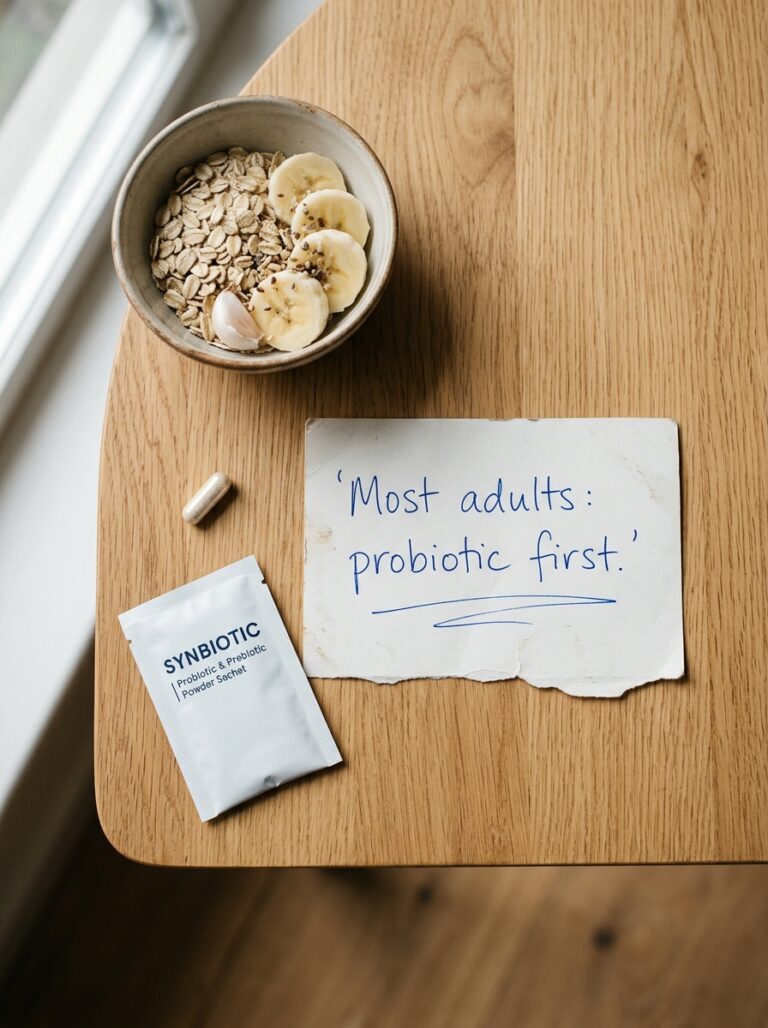
Three words on the same shelf, sold like they're interchangeable: prebiotic, probiotic, synbiotic. They're not synonyms, and the differences decide what actually shows up in your gut. A prebiotic is a fiber that feeds the bacteria you already have. A probiotic is a dose of live bacteria you swallow.
A synbiotic is the two packaged together. This guide sorts which one matches your goal so you stop paying for a category and start buying a result.
Before you decide

A few people should not start any of these on their own. If you are severely immunocompromised, critically ill, recovering from major surgery, fitted with a central venous catheter, or caring for a premature infant, talk to your physician before adding a probiotic or synbiotic, because rare bloodstream infections from probiotic organisms have been documented in exactly these groups.
The same caution applies if you have an active gastrointestinal disease such as ulcerative colitis or Crohn's, where these products belong in a plan your gastroenterologist directs, not a self-prescribed add-on. None of this is a cure claim: these supplements support specific situations within standard medical care, they don't replace it.
If none of that applies, the useful first step is naming the goal honestly. "Better gut health" is not a target the evidence can hit. A specific goal can be: you're about to start antibiotics, you have diagnosed IBS, you're chronically constipated, or your diet is thin on plants and you want to feed your microbiome better.
Each points to a different answer, and some point away from a supplement entirely. As a dietitian, I'd flag the obvious lever before any of the three: a diet broad in plants and fermented foods feeds and seeds your gut community far more consistently than any capsule or sachet.
If persistent bloating, reflux, or bowel changes are the reason you're here, ask your doctor whether a basic workup makes sense first, because those symptoms can have causes none of these products address. You can see how I weigh evidence and conflicts of interest on the how we review supplements page.
What each one actually is

The three terms come from the same expert body, the International Scientific Association for Probiotics and Prebiotics, and the definitions are tighter than the marketing suggests.
A probiotic is defined as "live microorganisms which, when administered in adequate amounts, confer a health benefit on the host" in the 2014 ISAPP consensus statement. The key words are "live," "adequate amounts," and "health benefit," which means a probiotic is a specific named strain at a specific dose with a specific proven effect, not a generic category. I cover the strains and doses in depth in the complete guide to probiotics.
A prebiotic is "a substrate that is selectively utilized by host microorganisms conferring a health benefit," in the 2017 ISAPP consensus definition. In plain terms, it's a compound your own gut bacteria ferment as fuel. The best-established prebiotics are specific fibers: inulin, fructo-oligosaccharides (FOS), and galacto-oligosaccharides (GOS). You don't swallow new bacteria; you feed the ones already living in you.
A synbiotic is "a mixture comprising live microorganisms and substrate(s) selectively utilized by host microorganisms that confers a health benefit on the host," per the 2020 ISAPP synbiotics consensus statement. That same statement drew an important line here: a true "synergistic" synbiotic uses a fiber chosen specifically to feed the strain it's packaged with, while a "complementary" synbiotic just bundles a probiotic and a prebiotic that each work on their own.
That distinction is the whole game when you're deciding whether a synbiotic is worth the premium.
The three compared, side by side
The table below lays out what each one is, what it does in your body, who has the best evidence behind it, and a practical starting dose. Treat it as a map of the decision, not a ranking, because the right answer depends entirely on your goal.
| Type | What it is | What it does | Best-evidenced use | Typical starting dose |
|---|---|---|---|---|
| Prebiotic | A fermentable fiber (inulin, FOS, GOS) | Feeds your existing bacteria; raises Bifidobacterium and short-chain fatty acids | Functional constipation; long-term microbiome support | 3 to 5 g/day, built up slowly |
| Probiotic | Live bacteria or yeast, a specific named strain | Adds transient microbes that act while present, then pass through | Antibiotic-associated diarrhea; some IBS symptoms | 1 to 20 billion CFU/day, strain-dependent |
| Synbiotic | A probiotic strain plus a prebiotic fiber in one product | Delivers live microbes alongside fuel intended to support them | Modest microbiota shifts; situations where a matched pair was trialed | As studied for that exact combination |
Notice the pattern: a prebiotic works on the bacteria you keep, a probiotic adds bacteria that mostly pass through, and a synbiotic tries to do both at once. The "best dose" column is where synbiotics get slippery, because there is no general synbiotic dose, only the dose of the specific combination that was tested.
Who actually benefits from a prebiotic

Prebiotics are the quiet workhorse of this trio, and their strongest evidence is unglamorous: bowel regularity. A meta-analysis of randomized trials on inulin and chronic constipation found that inulin improved stool frequency and consistency, sped intestinal transit, and reduced stool hardness in people with chronic constipation, though it did not reliably ease pain or bloating.
A separate 2024 systematic review of 17 randomized trials in 713 participants found FOS significantly increased bowel-movement frequency and softened stool, with mild flatulence as the main trade-off.
Beyond regularity, prebiotics reliably nudge the composition of your microbiome. A double-blind trial in healthy women showed that even low doses of GOS, just 1.3 to 2.0 g/day over three weeks, significantly raised the relative abundance of beneficial Bifidobacterium. That is the prebiotic mechanism in one sentence: you feed the residents, and the helpful ones multiply.
Here's the dietitian's caveat. The average adult eats well under the recommended 25 to 38 g of total fiber per day, and prebiotic fibers are a subset of that gap. Food covers a lot of it. Inulin and FOS occur naturally in chicory root, garlic, onions, leeks, asparagus, slightly green bananas, and Jerusalem artichokes.
If your plate is thin on those, a 3 to 5 g/day supplement closes a real gap rather than overshooting it. Start low and build up, because the same fermentation that helps your bacteria produces gas, and jumping to a big dose is the fastest way to bloat yourself off the idea.
Who actually benefits from a probiotic
Probiotics are the right first move when your goal is specific and short-term. The clearest win is antibiotic-associated diarrhea, where certain named strains, taken alongside the antibiotic, reduce the risk. For irritable bowel syndrome the picture is real but modest and strain-dependent: some people clearly improve, but the average effect is small, which is why guidelines stop short of a blanket recommendation.
The crucial detail is that benefits attach to the exact strain, not the species or the category, so a product is only as good as the named strain on its label matched to a goal that strain was actually tested for. I break down which strain fits which goal in probiotic strains explained.
What probiotics don't do is "repopulate" your gut. Most strains are transient: they act while present, then largely clear within days to weeks of stopping. That makes a probiotic a tool for a defined window, not a permanent reset.
Who probably doesn't need one is a healthy, symptom-free adult taking a daily capsule for general wellness, where the evidence is thin and the money is better spent on the fiber and fermented foods that feed your own community.
Who actually benefits from a synbiotic
Synbiotics are the most over-promised of the three, so they deserve the most skepticism. The logic is appealing: send in live bacteria and the fuel to support them in one dose. The evidence is more measured.
A 2025 systematic review and meta-analysis of oral synbiotics in healthy adults found significant increases in Lactobacillus counts and the short-chain fatty acid propionate, a non-significant trend toward more Bifidobacterium, and no meaningful change in microbial diversity or inflammatory markers like CRP and IL-6. In other words, measurable microbiota shifts, but not a dramatic clinical effect in already-healthy people.
A synbiotic earns its place in two situations. First, when the specific strain-plus-fiber combination was trialed together and showed a benefit, because the 2020 ISAPP definition reserves the strongest claim for a fiber chosen to feed its partner strain. Second, as a convenience play, if you were going to take both a probiotic and a prebiotic anyway and prefer one sachet to two products.
What a synbiotic is not is automatically better than its parts. Pairing a random probiotic with a random fiber in one capsule doesn't create synergy; it just creates a "complementary" synbiotic that is only as good as the two ingredients would have been separately. The NIH Office of Dietary Supplements makes the same point, noting that synbiotics are simply commercial products combining prebiotics and probiotics, and that a probiotic label is not a guarantee of proven benefit.
How to actually choose
Map your situation to one answer rather than buying all three.
- Starting antibiotics: a probiotic, specifically a named strain studied for antibiotic-associated diarrhea, begun close to the first dose and continued through the course.
- Diagnosed IBS: a probiotic, matched to the single strain studied for your dominant symptom, given a four-week trial before judging it.
- Chronic constipation: a prebiotic fiber such as inulin or FOS at 3 to 5 g/day, built up slowly, alongside the obvious fixes of water and total fiber.
- Generally want a healthier microbiome long-term: food first, then a prebiotic fiber if your diet is thin on plants. A daily probiotic in a well person has little evidence behind it.
- Want one product and a matched pair exists: a synbiotic, but only if that exact combination was tested, not a generic bundle.
FAQ
Can I just take all three?
You can, but it's usually paying for overlap. Pick the one that matches your goal. A prebiotic-rich diet plus a targeted probiotic for a defined need covers most people without a synbiotic on top.
Is a synbiotic always better than a probiotic plus a prebiotic separately?
No. Only a "synergistic" synbiotic, where the fiber was chosen to feed its partner strain, has a claim to being more than the sum of its parts. A bundled "complementary" synbiotic is just two ingredients in one wrapper.
How long until a prebiotic works?
For bowel regularity, give it a couple of weeks at a consistent dose. Microbiome shifts like rising Bifidobacterium have shown up within about three weeks in trials, but the benefit lasts only while you keep taking it.
Why does a prebiotic make me gassy?
The same fermentation that feeds your good bacteria produces gas. Start at 1 to 2 g/day and build up; most people adjust within a week or two. Persistent severe bloating is worth raising with your doctor, especially if you have IBS.
Do I need any of these if I eat well?
For general health, often not. Fermented foods deliver live cultures and plants deliver prebiotic fiber. Supplements earn their place when the diet doesn't cover the requirement, or when a specific clinical situation calls for a specific strain.
The bottom line on prebiotics, probiotics, and synbiotics
These three are not a hierarchy where the combined product wins by default. They're three different tools. A prebiotic feeds the bacteria you already have and is the better long-term lever, with its clearest evidence in bowel regularity and a real bonus in cheap food sources.
A probiotic adds specific live strains for a specific short-term goal, which is why it's the right first move for most adults facing antibiotics or managing diagnosed IBS, as long as you match the named strain to the studied use. A synbiotic only makes sense when the exact strain-and-fiber pair was trialed together or when one sachet beats juggling two products.
So for most adults with a defined goal, reach for the probiotic first, lean on prebiotic fiber and a plant-rich diet for the long game, and treat synbiotics as a matched-pair purchase rather than a default upgrade.
If you're symptom-free and eating broadly, your gut is probably better served by the food on your plate than by any of the three. And if a persistent symptom is what brought you here, ask your doctor whether a workup should come before any supplement.
Reviewed by Sarah Thompson, Registered Dietitian, focused on vitamin and mineral nutrition. See more from Sarah Thompson. This article is educational and is not a substitute for individualized medical advice; talk to your doctor before starting a supplement, especially if you are immunocompromised, pregnant, or managing a diagnosed condition.
