
Creatine gummies promise the one thing the powder never could: a creatine dose you can chew like candy and never have to scoop, stir, or choke down. The catch is that the very things that make a gummy a gummy are the things that quietly destroy creatine.
The honest math matters here, because gummies cost far more per 5 grams than powder and a striking share of them under-deliver. The picks at the bottom are the third-party-verified ones I'd actually let into my own family's supplement drawer rather than gamble on the shelf.
Affiliate disclosure: this article contains affiliate links. As an Amazon Associate, UsefulVitamins.com earns from qualifying purchases at no extra cost to you.
Before you decide
Creatine itself is one of the best-studied supplements in sports nutrition and, as the NIH Office of Dietary Supplements fact sheet for health professionals notes, is well tolerated in healthy adults, but a few people should clear any creatine product with a clinician first. If you have chronic kidney disease, reduced kidney function, or a single kidney, talk to your doctor before starting.
Creatine raises serum creatinine slightly as a normal byproduct of its metabolism, and that can muddy how your kidney labs read even when nothing is wrong. A 2025 systematic review and meta-analysis in BMC Nephrology found only a small, transient rise in serum creatinine and no meaningful change in glomerular filtration rate in healthy users, but lab interpretation is still a real reason to loop in your physician if your kidneys are already a question.
The same caution applies if you are pregnant or breastfeeding, where the safety data are thin. If any of that fits you, ask your doctor about a baseline kidney panel before you assume a gummy is harmless, because the form you take matters less than your starting health picture.
If none of that applies, the real decision with gummies is narrower than the marketing suggests: not "which brand tastes best," but whether the gummy actually contains the creatine on the label. You can see how I weigh evidence, testing, and conflicts of interest on the how we review supplements page.
Do creatine gummies actually work
In principle, yes. The creatine in a gummy is the same molecule as the creatine in powder, so if a full dose survives manufacturing and storage, your muscles can't tell the difference. The problem is that "if."
The active form everyone is buying is creatine monohydrate, and monohydrate is exquisitely stable as a dry powder and notoriously unstable once it meets water, heat, and acid, as the International Society of Sports Nutrition position stand details. A gummy is, by definition, all three at once.
Food scientists describe the gummy process bluntly: acid, heat, and liquid are the three things that degrade creatine, and traditional pectin gummies are cooked at roughly 180 to 200 degrees Fahrenheit to set the gel. At those temperatures and exposure times, a meaningful fraction of the creatine can convert to creatinine before the gummy ever cools (Stack3d, 2025).
Creatinine is the inert breakdown product of creatine. It is not harmful in these amounts, but it does nothing for your muscles, so a gummy heavy in creatinine is paying for ballast, not benefit.
Then there is the shelf-life problem. Gummies hold residual moisture by design to stay chewable, and creatine sitting in a moist, slightly acidic gummy keeps slowly degrading to creatinine for the life of the jar. A gummy that genuinely held 5 grams at manufacture may quietly drift below it months later in your cupboard.
This is the part that makes gummies different from a degraded powder. A powder is essentially inert in the tub, so a label dose and a delivered dose are usually the same number, while a gummy is a slow chemical reaction you keep in the kitchen. Heat in a summer car or a sunny windowsill only speeds that drift along.
The reassuring half of the picture is that the underlying creatine science is rock solid. Decades of trials show creatine monohydrate works, and none of that efficacy is in dispute, which is exactly why the gummy question is purely about whether the dose arrives intact, not about whether creatine itself does anything.
So the format can work, but it only works when a brand engineers around the chemistry and proves it with testing rather than hoping for the best. A few manufacturers now overage the formula, packing in extra creatine so the gummy still hits 5 real grams after expected losses, but without a test result you have no way to know whether a given jar was engineered or just optimistically labeled.
What the research shows
Start with the dose target, because gummies live or die by it. The International Society of Sports Nutrition position stand concludes that creatine monohydrate is the most effective and most extensively studied form, with 3 to 5 grams a day maintaining saturated muscle stores after an optional loading phase.
That 5-gram figure is the bar a gummy has to clear. A gummy delivering 2 or 3 real grams isn't a smaller version of an effective dose, it's an underdose dressed up as the real thing.
The good news for gummy hopefuls is that the dose doesn't need to be enormous. A 2025 meta-analysis on creatine and muscle-strength gains found that low-dose creatine regimens in the roughly 2.5 to 7.5 gram range drove muscle-strength gains as well as or better than high-dose protocols. You do not need to megadose, which is exactly why hitting an honest 5 grams matters more than chasing a bigger number.
A separate meta-analysis in older adults adds a useful nuance: lower-dose creatine reliably built lean tissue and supported strength, though pairing it with a short loading phase strengthened the effect for some outcomes. For the gummy buyer the takeaway is simple, a consistent real 5 grams a day is enough.
The catch is whether gummies deliver that real dose. When NOW Foods ran HPLC testing on creatine gummies in 2024, only 6 of 13 brands met their label claim, roughly a 46 percent failure rate, and the failing products showed elevated creatinine, the fingerprint of degraded creatine.
The detail behind that headline is what convinces me. NOW detected creatinine in every gummy that failed, and in several of them the creatinine was not a trace but a large fraction of what should have been intact creatine — proof that the missing dose did not simply vanish, it cooked into the inert byproduct.
There is a methodological twist that compounds the problem. NOW reported that it struggled to find an outside lab equipped to test gummies accurately at all, which means many of the "third-party tested" claims on gummy labels may rest on labs that cannot cleanly separate creatine from creatinine in a chewy matrix. A certificate of analysis is only as good as the lab behind it.
That 46 percent figure is the single most important number in this entire category. It means a coin-flip gummy bought blind is more likely to disappoint than deliver, which is why verification, not flavor, is the buying criterion.
What to look for when buying

Five things separate a gummy worth buying from a candy-flavored placebo. Treat all five as pass/fail, not nice-to-haves, because the testing data show how often this category cuts corners.
| What to check | Why it matters | Pass / fail signal |
|---|---|---|
| A real 5 g of creatine monohydrate per serving | 5 g is the studied maintenance dose; less is an underdose | Label states monohydrate and the gram amount, not a blend |
| How many gummies make a serving | “5 g per serving” can mean 4 to 8 gummies, which changes cost and calories | Do the math: dose per gummy x gummies you’ll actually eat |
| Recent third-party HPLC testing | Independent labs caught nearly half of gummies understrength | A current certificate of analysis showing creatine and creatinine |
| Added sugar per serving | Eight chewy gummies a day can add real sugar and calories | Low or no added sugar; check the nutrition panel |
| Cost per 5 g vs powder | Convenience carries a steep markup in this format | Compare to roughly $0.10 to $0.20 per 5 g for powder |
The cost gap is the part most roundups skip. A tub of plain monohydrate powder runs in the neighborhood of 10 to 20 cents per 5-gram dose, while gummies frequently land at several times that for the same gram count when you do the per-serving arithmetic.
Run the real math before you fall for a low sticker price. Divide the jar price by the number of full 5-gram servings it actually contains, not by the number of gummies, because a jar that looks generous at 60 gummies may only hold 15 real doses if a serving is four gummies — and at that ratio a $30 jar is $2 per dose, ten to twenty times the powder. The convenience can still be worth it, but you should know the multiple you are paying.
Sugar is the quiet second cost. A gummy is a confection, and four to eight sugary chews a day, every day, adds up to a standing daily sugar load that powder simply does not impose. Look for a sugar-free or low-sugar formula on the nutrition panel; the better verified brands now use sugar alcohols or allulose rather than cane sugar.
On the verification side, do not treat every badge as equal. A generic "lab tested" or "GMP" seal speaks to manufacturing hygiene, not to whether this specific gummy holds its creatine dose — only an analytical result that reports both creatine and creatinine tells you that. If a brand will not show a current certificate of analysis on request, treat the silence as a fail.
That premium can be worth it if chewing a gummy is the difference between taking creatine daily and abandoning it in a drawer. Adherence beats a theoretically perfect supplement you never actually take. But it is only worth it when the gummy is verified, because paying extra for a degraded dose is the worst of both worlds.
If you decide the powder math wins, my complete guide to creatine covers dose and timing, and creatine monohydrate vs HCl vs buffered explains why the "advanced" powder forms are mostly marketing too.
Recommended Products


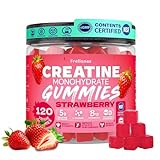
As an Amazon Associate, UsefulVitamins.com earns from qualifying purchases at no extra cost to you. We only recommend products supported by published research or third-party testing.
FAQ
Do creatine gummies actually contain 5 grams of creatine?
Some do, many don't. Independent HPLC testing by NOW Foods found only about half of the gummies tested met their label claim, with the rest showing creatine degraded to inactive creatinine. Buy only a gummy backed by recent third-party testing.
Are creatine gummies as effective as powder?
They can be, but only if the dose is intact. The molecule is identical, so a verified gummy holding a real 5 grams works the same as powder, while a degraded or underdosed gummy simply gives you less active creatine than the label promises.
Why do creatine gummies degrade?
Manufacturing exposes creatine to acid, heat, and liquid, and the cooking step alone can convert part of it to creatinine. Residual moisture in the finished gummy then keeps that slow conversion going on the shelf, so potency can drop over the life of the jar.
Are creatine gummies safe?
For healthy adults, creatine itself is well tolerated, and the creatinine in degraded gummies is inert rather than harmful, just useless. If you have kidney concerns, are pregnant, or are breastfeeding, clear any creatine product with your doctor first.
Should I choose creatine gummies or powder?
Powder wins on cost and reliability; gummies win only on convenience and taste. If you'll take powder consistently, it's the smarter buy at a fraction of the price with no degradation risk in the tub, so reserve gummies for cases where the chewable format is genuinely what gets you to take it daily.
Do creatine gummies need a loading phase?
No, and neither does powder. Loading with about 20 grams a day for five to seven days only saturates your muscles faster; a steady 5 grams a day reaches the same full stores in roughly three to four weeks with identical end results, per the ISSN position stand. Loading on gummies would also mean eating a lot of sugar, so a plain daily dose is the sensible route.
Are creatine gummies worth it for kids or travel?
For travel they shine: a sealed jar of chewables needs no scoop, no water, and no shaker, which is exactly the friction gummies are built to remove. For children, creatine is not a supplement to give without a pediatrician's guidance, and the dosing and safety questions there go well beyond format. For most adults the honest answer is that gummies are worth it only as a verified convenience purchase, not as a daily default.
Should women choose gummies?
The format question is the same regardless of sex: a verified dose works, an unverified one is a gamble. For dose, timing, and who benefits, see best creatine for women. If you want the cheaper, more reliable route, my best creatine monohydrate powder picks cover the verified tubs I trust.
The bottom line on creatine gummies
Creatine gummies are not a scam, but they are not a free lunch either. The format genuinely fights the chemistry, the testing data show nearly half of gummies fall short, and even the good ones cost a multiple of what powder does per 5 grams.
If a gummy is the only way you'll take creatine consistently, that's a legitimate reason to pay the premium, but spend it only on a product with recent third-party HPLC testing that proves a real 5 grams of monohydrate and minimal creatinine. The picks above are the ones that clear that bar.
For everyone else, the unglamorous answer holds: a cheap tub of plain creatine monohydrate powder delivers the same dose for a fraction of the price, scooped into water once a day. Powder's cheaper. Check the dose.
Reviewed by Sarah Thompson, Registered Dietitian, focused on vitamin and mineral nutrition. See more from Sarah Thompson. This article is educational and is not a substitute for individualized medical advice; talk to your doctor before starting a supplement, especially if you are pregnant, breastfeeding, or managing a kidney condition.
