
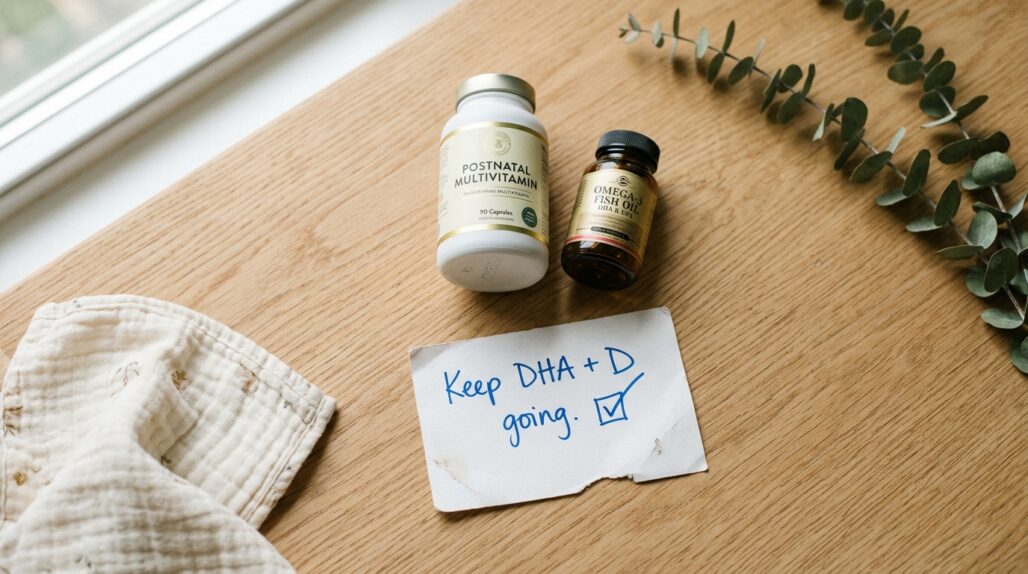
The postnatal vitamin aisle is newer than the prenatal one, and it exists mostly because someone realized you'd keep buying. The honest version is that the demands of the first postpartum year are real, but they don't all require a brand-new bottle with "postnatal" on the label. A good prenatal you already trust covers most of it.
This guide sorts the few nutrients that genuinely shift after birth from the marketing that surrounds them, so you spend on what moves the needle. The picks at the bottom are the ones I'd actually keep in my own family's cabinet, not the most expensive shelf.
Affiliate disclosure: this article contains affiliate links. As an Amazon Associate, UsefulVitamins.com earns from qualifying purchases at no extra cost to you.
Before you decide
This article is general education, not a prescription for your body. Your OB-GYN or midwife knows your delivery, your blood work, and your medical history, and your pediatrician owns your baby's nutrition plan. Run any supplement past them first.
A few situations change the calculus before you buy anything. If you had heavy postpartum bleeding, a known thyroid condition, prior bariatric surgery, or you follow a vegan or strict vegetarian diet, your needs are not "average" and deserve an individualized conversation.
The same is true for your baby. The American Academy of Pediatrics recommends that breastfed and partly breastfed infants get 400 IU of vitamin D daily as drops, starting in the first days of life, because breast milk alone is typically low in it. That is a separate decision from what you take, and it belongs to your pediatrician.
If none of that applies, the useful first question isn't "which postnatal," it's "what does my diet already cover." You can see how I weigh evidence and conflicts of interest on the how we review supplements page.
What postnatal and breastfeeding bodies actually need
There are two different jobs here, and conflating them is where most roundups go wrong. Recovering from birth and producing breast milk are not the same nutritional task.
Recovery leans on protein, fluids, fiber, and replacing what delivery depleted, which is mostly a food-and-rest story rather than a pill story. I cover that side separately in best supplements for postpartum recovery.
Lactation is where the dietary reference numbers actually move. Iodine jumps from 150 to 290 micrograms a day, choline rises, and DHA demand stays elevated because you're literally exporting it into milk.
Choline is the one almost nobody talks about. The adequate intake climbs to 550 milligrams a day during lactation, and most breastfeeding women fall well short of that, since the easy sources are eggs and organ meats that don't show up on every plate. It rarely makes the front of a label, so I treat it as a reason to keep eggs in rotation rather than to chase another pill.
For some nutrients, what you eat sets what your baby gets. Vitamin D, iodine, DHA, and B12 all pass into milk in amounts that track your own intake, which is why these few are the ones worth being deliberate about, as the CDC's guidance on maternal diet and breastfeeding lays out.
That "tracks your intake" point is the whole game. Iron and calcium are different: your milk holds its calcium fairly steady even when your own intake dips, pulling from your stores if it has to, so flooding yourself with a calcium pill doesn't enrich the milk the way an extra serving of fish raises its DHA. It's why the deliberate list stays short instead of covering every mineral on the panel.
As a dietitian, my framing is food first, gap second. A broad diet with fish, dairy or fortified alternatives, eggs, and iodized salt covers a surprising amount; a supplement earns its place where the diet falls short. The bottle is the patch, not the foundation, and the foundation is the part that also helps you sleep and heal.
What the research shows
Start with the two nutrients I'd protect first. DHA is the omega-3 your baby's brain and retina are built from, and your milk content reflects what you take in. A controlled-feeding trial in lactating women found that DHA supplementation raised both breast-milk and red-blood-cell DHA and shifted the infant's omega-6 to omega-3 ratio.
The dose-response there is the useful detail. Because your milk DHA rises in step with your own intake, the practical lever isn't a heroic dose but consistency: a steady couple hundred milligrams a day keeps the milk supply topped up far better than an occasional large one. Two servings of low-mercury fish a week does similar work; the softgel is for the weeks that doesn't happen.
Vitamin D is the other clear case. In a randomized trial, mothers taking 6,400 IU of vitamin D daily raised their own levels and supplied enough through milk to match giving the infant drops directly.
A later meta-analysis agreed that high-dose maternal vitamin D meaningfully lifts both mother and infant status, while noting that infant drops remain the simplest route at lower maternal doses. Either path is legitimate; the point is that vitamin D should not be coasting on diet alone. A standard prenatal's 400 to 600 IU keeps you steady but won't load enough into milk to skip the baby's drops, which is the trade-off that 6,400 IU figure is solving for, so don't reach for it casually without your clinician.
Iodine is the quietly important one for breastfeeding. The lactation RDA is 290 micrograms a day, roughly double the non-pregnant requirement, because iodine is concentrated into milk and drives both your thyroid and your infant's neurodevelopment, as a review of iodine and thyroid function in lactating women details. The catch is that this is one of the few nutrients where more is not safer: very high intakes can disturb the infant's thyroid as readily as too little, so the goal is hitting the number, not exceeding it.
B12 is conditional but serious. For mothers eating animal foods it's a non-issue, but in vegan or strict vegetarian diets, infant stores can run low and cause real neurological harm, documented in a case report of a breastfed infant of a strict-vegetarian mother. What makes it sneaky is timing: a baby is born with a reserve, so a marginal maternal B12 status can look fine for months and only surface as developmental regression once that reserve is spent, which is why a vegan mom's supplement is non-negotiable rather than precautionary.
Iron is the nutrient most over-recommended postpartum. Iron only helps if you're actually depleted, and universal postpartum screening has low yield in low-risk women; when there's reason to check, a review of postpartum anemia management notes that a ferritin under about 30 micrograms per liter signals early depletion worth treating. Heavy delivery bleeding, a twin pregnancy, or closely spaced births tip you toward checking; an uncomplicated birth with normal pregnancy labs usually doesn't.
Postpartum mood is where the supplement marketing gets ahead of the evidence. Omega-3s are sometimes pitched as a fix for the postpartum blues, but a meta-analysis of trials in perinatal women found only a small, inconsistent effect on depressive symptoms, strong enough that the authors would not prescribe it for prevention. Keep taking DHA for the milk-and-brain reasons above, but treat real mood changes as a conversation with your clinician, not a job for a fish-oil capsule.
What to look for when buying

You're really checking four things, and the label tells you most of them. A complete prenatal or postnatal that already covers these is usually a better buy than a flashy bottle that doesn't.
The table below is the shortlist I scan. Treat the first three as the priorities and iron as conditional.
| What to check | Target on the label | Why it matters |
|---|---|---|
| DHA omega-3 | ~200 to 300 mg DHA per day | Passes into milk; supports infant brain and eye development |
| Vitamin D | At least the prenatal’s usual dose; higher under guidance | Milk is low in it unless your intake is high |
| Iodine present | ~150 mcg in the multi (RDA 290 with diet) | Many multis skip it entirely; key for infant thyroid |
| Folate form | Methylfolate or folate, not just folic acid | A well-absorbed, gentler-on-some-guts form |
| Iron | Only if blood work shows depletion | Constipating and unnecessary if you’re not low |
| Third-party tested | USP, NSF, or equivalent seal | Independent check on identity and dose |
The iodine point deserves emphasis. A survey of best-selling US prenatal and adult multivitamins found a large share contained no iodine at all, so "it's in my prenatal" is an assumption worth verifying on the panel.
DHA is the other one to read carefully. Many multis bury a token amount of omega-3, so if the DHA line is missing or tiny, a separate fish-oil or algal-DHA softgel is the cleaner fix. Algal DHA is the plant-based route if you don't eat fish, and it delivers the same molecule, so vegan moms don't lose anything by skipping fish oil.
On the folate line, the form matters more than the number. Look for methylfolate (sometimes listed as 5-MTHF or L-methylfolate) or food folate rather than folic acid alone, because the methylated form is ready to use and doesn't depend on an enzyme step that a meaningful slice of people carry a less-efficient version of. It's a small upgrade, not a deal-breaker, but it costs you nothing to prefer it.
Third-party testing is the line I won't skip. A USP, NSF, or equivalent seal means an independent lab confirmed the bottle contains what the label claims and isn't carrying contaminants, which matters more for a fish-oil softgel than almost anything else, since oils can oxidize and concentrate ocean pollutants. Supplements aren't pre-approved before sale, so that seal is doing the verification the regulator doesn't.
Then there's the cost question that started this whole article. A dedicated "postnatal" bottle often costs more than the prenatal you already buy, and the premium frequently buys you a softer color and a new name rather than different nutrients, so the cheaper, smarter move is usually to finish or repurchase a complete prenatal and add a standalone DHA softgel only if its omega-3 line is thin. Run that comparison panel-to-panel before you pay for the upgrade.
Recommended Products

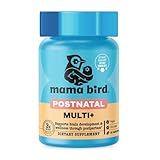
As an Amazon Associate, UsefulVitamins.com earns from qualifying purchases at no extra cost to you. We only recommend products supported by published research or third-party testing.
FAQ
Can I just keep taking my prenatal while breastfeeding?
For most moms, yes, that's a perfectly reasonable default. Both ACOG and CDC guidance support continuing a prenatal multivitamin during lactation. The main caveats are confirming it contains iodine and adequate DHA, since those are the two lactation demands a prenatal most often under-delivers.
Do I really need a dedicated "postnatal" vitamin?
Usually not. A complete prenatal covers most of the same ground, and the word "postnatal" on a label doesn't guarantee anything extra. Compare the actual nutrient panel rather than the marketing category, and see my best prenatal vitamins guide for what a complete one looks like.
Should I take iron postpartum just in case?
Not by default. Iron is constipating and offers little benefit if your stores are normal. Ask your doctor about a blood test for ferritin before assuming you're low, and treat a documented deficiency rather than guessing.
What if I'm vegan or vegetarian and breastfeeding?
This is the one situation where supplementation is less optional. Vitamin B12, DHA via algal oil, and often iron and iodine deserve a deliberate plan with your clinician, because plant-only diets can leave breast-milk levels of B12 and DHA low.
Does my baby still need vitamin D drops if I take vitamin D?
That's a question for your pediatrician. The standard recommendation is 400 IU of vitamin D daily for breastfed infants, and while a high maternal dose can supply enough through milk, the drops are the simplest, most reliable route and shouldn't be dropped on your own.
How long should I keep taking a postnatal or prenatal?
For as long as you're breastfeeding, the case for DHA, vitamin D, and iodine holds, so most moms keep going through weaning. Once you've stopped nursing, you no longer need the lactation-specific extras and can step back to a regular multivitamin if your diet has gaps, or to nothing in particular if it doesn't. There's no fixed end date; the breastfeeding window is the thing driving the timeline.
Do I need a postnatal vitamin if I'm formula feeding or not breastfeeding?
Most of the lactation-specific reasons disappear once you're not producing milk, since the elevated DHA, iodine, and vitamin D needs are about what passes into milk. What remains is ordinary postpartum recovery: a balanced diet, and iron only if blood work shows you're low after delivery. A standard multivitamin is plenty for most formula-feeding moms, and a dedicated postnatal isn't doing much extra.
Will a postnatal vitamin stop my postpartum hair loss?
Almost certainly not, and that's worth saying plainly. Postpartum shedding is hormonal, the lag effect of estrogen dropping after birth, and it's self-limiting, usually peaking around three to four months and recovering by six to twelve. No vitamin changes that timeline. The exception is if blood work turns up genuine iron or thyroid issues, which your doctor can check; chasing biotin gummies for normal postpartum shedding mostly buys you patience you'd have had anyway.
The bottom line on postnatal vitamins
Postnatal vitamins aren't a scam, but the category oversells itself. The truthful summary is that a good, complete prenatal you already tolerate is a fine foundation, and the nutrients worth being deliberate about are DHA, vitamin D, and iodine while you're breastfeeding.
Read the panel for those three, add iron only when blood work shows you need it, and give your vegan or vegetarian diet the B12 and DHA attention it specifically requires.
Spend on the nutrients with evidence behind them and on third-party testing, not on a relabeled bottle. Then route the decisions that touch your baby, vitamin D drops, any high-dose plan, through your pediatrician and OB.
Reviewed by Sarah Thompson, Registered Dietitian, focused on vitamin and mineral nutrition. See more from Sarah Thompson. This article is educational and is not a substitute for individualized medical advice; talk to your OB-GYN, midwife, or pediatrician before starting or changing a supplement, especially while breastfeeding.
