
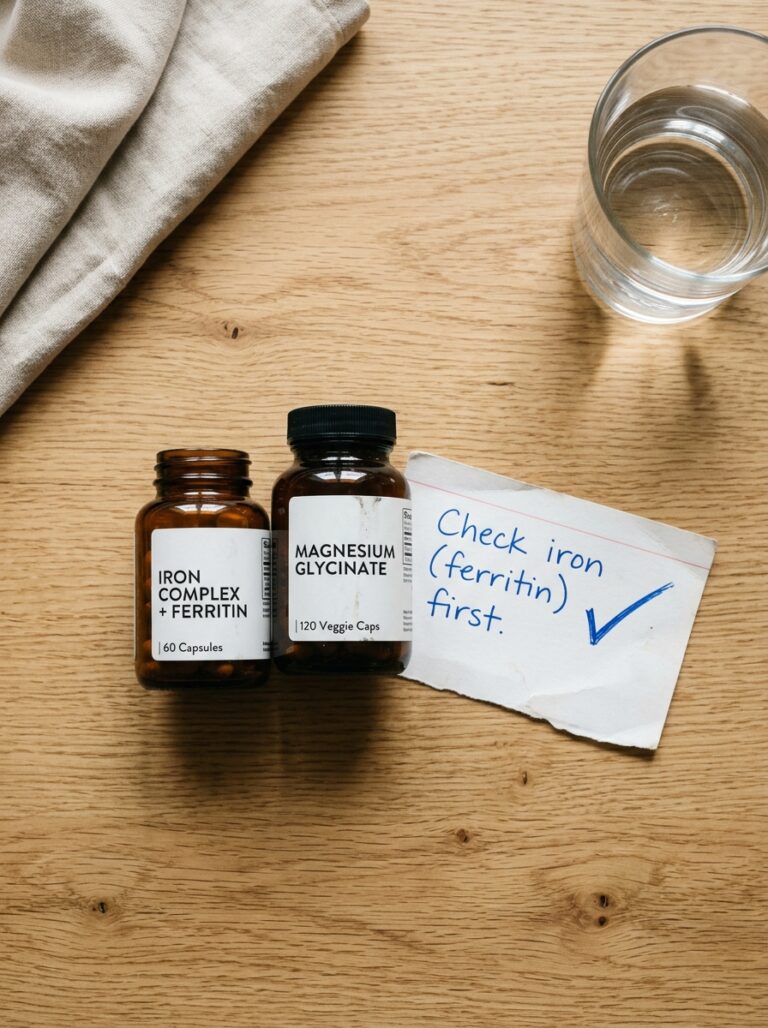
Type "best supplements for restless legs" into a search bar and the top results almost all lead with magnesium. That's the wrong place to start. The single highest-yield move for restless legs is not a supplement you buy on a hunch, it's a blood test you ask your doctor for first.
This guide does what most RLS roundups skip: it puts the ferritin test ahead of the magnesium bottle, because the one nutrient with real trial support only helps the people whose lab work says it should. The products I'd actually keep in my own family's cabinet for this are at the bottom, but the lab slip comes before any of them.
Affiliate disclosure: this article contains affiliate links. As an Amazon Associate, UsefulVitamins.com earns from qualifying purchases at no extra cost to you.
Before you decide
Some people should not self-treat restless legs at all, and some common medicines make it worse. If your symptoms are severe, disrupting sleep most nights, or new in pregnancy or kidney disease, that's a clinician conversation, not a supplement experiment.
Before adding anything, the first step is a blood test. Ask your doctor for iron studies, specifically serum ferritin and transferrin saturation, because that number decides whether iron is your lever or a waste of time.
It's also worth auditing your medicine cabinet. According to the National Institute of Neurological Disorders and Stroke, several common drugs can trigger or worsen RLS, including sedating antihistamines like diphenhydramine, many antidepressants, anti-nausea drugs, and dopamine-blocking medications.
Do not stop a prescribed medication on your own. But if your restless legs started or worsened after a new drug, that's the kind of thing to flag, because a culprit medication can undo any supplement you add. You can see how I weigh evidence and conflicts of interest on the how we review supplements page.
What restless legs actually is

Restless legs syndrome, also called Willis-Ekbom disease, is an urge to move the legs, usually with an uncomfortable crawling or aching sensation, that comes on at rest and eases with movement. It's worst in the evening and at night, which is why it wrecks sleep.
The mechanism is more interesting than "a magnesium deficiency," which is the folk explanation. The leading model is a brain iron and dopamine problem. Neuroimaging and autopsy work summarized in a review of brain iron homeostasis in RLS consistently shows reduced iron in regions like the substantia nigra, even when blood iron looks normal.
That regional iron shortfall appears to disturb the dopamine system. A synthesis of iron, dopamine, and genetics in RLS describes how brain iron deficiency drives a state of relative dopamine dysregulation, which is why both iron repletion and dopamine drugs can help.
The severity range is wide. Some people have occasional evening fidgetiness; others have nightly symptoms that destroy sleep and need prescription treatment. First-line drug therapy in modern guidelines has shifted toward alpha-2-delta agents such as gabapentin, with iron correction as a foundational step. Supplements sit on top of that standard of care, not in place of it.
The strongest evidence supplement: iron (when ferritin is low)
Here is the part most roundups bury: iron is the only supplement for restless legs with both a clear mechanism and guideline backing, and it works specifically by addressing the brain iron deficiency at the root of the disorder. It is the real lever.
But it is conditional. Iron helps the people whose iron stores are low; in everyone else, the trials are unconvincing and the side effects are real. This is exactly why the ferritin test comes first.
What the trials show. A systematic review and meta-analysis of iron supplementation for RLS pooled ten trials and found iron produced a significant drop in symptom severity (about 3.6 points on the IRLS scale) and roughly doubled the likelihood of meaningful improvement. The cleanest single trial, a double-blind study of oral iron in patients with low-normal ferritin, saw IRLS scores fall about 10 points on iron versus barely 1 on placebo over 12 weeks.
The guideline target. The American Academy of Sleep Medicine clinical practice guideline recommends checking iron studies in everyone with significant RLS and considering iron when serum ferritin is low. A widely used threshold is ferritin at or below about 75 mcg/L, higher than the cutoff for ordinary anemia, because the goal is brain iron, not just red blood cells.
Dose and form. A common oral regimen used in the literature is ferrous sulfate 325 mg taken with about 100 mg of vitamin C to aid absorption, often every other day, for roughly 12 weeks, then a recheck of ferritin. Take it away from coffee, tea, and calcium.
Skip it if your ferritin is normal or high. Routine iron in someone who isn't iron-deficient adds no clear benefit and a real risk of constipation, GI upset, and, in conditions like hemochromatosis, dangerous iron overload. The same meta-analysis flagged a higher rate of (mostly mild) adverse events. For the underlying nutrient, see the complete guide to iron.
Magnesium and the rest

Magnesium is the supplement everyone reaches for, and its evidence for restless legs is real but weak, not the slam dunk the marketing implies. That's a defensible verdict, not dismissiveness.
The best human data is modest. A randomized trial of magnesium plus vitamin B6 in RLS gave 75 patients 250 mg of magnesium oxide daily and found improved symptom severity and sleep quality by the second month, but it was single-blind, used a form with poor absorption, and was rated at meaningful risk of bias. That is a hint, not proof.
Worth a try if your magnesium intake is genuinely low, which is common, since plenty of adults fall short of the recommended intake. The downside is small: a well-absorbed form like glycinate in the evening is low-risk, and the worst likely outcome is loose stools from too high a dose.
Just don't expect magnesium to do what iron repletion does in a deficient patient. If your interest is overlapping nighttime leg symptoms, note that cramps and RLS are different problems even though people conflate them; I cover the cramp side in best magnesium for muscle cramps, and the mineral itself in the complete guide to magnesium.
Vitamin D is the other reasonable second-tier candidate. A small randomized trial of vitamin D replacement in RLS reported reduced symptom severity, but specifically in patients who were vitamin D deficient to begin with. The pattern is the same as iron: correct a measured deficiency, don't supplement blindly.
Popular but evidence-thin
A handful of supplements are heavily marketed for restless legs with little behind them. Treating them honestly is part of not selling you everything.
Folate, vitamin B12, vitamin E, and various "leg health" blends circulate widely in RLS forums and brand copy. The systematic-review literature on dietary supplements in RLS finds most of these rest on tiny studies, special populations like dialysis patients, or no controlled human data at all. If you have a documented B12 or folate deficiency, correct it for that reason; otherwise, the RLS-specific case is thin.
Topical magnesium sprays and "RLS relief" proprietary formulas deserve particular skepticism. There's no good evidence transdermal magnesium meaningfully raises body magnesium, and proprietary blends hide doses you can't evaluate. If you want to test one, give it a few weeks with realistic expectations, but spend your effort on the ferritin check first.
What to look for, plus lifestyle
When you do buy, keep it simple. For iron, choose a clearly labeled elemental-iron amount in a standard form (ferrous sulfate, gluconate, or bisglycinate) and pair it with vitamin C; for magnesium, prefer glycinate or citrate over oxide for absorption.
Look for third-party testing such as USP Verified or NSF, and skip anything that hides doses inside a proprietary blend or makes "cure" claims. A serious product states the dose per serving you can match to the literature.
Lifestyle matters more than the supplement aisle admits. Regular moderate exercise, consistent sleep timing, and cutting evening alcohol, nicotine, and caffeine all reduce RLS for many people, and they cost nothing. A warm bath or leg stretching before bed helps some. None of this is a cure, but it's the low-risk base layer under any supplement.
When to see a doctor
Restless legs can be a nuisance or a serious sleep-destroying disorder, and a few signals mean stop self-treating and get evaluated.
See a clinician if your symptoms occur most nights and ruin your sleep, if they're spreading to your arms or getting steadily worse, or if they appear during pregnancy or alongside kidney disease, where the workup and treatment differ.
You also need a doctor to order and interpret the ferritin and iron studies that should drive your whole plan, and to review whether a medication you take is the real trigger. If you've already tried supplements for several weeks without relief, that's your cue: persistent RLS has prescription treatments that work, and dragging out a supplement experiment just delays them. None of this is a cure claim. Supplements support a condition that often needs medical management.
FAQ
Should I take magnesium or iron for restless legs?
Check your ferritin first, then decide. If your iron stores are low, iron is the higher-yield choice and the one with guideline support. If your ferritin is normal, iron won't help and magnesium becomes a reasonable low-risk experiment, especially if your dietary magnesium is poor.
What ferritin level is "low" for restless legs?
Higher than you'd think. The AASM guideline supports considering iron when serum ferritin is roughly at or below 75 mcg/L, well above the threshold for diagnosing anemia, because the target is brain iron. Your doctor interprets it alongside transferrin saturation.
How long until iron helps restless legs?
Give it about 12 weeks. That's the timeframe used in the better oral-iron trials, after which ferritin is rechecked. Iron repletion is slow, so judging it after a week or two is premature.
Can supplements cure restless legs?
No. Correcting low iron can substantially reduce symptoms, and magnesium or vitamin D may help in deficient people, but RLS is a chronic neurological condition managed, not cured. Persistent or severe cases need medical treatment.
Can a supplement make restless legs worse?
Indirectly, yes. Sedating antihistamines like diphenhydramine, sold in many over-the-counter sleep aids, can worsen RLS, so an OTC "PM" product you bought for sleep may be part of the problem rather than the solution.
The bottom line on restless legs supplements
For restless legs, the honest hierarchy is short. Iron is the one supplement with a real mechanism and guideline backing, but it only helps when your ferritin is low, which is why the blood test comes before the bottle. Magnesium and vitamin D are low-risk and worth a trial mainly when your own levels are poor, and most of the rest is marketing.
The realistic effect size, even for iron in the right patient, is meaningful but not curative, and supplements sit on top of standard care rather than replacing it.
Next steps:
- Ask your doctor for iron studies (ferritin + transferrin saturation) before buying anything.
- Audit your medicine cabinet for RLS-aggravating drugs, especially sedating antihistamines, with your clinician.
- If symptoms are nightly, worsening, or wrecking your sleep, see a clinician; review the complete guide to iron to understand the nutrient driving the plan.
Recommended Products


As an Amazon Associate, UsefulVitamins.com earns from qualifying purchases at no extra cost to you. We only recommend products supported by published research or third-party testing.
Reviewed by Michael Ward, MD MPH, Preventive Medicine, focused on guideline-based chronic disease management. See more from Michael Ward. This article is educational and is not a substitute for individualized medical advice; talk to your doctor before starting a supplement, especially if you are pregnant, have kidney disease, or take prescription medication.
