
Affiliate disclosure: this article contains affiliate links. As an Amazon Associate, UsefulVitamins.com earns from qualifying purchases at no extra cost to you.
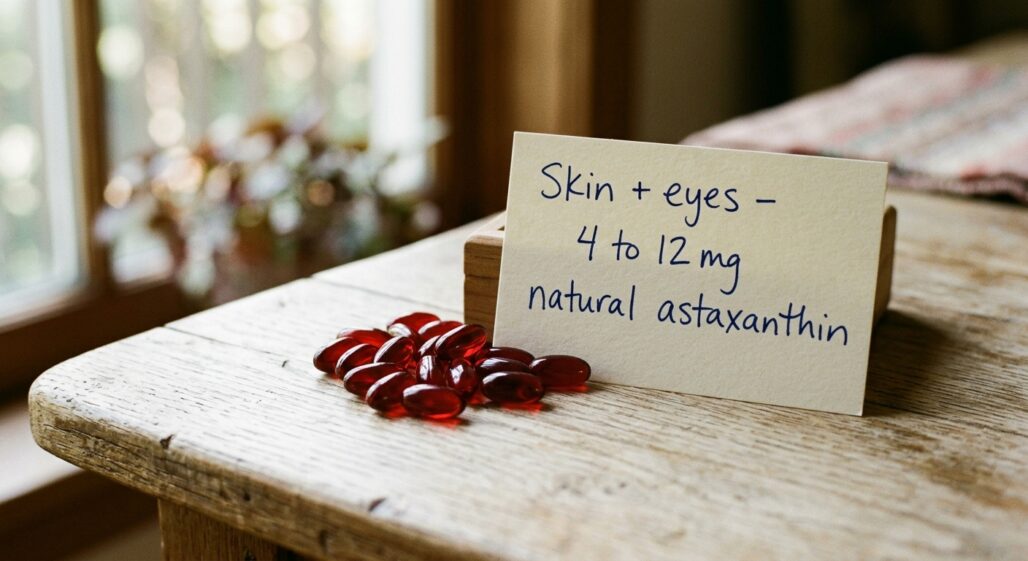
If you are searching for the best astaxanthin supplements, you have probably seen it called the strongest antioxidant in nature and want to know whether that hype survives contact with the actual trials. The short answer: for skin elasticity and screen-related eye fatigue, the evidence is modest but real at 4 to 12 mg a day, and the form you buy matters more than the brand name. The picks below are the ones I would put in my own family's supplement cabinet, and this article walks through what astaxanthin is, what the skin and eye studies honestly show, the dose that matches the trials, and why natural beats synthetic.
A quick note on framing before the picks. I am a dietitian, so I think in food first. Astaxanthin is the pigment that makes salmon, trout, and shrimp pink, and a few servings of wild salmon a week deliver a meaningful amount. The supplement earns its place when your diet does not, or when you want a consistent daily dose for a specific goal like reducing eye strain.
Before you decide
A few honest caveats first, because most roundups skip them.
Buy natural astaxanthin from the microalga Haematococcus pluvialis, not synthetic astaxanthin made from petrochemicals. The two are not interchangeable. Natural astaxanthin is a single stereoisomer (3S,3'S) bound to fatty acids, while synthetic is a roughly 1:2:1 mix of three isomers, and a 2022 review by Snell and Carberry describes how the natural esterified form inserts into cell membranes far more effectively than the free synthetic isomers.
Take it with fat. Astaxanthin is fat-soluble, so swallowing a softgel on an empty stomach wastes much of the dose. A meal with some olive oil, avocado, eggs, or fish meaningfully improves absorption.
The effect is modest, not dramatic. This is a fine-print antioxidant, not a face-lift in a capsule. People expecting a visible transformation in two weeks will be disappointed; people who give it 8 to 12 weeks for skin elasticity or a few weeks for eye fatigue are matching what the trials actually measured.
Some people will not notice much at all. If you already eat oily fish several times a week, or your concern is deep static wrinkles rather than elasticity and hydration, the marginal benefit is small.
At very high doses your palms or skin may take on a faint reddish tint. It is harmless and reverses when you stop, the same way heavy carrot or beta-carotene intake can. Children should not take supplemental astaxanthin at adult doses, as I cover in the safety section. Ask your doctor first if you take medication or are pregnant or nursing.
What astaxanthin actually is
Astaxanthin is a carotenoid, the same pigment family as beta-carotene and lutein. Unlike most antioxidants that work in one compartment of the cell, astaxanthin physically spans the entire width of the cell membrane, with its two polar rings anchored at each surface and a long chain bridging the fatty interior.
That geometry is the whole story. A 2011 review by Parris Kidd explains how this polar-nonpolar-polar layout lets astaxanthin neutralize free radicals at both membrane surfaces and inside the fatty core at once, while it accepts or donates electrons without becoming a damaging radical itself.
In plain terms, it parks where a lot of oxidative damage happens, in the lipid layer, and intercepts it there. That membrane position is why astaxanthin shows up in skin and eye research rather than as a general "feel better" pill. Skin and the retina are both tissues with a lot of membrane surface and a lot of light-driven oxidative stress, which is exactly the environment astaxanthin is built for.
The skin evidence, honestly
This is where you need a clear head, because marketing rounds the evidence up and I am going to round it to the actual numbers.
The strongest single study is a 2012 trial by Tominaga and colleagues, which gave 36 healthy men 6 mg of astaxanthin a day for 6 weeks and saw improvements in crow's-feet wrinkles, skin elasticity, and a positive trend in moisture. A companion arm in women using 6 mg orally for 8 weeks showed similar elasticity and moisture gains.
The honest read comes from pooling the studies. A 2021 systematic review and meta-analysis by Zhou and colleagues combined 8 randomized controlled trials across a 2 to 12 mg daily range. Skin elasticity improved significantly and moisture improved significantly, but wrinkle reduction did not reach statistical significance when the trials were pooled.
That split is the part most articles bury. Astaxanthin has decent support for the things you feel and measure as suppleness and hydration, and weak support for erasing lines you can see in the mirror.
The same review is candid about its limits: small samples, mostly Japanese female participants, and several trials funded by industry. Treat astaxanthin as a reasonable adjunct for skin texture and resilience, not a wrinkle eraser. If wrinkles are your main concern, sunscreen, retinoids, and collagen have more direct evidence, and you can compare those in our guide to the best supplements for skin health.
The eye-fatigue evidence
The eye research is arguably more practical for daily life, because almost everyone stares at screens.
Astaxanthin concentrates in the eye and has been studied for the ciliary muscle that focuses your lens. A 2020 review by Giannaccare and colleagues summarizes trials in visual display terminal workers where astaxanthin in the 4 to 12 mg range produced significant relief from eyestrain versus placebo, along with improvements in accommodation timing.
A more recent 2022 randomized controlled trial by Sekikawa and colleagues tested 9 mg a day for 6 weeks and found better corrected visual acuity after screen work in adults over 40, though it did not move every measure it tracked.
If your goal is fewer tired, dry, hard-to-focus eyes after a long day at a monitor, this is astaxanthin's best-supported use case. The effect is supportive rather than corrective, so keep it alongside basic eye hygiene like screen breaks. For the bigger antioxidant and omega-3 picture for eyes, our complete guide to omega-3 covers the fatty-acid side that pairs well with carotenoids.
The dose that matches the trials
Here is the dose math, dietitian style.
Almost every meaningful human trial used somewhere between 4 and 12 mg a day. The skin studies clustered at 6 mg, the eye studies ran 6 to 9 mg, and 12 mg appears at the upper end without obvious extra benefit for most outcomes.
Wild salmon delivers roughly 0.5 to 1 mg of astaxanthin per serving, so even a fish-heavy diet rarely reaches the supplemented range every day. That gap is the honest reason a supplement exists here: a 4 to 6 mg softgel closes the distance between a good diet and the trial dose without overshooting.
There is a difference between the dose that does something in a study and the dose that just stacks up unused. More is not better once you are inside the studied range. Start at 4 to 6 mg with a fatty meal, and only consider 12 mg if eye fatigue is your specific target.
Natural vs synthetic, the part that decides quality
This is the single most important buying decision, and it is invisible on the front of the bottle.
Natural astaxanthin from Haematococcus pluvialis is the 3S,3'S stereoisomer, attached to fatty acids (esterified), which is the form your body and the trials used. Synthetic astaxanthin, made from petrochemicals for fish and shrimp farming, is an unesterified mix of three stereoisomers in roughly 1:2:1 proportions.
The Snell and Carberry review describes how the natural esterified molecule orients correctly in the lipid membrane and reaches high bioavailability, while the synthetic isomers float more freely with lower bioactivity. The human skin and eye trials above used natural algal astaxanthin, so that is the form whose results you are actually buying.
Practical rule: if the label does not say Haematococcus pluvialis or algal source, assume synthetic and skip it. A recognized branded ingredient such as AstaReal is a useful shortcut, because it is the algal material used in much of the published research.
What to look for when buying
A short checklist to separate a real product from a pretty label.
Confirm the actual milligrams of astaxanthin, not the milligrams of oleoresin or extract. Bottles sometimes advertise a big number that refers to the algae oil, while the real astaxanthin content is a fraction of it. The supplement-facts panel must list astaxanthin in mg.
Source matters: look for "natural astaxanthin from Haematococcus pluvialis" or a named algal ingredient like AstaReal. This is the one spec that decides whether you are buying the studied molecule.
It should be a softgel in oil, taken with fat. Astaxanthin in a dry tablet without fat absorbs poorly; an oil-based softgel swallowed with a meal is the format the trials used.
Prefer third-party tested products with USP, NSF, or an independent assay, and skip proprietary blends that hide the per-ingredient dose. For how we weigh testing and sourcing across categories, see how we review supplements.
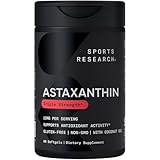
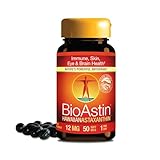

As an Amazon Associate, UsefulVitamins.com earns from qualifying purchases at no extra cost to you. We only recommend products supported by published research or third-party testing.
Who should skip astaxanthin
Astaxanthin is well tolerated, but it is not for everyone, and the safety picture is specific.
The European Food Safety Authority concluded in a 2020 safety opinion that up to 8 mg a day from supplements is safe for adults, based on an acceptable daily intake of 0.2 mg per kilogram of body weight. The same assessment flagged that children under 14 can exceed that intake at adult supplement doses, so astaxanthin is an adult supplement.
Skip it, or check with your doctor first, if you are pregnant or nursing, since dedicated safety data in pregnancy is thin. Ask about a blood test or a medication review before adding any new daily supplement if you take prescription drugs, particularly blood-pressure or hormone medication, because astaxanthin can have mild blood-pressure-lowering effects in some studies.
And if your diet already includes wild salmon or trout several times a week, you may be close enough to the studied intake that a supplement adds little. Food first, supplement second.
FAQ
How long until astaxanthin works?
For eye fatigue, the trials ran 4 to 6 weeks. For skin elasticity and moisture, give it 8 to 12 weeks, since that is the window the skin meta-analysis measured. It is a slow, cumulative antioxidant, not an overnight effect.
Is astaxanthin better than other antioxidants for skin?
It has a specific edge for elasticity and moisture because of where it sits in cell membranes, but it is not a replacement for the basics. Sunscreen and a balanced diet do more for long-term skin than any single antioxidant capsule.
Can I take astaxanthin with other supplements?
Yes, it pairs naturally with fat-soluble nutrients and omega-3s, and is commonly stacked with lutein for eyes. If you are building a broader antioxidant routine, our complete guide to longevity supplements puts it in context.
Will astaxanthin turn my skin orange?
Only at high or prolonged intake, and the faint reddish tint is harmless and reversible, the same as heavy carotenoid intake from carrots. At 4 to 12 mg a day it is uncommon.
Natural or synthetic, does it really matter?
Yes. The published human benefits used natural algal astaxanthin. Synthetic is cheaper and made for animal feed, with a different isomer profile and lower bioactivity. Buy natural.
Conclusion
Astaxanthin is one of the more honestly supported antioxidant supplements you can buy, with the strongest evidence for skin elasticity and moisture and for reducing screen-related eye fatigue, both in the 4 to 12 mg daily range. It is a modest, cumulative benefit, not a dramatic one, and the form you choose decides whether you get the studied effect at all. What sets this verdict apart from most roundups is the combination most of them skip: insist on natural 3S,3'S astaxanthin from Haematococcus pluvialis, always take it with fat, and read the meta-analysis honestly as elasticity-and-moisture yes, wrinkles no.
Next steps:
- Pick a natural Haematococcus pluvialis softgel at 4 to 6 mg and take it with a fatty meal.
- Give it 8 to 12 weeks for skin or 4 to 6 weeks for eye fatigue before judging results.
- If you want to build a fuller routine, read more from Sarah Thompson, RD on matching supplements to real dietary gaps.
Reviewed by Sarah Thompson, Registered Dietitian, focused on vitamin and mineral nutrition.
This article is for informational purposes and not medical advice. Supplements can interact with medications and health conditions. Consult a licensed physician before starting any supplement, particularly if you are pregnant, nursing, taking prescription medications, or managing a chronic condition.
