
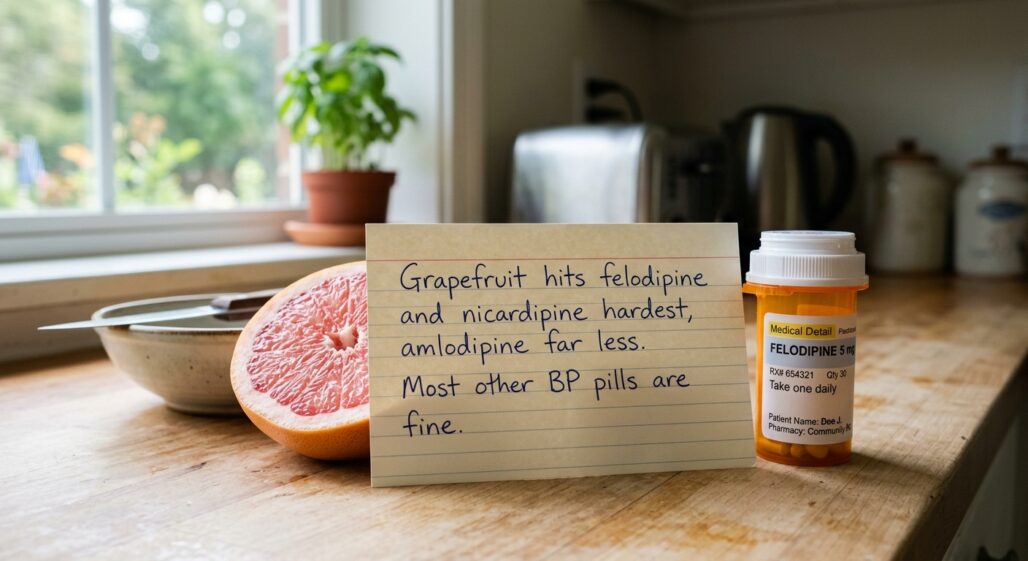
If you are searching for the truth about grapefruit and blood pressure medication, you are probably either newly prescribed a pill and reading the leaflet, or you have eaten grapefruit for years and just noticed the warning. The short answer: for most people the risk is real but narrow, concentrated in a few calcium channel blockers, and easy to manage once you know which drug you take. This article walks through the mechanism, how big the effect actually is in the trial data, what to do, and when to call your clinician.
One framing first. The standard of care for high blood pressure is the medication your doctor prescribed plus the lifestyle changes that go with it. Grapefruit is a food question layered on top of that, not a reason to skip or change the drug.
Before you decide
This is general health information, not medical advice. Never stop, skip, or change the dose of a blood pressure medication on your own, and never start avoiding a food because of an article. Blood pressure control is the thing that lowers your stroke and heart attack risk, and an abrupt change can do more harm than a glass of juice.
The people who need to be most careful are those taking the calcium channel blockers that grapefruit affects strongly: felodipine, nicardipine, nifedipine, and nisoldipine. If your pill is one of those and you eat grapefruit regularly, that is the conversation to have with your pharmacist this week.
Call your doctor or pharmacist promptly if you notice new dizziness, flushing, headache, a racing heartbeat, or feeling faint when you stand, especially after grapefruit. Those can be signs your blood pressure has dropped too far. The real question is not "is grapefruit dangerous," it is "which drug am I on, and does grapefruit reach it."
What the interaction actually is
Grapefruit does not change your blood pressure directly. It changes how much of certain drugs survives the trip from your gut into your bloodstream. The mechanism is well mapped: compounds in grapefruit called furanocoumarins shut down an enzyme called CYP3A4 in the wall of your small intestine.
Normally that gut enzyme destroys a large fraction of some drugs before they ever reach circulation, a process called first-pass metabolism. When grapefruit knocks the enzyme out, more of the drug gets through, so blood levels climb as if you had taken a bigger dose. The classic review by Bailey and colleagues in the British Journal of Clinical Pharmacology established that this happens in the intestine, not the liver, which is why it hits drugs with heavy gut metabolism hardest.
Think of CYP3A4 as a toll booth that taxes drug molecules on the way in. Grapefruit lifts the gate. Drugs that paid a big toll suddenly flood through; drugs that barely used that booth are unaffected. That single fact explains why felodipine reacts strongly and many other blood pressure drugs do not.
This is also why the food matters more than the form. Fresh grapefruit, grapefruit juice, and even some grapefruit-containing juice blends carry the furanocoumarins. Lemons, oranges, and most other citrus do not act the same way, with Seville (bitter) oranges and pomelos being the notable exceptions worth asking your pharmacist about.
How big is the effect, in real numbers
Here is where the cited data matters, because the magnitude varies enormously by drug. The headline interaction is felodipine. In a randomized crossover study, Bailey's team in Clinical Pharmacology and Therapeutics found that felodipine blood exposure (AUC) was on average roughly 3-fold higher with grapefruit than with water. That is a large, clinically meaningful jump.
Nisoldipine is even more extreme. An earlier Bailey crossover trial reported peak concentrations rising to 406% and total exposure to 198% of the water value. Nifedipine sits lower: a study of a slow-release formulation in Pharmazie found the AUC rose about 103%, roughly doubling, with wide person-to-person variation.
Amlodipine, the most commonly prescribed pill in this class, is the reassuring outlier. In a controlled study in healthy volunteers, grapefruit juice produced no appreciable change in amlodipine levels: the AUC ratio was 107.8% (95% CI 99.7 to 116.5) and blood pressure changes were not significantly altered. Amlodipine has a long half-life and low first-pass metabolism, so it barely uses the booth grapefruit closes.
| Drug | Grapefruit effect on blood levels | Practical read |
|---|---|---|
| Felodipine | About 3x higher exposure | Strong interaction, avoid grapefruit |
| Nisoldipine | AUC to ~198%, peak to ~406% | Strong interaction, avoid grapefruit |
| Nicardipine | Increased exposure reported | Treat as a strong interactor |
| Nifedipine | AUC roughly doubled, variable | Moderate, be cautious |
| Amlodipine | No appreciable change in studies | Low concern, but watch symptoms |
| Losartan, lisinopril, hydrochlorothiazide, atenolol | Not CYP3A4 dependent | Generally fine with grapefruit |
The pattern is the point. Most blood pressure drug classes, ACE inhibitors like lisinopril, ARBs like losartan, thiazide diuretics, and beta-blockers like atenolol, do not run through gut CYP3A4 and are not meaningfully changed by grapefruit. The grapefruit problem lives mostly inside one slice of one drug class.
What to do, practically
If you take amlodipine, lisinopril, losartan, a thiazide, or a beta-blocker, the evidence says you can eat and drink fairly normally. The NHS notes for amlodipine that only large amounts of grapefruit may matter, and to tell your doctor if you get extra dizziness, flushing, or headaches.
If you take felodipine, nicardipine, nifedipine, or nisoldipine, the cleanest move is to avoid grapefruit and grapefruit juice entirely while on the drug. Spacing does not reliably rescue you here, and that surprises people.
Because grapefruit causes the gut enzyme to be rebuilt rather than just temporarily blocked, the effect lasts far longer than the juice sits in your stomach. Bailey's review documented that a single serving can suppress intestinal CYP3A4 for around 24 hours, and full recovery can take a few days. Taking your pill in the morning and your grapefruit at night does not separate them.
There is no safe "spacing window" that works the way it does for, say, calcium and certain antibiotics. The honest tradeoff: a daily grapefruit habit is the real hazard, while one accidental half-grapefruit on a strong interactor is a reason to watch for symptoms, not to panic.
A simple way to keep this straight without a pharmacology degree: read the actual drug name on your bottle, not the class. The interaction tracks the specific molecule, so "I take a blood pressure pill" is not enough information to know your risk.
Our companion app StackMyMed can help you log your exact medications and flag a grapefruit conflict before it bites, but it helps you spot and space, it does not replace your pharmacist.
Who is most at risk
Three groups should be most careful. First, anyone on felodipine, nicardipine, nifedipine, or nisoldipine, since those are the strong and moderate interactors. The same gut-enzyme effect also amplifies other unrelated CYP3A4 drugs, so people on several such medicines stack the risk.
Second, older adults. Blood pressure that drops too far raises the chance of dizziness and falls, and the felodipine interaction specifically increases the risk of an exaggerated drop. A fall from low blood pressure is a far bigger threat to an 80-year-old than to a 40-year-old.
Third, people with naturally high baseline gut CYP3A4 activity, who Bailey's group showed get the largest jumps in drug level. You cannot easily measure this about yourself, which is exactly why the conservative rule, avoid grapefruit on strong interactors, exists. For a wider map of which medicines react, our guide to grapefruit drug interactions covers the statins, immunosuppressants, and others beyond blood pressure.
When to see a clinician
Most of this is a quiet pharmacy conversation, not an emergency. But certain signals deserve a same-day call to your doctor or pharmacist: new or worsening dizziness, lightheadedness on standing, fainting, marked flushing, a pounding or racing heartbeat, or unusual swelling, particularly if they followed grapefruit.
Bring your actual pill bottles or a current list to that conversation. A pharmacist can confirm in seconds whether your specific medication is a CYP3A4 substrate, and our drug and supplement interaction checker is a useful first pass before you call. If you also take supplements alongside your blood pressure regimen, our overview of common drug and supplement interactions is worth a scan. Common pairings get their own deeper guides, such as taking ashwagandha with blood pressure medication and taking melatonin with blood pressure medication.
Do not use any of this to self-adjust. The supplement and food conversation is a layer on top of a treatment that is already doing the heavy lifting, not a substitute for it. If your pressure is well controlled on your current pill, the grapefruit question is about avoiding an unnecessary swing, not about second-guessing the prescription.
Frequently asked questions
Does grapefruit interact with amlodipine? Only weakly. Controlled studies found no appreciable change in amlodipine blood levels, though the NHS still advises watching for extra side effects with large amounts. It is far lower concern than felodipine.
Is grapefruit juice worse than the whole fruit? Both contain the active furanocoumarins. Whole grapefruit, fresh juice, and grapefruit-containing blends can all cause the interaction; the amount and frequency matter more than the form.
Can I just space my grapefruit hours away from my pill? No. The enzyme stays suppressed for roughly a day after a single serving, so timing tricks do not reliably prevent the felodipine interaction.
What about oranges, lemons, or pomelos? Standard sweet oranges and lemons do not cause this. Seville (bitter) oranges and pomelos can act like grapefruit, so mention them to your pharmacist.
Are ACE inhibitors and ARBs safe with grapefruit? Generally yes. Drugs like lisinopril and losartan are not cleared by gut CYP3A4, so grapefruit does not meaningfully change them.
Conclusion: the bottom line on grapefruit and blood pressure medication
The fear is broader than the fact. Grapefruit genuinely matters for a handful of calcium channel blockers, felodipine and nicardipine most, nisoldipine and nifedipine close behind, where it can push blood levels up several-fold and risk an exaggerated drop in pressure. For amlodipine, ACE inhibitors, ARBs, diuretics, and beta-blockers, the interaction is minor or absent. The deciding factor is the specific molecule on your bottle, not the words "blood pressure pill."
Next steps:
- Read the exact drug name on your bottle and check it against the strong-interactor list above.
- If it is felodipine, nicardipine, nifedipine, or nisoldipine, plan to avoid grapefruit and confirm with your pharmacist.
- Track your full regimen and surface conflicts early, and review related cautions like magnesium and blood pressure medication.
- Never stop or change a prescription on your own; bring questions to your doctor or pharmacist.
To understand how we weigh evidence for pieces like this, see how we review supplements and the credentials behind this article on the the UsefulVitamins Editorial Team.
Reviewed by the UsefulVitamins Editorial Team.
This article is for informational purposes and not medical advice. Grapefruit and other foods can interact with prescription medications. Consult a licensed physician or pharmacist before changing your diet or supplements, particularly if you take blood pressure medication, are pregnant or nursing, or manage a chronic condition. Never stop or adjust a prescription on your own.
