
Before you decide
This article is general information, not medical advice for your situation. Birth control and herbal products affect people differently, and your prescriber and pharmacist know your full history.
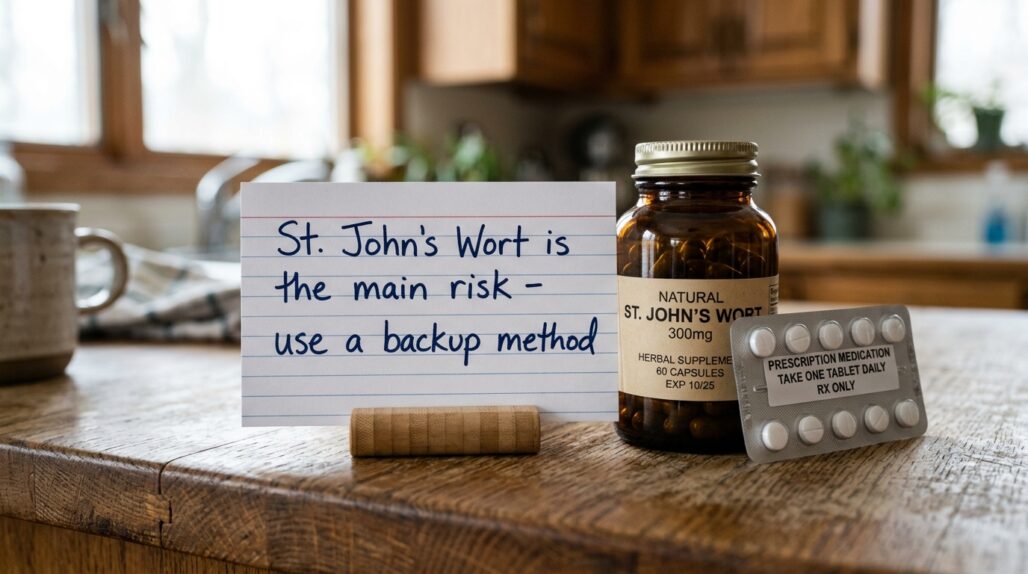
The honest answer surprises most people. The internet lists a dozen supplements that supposedly sabotage the pill, but when you trace the claims back to studies, almost all of them fall apart. The single supplement with solid evidence of reducing contraceptive efficacy is St. John's wort.
A few others sit in a gray zone of weak or theoretical concern. And one famous offender, high-dose vitamin C, was tested and cleared decades ago. The people at highest risk are those who take St. John's wort for mood and rely on a low-dose combined pill, the group where small drops in hormone levels matter most.
What St. John's wort actually does to the pill
St. John's wort (Hypericum perforatum) is sold for low mood and mild depression. Its main active compound, hyperforin, switches on a liver enzyme called CYP3A4 and a drug transporter called P-glycoprotein.
That matters because CYP3A4 is the same enzyme that clears the hormones in your birth control. Turn it up, and your body burns through the progestin and estrogen faster, so blood levels drop. The U.S. Food and Drug Administration classifies St. John's wort as a strong CYP3A4 inducer, the same category used for prescription drugs known to cause failures, as summarized in the systematic review of St. John's wort and hormonal contraceptives.
The national consumer guidance is blunt about it. The NCCIH page on St. John's wort lists "birth control pills" among the medicines it can weaken and warns that these interactions can undercut the drugs you depend on.
One detail trips people up. The enzyme effect takes about 10 to 14 days to build to full strength, and a similar stretch to fade after you stop. So the risk is not just the day you take it, and it does not vanish the moment you quit.

How big is the effect
This is where the evidence gets specific. In a randomized controlled trial of St. John's wort with a low-dose oral contraceptive, the exposure to the active progestin metabolite (3-ketodesogestrel) fell by roughly 42 to 44 percent when women added St. John's wort.
Breakthrough bleeding climbed in step with that drop. In the control cycle on the pill alone, about 35 percent of women had intracyclic bleeding. On St. John's wort, that jumped to 77 to 88 percent depending on the dose.
Other trials line up. The systematic review found three of four studies showed reduced contraceptive hormone exposure, and three of four showed significantly more breakthrough bleeding, including one trial where bleeding rose from 17 percent to 58 percent. Researchers also reported signs of follicle growth and probable ovulation in some participants, which is the mechanical step that can lead to pregnancy.
Real-world reports back this up. National pharmacovigilance systems in the UK and Sweden logged unplanned pregnancies attributed to St. John's wort taken alongside oral contraceptives. The effect is not theoretical.
A useful mental model: breakthrough bleeding is the smoke alarm. It signals hormone levels have dropped, and where levels drop, protection can slip.
The supplements people worry about but mostly should not
Plenty of supplements get blamed without evidence. Sorting them by real risk keeps you focused on what counts.
Vitamin C is the classic false alarm. A small 1970s-era idea suggested high-dose vitamin C might compete for the same metabolic pathway as ethinylestradiol and push estrogen levels up. It sounded plausible, so it spread. Then it was tested directly. A controlled trial, indexed as the study on high vitamin C dosage and ethinylestradiol availability, found no meaningful change and concluded vitamin C can be removed from the list of drugs that interfere with the pill. We cover this in depth in our piece on vitamin C and birth control.
Magnesium does not reduce effectiveness either. There is no evidence that magnesium lowers contraceptive protection. The relationship actually runs the other way, since the pill may modestly lower your magnesium. Our article on magnesium and birth control walks through both directions.
A handful of herbs carry weak or theoretical concern based on enzyme activity rather than human contraceptive data:
- Other enzyme-inducing botanicals studied in lab or limited human work, which have not been shown to cause contraceptive failure but warrant a mention to your prescriber.
- High doses of certain herbal extracts marketed for energy or detox, where quality and dosing vary widely between brands.
The practical rule: if a botanical is a known liver enzyme inducer, treat it like St. John's wort until proven otherwise, and ask your pharmacist.
Charcoal, fiber, and the timing trap
A different kind of interference is worth knowing because it is about absorption, not enzymes. Activated charcoal binds drugs in the gut and can blunt how much you absorb.
Per the StatPearls overview of activated charcoal, it adsorbs a broad range of oral medications. Standard consumer guidance is to separate it from other drugs by giving charcoal at least one hour before or two hours after them. Taken close to your pill, charcoal could in theory reduce how much hormone reaches your bloodstream.
High-dose soluble fiber supplements raise a milder version of the same timing concern. The fix is simple spacing, not avoidance.
- Take your pill at a consistent time away from activated charcoal.
- Separate charcoal by at least 2 hours from your contraceptive dose if you use it at all.
- Treat large fiber doses the same way and keep them apart from the pill.
For prescription enzyme inducers, the stakes are higher. The CDC US Medical Eligibility Criteria note that strong inducers like rifampin can cut hormone exposure by more than half and call for a backup or non-hormonal method. St. John's wort sits in the same mechanistic family, which is why clinicians treat it seriously.
What to do if you take St. John's wort
You have options, and none of them require panic. The goal is to keep your protection intact while you and your prescriber decide on the plan.
Use a backup method. If you are taking St. John's wort and a hormonal method, add condoms for the whole time you take it. Because enzyme induction lingers, keep the backup going for at least two weeks after you stop, and ask your prescriber whether longer makes sense.
Consider a method that bypasses the interaction. Copper IUDs work without hormones and are not affected by enzyme inducers. That is a conversation for your clinician, not a switch to make alone.
Be honest about the depression question. If you are using St. John's wort for low mood, the better move is often a proper evaluation rather than self-treating. Our overview of supplements for depression can help frame that talk, and our deep dive on St. John's wort birth control failure covers the case reports in detail.
Tracking what you take makes these conversations sharper. A free app like StackMyMed lets you log your supplements and prescriptions in one place so you can flag a possible interaction to a pharmacist. It is a prompt for a clinical conversation, not a substitute for one.
You can also pre-screen a combination with our drug-supplement interaction checker, then read the wider context in our guide to drug-supplement interactions. Our standards for vetting this material are explained in how we review supplements.

When to see a clinician
Some signs deserve more than a note to self. Breakthrough bleeding while on a steady pill routine is a flag that hormone levels may have dropped, especially if you recently started an herbal product.
Reach out promptly if you notice:
- A missed period or a positive or uncertain pregnancy test while on birth control.
- Unexpected spotting that started after you began St. John's wort or another supplement.
- Any plan to start a new herbal product while you rely on the pill, patch, ring, or implant.
If you think your contraception may have failed, contact your clinician or a pharmacist quickly. They can advise on emergency contraception and on whether a different method fits you better.
FAQ
Does vitamin C reduce birth control effectiveness? No. The old theory that high-dose vitamin C raises and then disrupts estrogen levels was tested directly and did not hold up, so vitamin C is not considered a contraceptive risk.
Is St. John’s wort really that risky with the pill? Yes, more than any other common supplement. It speeds hormone breakdown through CYP3A4, lowers progestin levels by roughly 40 percent in studies, and is linked to breakthrough bleeding and reported pregnancies.
How long after stopping St. John’s wort am I protected again? The enzyme effect takes about 10 to 14 days to fade, so keep a backup method for at least two weeks after stopping and confirm the timing with your prescriber.
Does magnesium or a B-complex weaken my birth control? There is no evidence that magnesium, B vitamins, vitamin D, or a standard multivitamin reduce contraceptive effectiveness. The pill may actually lower some of these nutrients, which is why many people review the best supplements for birth control users.
Can activated charcoal affect my pill? Possibly, by binding the hormones in your gut. Separate activated charcoal from your contraceptive by at least two hours, and treat large fiber doses the same way.
What should I do before starting any new supplement on the pill? Run the combination by your pharmacist or prescriber, and log your stack so nothing slips through unnoticed. Most supplements are fine, but enzyme-inducing herbs are the exception to check.
Conclusion: one supplement, not a long list
Strip away the noise and the picture is reassuring. St. John's wort is the supplement that genuinely makes birth control less effective, through a well-documented enzyme effect that lowers hormone levels and raises pregnancy risk.
Vitamin C and magnesium do not belong on the danger list, and activated charcoal is a timing issue you can manage with simple spacing. If you take St. John's wort, use a backup method, keep it going for about two weeks after you stop, and bring the whole stack to your prescriber. The next step is a five-minute conversation with your pharmacist before you combine anything new with your contraception.
This article is for general education and does not replace personalized medical advice. Talk with your prescriber or pharmacist before changing any supplement or contraceptive routine.
Reviewed by the UsefulVitamins Editorial Team.
