
Before you decide
This article is general information, not medical advice for your situation. Xanax is a prescription benzodiazepine, and how it behaves with anything else depends on your dose, your other medications, and your health. The safe move is to run any new supplement past the clinician who prescribed it.
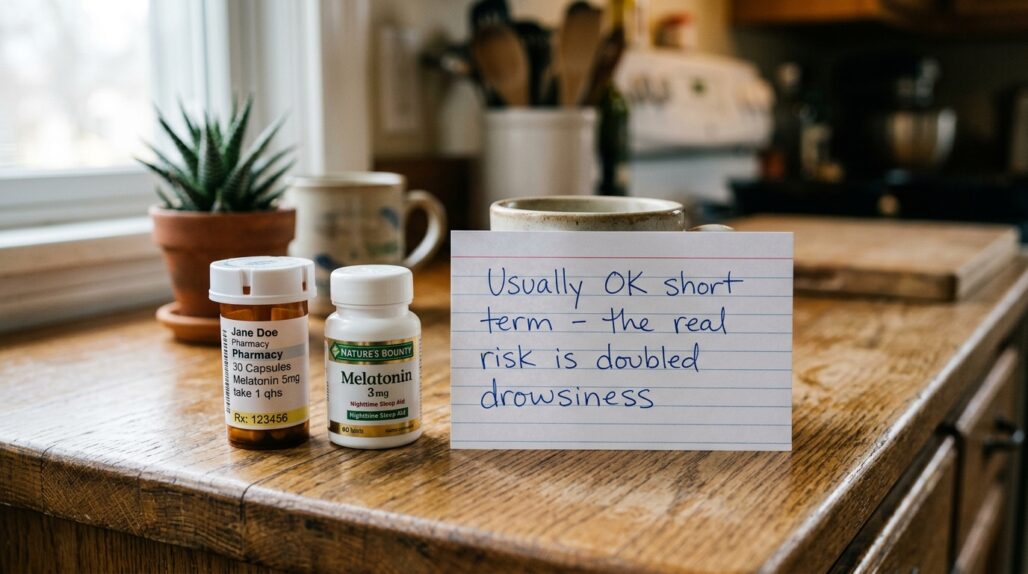
The good news is that melatonin and alprazolam do not appear to fight each other chemically. The concern is simpler and more physical: two sedatives at once hit harder than one. That matters most for older adults, anyone with breathing problems during sleep, and anyone who needs to be alert soon after waking.
A few people should treat this combination as a real conversation rather than a casual add-on. If you are over 65, have sleep apnea or another breathing condition, drink alcohol in the evening, or take opioids or other sedating medications, the stacked drowsiness can tip into something dangerous.
What the interaction actually is
Melatonin is a hormone your body makes in the evening to signal that it is time to sleep. As a supplement, it nudges the same timing system through the MT1 and MT2 receptors. Xanax works on a different switch entirely, boosting the calming neurotransmitter GABA at the GABA-A receptor, which is why a benzodiazepine quiets anxiety and brings on sleep, per the StatPearls clinical review of alprazolam.
Different mechanisms, same direction of travel. Both pull the brain toward sedation. When you take them together, the sedating effects add up, and professional interaction references classify this as a moderate interaction driven by additive central nervous system depression, as described in the professional alprazolam-melatonin monograph.
So the headline risk is not a spike in your blood level of either drug. It is more drowsiness, more dizziness, and slower reaction time than you would get from either one alone. That can feel like deeper sleep, or it can feel like grogginess that lingers into the morning.

How big is the effect?
For a healthy adult taking a low melatonin dose at bedtime alongside a prescribed Xanax dose, the added drowsiness is often mild. Many people combine them for a short stretch without trouble. Mild and predictable is not the same as zero, though, and the size of the effect climbs with higher benzodiazepine doses, alcohol, or other sedating drugs.
The interaction monograph notes that the combined effect can show up as dizziness, drowsiness, confusion, and trouble concentrating, and that some people, especially older adults, also notice changes in thinking, judgment, and motor coordination. The standard clinical advice is to watch for excessive or prolonged sedation and to be cautious when starting.
Melatonin can also stay in your system longer in older adults, which raises the odds of daytime drowsiness the next day, according to the NCCIH overview of melatonin. Pair that lingering melatonin with a benzodiazepine and the morning fog can be heavier than expected.
There is one common worry worth clearing up. Xanax is broken down by the liver enzyme CYP3A4, which is why people ask about grapefruit. In practice, a controlled study found that grapefruit juice does not meaningfully change alprazolam levels, as reported by Yasui and colleagues in Psychopharmacology, unlike some other benzodiazepines such as diazepam, whose levels grapefruit can raise. Melatonin is not a strong CYP3A4 player at usual doses either, which is the main reason the melatonin-Xanax issue stays about sedation rather than drug levels.
Who is most at risk
The combination is far from equal across people. The same two pills that barely register for one person can be genuinely risky for another.
| Risk factor | Why it raises the stakes | What helps |
|---|---|---|
| Age over 65 | Slower drug clearance and higher fall risk from combined sedation and poor balance | Lowest effective melatonin dose, night-time only, clinician review |
| Sleep apnea or breathing problems | Benzodiazepines can worsen breathing depression during sleep | Do not combine without your doctor and apnea treatment in place |
| Alcohol in the evening | A third CNS depressant multiplies sedation and impairment | Avoid alcohol while using this combination |
| Opioids or other sedatives | Stacked depressants carry serious respiratory-depression risk | Full medication review with a pharmacist before adding melatonin |
| Driving or operating machinery | Slowed reaction time and reduced coordination | No driving until you know how the pair affects you |
The opioid line deserves emphasis. The FDA requires a boxed warning across the benzodiazepine class about abuse, dependence, withdrawal, and the serious dangers of combining them with other CNS depressants, with respiratory depression and death listed among the worst outcomes, per the FDA benzodiazepine boxed-warning update. Melatonin is far milder than an opioid, but the principle holds: every sedative you add raises the floor on risk.

What to do about timing and dose
If your prescriber agrees the combination is reasonable for you, a few habits keep it sensible.
- Take both at bedtime, not spread through the evening, so the sedation lands when you are already in bed.
- Start melatonin low. Research and product habits often point to roughly 0.5 to 3 mg about 30 to 60 minutes before sleep, but the right amount for you belongs to your clinician, not a blog. Higher is not better and tends to add morning grogginess.
- Skip alcohol entirely on nights you use both.
- Do not drive or operate machinery until you have seen how you feel the next morning.
- Keep melatonin to short-term use. Its long-term safety is not well studied, as NCCIH notes, and benzodiazepines carry their own dependence concerns over time.
A practical point on the bigger picture: melatonin is not a fix for needing Xanax to sleep. The American Academy of Sleep Medicine treats cognitive behavioral therapy for insomnia (CBT-I) as the first-line approach for chronic insomnia and frames sleep medications as short-term or adjunct tools, per the AASM guidance on insomnia treatment. If you are reaching for both most nights, that is the signal to revisit the plan with your prescriber rather than to keep layering aids.
Keeping an honest record helps that conversation. A free app like StackMyMed lets you log every supplement and prescription in one place and flag pairs worth raising with a pharmacist. It does not replace clinical judgment, but it makes the medication review faster and more complete.
For the broader picture on supplement-drug overlaps, our ultimate guide to drug-supplement interactions and the drug-supplement interaction checker are good next stops.
When to call a clinician
Some signals mean stop guessing and get help.
Reach out to your prescriber or pharmacist if you notice heavy daytime drowsiness, confusion, slurred speech, or poor balance, or if you find yourself needing the combination most nights to sleep. These are signs the dosing or the overall plan needs a second look.
Treat it as urgent and seek emergency care for slowed or difficult breathing, extreme sleepiness you cannot shake, fainting, or unresponsiveness, especially if alcohol, opioids, or other sedatives were also involved. Those are the outcomes the benzodiazepine warnings exist to prevent.
If you have been on Xanax for a while, never stop it abruptly to make room for melatonin. Benzodiazepine withdrawal can be severe and even cause seizures, so any change runs through your prescriber on a tapering plan.
If you want gentler, lower-risk sleep options to discuss, our roundups on the best magnesium for sleep and our sleep supplement protocol lay out what the evidence supports.
FAQ
Is it safe to take melatonin and Xanax on the same night? For many healthy adults, short-term use at bedtime is usually tolerated, but both cause sedation, so the combined drowsiness can be stronger than expected. Clear it with your prescriber first, especially if you are older or take other sedating drugs.
Will melatonin make my Xanax stronger? Not by raising the drug level. Melatonin does not meaningfully change how much alprazolam is in your blood, but it does add its own sedating effect on top, so you may feel sleepier or groggier than with Xanax alone.
How much melatonin should I take with Xanax? There is no one-size dose, and the right amount depends on you, so ask your clinician. Research often uses low amounts taken shortly before bed, and starting low generally limits next-day grogginess.
Can I drive the next morning? Maybe not safely at first. Both can leave residual drowsiness, and melatonin can linger longer in older adults, so avoid driving until you know how the combination affects you the morning after.
Does grapefruit matter with this combination? Less than you might think. Studies suggest grapefruit does not meaningfully change alprazolam levels, unlike some other benzodiazepines, so the melatonin issue stays about added sedation rather than drug-level changes.
Can I use melatonin to get off Xanax? No. Melatonin does not treat benzodiazepine dependence and cannot replace a supervised taper. Stopping Xanax suddenly can trigger serious withdrawal, so any plan to come off it belongs to your prescriber.
Conclusion: usually tolerated, but respect the doubled sedation
Melatonin and Xanax do not collide chemically, and short-term use together is often fine for healthy adults. The risk that matters is the one that is easy to underestimate: two CNS depressants at once mean more drowsiness, slower reactions, and a higher fall risk, with the stakes climbing for older adults, people with sleep apnea, and anyone adding alcohol or opioids.
Use the lowest melatonin dose that works, keep it to bedtime, skip driving and alcohol, and make this a short-term bridge rather than a nightly habit. Then bring the full picture to your prescriber or pharmacist, because the safest version of this combination is the one your clinician signed off on.
This article is for general information and education. It is not medical advice and does not replace a conversation with your doctor or pharmacist about your own medications and health.
Reviewed by the UsefulVitamins Editorial Team.
