
Before you decide
This article is general information about a known prescription effect, not medical advice for your situation. Prednisone is a powerful drug, and electrolyte balance is something your clinician should track for you, not something to manage by guesswork.
The people who need to pay closest attention are on high daily doses, on prednisone for weeks or months, or already taking other medications that move potassium. Anyone with heart disease or kidney disease sits in the higher-risk group too. Bone loss is the other big prednisone concern – we cover that in our piece on vitamins to take with prednisone for bones.
If you are on a short low-dose course for poison ivy or a flare, the mineral drop is usually small and often goes unnoticed. The cautions below matter most as the dose and duration climb. Potassium and magnesium are only part of the story, so it helps to see our overview of the best supplements for prednisone users for the fuller list. For the wider picture, see our guide to drug and supplement interactions.
What prednisone actually does to potassium and magnesium
Prednisone is a glucocorticoid, but it is not purely a glucocorticoid. It also has weak mineralocorticoid activity, which is the same signaling pathway that the hormone aldosterone uses.
When that pathway is switched on in the kidney, the body reabsorbs sodium and water and excretes more potassium. The classic teaching from corticosteroid pharmacology, summarized in the NCBI Bookshelf chapter on corticosteroid effects, is that aldosterone-like signaling drives sodium retention alongside potassium loss in the renal tubule. Prednisone nudges that same lever.
Magnesium tends to follow potassium out the same door. Mineralocorticoid activity increases renal magnesium excretion, so the two minerals often run low together rather than one at a time.
The effect is dose-related. The corticosteroid class labeling lists sodium retention, potassium loss, and hypokalemic alkalosis among recognized fluid-and-electrolyte effects. It attaches the salt-and-water retention and increased potassium excretion specifically to average to large doses of hydrocortisone or cortisone, noting these effects are less likely with synthetic derivatives like prednisone except at large doses. A short 10 mg taper rarely moves the needle; 40 mg or more for weeks is a different story.

How big is the effect, really?
For most people on a brief course, the change is minor and the body compensates. The risk rises with dose, duration, and what else you take.
A useful frame comes from the review Medication-Induced Hypokalemia in Pharmacy and Therapeutics, which catalogs the drugs that pull potassium down and explains the corticosteroid mechanism. Prednisone is a milder offender than fludrocortisone or hydrocortisone, which carry stronger mineralocorticoid punch, but it still belongs on the list.
The same review makes a point worth repeating: hypomagnesemia is present in more than half of cases of clinically significant low potassium. Low magnesium increases urinary potassium loss, so the two deficiencies feed each other.
That is why a doctor will sometimes check both minerals together and correct magnesium first. You cannot reliably refill potassium while magnesium stays low – the kidney keeps leaking it.
Symptoms worth flagging
Mild shortfalls often cause nothing at all. As potassium or magnesium drop further, the body starts to complain, usually through muscle and nerve tissue.
The StatPearls reference on hypokalemia lists the common signals: muscle weakness, fatigue, cramping, palpitations, and constipation. It also sets the numbers – serum potassium below 3.5 mmol/L counts as low, and below 2.5 mmol/L is severe.
Low magnesium overlaps heavily, adding tremor, muscle spasms, and numbness or tingling in the hands and feet. Severe deficiency can trigger seizures or dangerous heart rhythms, which is the line where this stops being a supplement question and becomes an emergency. If lingering tiredness is your main complaint, our roundup of supplements for energy and fatigue is worth a read, though a low reading needs a lab test rather than a guess.
Here is the part that catches people out: these symptoms are easy to blame on the underlying illness or on prednisone's general side effects. Persistent cramps, a racing or skipping heartbeat, or unusual weakness on steroids deserve a blood test, not a guess.

Who is most at risk
Some people can drift toward low potassium on a dose that would not bother anyone else. The combinations below stack the odds.
| Risk factor | Why it raises the stakes | What it changes |
|---|---|---|
| High or long-term prednisone | Mineralocorticoid effect is dose-related | Schedule periodic electrolyte checks |
| Loop or thiazide diuretics | They also waste potassium and magnesium | Combined losses can add up fast |
| Vomiting or diarrhea | Direct GI loss of both minerals | Replace fluids and recheck levels |
| Kidney disease | Impaired handling of potassium | Supplements can swing either way – clinician only |
| ACE inhibitor, ARB, or potassium-sparing diuretic | These raise potassium | Added potassium can cause dangerous highs |
That last row is the one to take seriously. If you take an ACE inhibitor, an ARB, or a potassium-sparing diuretic, the bigger danger may flip from too little potassium to too much.
The Cleveland Clinic Journal of Medicine review on managing potassium with these drugs notes that ACE inhibitors and ARBs raise potassium, especially together, and that the risk climbs steeply as kidney function falls. In that setting a casual potassium supplement is genuinely risky. If kidney disease is part of your picture, our notes on kidney-friendly vitamins and medications cover the extra cautions, and you can sanity-check any new combination with our drug and supplement interaction checker.
What to take, and how to do it safely
Food first is the safe default for most people. Whole foods deliver potassium and magnesium in amounts your kidneys can usually handle, without the spike risk of a concentrated pill.
For potassium, lean on the plate rather than a bottle. Reasonable food sources include the following:
- White beans, lentils, and other legumes
- Potatoes and winter squash with the skin
- Leafy greens such as spinach
- Bananas, oranges, and dried apricots
- Plain yogurt and salmon
Over-the-counter potassium pills are deliberately capped at small doses for a reason. Higher-dose potassium and potassium-based salt substitutes belong under medical supervision, because the line between fixing a low and causing a dangerous high is narrow. The NIH Office of Dietary Supplements potassium fact sheet for professionals is blunt about this: in people with reduced kidney function or on potassium-raising drugs, even ordinary intakes can push potassium too high.
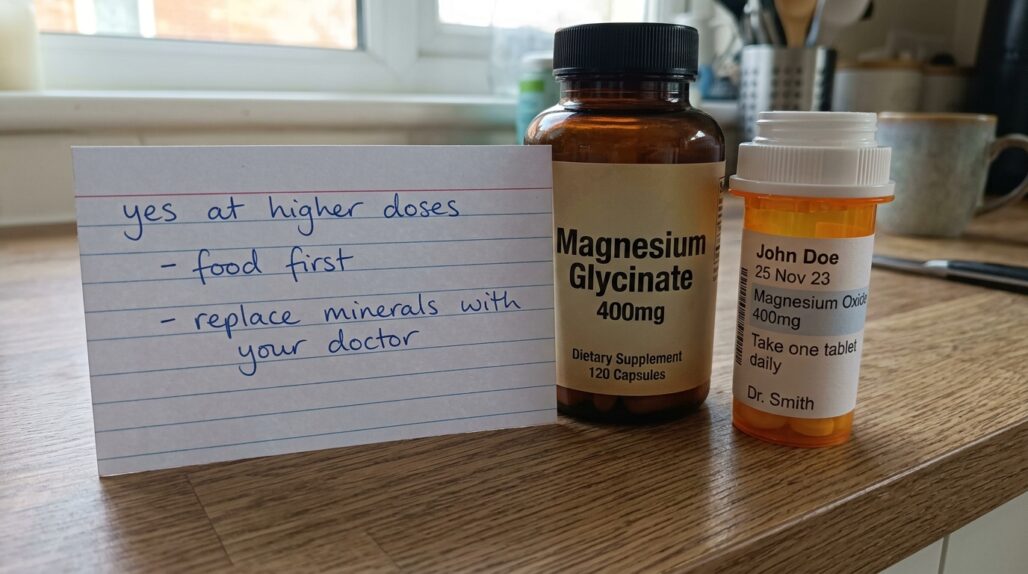
For magnesium, repletion is more forgiving for people with normal kidney function, and a supplement is more reasonable to discuss. But if you have reduced kidney function, supplemental magnesium can build up to dangerous levels, so magnesium also belongs under clinician supervision in kidney disease. Better-absorbed forms include magnesium glycinate and magnesium citrate, while magnesium oxide is cheap but poorly absorbed – our complete guide to magnesium breaks down the forms. The NIH ODS magnesium fact sheet sets the tolerable upper limit for supplemental magnesium at 350 mg per day for adults, with loose stools being the usual sign you have overdone it.
A few practical guardrails:
- Get a baseline. Ask whether your dose or duration warrants an electrolyte panel before you add anything.
- Magnesium before potassium. If both are low, magnesium usually needs correcting first for potassium to hold.
- Split magnesium doses with food to limit the laxative effect.
- Skip potassium pills and salt substitutes unless your clinician specifically tells you the amount.
If you are juggling prednisone alongside other prescriptions and a shelf of supplements, keeping one clear list helps you and your pharmacist spot conflicts. The free StackMyMed app lets you log a stack and flag possible interactions to raise at your next visit. It is a prompt for a real conversation, not a replacement for your prescriber's judgment.

When to get electrolytes checked
On a short low-dose course with no symptoms, routine testing is usually unnecessary. The threshold for checking drops as the regimen intensifies.
Ask about a potassium and magnesium check if any of these apply:
- You are on high-dose or long-term prednisone
- You also take a diuretic, ACE inhibitor, ARB, or potassium-sparing diuretic
- You have kidney or heart disease
- You develop cramps, marked weakness, fatigue, or palpitations
Seek prompt care for chest pain, fainting, or a heartbeat that feels fast, hard, or irregular. Those can signal an electrolyte problem that needs treating now, not at your next routine appointment.
FAQ
Does prednisone always lower potassium? No. The potassium-lowering effect is dose-related and usually mild, so short low-dose courses often cause no meaningful change. Higher doses and longer courses carry more risk.
Should I take a potassium supplement while on prednisone? Not on your own. Over-the-counter potassium is capped at small doses, and larger amounts or salt substitutes can be dangerous if you have kidney disease or take an ACE inhibitor, ARB, or potassium-sparing diuretic. Let your clinician decide the amount.
What kind of magnesium is best for repletion? Better-absorbed forms such as magnesium glycinate or citrate are commonly chosen, while oxide is poorly absorbed. The NIH upper limit for supplemental magnesium is 350 mg per day, and loose stools are the usual sign of too much.
Why would my doctor check magnesium when potassium is the problem? Low magnesium increases urinary potassium loss, so potassium is hard to refill while magnesium stays low. Correcting magnesium first often lets potassium recover.
What are the warning signs of low potassium or magnesium? Muscle cramps, weakness, fatigue, tremor, numbness, and palpitations are common. Chest pain, fainting, or an irregular heartbeat are urgent and warrant immediate care.
Can I just eat bananas to fix it? Food first is a sensible default, and bananas, beans, potatoes, and greens all help. But a banana cannot match a clinically significant deficit, which is why symptomatic or high-risk patients need a blood test rather than a fruit bowl.
Conclusion: food first, testing when it counts
Prednisone can lower potassium and magnesium, but the effect mostly matters at higher doses, longer courses, or alongside other potassium-moving drugs. For most short courses, a varied diet covers it.
The safe path is simple: build meals around potassium-rich foods, treat magnesium repletion as a conversation rather than a solo experiment, and never add potassium pills or salt substitutes without your clinician's say-so. If symptoms show up or your dose is high, ask for an electrolyte check instead of guessing.
This article is for general education and does not replace personalized medical advice. Do not start, stop, or change any medication or supplement without talking to your doctor or pharmacist.
Reviewed by the UsefulVitamins Editorial Team.
