
Affiliate disclosure: this article contains affiliate links. As an Amazon Associate, UsefulVitamins.com earns from qualifying purchases at no extra cost to you.
Before you buy
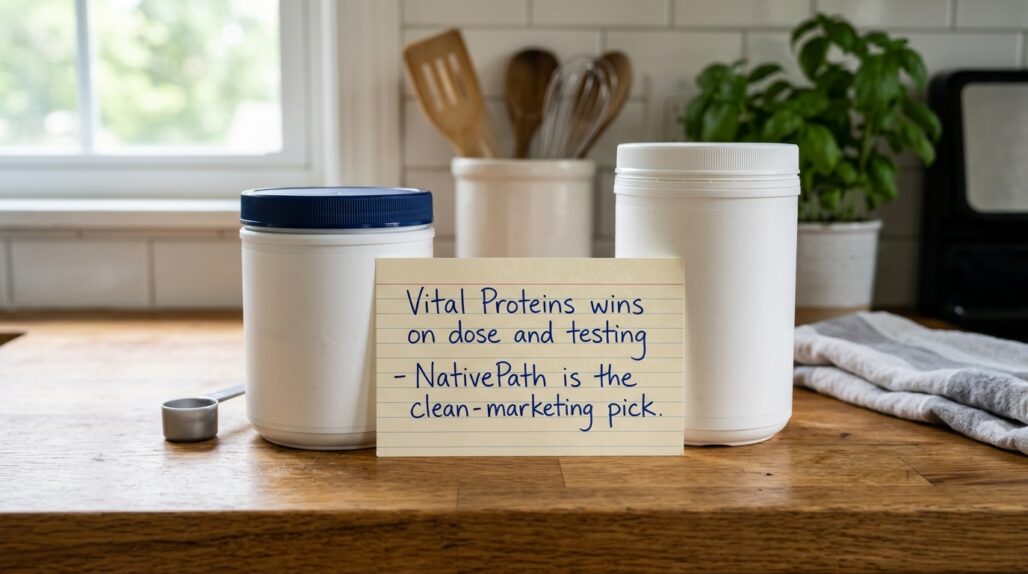
Both of these are the same basic thing: hydrolyzed bovine collagen peptides, Types I and III, from grass-fed cattle. There is no exotic ingredient hiding in either tub. So the real decision is not "which collagen is better for my skin" – it's how much peptide you get per scoop, how much you pay for it, and whether anyone outside the company has checked the label.
NativePath spends heavily on ads built around "grass-fed" and "pasture-raised." Vital Proteins is the brand most people already know from the grocery aisle. Strip the marketing away and you are comparing a 10g scoop against a 20g scoop, plus a difference in third-party testing.
If you already take collagen and just want to know which to reorder, the short version is in the green box above. If you want to see the math, keep reading. We will also point you to a couple of cheaper picks that do the same job if neither brand's price sits right.
What's actually inside each one
Here is where the two brands look almost identical on paper, with one big exception.
NativePath Original Collagen Peptides is a single-ingredient powder: hydrolyzed bovine collagen, Types I and III, at 10g per scoop, with 25 servings per standard tub. The company says it sources from grass-fed, pasture-raised cattle in South America, primarily Brazil, per its NativePath product page. It is free of dairy, gluten, soy, and GMOs.
Vital Proteins Collagen Peptides is also a single ingredient: grass-fed, pasture-raised bovine collagen peptides, 20g per serving in the unflavored tub. Its Vital Proteins product page lists sizes from a small 9.33oz tub up to a 20oz tub at 28 servings.
So the formulas are cousins. The first real difference is dose: one Vital Proteins scoop equals two NativePath scoops. That matters because most skin and joint research uses somewhere in the 2.5g to 10g per day range, and a 20g serving overshoots that comfortably while a 10g serving sits right at the top of it.
Worth knowing: Vital Proteins also sells an "Advanced" version with added hyaluronic acid and vitamin C. That is a different product from the plain peptides we are comparing here, and it costs more. For a like-for-like fight, we are using the standard single-ingredient tubs from both brands.
Collagen per scoop and what counts as a serving
This is the part the ads gloss over. A "scoop" is not a fixed amount – each brand defines its own serving.
- NativePath: 10g per scoop, marketed as one scoop a day.
- Vital Proteins: 20g per serving, also marketed as one scoop a day.
If you follow each label literally, a Vital Proteins user takes twice the collagen a NativePath user does. You can of course take two NativePath scoops to match, but then your 25-serving tub becomes a roughly 12-day tub, and the cost picture changes fast.
For skin and nail goals, 10g a day is a perfectly reasonable dose – it sits at the upper end of what most trials used. For joint or connective-tissue goals, some protocols push higher, which is where Vital Proteins' larger serving has a slight edge. Neither dose is wrong. The question is what you pay to get it.
Sourcing and testing – where the brands split
Both brands say "grass-fed" and "pasture-raised." Neither claim is independently verified on the label in the way a certification would be, so treat "grass-fed" as a sourcing description, not a quality guarantee. Collagen is highly processed regardless of the animal's diet.
Where they genuinely diverge is third-party testing.
NativePath states it manufactures in a GMP-certified US facility and that every batch ships with a Certificate of Analysis. A COA is useful, but it is the company testing its own product – not an outside body. There is no NSF or USP seal on the standard tub at the time of writing.
Vital Proteins' unflavored Collagen Peptides is NSF Certified for Sport, which you can confirm on the public NSF Certified for Sport listing. That program checks the product against 290-plus banned substances and verifies the label matches what is in the tub. It is one of the few collagen products carrying it.
For a regulator's plain-English take on what collagen does and does not do, the NIH Office of Dietary Supplements collagen fact sheet is the neutral starting point. Bottom line on testing: Vital Proteins has the stronger paper trail. That is a real point in its favor, especially if you compete in tested sport or just want outside verification.
Cost per serving – the number that decides it
This is where the comparison stops being close. Prices move, so treat these as ballpark figures and check current pricing before you buy.
- NativePath runs around $37.99 on the brand's own site for a 25-serving (10g) tub when on sale, and closer to $42.99 at other retailers as of writing. That works out to roughly $1.50 per 10g scoop.
- Vital Proteins runs around $49.99 for the 20oz, 28-serving (20g) tub at full price, often less at warehouse clubs and on Amazon. That is about $1.78 per 20g serving – or roughly $0.89 per 10g of collagen, and frequently lower on sale or subscription.
| Factor | NativePath Original | Vital Proteins Collagen Peptides |
|---|---|---|
| Collagen per scoop | 10g (Types I and III) | 20g (Types I and III) |
| Servings per tub | 25 | 28 (20oz size) |
| Source | Grass-fed bovine, South America | Grass-fed, pasture-raised bovine |
| Third-party testing | In-house COA, GMP facility | NSF Certified for Sport (unflavored) |
| Approx price | Around $38-43 per tub | Around $50 per 20oz tub |
| Cost per 10g collagen | Around $1.50 | Around $0.89 |
| Where to buy | Mostly direct, some Amazon | Everywhere – Costco, Amazon, grocery |
Read that "cost per 10g" row twice. You pay roughly 60 percent more per gram of collagen with NativePath. The brand's grass-fed story is real, but Vital Proteins makes the same grass-fed claim and charges less per gram while carrying the better certification.
Who each one is actually for
Neither brand is bad. They just fit different buyers.
Buy Vital Proteins if you want the most collagen per dollar, you value outside testing, or you want to grab a tub at Costco without thinking about it. For the large majority of people, this is the smarter default.
Buy NativePath if you specifically want a pre-measured 10g scoop, you bought into the brand's grass-fed messaging, and the price does not bother you. It is a clean, honest product – you are simply paying a marketing premium for a smaller dose.
Buy neither at full price if your only goal is basic skin or nail support. A plain unflavored bovine peptide from a value brand does the same thing for less. We compare those side by side in our roundup of Vital Proteins collagen alternatives on Amazon, and we break down the NativePath value case on its own in our NativePath collagen review.

Value pick and where to buy
For best dose-per-dollar with real third-party testing, Vital Proteins is the pick of these two. If you want to see how it stacks against another popular grass-fed option, our Vital Proteins vs Sports Research comparison covers that head to head, and the Ancient Nutrition vs Vital Proteins breakdown covers the multi-source angle if you want Types beyond I and III.


As an Amazon Associate, UsefulVitamins.com earns from qualifying purchases at no extra cost to you.
Useful Vitamins may earn a commission from purchases made through links on this page, at no extra cost to you. This never changes which products we recommend.
A quick note on expectations. Collagen is not magic, and no powder reverses aging. The better-controlled studies show modest improvements in skin elasticity and hydration over 8 to 12 weeks at daily doses in the 2.5g to 10g range, as summarized in this randomized placebo-controlled skin study. Both products clear that dose. Consistency matters more than brand.
FAQ
Is NativePath or Vital Proteins better for skin? Neither has a skin advantage – both are Type I and III bovine peptides, and skin benefits depend on a consistent daily dose in the 2.5g to 10g range, which both deliver.
Why is NativePath so much more expensive? NativePath sells mostly direct-to-consumer with heavy advertising and a smaller 10g scoop, so you pay roughly 60 percent more per gram of collagen than with a 20g Vital Proteins serving.
Is Vital Proteins really third-party tested? Yes – the unflavored Collagen Peptides is NSF Certified for Sport, which you can verify on NSF’s public product listing. NativePath relies on its own in-house Certificate of Analysis instead.
Can I just take two NativePath scoops to match Vital Proteins? You can, but a 25-serving tub then lasts about 12 days, which makes NativePath even more expensive per gram than the table above shows.
Does grass-fed collagen work better? There is no strong evidence that grass-fed sourcing changes how the peptides perform; collagen is heavily processed regardless. Treat grass-fed as a sourcing preference, not a results claim.
Is there a cheaper option that works just as well? Yes – several value bovine peptides match both brands on type and dose for less, which we cover in our Vital Proteins alternatives roundup linked above.
The verdict
Same animal, same collagen types, same basic powder. The differences that matter are dose, price, and testing – and on all three, Vital Proteins comes out ahead for most buyers. You get 20g per scoop, an NSF Certified for Sport seal, and a lower cost per gram, with the convenience of buying it almost anywhere.
NativePath is not a bad product. It is a clean, single-ingredient 10g scoop with a grass-fed story and a Certificate of Analysis. But you are paying a noticeable premium for marketing and a smaller serving, not for a better peptide.
So here is the honest call: start with Vital Proteins. If you want a pre-portioned 10g dose and the brand fits your routine, NativePath is fine – just go in knowing you are paying more per gram. And if you only need basic skin or joint support, a value bovine peptide will do the same work for less. Whatever you pick, take it daily for at least 8 weeks before judging it.
This article is for general information and is not medical advice. Talk to your doctor or a registered dietitian before starting a supplement, especially if you are pregnant, nursing, or managing a health condition.
Reviewed by the UsefulVitamins Editorial Team.
