
Affiliate disclosure: this article contains affiliate links. As an Amazon Associate, UsefulVitamins.com earns from qualifying purchases at no extra cost to you.
Before you buy
There is a real reason people search for "high-EPA fish oil for mood" instead of just "fish oil." The clinical trials that found a signal for low mood almost all used EPA-dominant formulas, not the balanced EPA/DHA oil on most shelves. A standard fish oil softgel that lists "1,000 mg fish oil, 300 mg omega-3" is not the same product the researchers tested.
So this is not really a "which brand is best" question. It is a formula question: you are looking for an oil where EPA makes up the large majority of the omega-3, ideally at a dose you can actually take every day.
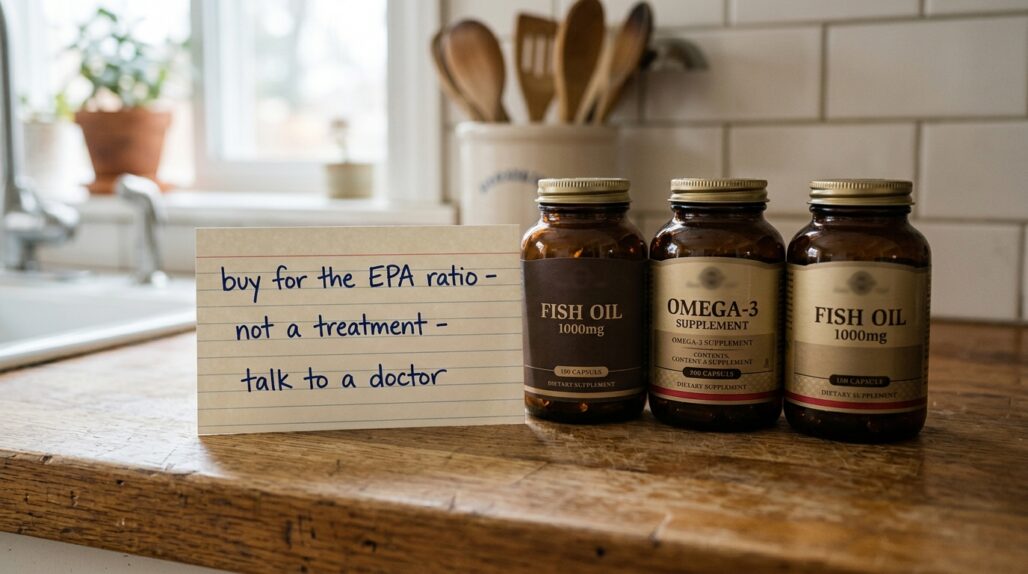
One thing to be clear about before anything else. Omega-3 is not a treatment for depression, and nothing here is medical advice. The evidence is best read as "possibly helpful as an add-on for some people," not "take this instead of seeing someone." If you are struggling, or you take any medication, the first move is a conversation with a clinician, not a supplement order.
With that framing set, the picks below are sorted by what the research cares about: EPA per dose and the EPA share of the oil.
Why EPA, not DHA, is the form studied for mood
Fish oil gives you two long-chain omega-3s, EPA and DHA. They behave differently in the body, and the mood research leans hard on EPA.
The most-cited piece of evidence here is a 2011 meta-analysis in the Journal of Clinical Psychiatry by Sublette and colleagues. It found a fairly clear pattern: supplements where EPA made up at least 60% of the total EPA plus DHA showed a benefit in depression trials, and formulas below that line did not. Later reviews have echoed the same direction.
A 2025 systematic review and meta-analysis of major depressive disorder reached a similar place: EPA-pure and EPA-major formulas (roughly 60% EPA or more) were the ones associated with reduced depressive symptoms, while DHA-heavy formulas were not. The effect sizes are modest, and the trials vary a lot, so read this as a leaning, not a verdict.
The practical takeaway is simple. You want the EPA share of the oil to clear about 60%, and most ordinary "balanced" fish oils sit well below that. That single rule eliminates most of the supplement aisle and explains why the picks below are specialty oils rather than the cheapest tub.
What the evidence actually shows (and does not)
This is the part worth slowing down on, because the marketing around mood and fish oil tends to outrun the data.
What the better studies suggest: in people with diagnosed depression, an EPA-forward omega-3 may modestly reduce symptoms, and the signal is strongest as an add-on to standard treatment, not on its own. The NIH Office of Dietary Supplements summarizes the omega-3 and depression literature as mixed and still unsettled, which is a fair description.
What it does not show: that fish oil treats depression, that it works for everyone, or that it is a substitute for therapy or medication. The NIH National Center for Complementary and Integrative Health is blunt that the research is not strong enough to recommend omega-3 as a stand-alone treatment for any mental health condition.
A few honest caveats most product pages skip:
- People who already eat a lot of fatty fish probably have less to gain than people starting from a low omega-3 intake.
- The benefit, where it shows up, is small and slow – think weeks, not days, and not a mood switch.
- Trials use doses you should not self-prescribe at the top end without a clinician in the loop.
If you take a blood thinner, are pregnant, or have any psychiatric diagnosis, treat high-dose fish oil as something to clear with your doctor first. That is the responsible read of the data, not a disclaimer.
Top high-EPA picks compared
Three oils get the EPA share right and are easy to actually buy. They are not interchangeable, mostly because of how EPA-pure each one is.
OmegaVia EPA 500 is the most EPA-pure of the group. Per its official product page, each softgel delivers 500 mg of EPA in triglyceride (rTG) form with only trace DHA, so the EPA share is roughly 95%-plus. It is enteric-coated to cut fishy burps and carries an IFOS 5-star rating. Around $40 to $45 for 120 softgels as of writing; check current price.
Nordic Naturals ProEPA is the balanced-but-EPA-leaning option. The label lists about 425 mg EPA and 100 mg DHA per softgel (850 mg EPA / 200 mg DHA per 2-softgel serving), so EPA is roughly 80% of the omega-3 – comfortably over the 60% line. It runs about $50 to $56 for 120 softgels as of writing; check current price.
Thorne Super EPA is the pick for tested athletes, with a catch. Per the Thorne product page, each gelcap has 425 mg EPA and 270 mg DHA, which puts EPA at only about 61% of the omega-3 – it clears the 60% mood threshold by a hair, no more. What it adds is NSF Certified for Sport status, which the others do not carry. About $36 to $40 for 90 gelcaps as of writing; check current price.
| Product | EPA per softgel | EPA share of omega-3 | Third-party testing | Approx. price |
|---|---|---|---|---|
| OmegaVia EPA 500 | 500 mg | ~95%+ (trace DHA) | IFOS 5-star | ~$40-45 / 120 ct |
| Nordic Naturals ProEPA | ~425 mg (+100 mg DHA) | ~80% | In-house + third-party tested | ~$50-56 / 120 ct |
| Thorne Super EPA | 425 mg (+270 mg DHA) | ~61% | NSF Certified for Sport | ~$36-40 / 90 ct |
Read that EPA-share column first. For the mood question specifically, OmegaVia is doing the most per capsule, Nordic ProEPA is close behind, and Thorne is the weakest fit despite being a fine oil – its high DHA dilutes the EPA share toward the floor of what the studies looked at.
Cost per gram of EPA, and the value pick
The fair way to compare these is dollars per gram of EPA per day, not the bottle price, because the EPA density is so different.
- OmegaVia EPA 500: two softgels give 1,000 mg EPA. At about $0.35 per softgel, that is roughly $0.70 per gram of EPA – and you swallow two pills, not four.
- Nordic ProEPA: about 2.3 softgels for 1,000 mg EPA at roughly $0.45 each, so near $1.05 per gram of EPA.
- Thorne Super EPA: similar EPA per cap to Nordic, so roughly $1.00 per gram of EPA, but you also take on a lot of "extra" DHA you were not specifically buying.
So OmegaVia is both the most EPA-pure and, by EPA, the best value of the three – an unusual combination at the premium end. That is the value pick for the mood use case.


As an Amazon Associate, UsefulVitamins.com earns from qualifying purchases at no extra cost to you.
UsefulVitamins is reader-supported. If you buy through links on this page we may earn a small commission, at no extra cost to you. It never changes our picks or our verdict.
If none of these fit your budget, a plain, balanced fish oil still supports general health – it just is not the formula the mood studies used. For that broader buying question, our look at whether the Sports Research triglyceride omega-3 is worth it is a more sensible starting point than an EPA-pure specialty oil.
How to think about dose, routed to a clinician
The study doses are higher than what a general wellness label suggests, which is exactly why this is a conversation to have with a doctor rather than a number to copy off a meta-analysis.
For context only: trials in depression often used 1 to 2 grams of EPA per day, frequently as an add-on to existing treatment. That is meaningfully more than the EPA in one or two everyday fish oil capsules, and it is the kind of dose where drug interactions and bleeding risk start to matter.
A few practical notes that are not prescriptions:
- Take it with a meal that has some fat – omega-3 absorbs better that way.
- Give it weeks, not days, before judging anything.
- Do not stack it on top of an existing high-dose regimen without telling whoever manages your care.
If you also care about absorption between oil types, our breakdown of triglyceride vs ethyl ester vs krill omega-3 explains why the rTG form in OmegaVia is a reasonable thing to pay a little for.

FAQ
Does fish oil treat depression? No. The evidence suggests an EPA-forward omega-3 may modestly help some people as an add-on to real treatment, but it is not a treatment on its own and should never replace medication or therapy. Talk to a doctor.
Why EPA and not DHA for mood? The depression trials that showed a benefit overwhelmingly used EPA-dominant formulas. A widely cited analysis found that oils with at least 60% EPA helped, while DHA-heavy oils generally did not.
Which of these has the highest EPA? OmegaVia EPA 500, at 500 mg of nearly pure EPA per softgel. Nordic ProEPA is next, and Thorne Super EPA has the lowest EPA share of the three because of its higher DHA content.
Is Thorne Super EPA a bad choice then? Not at all – it is a quality NSF Certified for Sport oil. It is just the weakest fit for the specific mood question, since its EPA share sits right at the 60% floor. If you want a deeper look, see our review of whether Thorne Super EPA is worth it.
How much should I take? Mood trials often used 1 to 2 grams of EPA daily, usually alongside standard treatment. That is a clinician-level decision, not something to self-prescribe, especially if you take any medication.
Can I just take a cheaper regular fish oil? For general health, yes. For the mood research specifically, a balanced oil usually falls below the EPA share the studies used, so it is not really the same product.
The verdict
If you are buying with the mood research in mind, let the EPA share decide, not the front-of-bottle omega-3 number. By that test, OmegaVia EPA 500 is the cleanest pick and the best value per gram of EPA, with Nordic Naturals ProEPA a close, slightly pricier runner-up.
Thorne Super EPA earns its place only if NSF Certified for Sport is a hard requirement for you – otherwise its higher DHA makes it the least EPA-focused of the three. And if you only want everyday omega-3 support, a cheaper balanced oil is the honest answer, with our take on whether OmegaVia fish oil is worth it covering the brand's broader lineup.
The most important next step is not a checkout button. If low mood is the reason you are reading this, book a conversation with a clinician first, and treat any EPA-forward oil as a possible add-on you raise in that conversation – not a replacement for care.
This article is for general information only and is not medical advice. Supplements are not a treatment for depression or any mental health condition. Do not start, stop, or change any medication based on this page, and talk to a qualified healthcare professional before adding high-dose fish oil, especially if you are pregnant, take a blood thinner, or have any diagnosed condition.
Reviewed by the UsefulVitamins Editorial Team.
