
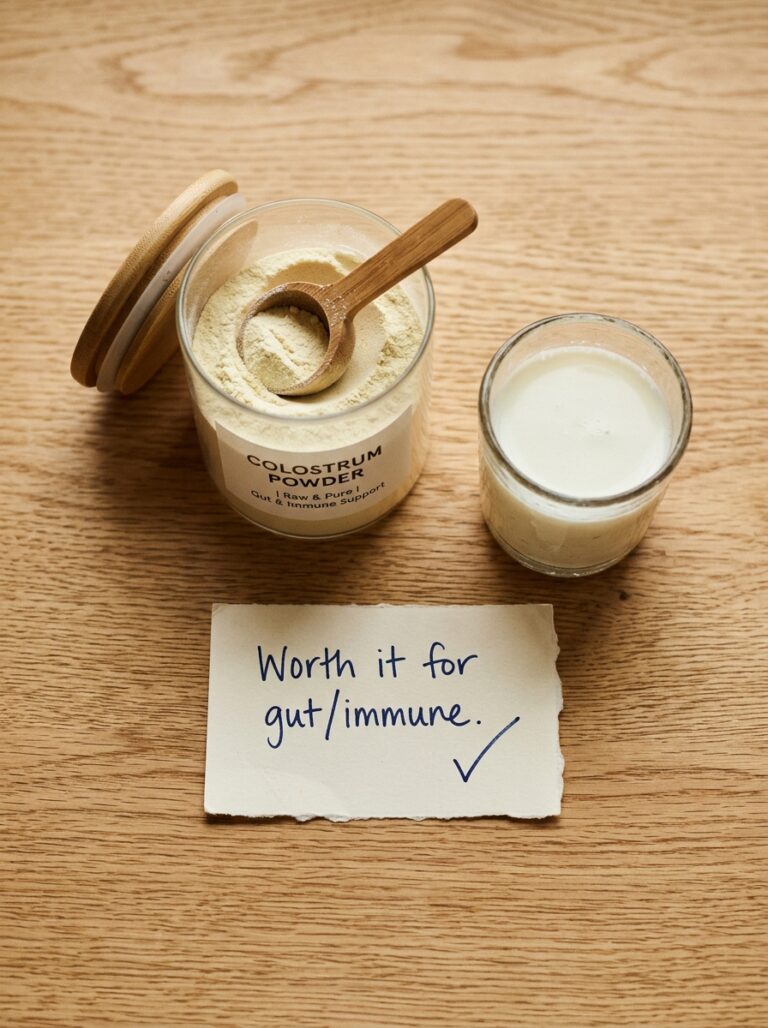
Colostrum is the first milk a cow produces after calving, and right now it is the supplement aisle's loudest comeback story, sold in pastel jars at prices that would make a probiotic blush. The reason it works at all is real, but most of what made it go viral in 2024 is not. This guide separates the two.
I'll show you where the gut and immune evidence actually holds up, why the "glowy skin and anti-aging" claims are marketing, and why the $100 jar isn't buying you anything the value brand can't. For what it's worth, the three picks at the bottom are the ones I'd keep in my own family's cabinet, chosen for verified IgG and a fair price, not for the influencer who posted them.
Affiliate disclosure: this article contains affiliate links. As an Amazon Associate, UsefulVitamins.com earns from qualifying purchases at no extra cost to you.
Before you decide
Colostrum is a dairy product, so anyone with a milk-protein allergy should not take it. It is concentrated bovine milk, immunoglobulins and all, and it can trigger the same reaction whole milk does. Lactose intolerance is different and usually milder, but high-lactose powders can still cause bloating.
If you are pregnant, breastfeeding, immunocompromised, or managing a diagnosed gut condition, treat colostrum as something to clear with your clinician rather than start on your own. It is a supplement, not a medication, and it does not replace anything your doctor has prescribed.
It also helps to be honest about the goal. "General wellness" is not a target the evidence can hit, but "I get repeated colds during heavy training" or "I have exercise-related gut symptoms" are. Those are the scenarios where the data actually lives.
If your real interest is digestion broadly, colostrum is one option among several, and not always the strongest. I'd start with my best supplements for gut health guide first, and you can see how I weigh evidence and conflicts of interest on the how we review supplements page.
What colostrum actually does
Colostrum is the dense, antibody-rich milk mammals produce in the first day or two after birth, before regular milk comes in. Its job in nature is to hand a newborn calf a starter pack of passive immunity, which is why it is loaded with immunoglobulins (mainly IgG), lactoferrin, and growth factors.
When sold as a supplement, it's that bovine first-milk, pasteurized and dried into a powder. The active ingredient everyone is really paying for is IgG, the antibody fraction, usually listed as a percentage of the powder.
The proposed mechanism is local, not systemic. Rather than being absorbed whole into your blood, the immunoglobulins and growth factors are thought to act in the gut itself, supporting the intestinal lining and interacting with gut-associated immune tissue as they pass through.
That distinction matters for the next section, because it's also why the bigger, body-wide claims fall apart. Most of what colostrum can plausibly do, it does in your digestive tract, not in your skin or bloodstream.
What the research shows
Start with the strongest signal: the gut barrier. A 2024 meta-analysis of ten randomized trials found that bovine colostrum significantly reduced intestinal permeability, measured by the urinary lactulose-to-rhamnose ratio, in athletes and patients.
That is a meaningful, mechanism-specific result, which is more than most trendy supplements can claim. The honest caveat is that it's still a modest effect from a small evidence base, and a broader 2024 review of colostrum across gastrointestinal diseases called the overall evidence limited and mixed, even while stool frequency improved consistently.
It's worth knowing how small that "modest" really is. The pooled reduction in the lactulose-to-rhamnose ratio was a mean difference of about −0.24, drawn from only ten trials totaling a few hundred people, and the doses that produced it ranged enormously, from under a gram a day in some arms up to 20 to 60 grams in others. That's a real signal for keeping the gut lining tight, but it is not a guaranteed fix for "leaky gut," a phrase the trials never actually use.
The immune story is similar: real but bounded. A meta-analysis of exercise studies found colostrum cut upper-respiratory-symptom days by 44% and episodes by 38% versus placebo over 8 to 12 weeks, and a 2023 triple-blind RCT in medical students saw fewer symptomatic days on a moderate daily dose.
Notice who those wins belong to. The clearest immune benefit shows up in athletes under heavy training load and in high-exposure groups like medical students, not in healthy adults living ordinary lives. Hard exercise transiently dents immune defenses and stresses the gut barrier, which is exactly the gap colostrum seems to plug; if you're not in that bucket, the expected effect shrinks toward nothing.
One more honest wrinkle from the same literature: the benefit is mostly symptomatic, not a measurable surge in your defenses. A systematic review of trained people found colostrum had little consistent effect on actual blood or saliva immunoglobulin levels, even when symptom-days dropped. The "immune-boosting" picture is more about fewer sick days during a hard block than about engineering a stronger immune system on paper.
Then there's the part the viral videos skip. The systematic reviews that cover colostrum in healthy and sick people catalog gut, immune, and performance outcomes, and skin or anti-aging benefits simply aren't among the supported findings. Topical wound-healing research on colostrum exists, but "drink this powder for glowier skin and reversed aging" is an extrapolation, not a finding.
The logic of the skin claim is also the same logic that fails the IGF-1 worry. The "glow" pitch assumes colostrum's growth factors travel through your body to rebuild collagen, but those proteins are digested in the gut like any other protein, so they don't arrive intact at your skin to do anything. If a skin change happens after starting colostrum, the likelier explanation is the rest of a wellness reset, more water, sleep, and protein, not the powder.
This is also where the IGF-1 worry gets defused. People hear "growth factors" and assume colostrum raises IGF-1 in the body, but a 2019 study across short- and long-term dosing found oral colostrum does not raise circulating IGF-1 in healthy adults because it's broken down during digestion. That's reassuring on safety, but it also undercuts the systemic "anti-aging growth factor" pitch. If broad longevity is your goal, I cover what actually has evidence in my complete guide to longevity supplements.
What to look for when buying

Because the IgG fraction is the active part, a label that states its IgG percentage is doing more for you than any "proprietary" buzzword on the front. Look for it explicitly; if a brand won't tell you, you can't compare what you're buying. Quality bovine colostrum powders typically land somewhere around 15 to 30 percent IgG, so that's the range to sanity-check against.
A quick clarification that saves money: colostrum is not the same thing as whey, even though both come from milk. Whey protein is a cheap, mostly muscle-focused protein with only trace immunoglobulins; colostrum is the antibody-dense first milk. Some "immune whey" products bolt a little colostrum or an IgG-enriched whey fraction onto a protein powder, which is fine, but it's not interchangeable with a true colostrum supplement, and the IgG number is again how you tell them apart.
Heat treatment is the detail that confuses people most. Every supplement colostrum is pasteurized for safety, and gentle, low-temperature processing preserves the IgG, while aggressive high-heat spray-drying can degrade it. You usually can't see the exact method on the label, which is precisely why a third-party-verified IgG number matters more than any "raw" or "minimally processed" claim on the front, those words aren't regulated, but a tested potency figure is checkable.
Sourcing details that genuinely matter, in order:
| Label feature | What it tells you | Worth paying for? |
|---|---|---|
| Stated IgG percentage | How much of the active antibody fraction you’re actually getting | Yes, essential |
| First-milking colostrum | Genuine first-day colostrum, the richest in immunoglobulins, not later “transition” milk | Yes |
| Grass-fed, pasture-raised source | A cleaner, more consistent supply, and surplus beyond what calves need | Yes, a reasonable signal |
| Third-party tested seal | Independent check on identity, IgG content, and contaminants | Yes, a useful signal |
| “Cellular nutrition” / premium price, no IgG number | Marketing language you can’t verify, often at a 2 to 3x markup | No, skip it |
Here's the uncomfortable comparison. The flagship hype brands run around $100 for roughly a 40-day supply at only 3 to 4 grams a day, while most trial benefits came from far larger doses, often 10 to 60 grams. You are frequently paying a premium price for a sub-trial dose.
Meanwhile, a value brand that lists a 20%+ IgG content and uses first-milking, grass-fed colostrum delivers the same active fraction for a fraction of the cost. The immunoglobulins don't know which jar they came in. Source quality and a verified IgG number are what matter; the luxury packaging is not.
Do the math on a cost-per-gram-of-IgG basis and the gap gets stark. A premium jar at $100 for a 40-day supply of 3-gram scoops is delivering roughly 120 grams of powder total, of which maybe 25 to 30 grams is actual IgG, for well over a dollar per gram of the active fraction. A value brand at a third of the price, listing comparable IgG and first-milking sourcing, beats it on every axis that the research actually rewarded. Pay for the potency and the testing, not the founder's story or the matte-finish lid.
Recommended Products


As an Amazon Associate, UsefulVitamins.com earns from qualifying purchases at no extra cost to you. We only recommend products supported by published research or third-party testing.
FAQ
Is colostrum good for skin and anti-aging?
The evidence doesn't support it. Systematic reviews of colostrum find gut and immune effects, not skin or anti-aging benefits, and oral colostrum doesn't even raise IGF-1 in the body. The skin claims are marketing, not data.
Does the IGF-1 in colostrum raise my hormone levels or cause cancer?
There's no good evidence it raises circulating IGF-1 at all. A 2019 study across acute, 4-week, and 12-week dosing found no increase in healthy adults because the growth factors are digested before absorption.
Can lactose-intolerant or dairy-allergic people take colostrum?
Anyone with a true milk-protein allergy should avoid it entirely, because it's a concentrated dairy product that carries the same milk proteins that trigger the reaction. Lactose intolerance is different and usually milder; some people tolerate low-lactose colostrum powders, but a high-lactose product can still cause bloating or gas, so start with a small dose and see how you respond.
Colostrum or a probiotic, which should I take for gut health?
They do different jobs, so it isn't really either-or. A probiotic adds live bacteria to your gut, while colostrum's plausible role is supporting the intestinal lining and gut-associated immune tissue, not seeding new microbes. If your main goal is digestion broadly, I'd usually reach for the better-studied options in my best supplements for gut health guide first, and treat colostrum as a targeted add-on for barrier or exercise-related gut issues rather than a probiotic replacement.
When should I take colostrum, and with or without food?
The trials weren't precise about timing, so don't overthink it. Taking it on an empty stomach, away from very hot liquids that could stress the delicate proteins, is a reasonable default, and athletes often dose it around training because that's the context the gut and immune research was built in. Consistency over weeks matters far more than the exact hour you take it.
What dose should I take?
Trial doses varied widely, often 10 to 60 grams daily, far above the 3 to 4 grams in many premium jars. Follow the product's label, lean toward brands with a meaningful IgG content, and don't assume a tiny scoop matches the research. Talk to your clinician for your situation.
Do I really need the expensive brand?
No. The IgG fraction is the active ingredient, and value brands list it just like the premium ones do. Buy on verified IgG content, first-milking, grass-fed sourcing, and third-party testing, not on price.
The bottom line on colostrum
Colostrum earned a small, legitimate place on the shelf, and then 2024 oversold it. The gut-barrier and respiratory-infection evidence is real but modest, concentrated in athletes and high-exposure groups, while the skin, anti-aging, and "fixes everything" claims that drove the hype don't hold up.
So buy it for the right reason. If you have exercise-related gut symptoms or get knocked down by repeated colds during heavy training, a quality colostrum is a reasonable, evidence-aligned trial. If you're a symptom-free adult chasing glowier skin, your money is better spent elsewhere.
And whatever you choose, read the IgG percentage, check for first-milking and grass-fed sourcing and a third-party seal, and skip the luxury markup. The expensive jar and the sensible one carry the same antibodies; only one of them carries the price tag.
Reviewed by Sarah Thompson, Registered Dietitian, focused on vitamin and mineral nutrition. See more from Sarah Thompson. This article is educational and is not a substitute for individualized medical advice; talk to your doctor before starting a supplement, especially if you have a dairy allergy, are pregnant, immunocompromised, or managing a diagnosed condition.
