
If you're on semaglutide or tirzepatide and searching for a probiotic to manage bloating, constipation, or diarrhea during dose escalation, the short answer is: strain identity matters far more than CFU count, and most consumer probiotic labels don't tell you which strains you're actually taking. This article breaks down which specific strains have human trial data for the GI complaints most common on GLP-1 medications, why "50 Billion CFU" is a marketing signal rather than an efficacy signal, and which products are worth your money. You'll also get a plain comparison table, five picks with honest trade-offs, and one clear category to skip.
Affiliate disclosure: this article contains affiliate links. As an Amazon Associate, UsefulVitamins.com earns from qualifying purchases at no extra cost to you.

Quick answer: best probiotic for GLP-1 GI issues
Top Pick for most users: Florastor Saccharomyces boulardii CNCM I-745. Survives stomach acid without refrigeration, documented across 21+ RCTs, and available at roughly $0.50 per dose.
Best for: GLP-1 users dealing with diarrhea or GI disruption during dose escalation; anyone co-prescribed antibiotics.
Not ideal for: Users whose primary complaint is constipation (Bifidobacterium lactis BB-12 is a better match); immunocompromised individuals (live yeast carries theoretical risk in that group; consult a physician first).
What to check before buying: Is the exact strain designation listed (genus + species + strain code)? Is CFU count guaranteed at expiry, not at manufacture? Does the retailer store refrigerated products cold?
Decision shortcut: Diarrhea or dose-escalation disruption: Florastor. Constipation: Renew Life Ultimate Flora (B. lactis fraction) paired with magnesium citrate. Traveling: Garden of Life shelf-stable. Want the single most-studied strain at budget cost: Culturelle.
Table of contents
- Why GLP-1 medications disrupt gut flora
- The strains that matter and the CFU problem
- How we picked
- Comparison table
- Product picks
- Brands to skip
- How to use probiotics on a GLP-1
- FAQ
- Related reading
Why GLP-1 medications disrupt gut flora
GLP-1 receptor agonists slow gastric emptying and reduce caloric intake by design. Both changes alter the gut environment: food transits more slowly, fermentation patterns shift, and reduced caloric intake itself changes which microbes thrive. The practical results are constipation (slowed motility), bloating (altered fermentation), or episodic diarrhea (especially during dose escalation). These are distinct problems that respond to different strains, which is why picking any probiotic labeled "digestive health" without checking the organism identity is unlikely to help what you're actually dealing with.
For a broader view of GLP-1 gut effects, see peptides for gut health and the GLP-1 side effects overview.
The strains that matter and the CFU problem
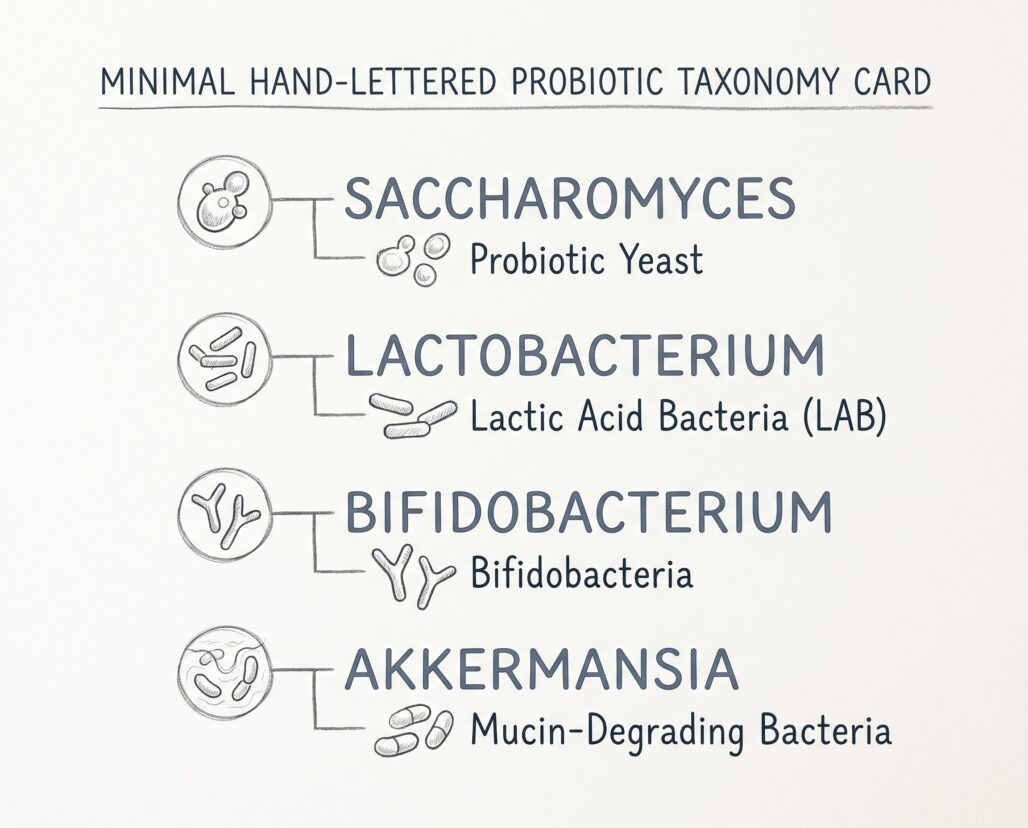
Think of probiotic strains like active pharmaceutical ingredients: the strain name is what tells you what the product does, not the category label. "Probiotic" on a bottle tells you as much as "pharmaceutical" would on a drug label with no compound named.
Saccharomyces boulardii CNCM I-745 is a yeast, not a bacterium. It survives stomach acid and antibiotics. A 2015 Cochrane review (Szajewska and Kolodziej) across 21 RCTs found CNCM I-745 significantly reduced antibiotic-associated diarrhea in adults. Generic "Saccharomyces boulardii" without a strain code may or may not be the same organism.
Lactobacillus rhamnosus GG (ATCC 53103) has the largest human trial count of any probiotic strain. A 2021 meta-analysis (Guo et al.) across 83 RCTs found LGG reduced diarrhea duration by ~1.1 days and improved IBS symptom scores.
Bifidobacterium lactis BB-12 targets constipation. A 2014 RCT (Eskesen et al., n=1248) found 10 billion CFU/day of BB-12 significantly increased stool frequency versus placebo over 4 weeks — directly relevant for GLP-1 users whose motility is already slowed.
Akkermansia muciniphila (Pendulum only) colonizes the gut mucin layer. A 2019 pilot (Plovier et al., n=32) showed pasteurized Akkermansia improved insulin resistance markers versus placebo. Human data remain limited; Pendulum is the only commercial source of live Akkermansia.
The CFU problem: More CFU is not more effective. Strain identity, acid tolerance, and storage conditions determine how many organisms actually reach the colon alive. A well-documented strain at 5 billion CFU that survives transit outperforms a 100-billion CFU proprietary blend that arrives mostly inert. Check that the label says "guaranteed through expiry," not "at time of manufacture."
Actionable takeaway: Before checking the CFU count, check the strain designation. No strain code means no way to match the product to a trial.
How we picked
We reviewed 30+ products listed under "digestive health probiotic" on Amazon (500+ reviews each). Criteria: specific strain designation on the label; CFU count guaranteed at expiry; at least one peer-reviewed RCT using the exact listed strain; storage instructions consistent with strain requirements; cost per effective dose. We did not conduct lab testing.
Comparison table
| Brand | Strain(s) | CFU per dose | Refrigerated | Cost per dose | Best for |
|---|---|---|---|---|---|
| Florastor | S. boulardii CNCM I-745 | 5 billion | No | ~$0.50 | Top Pick: diarrhea, dose-escalation disruption |
| Culturelle Digestive | L. rhamnosus GG (ATCC 53103) | 10 billion | No | ~$0.40 | Budget: IBS + diarrhea, broadest trial record |
| Visbiome High Potency | 8 strains inc. LGG, B. longum | 112 billion | Yes | ~$2.10 | Post-antibiotic reset, concurrent IBD/IBS |
| Garden of Life Dr. Formulated | 16 strains inc. L. rhamnosus, B. lactis | 50 billion | Yes (shelf-stable version available) | ~$1.00 | Travel-friendly broad coverage |
| Pendulum Akkermansia | A. muciniphila (live) | 25 million | No | ~$2.15 | Metabolic/gut-lining angle, early-adopter |
| Renew Life Ultimate Flora | 10 strains inc. B. lactis | 30 billion | Yes | ~$0.70 | Constipation-predominant users |
Product picks
Top Pick: Florastor Saccharomyces boulardii CNCM I-745
Strain: S. boulardii CNCM I-745, 5 billion CFU per capsule guaranteed at expiry
Best for: GLP-1 users with diarrhea or GI disruption during dose escalation; anyone co-prescribed antibiotics
Why we picked it: Florastor prints CNCM I-745 on the label and is the strain with the strongest RCT diarrhea evidence base. Because S. boulardii is a yeast, antibiotics do not kill it — the rare probiotic that survives co-administration with the medications most commonly prescribed alongside a GLP-1. No refrigeration required; the CFU count in the bottle reflects what you actually ingest.
The trade-off: At $0.50 per dose, Florastor costs about 2.5x generic Saccharomyces boulardii capsules sold without a strain code. The premium buys confirmed strain identity. Seed Daily Synbiotic costs roughly $50/month for a multi-strain prebiotic-probiotic combination with no single organism approaching the trial volume of CNCM I-745 for diarrhea. For this indication, the single-strain product at lower cost is the better-evidenced choice.
Skip if: Constipation, not diarrhea, is your primary complaint. Also skip if you are immunocompromised or have a central venous catheter.
Actionable takeaway: The default for GLP-1 diarrhea. One capsule twice daily during dose escalation or antibiotic courses matches the dosing pattern in most trials.
Premium choice: Pendulum Akkermansia
Strain: Akkermansia muciniphila (live), 25 million CFU per capsule
Best for: GLP-1 users interested in the metabolic and gut-lining angle beyond acute symptom management
Why we picked it: Pendulum is the only company selling live Akkermansia commercially. The 2019 pilot trial (n=32) found improvements in insulin resistance markers versus placebo in metabolic syndrome patients. For GLP-1 users managing weight and glucose together, the mechanistic overlap is genuinely interesting. Human data remain limited — this is a 32-person pilot, not a large RCT.
Skip if: Acute GI symptom relief is your goal. The evidence base does not yet justify $65/month over a $15/month proven option for diarrhea or constipation management.
Actionable takeaway: An experimental addition once acute symptoms have stabilized, not a substitute for better-documented organisms during active disruption.
Budget pick: Culturelle Digestive Health (Lactobacillus rhamnosus GG)
Strain: Lactobacillus rhamnosus GG, ATCC 53103, 10 billion CFU guaranteed at expiry
Best for: Cost-conscious GLP-1 users with general GI disruption or IBS-type symptoms; anyone wanting the single most-studied probiotic strain
Why we picked it: Culturelle prints ATCC 53103 on the label. The 2021 Guo et al. meta-analysis (83 RCTs) found LGG reduced diarrhea duration and improved IBS symptom scores. No refrigeration, widely available, $0.40 per dose. LGG's evidence is predominantly diarrhea and IBS, not constipation — if slowed motility is the primary issue, B. lactis BB-12 is a better-matched strain.
Skip if: Constipation is your main complaint.
Actionable takeaway: The sensible default for general GI disruption if budget matters and you don't want to overthink strain selection.
Best for constipation on GLP-1: Renew Life Ultimate Flora Probiotic
Strains: Multi-strain blend including Bifidobacterium lactis and L. acidophilus, 30 billion CFU, refrigerated
Best for: GLP-1 users whose primary complaint is constipation or slowed transit
Why we picked it: The Bifidobacterium lactis fraction addresses constipation directly. The 2014 Eskesen et al. trial (n=1248) found 10 billion CFU/day of B. lactis BB-12 significantly increased stool frequency versus placebo over 4 weeks. Verify the strain code at purchase — Renew Life labeling varies between runs, and generic "B. lactis" without a code is a different product from the one the trial studied. Requires refrigeration.
Skip if: Diarrhea is your primary complaint, or refrigeration is unreliable.
Actionable takeaway: Pair with magnesium citrate for a two-pronged constipation approach — the magnesium draws water into the colon osmotically while B. lactis addresses the microbiome side over 4+ weeks.
Best travel-friendly: Garden of Life Dr. Formulated Once Daily

Strains: 16 strains including L. acidophilus LA-5, L. rhamnosus, B. lactis, B. longum BB536 (30 billion CFU, shelf-stable version available)
Best for: GLP-1 users who travel frequently or cannot refrigerate; people who want broad strain coverage in one daily capsule
Why we picked it: The shelf-stable version covers both Lactobacillus and Bifidobacterium genera with labeled strain identifications and survives without refrigeration. Useful once acute GI symptoms have stabilized and you want a maintenance product without cold-chain logistics. Sixteen strains sounds comprehensive, but more strains in one capsule is not necessarily more effective — each organism may be present at subtherapeutic levels relative to what individual RCTs used.
Skip if: You need acute GI protection during dose escalation. Florastor or Culturelle are better matched.
Actionable takeaway: A maintenance pick for ongoing gut support once GLP-1 side effects have settled, not an acute symptom-management pick.
Brands to skip
Skip: Seed DS-01 Daily Synbiotic for GLP-1 GI symptom management
Seed is a thoughtfully designed product with a capsule-within-a-capsule delivery system and documented strains. The reason it doesn't earn a pick for this specific use: the DS-01 formulation as a whole has not been studied in large RCTs for the GI complaints most common on GLP-1 medications. Florastor delivers a better-evidenced protective effect for dose-escalation diarrhea at roughly $15-20 per month; Seed charges $50 per month. The cost difference is not currently justified by comparative human data for this indication. Not a harmful product — an expensive one relative to what the evidence supports here.
Skip: Any product listing only "Proprietary Probiotic Blend, 50 Billion CFU" with no strain names
No strain designation means you cannot match the product to any clinical trial, confirm CFU survival methodology, or compare it across batches. There is no US regulatory requirement to disclose strain codes on supplement labels. If you can't find a strain code on the label or product page, treat the product as unverifiable regardless of the CFU count on the front.
How to use probiotics on a GLP-1
Timing: No pharmacological interaction with semaglutide or tirzepatide. For bacterial strains alongside antibiotics, space at least 2 hours from the antibiotic dose. For Florastor (yeast), co-administration with antibiotics is fine.
Start before a dose increase, not after symptoms appear. Beginning 1-2 weeks before a scheduled escalation gives organisms time to establish. For diarrhea protection, effects appear within the first week. For constipation with B. lactis BB-12, expect 3-4 weeks — short-term use is unlikely to help.
Pair with fiber. Probiotics and soluble fiber address different parts of the problem. See fiber supplements for GLP-1 users.
FAQ
Do probiotics actually help with GLP-1 GI side effects?
Probably yes for specific strains and specific complaints — not generically. The evidence for S. boulardii CNCM I-745 and LGG for diarrhea and IBS-type symptoms is reasonably solid. The specific microbiome effects of GLP-1 medications are still being characterized; a strain with documented GI efficacy is an evidence-informed choice, not a guaranteed one.
Is Seed worth $50/month versus Culturelle at $0.40/dose for this use case?
Not for acute GLP-1 GI management. Culturelle's LGG (ATCC 53103) has an 800+ publication trial history. Seed has not published a head-to-head trial demonstrating superior GI outcomes for GLP-1-associated complaints. The 125x cost-per-dose premium is not currently justified for this indication.
Can I take a probiotic and magnesium together for GLP-1 constipation?
Yes. Magnesium citrate works osmotically within days; B. lactis BB-12 addresses microbiome composition over 3-4 weeks. A reasonable two-pronged approach. See our magnesium for GLP-1 constipation guide.
Do refrigerated probiotics work better than shelf-stable?
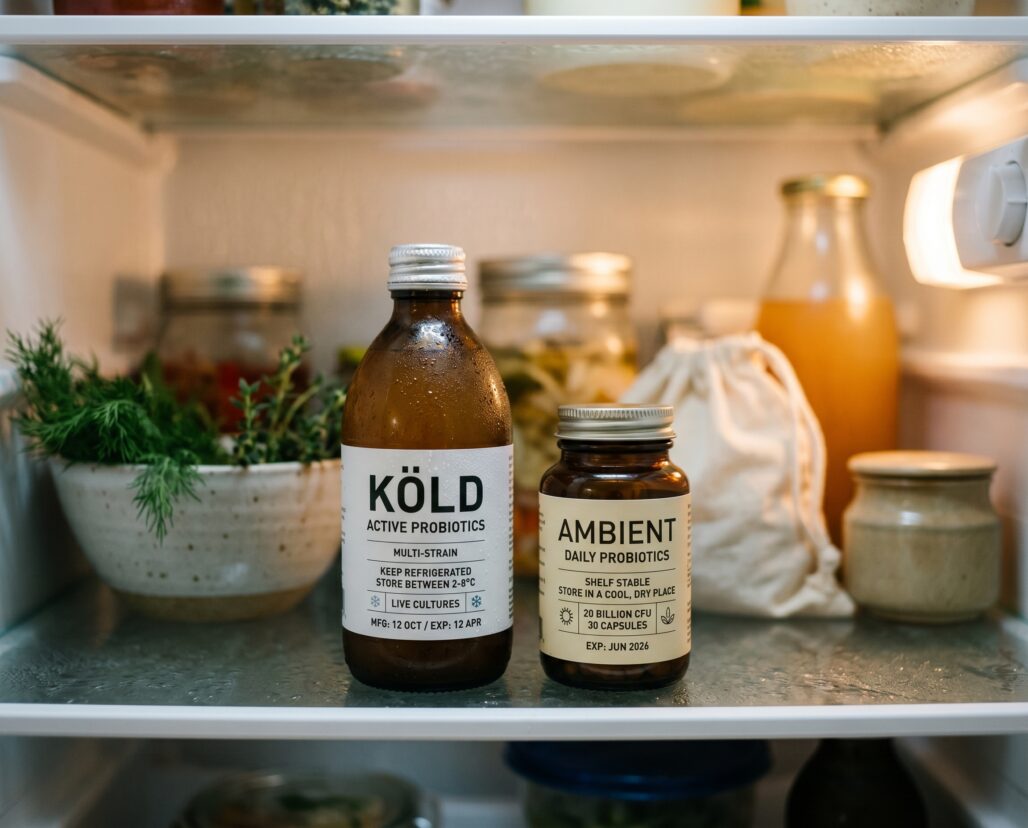
Refrigeration is strain-specific, not a quality signal. S. boulardii and Bacillus spore-formers tolerate ambient temperature by biology. L. acidophilus and some Bifidobacterium strains require cold storage. The question is whether the supply chain maintained what the specific organism needs.
How long before I notice results?
For diarrhea protection, within the first week. For constipation with B. lactis BB-12, expect 3-4 weeks. Starting before a dose escalation, not after symptoms appear, is the more effective approach.
As an Amazon Associate, I earn from qualifying purchases. Product recommendations are based on real reviews and independent research.
Related reading
- Peptides for gut health — parent overview on GLP-1 mechanisms and gut function
- GLP-1 peptide side effects — full side effect profile and supplement interventions
- Best fiber supplements for GLP-1 users — prebiotic substrate to pair with probiotics
- Best magnesium for GLP-1 constipation — the osmotic approach, often used alongside B. lactis BB-12
Conclusion: the bottom line on probiotics for GLP-1 GI issues
The probiotic aisle is one of the most oversold supplement categories. "50 Billion CFU" tells you nothing about what the product will do, and most consumer probiotic labels don't name the organisms inside. Strain specificity is the only variable that matters: S. boulardii CNCM I-745 for diarrhea and dose-escalation disruption, L. rhamnosus GG for IBS-type symptoms, B. lactis BB-12 for constipation. All three are inexpensive and available without a prescription.
Start with Florastor for diarrhea, Culturelle for the broadest trial evidence at minimum cost, or Renew Life (B. lactis fraction) paired with magnesium citrate for constipation. Pendulum Akkermansia is genuinely interesting for the metabolic angle — but not a substitute for a proven organism when acute GI management is the goal.
Next steps:
- Identify your dominant complaint before selecting a strain
- Check for a specific strain code on the label; if it's missing, choose a different product
- For constipation, pair with magnesium citrate and soluble fiber
- Start 1-2 weeks before a planned dose escalation, not after symptoms appear
- Reassess at 6 weeks; probiotics are most useful during active disruption, not necessarily as permanent daily supplements
This article is for informational purposes and not medical advice. Peptides — especially those marketed for therapeutic use — can interact with medications and health conditions. Consult a licensed physician before starting any supplement, particularly if you are pregnant, nursing, taking prescription medications, or managing a chronic condition.
As an Amazon Associate, I earn from qualifying purchases. Product recommendations are based on real reviews and independent research.
