
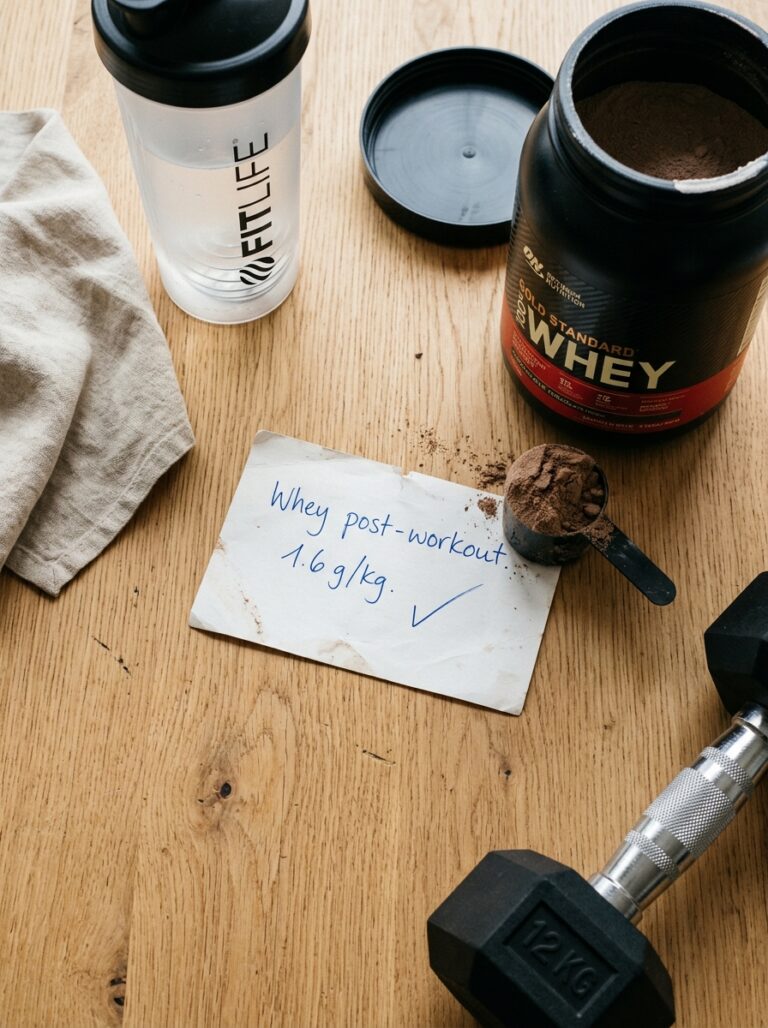
If you're shopping for the best protein powder for muscle gain, you've probably noticed the labels promise everything from "anabolic windows" to mass-gainer calories you supposedly can't grow without. The honest version is duller and cheaper than the marketing. Muscle is built by lifting hard and eating enough total protein across the day, and a plain tub of whey covers the supplement side for almost everyone. The picks at the bottom are the same ones I'd keep in my own family's kitchen for exactly that job.
This guide walks through how much protein actually drives growth, why whey is the workhorse, when a gainer is justified, and how loose the timing really is once the daily total is right.
Affiliate disclosure: this article contains affiliate links. As an Amazon Associate, UsefulVitamins.com earns from qualifying purchases at no extra cost to you.
Before you decide

A protein powder is food, not medicine, but a few people should run the plan past a clinician first. If you have chronic kidney disease or reduced kidney function, a high-protein diet can be inappropriate, and your nephrologist sets your protein target, not a supplement label.
The same caution applies if you are managing diabetes, are pregnant, or take medication that affects fluid or electrolyte balance. Protein powder is also not a treatment for any disease, and nothing here is a promise that a scoop builds muscle on its own.
If none of that applies, start with an honest look at your plate. Most people eating a typical mixed diet already get 0.8 to 1.2 g/kg of protein, so the question is whether you're closing the gap to a muscle-building target, not whether powder is magic.
A 75 kg lifter aiming for 1.6 g/kg needs about 120 g of protein a day. If your meals already supply 90 g, one or two scoops closes the gap rather than piling on protein you'll just oxidize. You can see how I weigh evidence and conflicts of interest on the how we review supplements page.
How protein builds muscle
Resistance training damages and stresses muscle fibers, and your body repairs them by assembling new muscle protein, a process called muscle protein synthesis (MPS). Net growth happens when synthesis outpaces breakdown over weeks, and dietary protein supplies the amino acids that fuel the synthesis side.
One amino acid does outsized signaling work here. Leucine acts as the trigger that switches MPS on by activating the mTORC1 pathway inside the muscle cell, and a protein feeding generally needs to clear a leucine threshold, roughly 2.5 to 3 g per meal, to maximally stimulate the response.
Below that threshold MPS still rises, just submaximally; above it, piling on extra leucine at the same sitting buys little more. In practice that threshold lands at about 25 to 30 g of a high-quality protein like whey, milk, or lean meat, which is why per-meal advice clusters in that range rather than telling you to eat all day.
That's why the ISSN position stand on protein and exercise recommends per-meal doses of about 20 to 40 g of high-quality protein, each carrying 700 to 3000 mg of leucine. Whey is leucine-rich, carrying roughly 10 to 11% of its protein as leucine, which is part of why it's the most studied muscle-building protein and the most reliable single trigger per gram.
The catch is that MPS is a daily story, not a single-meal one. You stimulate it again with each adequate protein feeding, so spreading protein across four to six meals tends to beat dumping it all into one. The supplement's job is simply to make hitting those feedings easy.
Whey vs mass gainer (when a gainer makes sense)
Walk the aisle and you'll see lean whey beside giant tubs of "mass gainer" promising 1,000-plus calories a scoop. The difference is almost entirely carbohydrate and calories, not better protein. A typical gainer is whey or a protein blend bulked up with maltodextrin, dextrose, and oils to drive a calorie surplus.
For building muscle, the protein you need is the same in both. A gainer just bolts a sugary calorie load onto it, which is useful only in one situation: you genuinely cannot eat enough total calories to gain weight.
That describes a narrow group. Hard-gainers, very tall teens, athletes with huge training volume, or people recovering appetite after illness may struggle to eat a surplus from food, and a gainer is a convenient liquid calorie source for them.
The reason it works for them is mechanical, not metabolic. Muscle gain requires a modest calorie surplus, roughly 250 to 500 extra calories a day, and someone with a small appetite or a fast metabolism can find that genuinely hard to chew through, especially around heavy training. Liquid calories sit lighter than another full plate, so a gainer shake gets the surplus in when solid food won't fit.
If that's you, the smarter move is often a homemade version: blend whey with whole milk, oats, a banana, and nut butter for the same calorie density with real food behind it. A commercial gainer is fine too; you're just paying for convenience and maltodextrin you could mix yourself.
For most people trying to add muscle, a gainer is an expensive way to drink several hundred calories of sugar you could get more nutritiously from oats, milk, fruit, or a peanut-butter banana. You'd build the same muscle on plain whey plus more food, usually for less money and with better satiety. The clearest tell is the scale: if you gain weight easily or sit at maintenance without trying, a gainer's calories will land as fat, not muscle.
| Powder type | What it really is | Best for | Watch out for |
|---|---|---|---|
| Whey isolate | Fast-digesting, leucine-rich, low carb/fat | Most lifters; cutting or watching calories | Costs more per gram than concentrate |
| Whey concentrate | Same protein, slightly more carb/fat, cheaper | Budget muscle-building; no lactose issues | A little lactose; fine for most |
| Casein | Slow-digesting milk protein | A pre-bed or long-gap feeding | Not “better” for growth than whey daily |
| Plant blend | Pea, rice, soy; blend to balance amino acids | Vegan or dairy-intolerant lifters | Lower leucine; aim for a slightly larger dose |
| Mass gainer | Whey plus 500 to 1000+ calories of carbs/fat | Genuine hard-gainers who can’t eat enough | Mostly sugar; skip if you gain weight easily |
Dose + timing (1.6 g/kg; the window is loose)

Here's the number that matters most. A 2018 meta-analysis in the British Journal of Sports Medicine pooled 49 trials with more than 1,800 participants and found that protein boosted resistance-training gains in lean mass, but the benefit plateaued at about 1.62 g/kg/day. Eating more protein past that point added no further muscle.
That plateau is worth sitting with, because it reframes the whole shelf of "high-protein" tubs. The meta-regression saw fat-free mass climb as daily protein rose, then flatten right around 1.6 g/kg with a confidence interval that stretched toward roughly 2.2 g/kg, so even a generous reading caps the useful intake far below what most gainer labels imply.
A 2022 dose-response meta-analysis reached a similar place from the strength angle, finding gains rose with total protein up to roughly 1.5 g/kg/day and then flattened. The practical target is 1.6 g/kg, with no reason to chase 2.5 or 3 g/kg in everyday training.
The one real exception is dieting. When you're in a calorie deficit trying to lose fat while keeping muscle, pushing protein higher, toward 1.8 to 2.4 g/kg, helps spare lean tissue. That's a muscle-preservation move, not a muscle-building one, so it's the situation, not a bigger scoop, that justifies the extra grams.
The ISSN supports a working range of about 1.4 to 2.0 g/kg/day for people training to build or keep muscle, split into 20 to 40 g feedings every three to four hours. A larger post-exercise dose can help bigger or fully trained lifters: one whey dosing study in Physiological Reports found 40 g stimulated more MPS than 20 g after whole-body training.
How you spread that daily total across the day matters more than most people expect. A 2013 distribution trial in The Journal of Physiology gave trained men the same 80 g of whey over 12 hours after lifting in three patterns: eight small 10 g hits every 90 minutes, a moderate 20 g every 3 hours, or two big 40 g boluses every 6 hours. The moderate, evenly spaced pattern, four 20 g feedings, produced the highest muscle protein synthesis. The frequent micro-doses kept slipping under the leucine threshold, and the two giant doses left long stretches with no signal.
The takeaway is practical, not fussy. Anchor three or four meals a day with 20 to 40 g of protein each, and a shake becomes most useful for plugging a gap, breakfast on a rushed morning, or the stretch right after a late workout, rather than as a fifth dose stacked on an already-adequate meal.
Now the part the labels oversell. The anabolic window is not a 45-minute panic. A meta-analysis of protein timing found that once total daily protein was accounted for, the timing of intake around workouts showed no independent benefit for size or strength.
The authors of a companion review of the post-exercise window estimated the practical window is several hours wide, not minutes. So a post-workout shake is genuinely useful, mainly because it's a convenient way to hit a feeding, not because the muscle expires if you eat an hour late. Get the daily total right and the clock relaxes.
What to look for when buying
Protein supplements are loosely regulated, so the label is your main quality signal. Lead with protein per scoop and third-party testing, then worry about flavor.
Check the actual grams of protein per serving against the scoop size, because some products inflate the scoop with fillers. A serious whey delivers 20 to 25 g of protein per scoop with minimal added sugar, and a short ingredient list.
For trust, look for an independent testing seal such as NSF Certified for Sport or Informed Sport. These verify the protein content and screen for contaminants and banned substances, which matters most if you compete. A third-party seal is the closest thing to a guarantee the tub contains what it claims.
Match form to your body and budget. Choose isolate if you're lactose-sensitive or counting calories, concentrate if you want the cheapest cost per gram, and a well-formulated pea-rice blend if you're plant-based, sizing the scoop a touch larger to clear the leucine threshold. Skip "proprietary blends" that hide how much actual protein you're getting.
Recommended Products


As an Amazon Associate, UsefulVitamins.com earns from qualifying purchases at no extra cost to you. We only recommend products supported by published research or third-party testing.
FAQ
How much protein do I really need to build muscle?
About 1.6 g per kg of body weight per day, from food and powder combined, paired with regular resistance training. For a 70 kg person that's roughly 112 g a day. Going much higher doesn't add muscle, per the BJSM meta-analysis.
Is whey better than plant protein for muscle?
Whey is higher in leucine, so gram for gram it's a slightly stronger MPS trigger. A good plant blend still builds muscle; just use a marginally larger dose, around 30 to 40 g, to match the leucine.
Do I need a mass gainer to grow?
No, unless you genuinely struggle to eat enough calories. For most people a gainer is mostly sugar bolted onto whey. Plain whey plus more whole food does the same job for less money.
When should I take my protein shake?
Whenever it helps you hit your daily total and your per-meal feedings. A post-workout shake is convenient, not mandatory, because the timing window is several hours wide once total intake is adequate.
How should I split my protein across the day?
Aim for three or four feedings of about 20 to 40 g each, every three to four hours. Even spacing beats one giant meal or constant grazing: the distribution trial in The Journal of Physiology found four 20 g doses drove more muscle protein synthesis than two 40 g doses or eight 10 g ones.
Can I take too much protein?
For healthy kidneys, intakes well above 1.6 g/kg are safe but simply wasted; the surplus is oxidized for energy or stored, not turned into extra muscle. The real downside is cost and crowding out other nutrients, not danger, but anyone with kidney disease should set their target with a clinician.
Can I get all my protein from food instead of powder?
Yes. Powder is a convenience, not a requirement. If chicken, eggs, dairy, fish, legumes, and tofu already get you to 1.6 g/kg, you don't need a supplement at all.
The bottom line on protein for muscle
The product that builds muscle is the one that helps you hit a sensible daily protein target while you train hard, and for most people that's a plain, well-tested whey at 20 to 25 g per scoop. The "best protein powder for muscle gain" is far less about the brand than about the total you reach each day.
Aim for roughly 1.6 g/kg/day, spread it across a few feedings, and treat the post-workout shake as convenient rather than critical. The window is loose, and the dose plateaus, so there's no edge in megadosing protein or buying a sugary gainer you don't need.
Reach for a gainer only if you genuinely can't eat enough calories, choose isolate or concentrate by your budget and gut, and let progressive training do the heavy lifting. Before you assume powder is the missing piece, add up what your meals already provide, and ask your doctor about your protein target first if you have kidney concerns.
Reviewed by Sarah Thompson, Registered Dietitian, focused on vitamin and mineral nutrition. See more from Sarah Thompson. This article is educational and is not a substitute for individualized medical advice; talk to your doctor before making large dietary changes, especially if you have kidney disease, diabetes, or are pregnant.
