
Affiliate disclosure: this article contains affiliate links. As an Amazon Associate, UsefulVitamins.com earns from qualifying purchases at no extra cost to you.
What Adderall and Vyvanse actually do to your nutrition
If you searched for this, you are most likely already taking the medication your doctor prescribed and you want to add the right supplement without doing anything dangerous. Good instinct. The honest starting point is this: amphetamine stimulants (Adderall, which is mixed amphetamine salts, and Vyvanse, which is lisdexamfetamine) have no recognized direct nutrient depletion the way metformin lowers B12 or a PPI lowers magnesium. There is no FDA label line that says these drugs drain a specific vitamin.
What the FDA prescribing information does document, heavily, is appetite loss. In the adult and adolescent trials, loss of appetite ran around 33 to 36 percent, and measurable weight loss showed up in 9 to 11 percent. That is the mechanism that matters. When you eat less, you take in less magnesium, zinc, iron and B vitamins from food. The gap, when there is one, is intake-driven and observational, not a chemical depletion caused by the pill itself. It is real, but be skeptical of any site claiming the drug "destroys" your minerals.
A second, separate thing the label records is not a depletion at all but a pharmacokinetic effect: acidifying agents, including ascorbic acid (vitamin C), lower how much amphetamine you absorb and how much stays in your blood. That single fact drives most of the timing rules below.
This page is education, not a prescription change. Keep taking your medication exactly as prescribed. Nothing here is a "natural Adderall" and nothing here lets you lower your dose.
What the stimulant depletes or affects (graded honestly)
Here is what the evidence actually supports.
Appetite suppression lowering dietary minerals – well-documented, but indirect. The drug reliably cuts appetite (FDA label). Lower food intake means less magnesium, zinc, iron and B vitamins arrive on your plate. Studies in children and adolescents with ADHD on stimulants describe exactly this risk of insufficient zinc and iron intake (see this review on iron, magnesium, vitamin D and zinc in ADHD). The deficiency, when present, tracks with how little you are eating, not with a special drug action. The fix is food first, then a targeted supplement.
Higher catecholamine turnover – theoretical. Stimulants push more dopamine and norepinephrine signaling, which in principle raises demand for the cofactors used to make and recycle those chemicals. This is a mechanistic idea, not a proven human depletion. Do not buy a "dopamine support" stack on the strength of it.
Sleep and the clenched jaw – a side-effect target, not a depletion. Two of the most common complaints are trouble falling asleep and bruxism (jaw and teeth clenching). Neither is a nutrient problem, but magnesium and low-dose melatonin are reasonable, low-risk ways to address them, which is why they sit in the safe-add list.
The realistic plan is modest: cover what poor appetite costs you, support sleep, and avoid the few supplements that fight the medication.

The supplements worth adding, and when to take each
These three are safe to take alongside amphetamine stimulants and none of them blunt the medication. The trick is mostly timing.


As an Amazon Associate, UsefulVitamins.com earns from qualifying purchases at no extra cost to you.
Some links below are affiliate links. If you buy through them we may earn a small commission, at no extra cost to you. It never changes what we recommend.
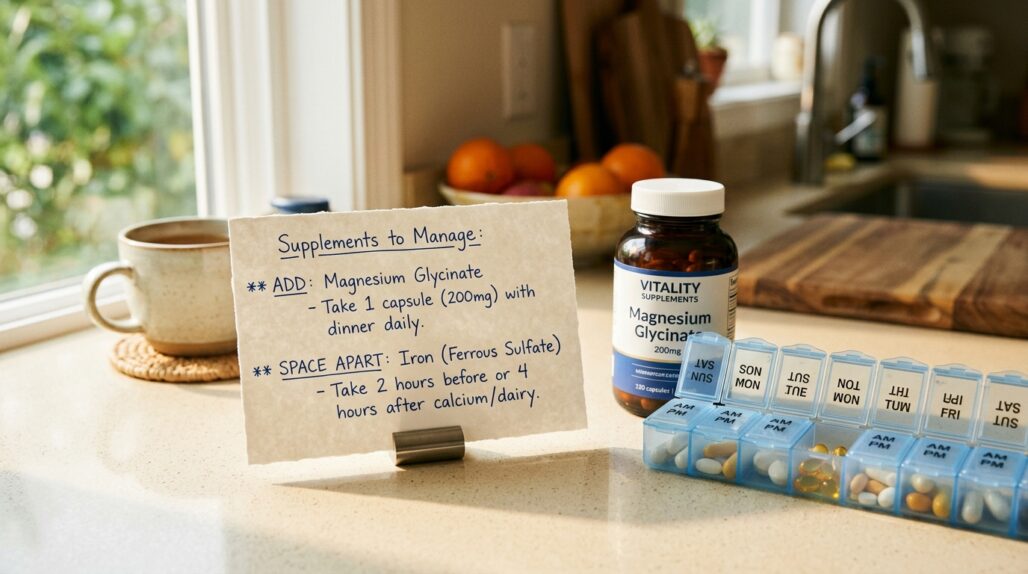
Magnesium glycinate, in the evening. This is the one most stimulant users get value from. Magnesium can ease the clenched jaw and the wired, restless feeling at night, and the glycinate form is gentle on the stomach. Take it at night, well away from your morning dose, so it doubles as wind-down support. A common range is 200 to 400 mg of elemental magnesium; start at the low end. The NIH Office of Dietary Supplements notes the tolerable upper limit for supplemental magnesium is 350 mg a day before loose stools become likely, so more is not better.
Vitamin D3, dosed to a blood test. When appetite is down and meals get skipped, vitamin D is one of the easier things to fall short on, and it matters for bone and general health. This is not stimulant-specific, but it is a sensible, non-interacting add. Get a level checked rather than guessing at a dose, and take it with a meal that has some fat.
Low-dose melatonin at bedtime, for sleep onset. Stimulant-related trouble falling asleep is common, and a low dose (0.5 to 1 mg is usually enough; skip the 5 to 10 mg megadoses on the shelf) is a reasonable, low-risk option. Randomized trials in children with ADHD show melatonin shortens the time it takes to fall asleep (see this JAACAP randomized trial, which used 3 to 6 mg in medication-free children); lower doses are generally recommended because more is not more effective for sleep onset. Take it 30 to 60 minutes before bed. It is for the sleep side effect, not a daily vitamin.
Here is the plan in one place.
| Supplement | What it helps with | How to take it (timing/spacing from your dose) | Caution |
|---|---|---|---|
| Magnesium glycinate | Jaw and teeth clenching, evening tension, restless sleep | 200-400 mg elemental at night, hours after the morning stimulant; no need to take it with the dose | Start low; loose stools above ~350 mg supplemental; use caution in reduced kidney function |
| Vitamin D3 | Bone and general support, easy to fall short on when appetite is low | With a meal that has some fat; any time of day, no spacing needed | Dose to a blood level rather than guessing; very high doses need monitoring |
| Melatonin (low dose) | Trouble falling asleep on the stimulant | 0.5-1 mg, 30-60 minutes before bed; not in the morning | Use the lowest dose that works; can cause grogginess; clear it if you are pregnant or on other sedatives |
Notice none of these go near the morning dose, and none of them are stimulants or acidifiers, which is the point. For more on choosing a calming magnesium, our guide to the best magnesium for anxiety and tension walks through the forms, and our vitamin D roundup covers softgels and drops. If you want to size a vitamin D dose to your level, the dose calculator here can help you sanity-check the magnesium side too.
What to avoid or space apart
This is the part to read twice. None of the items below belong in a supplement "stack" with a stimulant without your prescriber signing off.
Vitamin C, acidic juice, and other acidifiers – space them away from your dose. The FDA label is explicit: gastrointestinal acidifying agents, ascorbic acid named among them, lower the absorption of amphetamines, and urinary acidifiers speed their excretion. Either way, your blood level and your medication's effect drop. The practical rule is to keep high-dose vitamin C and large acidic drinks like orange juice away from the hour before and the few hours after your dose, and to keep your daily vitamin C steady rather than megadosing around the medication. A normal glass of juice with a separate meal is not a crisis; a 1,000 mg vitamin C tablet with your morning pill is the thing to avoid.
L-tyrosine and "focus" or "dopamine" precursors – avoid routine same-day use. Tyrosine is a building block your body uses to make catecholamines, the same chemicals the stimulant already raises. In theory that could add to heart rate or blood pressure, though human studies are mixed and have not shown a reliable pressor effect. It is marketed as a way to "boost" the medication, but it does not. Only use it under a clinician who is watching your blood pressure.
Serotonergic supplements – avoid while on the stimulant. St John's wort, 5-HTP, SAMe and high-dose L-tryptophan all raise serotonin. Amphetamines are serotonergic too, and the FDA labeling warns of serotonin syndrome when amphetamine is combined with serotonergic agents, naming tryptophan and St John's wort directly. This is a hard caution, not a spacing tip. If you also take an SSRI or SNRI, the warning is even more pointed: do not add a serotonin-raising supplement on top of two serotonergic drugs without your prescriber. Skip these unless cleared.
Stimulant "energy" and pre-workout products – avoid stacking. High-caffeine energy powders, bitter orange (synephrine), yohimbine and ephedra-type products add cardiovascular and nervous-system stimulation on top of the medication: faster heart rate, higher blood pressure, anxiety, palpitations. Keep caffeine modest and away from your peak medication effect.
Sodium bicarbonate and alkalinizing antacids – do not take routinely around your dose. The label notes alkalinizing agents push amphetamine levels the other way, up, which can intensify side effects. If you need an antacid regularly, that is a pharmacist conversation, not a daily habit around your stimulant.
A simple way to keep all of this straight is to log both the prescription and any supplement in one place. You can do that with StackMyMed (our own free app), which lets you record your medication and supplements together so possible overlaps and interactions get flagged for you to ask your pharmacist about. It is non-diagnostic; it points you to the right question, it does not give medical advice. The low-tech version works just as well: write your full list on paper and show it to your pharmacist. Either way, the decision routes to them.

Food first, before any capsule
Because the real gap here is what you do not eat, the table is the better fix than the bottle. The medication tends to flatten appetite during the day and let it return at night, so plan around that.
Eat a protein-forward breakfast before or right as the dose kicks in, while you can still stomach food. Lean on magnesium- and zinc-rich foods: pumpkin seeds, nuts, beans, leafy greens, oats, eggs, shellfish and lean meat. Keep a calorie-dense evening meal for when hunger comes back. If you are losing weight, raise the alarm with your prescriber rather than papering over it with supplements. A supplement tops up a real gap food cannot close, but it will never stand in for eating.
FAQ
Can I take vitamin C with Adderall or Vyvanse? A little dietary vitamin C is fine, but keep high-dose vitamin C and large acidic drinks away from your dose. The FDA label notes acidifiers like ascorbic acid lower how much amphetamine you absorb, so megadosing around your pill can blunt it. Keep your daily intake steady and separate from the dose.
Is L-tyrosine a safe way to make my medication work better? No. Tyrosine feeds the same catecholamine pathway the stimulant already drives, so it can add to heart rate and blood pressure rather than helping. It does not extend or improve the medication in any reliable way. Only use it if a clinician is supervising.
Will magnesium interfere with my stimulant? No. Magnesium does not blunt amphetamine and does not need to be spaced from it the way vitamin C does. Taking it at night keeps it useful for sleep and jaw clenching and out of the way of your morning dose.
I take an SSRI as well. Does that change anything? Yes, it raises the stakes on serotonin-raising supplements. Avoid St John’s wort, 5-HTP, SAMe and high-dose tryptophan entirely, since combining serotonergic agents can trigger serotonin syndrome. Take your full list to your pharmacist before adding anything.
Should I take melatonin every night for the insomnia? Low-dose melatonin has good evidence for shortening sleep-onset delay and is reasonable short term, but it treats a side effect rather than a deficiency. Use the lowest dose that works, take it 30 to 60 minutes before bed, and mention ongoing sleep trouble to your prescriber, since a dose-timing change may help more.
Can any supplement replace my prescription? No. No supplement, including L-tyrosine, is a “natural Adderall” or a way to lower your dose. The supplements here support sleep, jaw tension and the nutrition that appetite loss costs you. Your medication stays exactly as prescribed unless your doctor changes it.

The bottom line
The most useful, lowest-risk add for most people on Adderall or Vyvanse is magnesium glycinate at night, with vitamin D3 to a blood level and low-dose melatonin for sleep onset if you need it. The one rule you cannot skip is timing and avoidance: keep vitamin C, acidic juice and L-tyrosine away from your dose, and stay off serotonin-raising supplements and stimulant energy products. Eat first; supplement the gap second.
See a doctor or pharmacist promptly if you develop chest pain or tightness, a racing, pounding or irregular heartbeat, fainting, or a sudden severe headache or blood-pressure spike, or signs of serotonin syndrome such as agitation, fever, sweating, shivering, muscle twitching and confusion. Do not push through with more stimulant or stimulant supplements.
Before you add anything, write your full medication and supplement list and take it to your pharmacist or doctor. For a sibling read, our explainer on heart palpitations and energy supplements on Adderall goes deeper on the cardiovascular cautions above.
This article is educational and is not medical advice, a diagnosis, or a prescription change. It does not replace your prescription. Talk to your own doctor or pharmacist before adding, stopping, or changing any supplement or medication.
Reviewed by the UsefulVitamins Editorial Team.
