
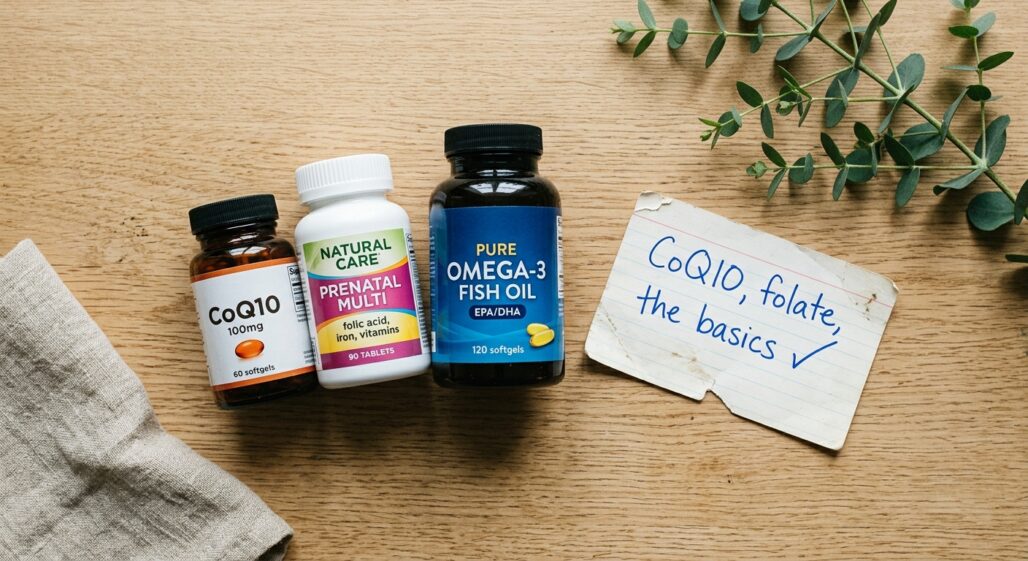
If you and your partner are trying to conceive, the supplement aisle promises a lot: "fertility blends," "egg quality" capsules, "male potency" stacks, all at confident prices. The honest version is shorter and cheaper than the marketing, and it applies to both of you, not just the partner carrying the pregnancy. The two or three picks I'd actually keep in our own family's cabinet during a trying-to-conceive stretch are at the bottom of this guide.
This article sorts fertility supplements by how strong the evidence is, splits what matters for eggs versus sperm, and is blunt about where the science is thin.
Affiliate disclosure: this article contains affiliate links. As an Amazon Associate, UsefulVitamins.com earns from qualifying purchases at no extra cost to you.
Before you decide

A supplement is an adjunct, not a fertility treatment. If you have been trying for 12 months (or 6 months if the partner with ovaries is over 35) without success, the first move is a workup with an OB-GYN or reproductive endocrinologist, not a bigger supplement order.
Some people should not self-prescribe here. If you have a thyroid disorder, a clotting disorder, take blood thinners, or are managing a diagnosed condition, clear any new supplement with your physician first. CoQ10 and omega-3 in particular interact with anticoagulants.
The single best fertility "supplement" for most couples is unglamorous: a prenatal-quality diet, a healthy weight, no smoking, and limited alcohol. Supplements earn their place by closing a real nutrient gap or supporting cell quality, not by replacing those basics. You can see how I weigh evidence and conflicts of interest on the how we review supplements page.
What affects fertility, for both partners

Fertility is a two-person system, and roughly a third of cases trace to the female partner, a third to the male partner, and a third to both or neither. That's the framing most "fertility supplement" lists quietly skip by addressing only eggs.
On the egg side, the numbers that matter are ovarian reserve (how many eggs remain) and egg quality, which declines with age as the energy-producing machinery inside the egg becomes less efficient. Ovulation itself can be disrupted by conditions like PCOS or thyroid dysfunction, which is why a diagnosis changes which supplement, if any, makes sense.
On the sperm side, a standard semen analysis looks at three things: concentration (count), motility (how well they swim), and morphology (shape). Sperm are produced continuously over roughly a 70-to-90-day cycle, which is why male-side changes take about three months to show up and why supplement trials run that long.
A registered-dietitian point worth stating plainly: most of these nutrients are also in food, and a broad diet covers the requirement for many people. Supplements close the gap when the diet doesn't, when absorption is impaired, or when age-related cell quality is the bottleneck.
Strongest-evidence supplements
These three have the most credible human trial support for fertility-relevant outcomes. Notice that two of them apply to both partners.
CoQ10 (coenzyme Q10 / ubiquinol)
Why it helps: CoQ10 is central to how mitochondria produce energy, and both eggs and sperm are unusually energy-hungry cells. The theory is that supporting mitochondrial function supports the cell quality that declines with age.
What the trials show: In a randomized controlled trial of low-prognosis young women with reduced ovarian reserve, CoQ10 pretreatment improved ovarian response and embryo quality and cut cancelled transfers (8.3% vs 22.9%), though it did not significantly move live-birth rates. On the male side, a double-blind RCT of 228 men found 200 mg of ubiquinol daily for 26 weeks raised sperm motility from about 25% to 36% versus placebo.
Dose used in trials: Commonly 200 to 600 mg per day, often as ubiquinol for absorption, taken for at least three months before judging effect.
Skip if: You take warfarin or another anticoagulant without clearing it first, since CoQ10 can blunt the drug's effect. If you want the deeper dive on forms and dosing, see our best CoQ10 supplements guide.
Folate (folic acid or methylfolate)
Why it helps: This is the one supplement that is non-negotiable for the partner who may become pregnant, and it's about protecting the pregnancy rather than boosting conception. Adequate folate before and during early pregnancy prevents a large share of neural tube defects like spina bifida.
What the trials show: The US Preventive Services Task Force recommends that everyone planning or capable of pregnancy take 400 to 800 mcg of folic acid daily, ideally starting at least one month before conception, citing evidence that periconceptional folate prevents 50% or more of neural tube defects. The defect forms in the first weeks, often before a pregnancy is confirmed, which is why the timing is "before," not "once you see two lines."
Dose used in trials: 400 to 800 mcg daily for most; those with a prior affected pregnancy may be advised up to 4,000 mcg under medical supervision.
Skip if: Nothing to skip here for most people, but if you carry an MTHFR variant or simply prefer it, the methylated form (L-methylfolate) is a reasonable choice. A standalone folate or a complete prenatal both work; see our best prenatal vitamins comparison.
Vitamin D
Why it helps: Vitamin D receptors sit in reproductive tissue in both sexes, and low vitamin D status tracks with poorer IVF outcomes in observational data, though correlation isn't proof.
What the trials show: A 2023 systematic review and meta-analysis found vitamin D supplementation associated with improved reproductive outcomes in infertile patients, while noting the evidence remains mixed and that benefit is clearest when correcting a true deficiency rather than topping off a normal level.
Dose used in trials: Depends entirely on your starting level. The NIH Office of Dietary Supplements considers below 20 ng/mL deficient; correcting that usually takes 1,000 to 2,000 IU daily, sometimes more under guidance.
Skip if: Your level is already adequate. This is a test-first nutrient, not a guess-the-dose one — ask your doctor for a 25-hydroxyvitamin D blood test before assuming you're low, because high-dose vitamin D taken indefinitely without a deficiency is the kind of overshoot that just stacks up.
For her vs for him

The split below is where most generic lists fall short. The same condition often points to a different supplement depending on which partner has it.
| Supplement | Primarily for her | Primarily for him | Evidence note |
|---|---|---|---|
| Folate | Yes, essential preconception | Minor, not a priority | Strong for neural tube defect prevention |
| CoQ10 | Egg quality, low ovarian reserve | Sperm motility and count | Most consistent both-partner signal |
| Vitamin D | If deficient | If deficient | Benefit mainly in correcting deficiency |
| Myo-inositol | PCOS-related ovulation only | Not established | Limited, condition-specific |
| Omega-3 | Supportive, pregnancy-relevant | Possible semen-quality benefit | Mixed, mechanism plausible |
For her, beyond folate and any deficiency correction, myo-inositol is worth a conversation only if PCOS is the issue. A 2024 systematic review informing the international PCOS guidelines found possible benefit for some metabolic and ovulatory measures but called the overall evidence "limited and inconclusive." If that's your situation, our best supplements for PCOS guide goes deeper.
For him, omega-3 fatty acids have the more plausible supporting story after CoQ10. A PRISMA systematic review found 14 of its included studies showed an association between omega-3 intake and at least one improved semen marker, though the authors stressed more research is needed.
Popular but evidence-thin
A few ingredients dominate "male fertility" and "egg quality" marketing on far weaker ground than their shelf space suggests.
Zinc and selenium for men are the clearest example. They appear in nearly every male fertility blend, but the NICHD-funded MOXI randomized trial found no association between zinc, selenium, or vitamin E levels and semen parameters or DNA fragmentation in men with normal baseline antioxidant status. The honest reading: correcting a documented deficiency may help, but loading these on top of an already-adequate diet has not earned its reputation.
Maca, ashwagandha, and proprietary "fertility blends" lean on small or surrogate-endpoint studies and a lot of testimonial. If you want to try one, treat it as an experiment with a defined stop date, and don't let it crowd out the basics or a proper workup.
What to look for when buying
A few decision shortcuts keep you from overpaying for marketing.
Favor third-party testing. Look for USP Verified, NSF Certified, or ConsumerLab seals, which independently check that the product contains what the label claims.
Read the form and dose, not the front of the bottle. For CoQ10, ubiquinol absorbs better than ubiquinone for many people; for folate, either folic acid or L-methylfolate is fine; for omega-3, check the actual EPA and DHA milligrams, not just "fish oil 1000 mg."
Skip proprietary blends that hide per-ingredient amounts. If a "fertility complex" lists a single combined milligram figure for ten ingredients, you can't tell whether any one of them is at a studied dose, and that's a reason to pass.
When to see a specialist
Supplements support; they do not diagnose or treat. See a clinician rather than reaching for another bottle if you've been trying for 12 months (or 6 months if the female partner is over 35) without success, have irregular or absent periods, have a known condition like PCOS or endometriosis, or have had a prior semen analysis flagged as abnormal.
A reproductive endocrinologist can order the tests that tell you which lever actually matters: ovarian reserve markers, a semen analysis, thyroid and prolactin labs, and that vitamin D level. The supplement that helps is the one that closes a gap your workup reveals, which is a very different thing from a blind stack.
FAQ
How long before trying to conceive should we start fertility supplements?
Start folate at least one month before conception, ideally three. For CoQ10 and other cell-quality supplements, give them about three months, since that matches both the sperm production cycle and the window over which eggs mature before ovulation.
Should both partners take supplements, or just the woman?
Both, when there's a quality concern. Folate is for the partner who may become pregnant, but CoQ10 and omega-3 have male-side evidence, and male factor accounts for roughly a third of infertility. Ignoring the male partner is the most common gap in "fertility supplement" advice.
Is a prenatal vitamin enough on its own?
For many couples it covers the essentials, especially folate, iron, and often vitamin D. A prenatal plus correcting any tested deficiency is a reasonable baseline; CoQ10 is the most likely add-on if egg or sperm quality is the concern.
Do fertility supplements work if we have an actual diagnosis like PCOS or low sperm count?
They may help at the margins, but a diagnosis means a clinician should lead. Myo-inositol for PCOS and CoQ10 for low motility have the most relevant data, yet both sit alongside medical care, not instead of it.
The bottom line on fertility supplements
If you scan only the green box and this paragraph, here's the whole article: the evidence-backed core is a folate-containing prenatal for the partner who may conceive, CoQ10 for either partner when egg or sperm quality is in question, and correcting a real vitamin D deficiency. Myo-inositol earns a look for PCOS, omega-3 is a reasonable male-side add, and most everything else is thinly supported.
The realistic effect size matters: these supplements may improve quality markers and, in some trials, intermediate outcomes, but they are adjuncts to the standard of care, not a substitute for a fertility workup. Spend on the basics, test before you guess at vitamin D, and treat a stalled timeline as a reason to see a specialist, not to buy a bigger blend.
Next steps:
- Pick a folate-containing prenatal and start it before conception (best prenatal vitamins)
- Ask your doctor for a vitamin D level and, for the male partner, a semen analysis
- Add CoQ10 for either partner if egg or sperm quality is the concern
Reviewed by Sarah Thompson, Registered Dietitian, focused on vitamin and mineral nutrition. See more from Sarah Thompson. This article is educational and is not a substitute for individualized medical advice; talk to your doctor or a fertility specialist before starting a supplement, especially if you are managing a diagnosed condition or taking medication.
Recommended Products


As an Amazon Associate, UsefulVitamins.com earns from qualifying purchases at no extra cost to you. We only recommend products supported by published research or third-party testing.
