
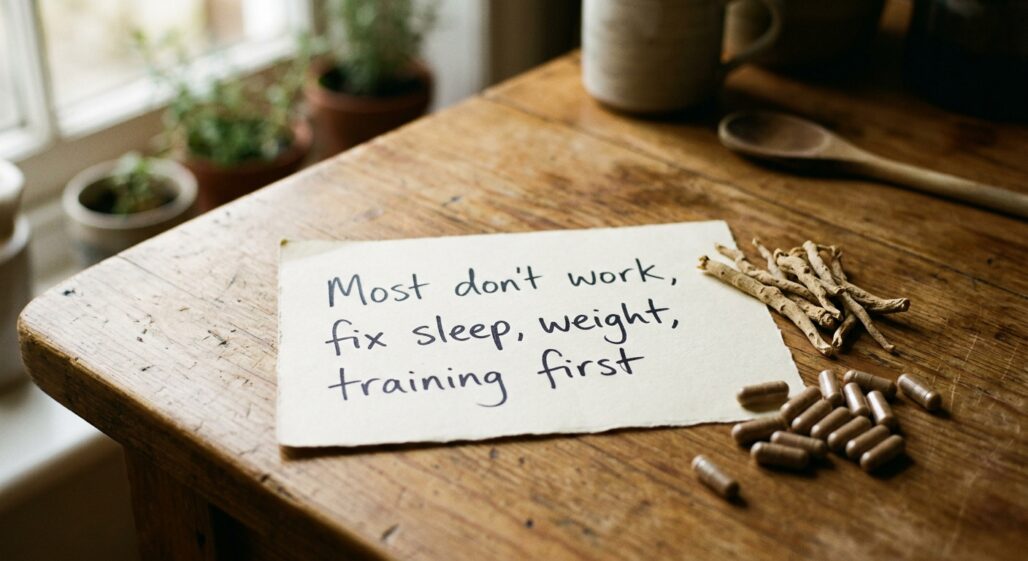
If you are searching for the best testosterone boosters, you are probably tired, foggy, training hard with nothing to show for it, or watching the number on a lab report drift down. The honest short answer: most testosterone boosters do not raise testosterone in healthy men, and the few with real evidence move it modestly, not dramatically. I will walk through what the randomized trials actually show, which supplements only help if you are genuinely deficient, and which ones I would skip on safety or null-data grounds. The handful I would actually point my own brother or father to are at the bottom, after the basics, not the marketing.
Affiliate disclosure: this article contains affiliate links. As an Amazon Associate, UsefulVitamins.com earns from qualifying purchases at no extra cost to you.
Before you decide
If you have real symptoms, low energy, low libido, depressed mood, loss of morning erections, get a morning total testosterone test (drawn before about 10 a.m., ideally repeated on a second day) ordered by a clinician before you buy anything. Symptoms alone are a poor guide, and a single afternoon reading is close to useless.
An over-the-counter booster is not testosterone replacement therapy. None of these supplements are TRT, and none should be used to self-treat diagnosed hypogonadism. The American Urological Association testosterone deficiency guideline reserves actual treatment (and its alternatives like hCG or SERMs) for a clinician to manage, because raising testosterone the wrong way can suppress fertility and carries cardiovascular and prostate monitoring needs.
One ingredient deserves an early flag: fadogia agrestis. There are no published human safety studies on fadogia, and rat data show adverse changes in testicular function. That is not a footnote; it is the reason I treat it differently from the rest of the list.
If you are functionally impaired by low-T symptoms, the conversation is a clinician first, supplements second. A tub of capsules is not a substitute for a diagnosis.
What a "testosterone booster" actually is
A "testosterone booster" is a marketing category, not a pharmacological one. The label covers any herb, mineral, or amino acid sold on the promise of raising your own testosterone production, usually through some claimed nudge to luteinizing hormone, the HPG (hypothalamic-pituitary-gonadal) axis, or aromatase.
The mechanisms are real on paper. The problem is the gap between a mechanism in a petri dish or a rat and a measurable change in a healthy man's blood.
When researchers actually checked, the gap was wide. A 2023 systematic review in the International Journal of Impotence Research examined 27 proposed testosterone boosters across 52 studies and concluded that most fail to increase total testosterone, with the few exceptions clustering in specific groups like athletes or men with late-onset hypogonadism. For a fuller ingredient-by-ingredient verdict on which of those claims survive randomized trials, see our breakdown of whether testosterone boosters actually work.
Conventional first-line care for genuinely low testosterone is supervised testosterone therapy, not a supplement. Keep that as the reference point while reading the rest of this list.
Strongest evidence: ashwagandha
Ashwagandha (Withania somnifera) is the only entry I would call genuinely evidence-backed, and even here the effect is modest.
Mechanistically, ashwagandha is an adaptogen that downregulates HPA-axis output and lowers cortisol, and because cortisol and testosterone sit on a partial seesaw, lowering chronic stress signaling is a plausible route to a small testosterone bump. That mechanism is the most defensible one in this whole category.
The trial data back a real but small effect. In a 2015 RCT, Wankhede and colleagues in the Journal of the International Society of Sports Nutrition gave 57 young men 600 mg/day of a standardized root extract for 8 weeks; the ashwagandha group gained about 96 ng/dL of testosterone versus 18 ng/dL on placebo (p = 0.004), alongside strength gains.
In older men the signal is similar in size. A 2019 crossover trial by Lopresti and colleagues in the American Journal of Men's Health found a standardized extract was associated with a 14.7% greater testosterone increase and an 18% DHEA-S increase versus placebo in aging, overweight men, though subjective vitality improved in both arms.
Here is the traditional-versus-trial-dose detail most roundups skip. Traditional Ayurvedic use is grams of raw root powder daily; the RCTs that found a testosterone effect used roughly 300 to 600 mg of a concentrated, standardized extract (KSM-66 or Shoden). Those are not the same intervention, and a scoop of generic bulk root powder is not what was tested.
- Dose to look for: 300 to 600 mg/day of a standardized extract, taken consistently for at least 8 weeks.
- Skip if: you take thyroid, sedative, or immunosuppressant medication, or are pregnant, since ashwagandha can interact with these. Clear it with your clinician first.
Moderate and mixed: tongkat ali
Tongkat ali (Eurycoma longifolia) has more human evidence than most of this aisle, but the picture is mixed and weighted toward men who started low.
A 2022 meta-analysis in Medicina pooled five clinical trials and found a significant increase in total testosterone (SMD 1.352, 95% CI 0.565 to 2.138, p = 0.001), with the effect most convincing in the hypogonadal subgroup.
The caveat is in that last clause. The strongest tongkat signal is in men who were deficient or stressed to begin with, not in already-replete healthy men, and the authors themselves wrote that more research is needed before clinical use. We grade each of those trials, and the marketing claims that do not survive them, in our deeper look at whether tongkat ali actually works.
Trial doses cluster around 200 to 400 mg/day of a standardized water-based root extract (Physta is the most-studied form). For a deeper look at forms, dosing, and quality, see our guide to the best tongkat ali supplements.
- Worth considering if: you are older, chronically stressed, or have a documented low-normal level and want a botanical with at least some human trials.
- Skip if: you expect a big jump as a healthy young man, the data do not support that.
Only if you are deficient: zinc, magnesium, vitamin D, boron
This is the group most marketing exploits, because the underlying biology is real but conditional. These nutrients support normal testosterone production only when you are short of them; topping up a replete man does almost nothing. That deficiency-versus-replete decision rule is the single most useful filter for this whole category.
Zinc is a genuine cofactor for testosterone synthesis, and deficiency lowers it. But the NIH Office of Dietary Supplements zinc fact sheet puts the adult-male RDA at just 11 mg/day, an amount a normal diet covers, and correcting a deficiency restores a normal level rather than pushing it above normal. Mega-dosing zinc long-term can actually cause copper deficiency.
Vitamin D shows the same pattern cleanly. A 2019 RCT by Lerchbaum and colleagues in the European Journal of Nutrition gave middle-aged men with low testosterone 20,000 IU of vitamin D weekly for 12 weeks and found no effect on total testosterone. Earlier signals of benefit came specifically from vitamin-D-deficient men, which is the whole point.
Magnesium follows suit: useful if you are low (and many people are), with little testosterone effect once you are replete, as the trained-athlete ZMA trials showed. Boron has small short-term human data suggesting it may nudge free testosterone by shifting binding-protein levels, but the evidence is thin and I would not build a stack around it.
- Dose to look for: zinc 11 to 25 mg/day, magnesium glycinate 200 to 400 mg elemental, vitamin D dosed to a tested blood level (commonly 1,000 to 2,000 IU/day).
- Skip if: your labs already show you are replete, spending more will not buy you more testosterone.
Evidence-thin or risky: fadogia, tribulus, D-aspartic acid
Some ingredients are popular precisely because they are aggressively marketed, not because they work or are well-studied. Turkesterone is a textbook example — the only human trial to test it by name found no effect, as we detail in our review of the turkesterone evidence.
Fadogia agrestis is the one I flag hardest. There are no published human studies on its safety or efficacy, and a 2008 study by Yakubu and colleagues in the Journal of Ethnopharmacology found that 28 days of fadogia extract produced adverse changes in testicular function indices in male rats, with higher doses causing structural damage. A podcast made it famous; the toxicology did not catch up. I would not take it. If you want the study-by-study case, our full review of whether fadogia agrestis actually works traces every claim back to its single rat-study origin.
Tribulus terrestris is the original "T booster" and the original disappointment. It can support libido in some studies but repeatedly fails to raise testosterone in men, which is why our broader supplements for testosterone overview treats it as a libido-adjacent herb at best. If libido is your actual goal, the supplements for low libido guide is the better starting point.
D-aspartic acid looked promising in one early sedentary-men study, then collapsed. A 2015 RCT by Melville and colleagues in the Journal of the International Society of Sports Nutrition found 3 g/day did nothing and 6 g/day actually lowered testosterone in resistant-trained men. That is the opposite of the marketing.
What actually moves testosterone (do this first)
Before any pill, the biggest levers are behavioral, and they are not glamorous.
Sleep is the highest-yield lever, restricting healthy young men to about 5 hours a night drops daytime testosterone by 10 to 15% within a week. No supplement reverses chronic sleep debt.
Carrying excess body fat lowers testosterone because adipose tissue converts it to estrogen via aromatase, so losing visceral fat often raises free testosterone more than anything in a bottle. Resistance training and adequate protein support this; chronic overtraining without recovery does the opposite.
Actionable takeaway: fix sleep duration, body composition, alcohol load, and resistance training before spending a cent on a booster. These are the interventions with the largest, most reliable effect, and they are free.
What to look for when buying
A few rules keep you out of the worst products.
Favor a single standardized, studied extract over a 12-ingredient "proprietary blend." A blend that lists a 1,500 mg total without per-ingredient milligrams is hiding pixie-dust doses, you cannot match it to any trial. That opacity is the single biggest red flag in this category.
Look for third-party testing (USP Verified, NSF Certified for Sport, or ConsumerLab) because the booster aisle is poorly policed and some products have been found spiked with undeclared compounds. Match the form and dose to the trials: a standardized ashwagandha extract at 300 to 600 mg, not generic root powder; tongkat ali as a standardized water extract, not a vague "Longjack 10:1."
For how we vet forms, doses, and third-party testing, see how we review supplements.


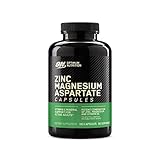
As an Amazon Associate, UsefulVitamins.com earns from qualifying purchases at no extra cost to you. We only recommend products supported by published research or third-party testing.
When to see a clinician, not buy a tub
Stop self-treating and book an appointment if you have persistent low libido, erectile dysfunction, unexplained fatigue, loss of morning erections, depressed mood, or infertility. These warrant a morning total testosterone test plus LH, FSH, and prolactin interpreted by a physician, not a guess from a supplement label.
If a real deficiency is confirmed, the management decision (including whether to treat, and how) belongs with an endocrinologist or urologist. Self-dosing OTC boosters can mask a treatable pituitary or testicular problem and delay care. Low testosterone with infertility, in particular, is a reason not to start testosterone on your own, since exogenous testosterone suppresses sperm production.
FAQ
Do testosterone boosters actually work?
For most healthy men, no. The largest systematic review of the category found most proposed boosters do not raise total testosterone. Ashwagandha is the best-supported exception, with modest single-digit-to-mid-teens percent gains.
Which testosterone booster has the most evidence?
A standardized ashwagandha extract at roughly 600 mg/day. Two RCTs show a real but modest testosterone increase, and the cortisol-lowering mechanism is plausible. It is not in the same league as prescription therapy.
Is fadogia agrestis safe?
There is no published human safety data, and rat studies show testicular harm at higher doses. Given that, I do not recommend it. The popularity is driven by media, not by safety testing.
Will zinc or vitamin D raise my testosterone?
Only if you are deficient. Correcting a shortfall restores a normal level; supplementing a man who is already replete shows little to no testosterone effect in trials.
The bottom line on the best testosterone boosters
The most defensible verdict is the least exciting one: the two or three supplements with any real evidence (a standardized ashwagandha extract, and tongkat ali mostly in men who started low) produce modest gains, while zinc, magnesium, and vitamin D only help if you are deficient. What separates this guide from the typical roundup is a clear deficiency-versus-replete decision rule plus an honest fadogia safety flag that most articles bury or omit. Supplements are an adjunct to the basics, not a replacement for them.
Next steps:
- Get a clinician-ordered morning testosterone test before buying anything if you have symptoms.
- Fix sleep, body fat, alcohol, and resistance training first, these move T more than any pill.
- Read our broader supplements for testosterone overview for forms and dosing detail.
This article is for informational purposes and not medical advice. Testosterone-related symptoms can signal underlying medical conditions, and supplements can interact with medications. Consult a licensed physician before starting any supplement, especially if you have low testosterone symptoms, take prescription medications, or are managing a chronic condition.
Reviewed by Jonathan Reynolds, ND, focused on botanical and naturopathic protocols. See more from Jonathan Reynolds, ND.
