
If you're on Wegovy, Zepbound, or another GLP-1 and wondering whether whey protein isolate is worth the premium over regular concentrate, the short answer is: yes, for most GLP-1 users — but not for the reasons most supplement brands emphasize. The lactose angle matters more than the protein percentage bump, and third-party testing matters more than any label claim. This guide covers five picks across a realistic price range ($0.90 to $1.67 per serving), a comparison table built around what actually matters for GLP-1 users, and one negative pick that keeps appearing in sponsored roundups.
Affiliate disclosure: this article contains affiliate links. As an Amazon Associate, UsefulVitamins.com earns from qualifying purchases at no extra cost to you.
Quick answer
Best fit for: GLP-1 users struggling to hit 100+ grams of protein on reduced calories, anyone with lactose sensitivity who has abandoned whey concentrate since starting their medication, and athletes on tirzepatide who need a verifiable third-party certificate.
Not ideal for: Vegans or anyone dairy-free for non-lactose reasons (see Best Protein Powder for GLP-1 Users 2026 for plant-based picks). Also less relevant if you are already meeting 1.2+ g/kg/day from food with no GI issues.
Decision shortcut: Nutricost if budget is the priority. Transparent Labs or Dymatize ISO100 if you want a full third-party audit trail.
Why isolate vs concentrate matters here {#isolate-vs-concentrate}
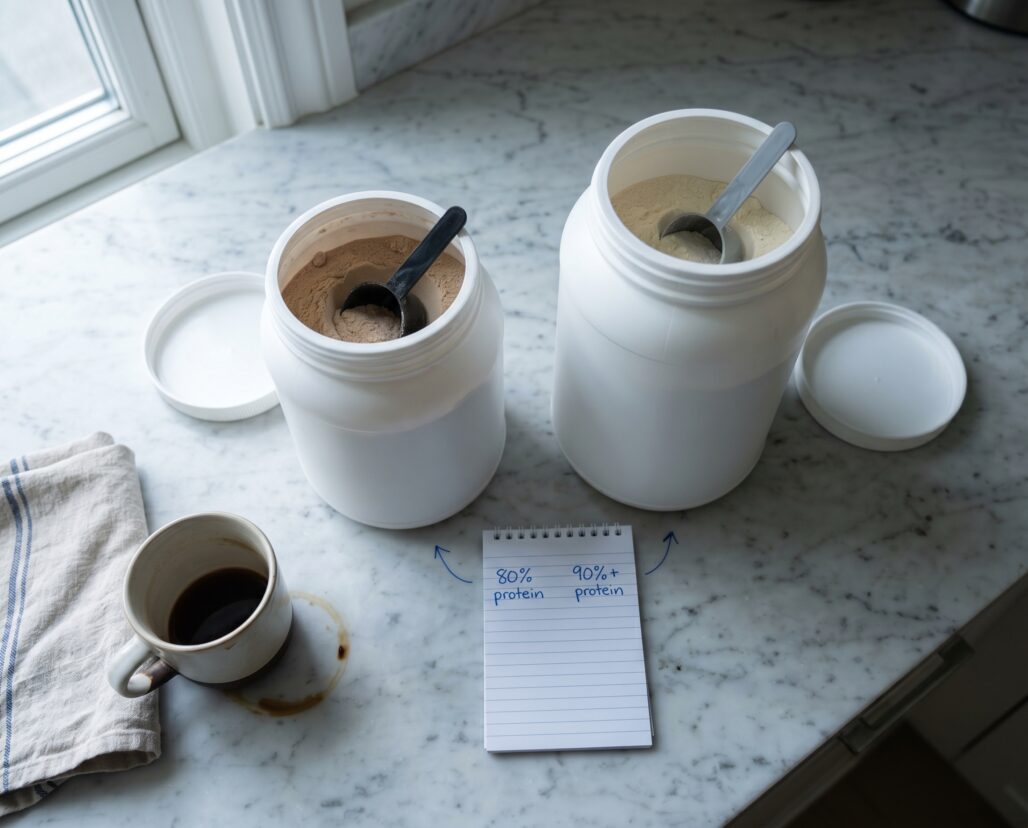
Whey concentrate is roughly 70-80% protein by weight, with 1-5g of lactose per serving in the remaining mass. Whey isolate goes through additional filtration (cross-flow microfiltration or ion exchange), removing most fat and lactose. A quality isolate lands above 90% protein by weight and carries under 1g of lactose per 25-30g serving.
For most people, that lactose difference is irrelevant. GLP-1 medications change the equation. Semaglutide and tirzepatide slow gastric emptying — think of it as traffic backing up at the exit ramp. Food leaves the stomach more slowly, which extends the transit window and amplifies any existing lactose sensitivity. Users who tolerated concentrate fine before starting Wegovy regularly report new bloating and GI distress after. The problem is usually the lactose sitting longer in the gut, not whey itself.
The higher protein density also matters when total calories are constrained. Getting 25-26g of protein from a 28g scoop versus 21-22g from the same volume adds roughly 28-35 grams of extra protein per week from the same number of servings — meaningful when appetite suppression limits how much you can drink.
Actionable takeaway: For GLP-1 users without lactose issues, concentrate is fine. For anyone who noticed new GI discomfort after starting a GLP-1, switching to isolate is the lowest-friction fix before writing off whey entirely.
How we picked {#how-we-picked}
We filtered major Amazon whey isolate listings against four criteria: protein purity above 88g per 100g of powder, lactose under 1g per serving, a verifiable third-party certificate (NSF for Sport, Informed Sport, Informed Choice, or ConsumerLab pass), and cost under $2.00/serving at the 2-pound size. We cross-referenced practitioner channels (Fullscript, Wellevate) for clinically stocked brands. We did not send products to a lab. Prices are based on Amazon listings at time of writing and shift frequently.
Comparison table {#comparison-table}
| Brand | Type | Protein/serving | Lactose/serving | Cost/serving | Third-party verified | Best for |
|---|---|---|---|---|---|---|
| Transparent Labs Whey Isolate | WPI | 28g | <1g | ~$1.67 | Yes (Informed Choice) | Most GLP-1 users, clean label |
| Naked Whey Isolate | WPI | 25g | <1g | ~$1.55 | Yes (Informed Sport) | Minimal-ingredient buyers |
| Nutricost Whey Isolate | WPI | 25g | <1g | ~$0.90 | Yes (GMP + ISO 17025 lab) | Budget-focused buyers |
| NOW Sports Whey Protein Isolate | WPI | 25g | <0.5g | ~$1.10 | Yes (Informed Sport) | Sensitive stomach, GI-prone |
| Dymatize ISO100 | Hydrolyzed WPI | 25g | <0.5g | ~$1.45 | Yes (Informed Choice) | Athletes, fastest absorption |
| Optimum Nutrition Gold Standard Whey | WPI/concentrate blend | 25g | ~1-2g | ~$1.20 | Partial (GMP only) | Skip — see below |
Top picks {#top-picks}
Top Pick: Transparent Labs Whey Protein Isolate {#transparent-labs}
Type: WPI (100% whey isolate, grass-fed)
Protein per serving: 28g from a 32g scoop
Lactose per serving: <1g
Third-party verified: Informed Choice
Why we picked it: Transparent Labs lists every ingredient with its source on the label, which is unusual in a category where vague claims are standard. The 28g protein per scoop is among the higher figures here, meaningful when total servings per day are limited by suppressed appetite. Informed Choice certification includes banned-substance screening. Stevia-based sweetening avoids sucralose, which some users find easier on GI tolerance.
Who should skip: Cost-sensitive buyers. At ~$1.67/serving, you are paying for the sourcing transparency and the audit certificate, not a measurably different protein molecule. Nutricost delivers near-identical amino acid composition for nearly half the price.
Actionable takeaway: Best default for GLP-1 users who want clean-label assurance and are not primarily budget-constrained.
Premium choice: Naked Whey Isolate {#naked-whey}
Type: WPI (grass-fed, cold-processed)
Protein per serving: 25g from a 30g scoop
Lactose per serving: <1g
Third-party verified: Informed Sport
Why we picked it: A single-ingredient product: whey protein isolate, nothing else. No sweeteners, flavors, gums, or lecithin. For GLP-1 users already managing a medication list who want to minimize additive exposure, the minimal-ingredient approach is defensible. Informed Sport certification clears the same banned-substance bar as Transparent Labs.
Who should skip: Anyone who wants flavored options or needs a ready-to-mix powder that dissolves cleanly in water alone. Unflavored WPI without lecithin clumps; it works best blended into a smoothie or coffee. Also skip if protein-per-dollar is the priority — Nutricost wins that comparison clearly.
Budget pick: Nutricost Whey Protein Isolate {#nutricost}
Type: WPI
Protein per serving: 25g from a 30g scoop
Lactose per serving: <1g
Third-party verified: GMP certified, ISO 17025 accredited lab
Why we picked it: Nutricost delivers a functional whey isolate at roughly $0.90 per serving. That is $0.77 less per serving than Transparent Labs — $23 saved over 30 days at one serving per day, from a product delivering essentially the same protein molecule. The explicit value comparison: Transparent Labs costs 85% more per serving and adds Informed Choice banned-substance screening plus grass-fed sourcing documentation. If you are not a drug-tested competitive athlete and are comfortable with GMP certification as your quality baseline, Nutricost provides the core benefit at lower cost.
Who should skip: Drug-tested competitive athletes — Nutricost's GMP and ISO 17025 lab testing is a quality baseline, not a banned-substance clearance. Informed Choice or NSF Sport certification is needed for competitive use. Also skip if you prefer no artificial sweeteners; the flavored versions use sucralose.
Best for sensitive stomach: NOW Sports Whey Protein Isolate {#now-sports}
Type: WPI
Protein per serving: 25g from a 29g scoop
Lactose per serving: <0.5g
Third-party verified: Informed Sport
Why we picked it: Cross-flow microfiltration plus Informed Sport certification produces one of the lower lactose figures on this list, under 0.5g per serving. For GLP-1 users whose GI sensitivity is already active — nausea and bloating as medication side effects — minimizing every potential irritant is worth a premium. NOW Sports is carried on Fullscript, which reflects a baseline clinical credibility that many Amazon-only brands lack.
Who should skip: Users sensitive to sucralose (the flavored versions use it). Also skip if a single-ingredient unflavored product is the priority — Naked Whey is the right call there.
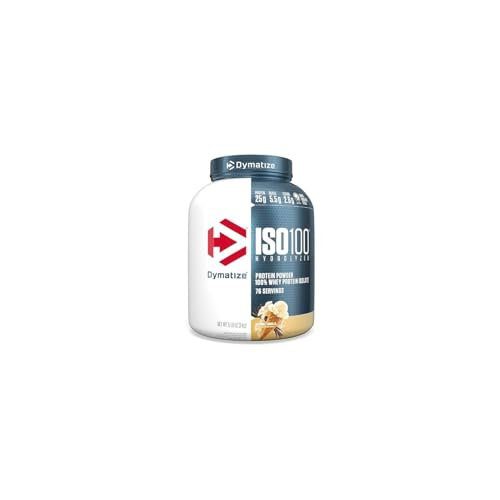
Best for athletes: Dymatize ISO100 {#dymatize-iso100}
Type: Hydrolyzed WPI
Protein per serving: 25g from a 31g scoop
Lactose per serving: <0.5g
Third-party verified: Informed Choice
Why we picked it: ISO100 uses hydrolyzed whey isolate — protein chains pre-broken into shorter peptides that absorb faster than standard WPI. The practical effect for a typical GLP-1 user having one shake per day is modest. For athletes on tirzepatide training in a fasted or heavily suppressed-appetite state who need the fastest post-workout amino acid delivery window, the hydrolyzed format has documented absorption advantages. Informed Choice certification makes it appropriate for drug-tested sport.
The real question is not whether hydrolyzed absorbs faster — it does. The question is whether that speed difference translates to measurably more muscle preservation for someone eating two small meals per day on a GLP-1. For most non-athletes, it probably does not. The exception is competitive athletes in a caloric deficit who train with a narrow post-workout window.
Who should skip: Non-athletes and general GLP-1 users — the hydrolysis premium does not translate to a meaningful outcome difference for general protein supplementation. Transparent Labs or Nutricost are better calls.
Brands and products to skip {#skip-these}
Skip: Optimum Nutrition Gold Standard Whey (standard version)
The standard ON Gold Standard is a concentrate-isolate blend, not a pure isolate. The label lists "whey protein isolate" as the first ingredient, which is accurate, but the product also contains whey concentrate, which brings real lactose into the serving — ON's own testing puts lactose at approximately 1-2g per serving. For GLP-1 users buying specifically for the low-lactose benefit, the blend undercuts the purchase rationale. You are paying a brand-recognition premium for a product that does not meet the isolate-purity standard this list is built around.
ON does make a dedicated Gold Standard 100% Isolate SKU that performs better on these criteria. But the default Amazon search result for "ON whey" usually surfaces the blend, not the isolate. Check the full product name before purchasing. "#1 best-seller on Amazon" should never be your only buying signal.
Skip: any isolate claiming "third-party tested" without naming the certifying body
A large share of Amazon whey isolate listings say "third-party tested" in the product description without identifying the lab, linking to a certificate, or offering batch-level verification. That phrase is unregulated and costs nothing to print. What to look for: the product explicitly names Informed Choice, Informed Sport, NSF for Sport, NSF Certified for Sport, or USP verification — or links to a ConsumerLab report. Anything vague is a marketing claim, not a quality standard.
How to dose and use whey isolate on GLP-1 {#dosing}
The protein target for GLP-1 users managing lean mass is 1.0-1.2g per kilogram of body weight per day — above the standard 0.8g/kg floor because rapid fat loss creates a catabolic environment. For a 90kg adult: 90-108g/day. A single isolate serving (25-28g protein) covers roughly 25-30% of that target; most users need one to two servings per day to close the gap.
Leucine triggers muscle protein synthesis (MPS) — the threshold from most MPS trials is approximately 2.5-3g of leucine per serving. Whey isolate at 25-28g protein delivers roughly 2.5-3.2g of leucine, placing a single serving at or near that threshold. Distributing protein across 3-4 daily shakes or meals, each clearing the leucine threshold, produces better lean-mass outcomes than one large bolus (JISSN 2020 review).
If morning nausea is an issue, a half-serving mixed into a smoothie or yogurt is often tolerated better than a full serving in water.
Side effects and interactions {#side-effects}
Whey isolate is well tolerated at 25-50g/day in adults without dairy allergy. Persistent GI discomfort after switching from concentrate to isolate is usually traceable to artificial sweeteners in flavored versions — try an unflavored variant before concluding that whey is the problem. No known pharmacokinetic interactions exist between whey protein and semaglutide or tirzepatide. If you have chronic kidney disease or your prescriber has noted elevated creatinine, confirm your protein target before significantly increasing intake.
One distinction to be clear on: lactose intolerance (a digestive enzyme deficiency) is different from milk allergy (an immune response to milk proteins). Whey isolate is not appropriate for dairy-allergic individuals even though it is low in lactose — both whey forms contain milk proteins.
FAQ {#faq}
How much whey isolate should I take per day on GLP-1?
One to two servings (25-50g protein from isolate) per day for most users. Calculate your food-derived protein intake first, then use isolate servings to close the gap to your 1.0-1.2g/kg/day target.
Is Nutricost just as good as Transparent Labs for GLP-1 protein goals?
For a non-athlete hitting daily protein targets, yes — both deliver above 83% protein by weight, both keep lactose under 1g per serving, both carry third-party quality documentation. Transparent Labs adds banned-substance screening (Informed Choice) and grass-fed sourcing disclosure. That matters for competitive athletes and buyers who specifically value those attributes. It does not produce meaningfully different MPS outcomes.
What is the difference between whey concentrate and whey isolate?
Concentrate is 70-80% protein by weight with 1-5g lactose per serving. Isolate is further processed to above 90% protein by weight with under 1g lactose per serving. The amino acid profile is similar; the meaningful differences are lactose content, protein purity, and price.
Is hydrolyzed whey isolate worth the premium for GLP-1 users?
For most GLP-1 users, no. The faster absorption rate benefits athletes in a narrow post-workout window, which is a specific scenario. For someone having one shake per day with a meal, the rate advantage does not translate to a measurable outcome difference.
As an Amazon Associate, I earn from qualifying purchases. Product recommendations are based on real reviews and independent research.
Related reading {#related-reading}
- Best Protein Powder for GLP-1 Users 2026 — whey, plant, and collagen options compared if you are not committed to isolate
- Best Pre-Workout for GLP-1 Users 2026 — pairing protein with exercise support on a GLP-1
- Supplements for GLP-1 Muscle Loss — the full evidence base for lean-mass protection
- Tirzepatide Complete Guide — context on why muscle preservation is a treatment-phase priority
Conclusion: the bottom line on whey protein isolate for GLP-1 users
Whey isolate earns its premium over concentrate for GLP-1 users specifically because the lower lactose content matters when gastric emptying is already slowed by medication. The protein density advantage is real but modest.
Transparent Labs is the default pick for clean-label assurance. Nutricost delivers the core benefit at lower cost. NOW Sports is the call for pronounced GI sensitivity. Dymatize ISO100 for drug-tested athletes. Naked Whey for a single-ingredient product without additives.
Skip any isolate that says "third-party tested" without naming the certifying body. That phrase is unregulated and verifies nothing.
Next steps:
- Calculate your food-derived daily protein before adding a supplement
- Use 1.0-1.2g/kg/day as your target; use isolate servings to close the gap
- Choose the pick that fits your budget and GI tolerance — not the highest Amazon star rating
- If GI discomfort persists with isolate, remove artificial sweeteners as the next variable
- For the full supplement context on GLP-1 therapy, read Supplements for GLP-1 Muscle Loss
This article is for informational purposes and not medical advice. Whey protein isolate is a food supplement. Consult a licensed physician or registered dietitian before making significant changes to your protein intake, particularly if you are pregnant, nursing, taking prescription medications, managing kidney disease, or another chronic condition.
As an Amazon Associate, I earn from qualifying purchases. Product recommendations are based on real reviews and independent research.
