
Affiliate disclosure: this article contains affiliate links. As an Amazon Associate, UsefulVitamins.com earns from qualifying purchases at no extra cost to you.
Before you decide
This article is general information, not medical advice. SSRIs treat depression and anxiety, and your treatment plan belongs to you and your prescriber, not a supplement label.
The people most likely to benefit from reading on are those whose mood has not lifted on an SSRI, anyone eating a limited diet, older adults, people who drink heavily, and those on medications that affect folate (such as methotrexate or some seizure drugs). For those groups, a B vitamin question is worth raising at the next appointment.
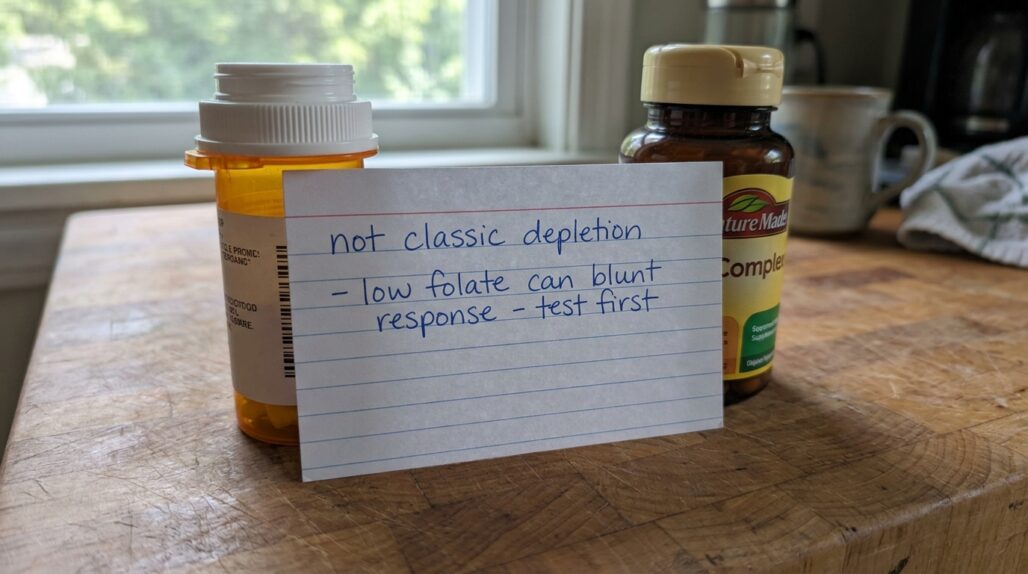
One framing trap is worth clearing up first. A lot of wellness content claims SSRIs "deplete" B vitamins by lumping them in with drugs that genuinely do. That claim is weak. The honest story is more specific, and it points toward testing rather than guessing.
What "depletion" really means – and why SSRIs are different
A true drug-induced nutrient depletion has a known mechanism. Metformin, for example, interferes with B12 absorption in the gut, so long-term users can develop a measurable, well-documented deficiency.
SSRIs do not work that way. There is no established pharmacologic pathway by which sertraline, escitalopram, fluoxetine or their cousins remove B6, folate or B12 from the body. The popular "SSRIs deplete B vitamins" lists circulating online lean on low-quality sources, not pharmacology references.
So the accurate statement is narrow. SSRIs are not B-vitamin thieves. If your folate or B12 is low while taking one, the more likely culprits are diet, malabsorption, age, alcohol, or another medication.
That distinction changes what you should actually do. With metformin and B12, periodic monitoring makes sense regardless of symptoms. With SSRIs, the smarter move is to check your levels only if response is poor, rather than reflexively adding pills.
The real link: low folate, low B12, and a weaker response
Here is where the evidence is genuinely interesting. Folate and B12 sit in the methylation cycle that helps build serotonin, dopamine and norepinephrine. When those nutrients run low, that machinery runs less smoothly.
In a study by George Papakostas and colleagues at Massachusetts General Hospital, patients with fluoxetine-resistant depression who had low serum folate responded far worse than those with normal folate. The numbers are striking: a 7.1% response rate in the low-folate group versus 44.7% in the normal-folate group. Low folate flagged who was likely to stay stuck.
A separate randomized trial by Coppen and Bailey tested the flip side – adding folate. Patients took fluoxetine plus either folic acid or placebo. Among women, folic acid lifted the good-response rate to 93.9% versus 61.1% on placebo. The benefit was much smaller in men, who appear to need a higher dose to shift their homocysteine.
B12 evidence is thinner and less consistent than folate, but some research links higher B12 status to better treatment outcomes over time. The signal is real enough to test for, not strong enough to promise anything.
So the mechanism is not depletion. It is that a pre-existing or dietary B-vitamin shortfall can blunt how well your antidepressant works. Fixing a genuine deficiency may help. Topping up someone who is already replete probably does not.
L-methylfolate: the evidence-based adjunct
If folate is the most-studied B vitamin here, L-methylfolate is the most-studied form. It is the active folate your brain can use directly, and unlike standard folic acid it crosses the blood-brain barrier more readily.
In the United States, prescription L-methylfolate (brand name Deplin) is regulated by the FDA as a medical food rather than an approved drug, intended for people with major depression who have suboptimal folate levels. That category matters: it is meant as an add-on to an antidepressant, under supervision, not a replacement.
The clinical-trial picture is mixed but real. In Papakostas's later adjunctive trials, adding 15 mg/day of L-methylfolate to an ongoing SSRI beat placebo, while 7.5 mg/day did not. The American Psychiatric Association lists folate, and L-methylfolate specifically, as a reasonable low-risk augmentation option for depression.
A reality check keeps this honest. A meta-analysis of folate and B12 trials found no meaningful short-term symptom reduction, with possible value only in longer-term management of select groups. Translation: this is an adjunct for specific people, decided with a clinician, not a quick fix for everyone on sertraline.


As an Amazon Associate, UsefulVitamins.com earns from qualifying purchases at no extra cost to you.
UsefulVitamins may earn a commission from purchases made through links on this page, at no extra cost to you. This never changes which products we recommend.
The B6 trap: more is not better
People reaching for a "B-complex to support my antidepressant" often end up taking far more B6 than they realize, because it hides in energy blends, stress formulas and multivitamins.
That is a problem, because high-dose B6 can cause sensory neuropathy – tingling, numbness and unsteadiness in the hands and feet. The NIH Office of Dietary Supplements sets the tolerable upper intake level for adults at 100 mg/day, and chronic gram-level dosing for many months has produced progressive nerve damage in case reports.
Two practical points follow. First, add up B6 across every product you take, not just the one labeled "B6." Second, Europe's food safety authority has set a far lower limit of 12 mg/day, a reminder that the safe ceiling is genuinely uncertain at the high end.
The symptoms usually ease if you stop early, but recovery is not guaranteed. There is no upside to megadosing B6 for mood, and a real downside.
Test first, then food, then a targeted supplement
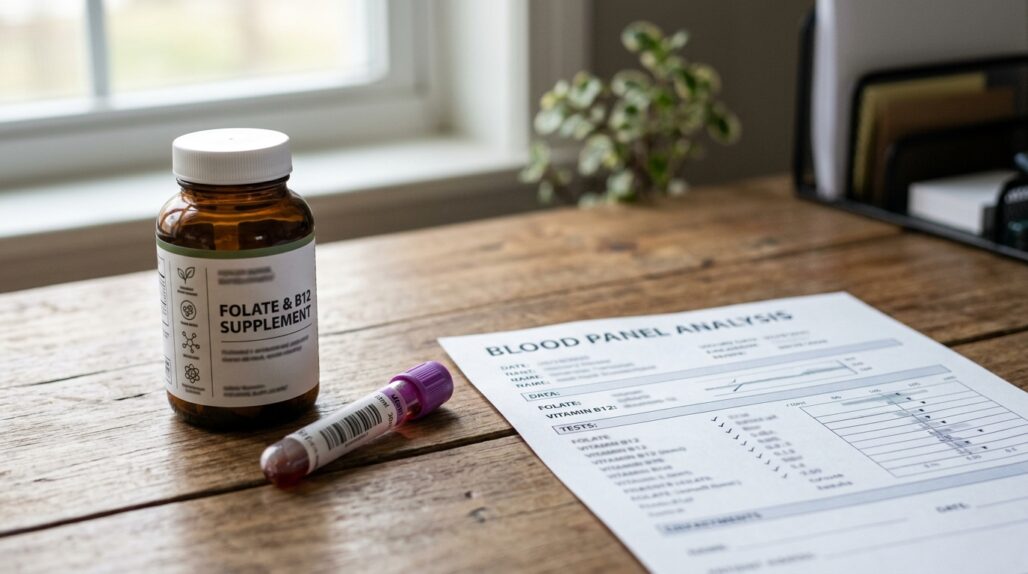
The thread running through all of this is sequence. Test before you treat. A simple blood panel for folate and B12 tells you whether you have a problem worth fixing, instead of spending money on a deficiency you do not have.
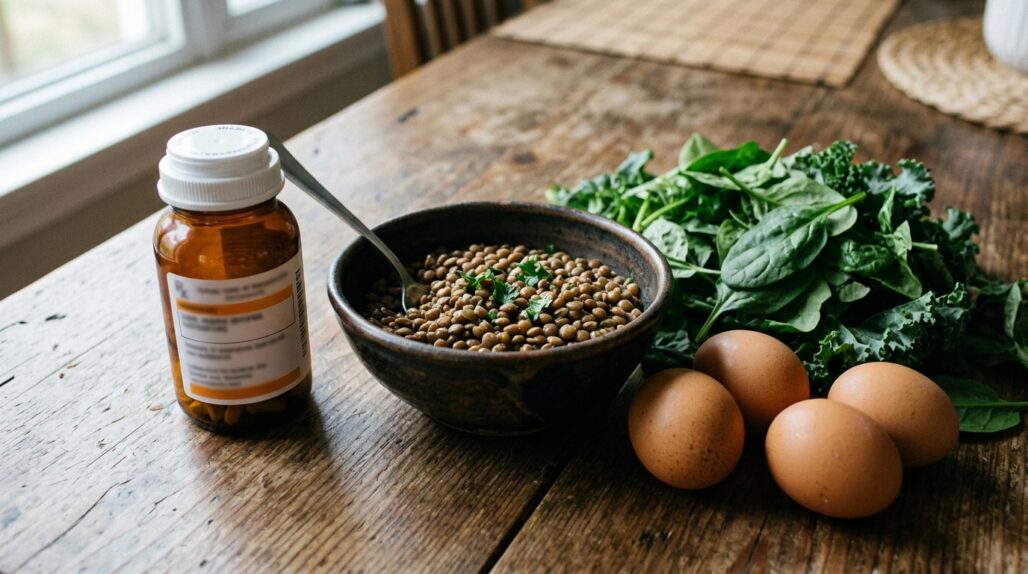
If a test comes back low, food is the cheapest correction. The NIH ODS folate sheet points to leafy greens, beans, lentils, citrus, eggs and fortified grains; B12 comes from meat, fish, dairy and fortified foods or a supplement if you eat plant-based.
When a supplement is warranted, a clinician can match the form to you. Our guides to folate supplements and B12 supplements cover the form differences in plain terms.
- Folate or L-methylfolate as an adjunct when folate is low or response is poor, dose decided clinically.
- B12 (including methyl-B12) when B12 is low, especially for older adults and vegans.
- B6 kept modest and counted across all products, well under the upper limit.
| B vitamin | SSRI relationship | Sensible step |
|---|---|---|
| Folate (B9) | Low folate linked to poorer, slower response; adjunct may help | Test; food first; L-methylfolate as a clinician-guided add-on |
| B12 | Mixed evidence; higher status may aid outcomes; no SSRI depletion | Test if at risk; replace only if low |
| B6 | No depletion link; high intake risks nerve damage | Keep under 100 mg/day total; count every product |
Keeping a clear list of everything you take makes that pharmacist conversation faster and safer. A free app like StackMyMed lets you log your medications and supplements and flag possible interactions to raise with a professional. It organizes the conversation; it does not replace clinical judgment.
For the wider picture, see our ultimate guide to drug-supplement interactions and run your own combination through the drug-supplement interaction checker.

When to involve a clinician or pharmacist
Some situations are worth a call rather than a search bar. Reach out promptly if your depression is not improving after a fair trial, since a folate or B12 check may be part of figuring out why.
Get medical advice if you notice persistent tingling, numbness, burning or unsteadiness, which can signal B6 excess or, less commonly, B12 deficiency. Do not write it off as stress.
And never stop or change a prescribed SSRI to try a supplement instead. Stopping abruptly can cause discontinuation symptoms, and a vitamin is not a substitute for an antidepressant. If you want to add folate, B12 or L-methylfolate, that is a shared decision with the person who prescribed your medication.
For mood-supplement context generally, our roundup of supplements studied for depression keeps the evidence in proportion.
FAQ
Do SSRIs deplete folate or B12? No. There is no established pharmacologic mechanism by which SSRIs remove folate, B12 or B6 from the body, which sets them apart from drugs like metformin that genuinely lower B12.
Should I take a B-complex with my antidepressant? Not automatically. If your folate or B12 is low or your response is poor, a clinician-guided supplement may help, but routine B-complex use offers no proven mood benefit if your levels are already normal, and it can push B6 too high.
What is L-methylfolate and is it better than folic acid? L-methylfolate is the active form of folate that crosses into the brain more easily. It is FDA-regulated as a medical food and is used as a prescribed adjunct to antidepressants in people with low folate, decided case by case.
Can too much vitamin B6 be harmful? Yes. High-dose B6 can cause sensory neuropathy. The adult upper limit is 100 mg/day, and the risk rises with chronic high doses, so total your B6 across every supplement you take.
Will folate make my SSRI work faster? Maybe, but only if you are actually low. Research suggests correcting a genuine folate shortfall may improve response, while short-term supplementation in people who are already replete has not clearly reduced symptoms.
Should I get my levels tested first? Yes. A simple folate and B12 blood test tells you whether supplementing is worthwhile, so you treat a real deficiency rather than guessing.
Conclusion: test, do not assume
SSRIs are not draining your B vitamins. The evidence-backed concern is the reverse – starting with low folate or B12 can hold your antidepressant back, and correcting a true shortfall, often with L-methylfolate, may help.
So skip the reflexive B-complex and the high-dose B6. Ask for a folate and B12 test, fix any gap with food and a targeted supplement chosen with your prescriber, and keep treating the depression as seriously as it deserves.
This article is for general education and is not a substitute for personalized medical advice. Talk to your doctor or pharmacist before starting, stopping or combining any medication or supplement.
Reviewed by the UsefulVitamins Editorial Team.
