
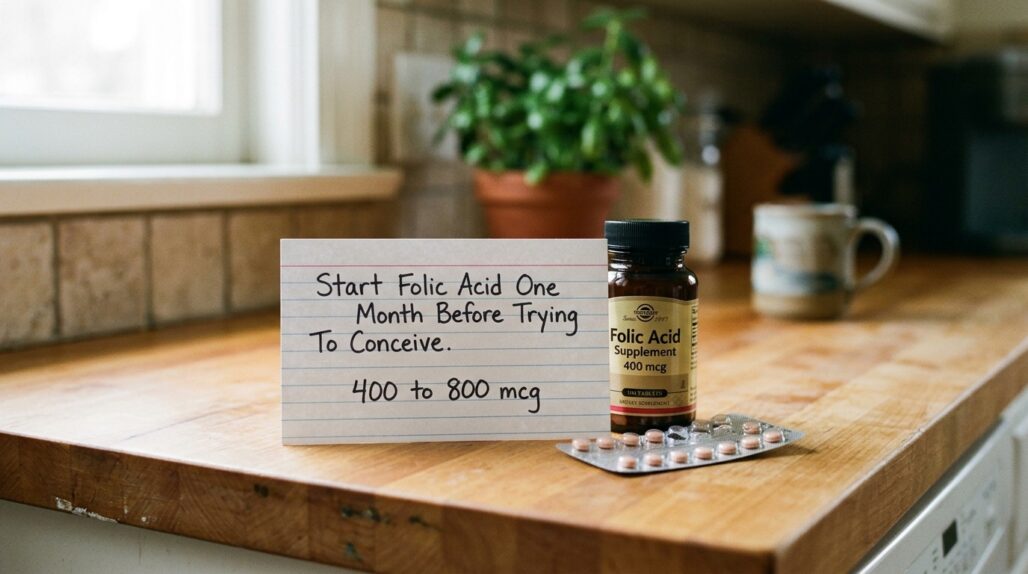
Before you decide
This is general information about preconception nutrition, not personal medical advice. Your dose and timeline should be confirmed with your own doctor, midwife, or pharmacist, who knows your history.
The people who benefit most from planning ahead are anyone who could become pregnant in the next few months. That includes those stopping the pill, the patch, the ring, an implant, an IUD, or the Depo shot.
The reason timing matters is biology, not marketing. The neural tube, which becomes the brain and spinal cord, closes in the first 3 to 4 weeks after conception. Many people do not realize they are pregnant that early, so the protective folate needs to already be on board.
So the short version is simple. Start early, take it daily, and do not wait for a positive test.
Why start folic acid before you even stop the pill
Folic acid is the synthetic, well-absorbed form of folate, a B vitamin your body uses to build DNA and close that early neural tube. Getting enough before conception is one of the most evidence-backed steps in all of preconception care.
The CDC tells clinicians that anyone planning pregnancy should start folic acid at least one month before conception and continue through pregnancy. Their blunt line is worth repeating: waiting until the first prenatal visit will not prevent neural tube defects, because by then the window has often closed.
The U.S. Preventive Services Task Force reaffirmed this as a grade A recommendation, its strongest tier. They advise all persons planning or capable of pregnancy take a daily supplement of 400 to 800 mcg of folic acid.
There is a second reason to start while you are still on birth control. Long-term oral contraceptive use is linked to lower levels of folate and several B vitamins, so beginning the supplement a month early gives depleted stores a chance to climb back up before you conceive.

How much, and when does the clock start
The numbers are refreshingly specific. For most people the target is 400 to 800 mcg of folic acid every day, and the protective window runs from about one month before conception through the first trimester.
You do not need a megadose. More is not better here, and a standard prenatal already lands in the right range.
There is one important exception. If you have had a previous pregnancy affected by a neural tube defect, the CDC recommends a much higher 4,000 mcg (4 mg) daily, started one month before conception and continued through the first three months. That dose is a prescription-level decision, so route it to your doctor rather than stacking it yourself.
| Situation | Typical folic acid target | When to start |
|---|---|---|
| Most people planning pregnancy | 400 to 800 mcg daily | At least 1 month before stopping contraception |
| Prior pregnancy with a neural tube defect | 4,000 mcg daily (clinician-directed) | 1 month before conception, through first trimester |
| Already pregnant, no prenatal yet | 400 to 800 mcg daily, start now | Immediately, do not wait for the appointment |
Think of the date you plan to stop preventing pregnancy and count backward at least four weeks. That earlier date is when the supplement should begin.
Does the pill leave you low on folate
This part gets oversold online, so here is the honest version. Oral contraceptives are associated with modestly lower folate and B vitamin levels, not a dramatic crash.
A widely cited review by Palmery and colleagues in the European Review for Medical and Pharmacological Sciences found that the pill is linked to lower levels of folic acid, vitamins B2, B6, B12, C and E, plus magnesium, selenium and zinc. The effect sizes vary, and for most people the dips are small.
Why it matters for conception is the overlap in timing. If folate is already running low when you stop the pill, and you conceive quickly, you have less of a buffer during that critical first month.
That is the practical case for the one-month head start. You are topping off the tank before the trip, not repairing major damage.
The folate angle is the one that tracks most directly to pregnancy outcomes, which is why it earns the early start. We cover the wider picture of pill-related nutrient changes in our guide to whether birth control depletes B vitamins, folate and magnesium.
Folic acid versus L-methylfolate and the MTHFR question
You have probably seen the MTHFR debate. Some people carry a common gene variant, MTHFR C677T, that makes the enzyme converting folic acid to its active form, 5-MTHF, work less efficiently.
According to the NIH Office of Dietary Supplements, roughly 25% of Hispanic, 10% of White and Asian, and 1% of Black individuals are homozygous for this variant. Supplements containing 5-MTHF (L-methylfolate) may be used more readily by people with the variant, since the body does not have to convert it.
Here is the part the supplement ads skip. ODS still states that all people who could become pregnant should get 400 mcg of folic acid, not 5-MTHF, even with an MTHFR C677T variant. The evidence base for preventing neural tube defects is built almost entirely on folic acid, not the methylated form.
So the practical guidance: folic acid is the default and the most studied for this exact job. If you already take a methylfolate prenatal you like, that is reasonable, but do not skip supplementation out of MTHFR worry. If you have a confirmed variant or a history of pregnancy complications, ask your clinician which form and dose fit you. Our breakdown of the best folate supplements walks through the form differences.
When will fertility actually return
A lot of anxiety around stopping birth control is really a fertility question. The reassuring news: stopping contraception does not damage long-term fertility, regardless of method or how long you used it.
A systematic review and meta-analysis of people discontinuing contraception found a pooled pregnancy rate of about 83% within the first 12 months, with no significant difference between hormonal methods and IUDs.
Where methods differ is in the speed of return, not the eventual outcome.
- Pills, patch, ring: fertility typically returns within a cycle or two, often the first month.
- Copper or hormonal IUD: fertility usually returns quickly once it is removed.
- Implant: ovulation generally resumes within weeks of removal.
- Depo (the shot): this one lags. It can take several months longer, sometimes around 10 months from the last injection, for ovulation to fully return.
That Depo lag is exactly why starting folic acid early is smart no matter your method. You want protective folate in place by the time ovulation comes back, however long that takes.
The detail of what to expect when stopping different methods is worth a longer read in our drug and supplement interactions hub, and you can sanity-check your full stack with the interaction checker.

What a good prenatal actually includes
You can take standalone folic acid, but most people planning pregnancy do better with a single daily prenatal that bundles the essentials.
Beyond 400 to 800 mcg of folate or folic acid, a solid prenatal usually provides iodine, choline, vitamin D, vitamin B12, and modest iron. Many also include omega-3 DHA, though that is sometimes a separate softgel.
A few practical pointers when you choose one:
- Confirm the folate dose lands in the 400 to 800 mcg range for general use.
- Look for third-party testing so the label reflects what is in the capsule.
- Take it with food if it upsets your stomach, and consistency beats perfection.
If you take other medications or several supplements at once, keeping an honest list helps your pharmacist catch overlaps and timing conflicts. The free StackMyMed app lets you log your prenatal and any prescriptions so you can flag the whole stack at your next visit. It is a record-keeping aid, not a substitute for your clinician's judgment.
For comparison shopping, see our roundups of the best prenatal vitamins and the broader complete guide to B vitamins.
When to talk to a clinician first
Most people can start a 400 to 800 mcg folic acid supplement on their own. A handful of situations call for a conversation before you do.
Loop in your doctor if you have had a prior pregnancy affected by a neural tube defect, take anti-seizure medication or methotrexate, have diabetes or obesity, have had bariatric surgery, or carry a known MTHFR variant. Each can change your target dose or form.
Seek prompt medical advice if you stop birth control and your periods do not return within about three months, especially after the Depo shot, or if you have trouble conceiving after 12 months of trying (or 6 months if you are over 35).
None of this is urgent in the emergency sense. It is the planning kind of care that pays off later.
FAQ
How long before stopping birth control should I start folic acid? Aim for at least one month before you stop preventing pregnancy. The CDC advises starting folic acid at least one month before conception, and the neural tube closes in the first few weeks, often before you know you are pregnant.
How much folic acid do I need? For most people planning pregnancy, 400 to 800 mcg of folic acid daily is the recommended range. People with a prior neural tube defect pregnancy may be advised to take 4,000 mcg under medical supervision.
Does the pill deplete folate? Oral contraceptives are linked to modestly lower folate and B vitamin levels, not a severe deficiency for most people. Starting folic acid a month early helps top off stores before you conceive.
Should I take folic acid or methylfolate if I have MTHFR? The NIH Office of Dietary Supplements still recommends folic acid for preventing neural tube defects, even with an MTHFR C677T variant, because the evidence is strongest for folic acid. If you have a confirmed variant, ask your clinician which form fits you.
How soon will I get pregnant after stopping the pill? Fertility usually returns within a cycle or two after stopping pills, the patch, or the ring. About 83% of people conceive within 12 months of stopping contraception. The Depo shot can delay the return of ovulation by several months.
Can I just take a prenatal instead of separate folic acid? Yes. A quality prenatal that contains 400 to 800 mcg of folate or folic acid covers the requirement and adds other nutrients like iodine and vitamin D. Check the label to confirm the folate dose.
Conclusion: start early, keep it simple
If pregnancy is the goal, the move is straightforward. Begin a 400 to 800 mcg folic acid supplement or a quality prenatal at least one month before you stop birth control, take it every single day, and continue through early pregnancy.
The pill may have left your folate a little low, fertility returns on its own timeline (slower after Depo), and the neural tube closes before most people miss a period. An early, daily, modest dose covers all three.
Your next step: pick a prenatal, set the start date a month ahead of when you plan to stop, and bring your supplement list to your doctor or pharmacist to confirm the dose is right for you.
This article is for general education and does not replace personal medical advice. Dosing and timing decisions, especially around pregnancy, should be made with your doctor, midwife, or pharmacist.
Reviewed by the UsefulVitamins Editorial Team.
