
If you're searching for how to buy adaptogens without getting misled by marketing, the short answer is: the label is the test, and most labels fail it. This article gives you a specific checklist for the three adaptogens with the strongest evidence base — ashwagandha, rhodiola, and lion's mane — covering the standardization markers that separate a real extract from an expensive powder, the third-party seals that mean something versus the ones brands invent, and the country-of-origin signals that predict heavy-metal contamination risk. You will also find the key drug interactions that require a prescriber conversation before you order anything, and three vetted product picks that clear every item on the checklist.
Affiliate disclosure: this article contains affiliate links. As an Amazon Associate, UsefulVitamins.com earns from qualifying purchases at no extra cost to you.
Summary: quick answer on buying adaptogens
Look for a standardized extract — not a crude powder — with a third-party certificate of analysis that names the active marker compound. Without that, the label tells you the plant is in the bottle, not whether the therapeutic compound is present at any useful concentration.
Best for using this checklist: Anyone considering ashwagandha for stress, rhodiola for fatigue, or lion's mane for cognitive support, especially buyers who have already been disappointed by a product that "didn't do anything."
Not a useful checklist for: Anyone on thyroid medication, immunosuppressants, antidepressants, or anticoagulants without first consulting their prescriber. The drug interactions for these adaptogens are specific and documented — see the interactions section before purchasing anything.
What to look at before buying: Standardization percentage for the active marker compound; which third-party organization ran the test (and whether it's an independent body or a brand's in-house lab); country of origin for the raw material, not just where the capsule was filled.
Decision shortcut: If a supplement bottle lists only the plant name and the weight of powder with no standardization percentage and no third-party seal, skip it. You're buying a bag of ground plant material, not a consistent extract.
What you'll find in this guide
- Why standardization labels matter more than the plant name
- The active marker compound checklist by adaptogen
- Third-party testing: which seals mean something
- Country of origin: what it actually signals for quality
- Red flags to avoid: proprietary blends, mycelium-on-grain, and contamination risk
- Drug interactions: the brief version
- Vetted product picks
- Frequently asked questions
Why standardization labels matter more than the plant name {#standardization-labels}
The adaptogen category has a labeling problem. A bottle can say "Ashwagandha Root 500mg" and legally contain a powder with almost any withanolide concentration — including close to zero. Withanolides are the steroidal lactones that RCTs associate with cortisol modulation and stress reduction. "Ashwagandha root powder" alone tells you nothing about how much of that compound you're actually getting.
Standardization is the extraction and verification process that guarantees a minimum percentage of the active marker compound per serving. When a product says "KSM-66 Ashwagandha Extract standardized to 5% withanolides," it means every batch was tested and confirmed to contain at least 5% withanolides by weight. That connects the product to the clinical-trial doses.
The real question isn't whether ashwagandha works in a lab study — it's whether what's in your bottle corresponds to what was used in the RCT that produced the result you're hoping for.
Buying a crude-powder adaptogen because the label says "ashwagandha root" is like buying olive oil labeled "Mediterranean blend" — the label tells you the geographic origin, not what's actually in it at what concentration.
This gap is not hypothetical. Independent testing from ConsumerLab's adaptogen supplement reviews has documented wide variation in active-marker content across commercial ashwagandha products, including products that failed to meet their own label claims. The variation correlates with whether a product uses a standardized extract or crude root powder.
Actionable takeaway: Before checking price or brand reputation, find the standardization percentage on the label. If it's not there, the product is not comparable to clinical-trial evidence regardless of what the marketing says.
The active marker compound checklist by adaptogen {#active-marker-checklist}
Different adaptogens have different active markers. The checklist is not the same across all three.
Ashwagandha: withanolides
The marker compound for ashwagandha is withanolides. The two extract families with the cleanest clinical evidence are KSM-66 and Sensoril, both patented standardized extracts.
- KSM-66: Standardized to 5% withanolides minimum. Root-only extract (Ixoreal Biomed proprietary). Used in the Chandrasekhar 2012 RCT (PMID 23439798) at 300mg twice daily.
- Sensoril: Standardized to 10% withanolides (root and leaf). Used in some anxiety and sleep trials at 125-250mg/day. Higher withanolide percentage doesn't always mean better outcome — the root vs. root-plus-leaf distinction means the compounds differ.
- Generic "ashwagandha extract": May claim 2.5% withanolides or give no percentage. Without independent batch verification, this is a guess.
Minimum to look for: 5% withanolides, from a named standardized extract (KSM-66 or Sensoril), with a COA available on request.
Rhodiola: rosavins and salidroside
For rhodiola (Rhodiola rosea), the active markers are a ratio of two compound families: rosavins and salidroside. The ratio that appears in most European clinical trials — including the Olsson 2009 fatigue RCT (PMID 19016404) using the SHR-5 extract — is 3% rosavins to 1% salidroside.
Salidroside is naturally present in rhodiola root; rosavins are more specific to Rhodiola rosea species versus cheaper Rhodiola crenulata, which is richer in salidroside but lower in rosavins. Products made primarily from Rhodiola crenulata can meet a "1% salidroside" claim while containing very little rosavin — which matters if rosavin-containing RCT evidence is the basis for the purchase.
The checklist for rhodiola:
- Is Rhodiola rosea (not crenulata) listed as the species?
- Does the label show 3% rosavins AND 1% salidroside, or just one of the two?
- Does the COA list both compounds independently?
Lion's mane mushroom: beta-glucans from fruiting body
Lion's mane (Hericium erinaceus) is the most misrepresented adaptogen category. The relevant compounds are beta-glucans — complex polysaccharides found in the cell walls of the fruiting body (the mushroom itself). Beta-glucan content drives the bulk of the evidence-based immune and neurotrophic activity.
Most commercial lion's mane in the US is grown as mycelium on a grain substrate, then dried and powdered. The resulting product contains substantial grain starch, diluting the beta-glucan percentage significantly. A product listing "Hericium erinaceus mycelium 500mg" may contain as little as 5-10% actual fungal beta-glucans.
The Mori 2009 RCT (PMID 18844328), which found improvements in mild cognitive impairment in 30 elderly adults over 16 weeks, used a fruiting body extract at 1g three times daily. The Nagano 2010 study (PMID 20834180) on anxiety and depression used the same fruiting body preparation.
The checklist for lion's mane:
- Does the label say "fruiting body" (not "mycelium" or "full spectrum")?
- Does it list a beta-glucan percentage (look for 25-40%+ for a quality extract)?
- Is there a COA showing the beta-glucan content independently verified?
Actionable takeaway: For all three adaptogens, the label must name the specific active marker compound and its concentration. A general "standardized extract" claim without a named compound and percentage is not standardization — it's marketing language.
Third-party testing: which seals mean something {#third-party-testing}
Third-party testing is the only way to verify that the standardization claim on the label corresponds to what's actually in the bottle — and to check that heavy metals, pesticides, microbial contamination, and undeclared fillers are within acceptable limits.
Not all third-party seals are equivalent. Here's the hierarchy:
USP Verified
USP Verified is the most stringent voluntary seal in the US dietary supplement market. USP (United States Pharmacopeia) tests for:
- Ingredient identity and potency (does the bottle contain what it claims, at the claimed dose)
- Contamination limits (heavy metals, microbial, pesticides)
- Dissolution testing (does the capsule break down appropriately in stomach acid)
- Manufacturing standards compliance (GMP audit)
Few adaptogen products carry USP Verified because the program requires ongoing batch testing and manufacturing audits, not a one-time certification. Seeing USP Verified on an adaptogen is a meaningful signal.
NSF Certified for Sport
NSF Certified for Sport tests for contamination and potency, plus screens for over 270 banned substances. Most relevant for rhodiola and ashwagandha used in athletic contexts. Requires annual re-testing.
Informed-Choice / Informed-Sport
Informed-Choice is a UK-based program with comparable scope to NSF Sport, widely used by European brands. Rhodiola products from Scandinavian or UK manufacturers frequently carry this seal rather than NSF.
ConsumerLab
ConsumerLab purchases products off retail shelves and tests them without brand involvement. A passing ConsumerLab review is meaningful precisely because the brand had no input into the process. Failing products are named publicly.
What NOT to trust
- In-house "Quality Assured" or "Lab Tested" badges on the brand's own website: These are unverifiable without independent confirmation. Any brand can design a badge.
- ISO certification alone: ISO 9001 (quality management process) does not verify what's in the bottle.
- COA from unnamed labs: A COA is only as credible as the testing organization. Ask whether the brand's COA comes from an ISO/IEC 17025-accredited laboratory — that's the testing-lab equivalent of being independently audited.
Actionable takeaway: Prioritize USP Verified, NSF Certified for Sport, Informed-Choice, or a recent passing ConsumerLab review. Everything else — including brand-generated seals and COAs from unknown labs — requires more scrutiny before you rely on it.
Country of origin: what it actually signals for quality {#country-of-origin}
Country of origin for the raw material matters for two distinct reasons: species authenticity and heavy metal contamination risk.
Ashwagandha: primarily India
Most commercial ashwagandha is grown and processed in India, and that is not inherently a quality concern — both KSM-66 (Ixoreal Biomed, India) and many Sensoril producers operate from India with rigorous internal testing. The concern is not geography but whether the raw-material supplier has been independently audited for heavy metals, pesticide residue, and species purity. The NCCIH ashwagandha fact sheet notes that liver injury cases have been reported in association with ashwagandha products — contaminated or adulterated raw material remains a plausible contributing factor in some of those reports.
Rhodiola: Russia, Scandinavia, and the Tibetan Plateau
Most SHR-5 extract used in European clinical trials originates from Siberian material processed in Sweden. Tibetan-plateau sources are increasingly common in US products and typically represent Rhodiola crenulata rather than rosea — a cheaper species with lower rosavin content. Multiple market-basket analyses have found products labeled "rhodiola rosea" that contained a different species upon botanical analysis. Check the Latin binomial on the label, not just the geographic description.
Lion's mane: China (quality varies)
Most lion's mane sold globally is grown in China — a starting point for due diligence, not a disqualifier. The relevant question is not "China yes or no" but whether the brand can provide a COA showing beta-glucan content, heavy metal levels (lead, cadmium, arsenic, mercury), and microbial counts from a named accredited testing laboratory. Real Mushrooms publishes batch-specific COAs with heavy metal results. That transparency is the standard to ask for, regardless of geography.
Actionable takeaway: Country of origin is a proxy for a harder question — does this brand have batch-level contamination data from an independent, accredited laboratory? Push for the COA. If the brand doesn't publish it or provide it on request, that is the red flag, not the geography alone.
Red flags to avoid {#red-flags}
Proprietary blends that hide dosing
A proprietary blend lists multiple ingredients with a total weight but no individual dose per ingredient. "Adaptogen Blend 1,200mg (ashwagandha root, rhodiola extract, holy basil leaf, schisandra berry)" tells you nothing about whether any individual adaptogen is present at a clinically relevant dose or just a token trace. Proprietary blends are legal, but they prevent you from evaluating the product against RCT doses.
Mycelium-on-grain mushroom products
As covered in the lion's mane section, mycelium grown on grain substrate contains starch dilution. The term "full spectrum" is used by some brands to normalize this — it sounds comprehensive but in practice means mycelium and fruiting body are mixed, often with the mycelium fraction predominating. Look specifically for "fruiting body" and a beta-glucan percentage. "Full spectrum" without a named beta-glucan content and percentage is a warning sign.
Heavy metal contamination risk in unstandardized powders
Ashwagandha root is a soil accumulator — it grows in mineral-rich dry soil and concentrates heavy metals accordingly. Products that use generic bulk root powder without batch heavy-metal testing data carry specific cadmium and lead risk. The FDA's dietary supplement cGMP regulation requires manufacturers to verify raw-ingredient safety, but routine batch-level testing is not mandated.
Adaptogens combined with stimulants
Some products combine adaptogens with caffeine or synephrine. This makes it impossible to attribute any perceived effect to the adaptogen specifically and creates additive stimulant risk for anyone sensitive to caffeine or taking cardiovascular medications.
Drug interactions: the brief version {#drug-interactions}
The adaptogens covered in this guide have documented pharmacological interactions that require a physician's input before use in specific populations. This section is a reference, not a clearance. For the comprehensive treatment, see Adaptogens and Medications: Interaction Reference.
Ashwagandha:
- Thyroid medications (levothyroxine, methimazole): Ashwagandha has stimulated TSH changes in case reports. The NCCIH ashwagandha fact sheet advises caution. Thyroid-medicated patients should not use ashwagandha without prescriber oversight.
- Immunosuppressants (cyclosporine, tacrolimus, biologics): Withanolides modulate immune function; combining with immunosuppressants creates unpredictable immune load.
- Sedatives and benzodiazepines: Additive CNS-depressant effect is plausible given ashwagandha's GABA-receptor activity, though human interaction trials are lacking.
- Pregnancy: Avoid. Traditional use includes ashwagandha as an abortifacient at high doses; modern clinical data on pregnancy safety is absent.
Rhodiola:
- Antidepressants (SSRIs, SNRIs, MAOIs): Rhodiola has mild monoamine-modulating activity. The risk of serotonergic interaction — though lower than with St John's Wort — is documented in pharmacology literature and flagged by Memorial Sloan Kettering's integrative herbs database.
- Stimulants: Rhodiola is mildly stimulating; combining with caffeine or other stimulants in high doses can produce excessive activation, agitation, or insomnia.
- Anticoagulants: Some in vitro data suggest platelet-aggregation effects; caution advised with warfarin or other anticoagulants pending human data.
- Pregnancy and breastfeeding: Insufficient safety data; avoid.
Lion's mane:
- Anticoagulants: Animal models have suggested lion's mane may affect platelet aggregation. Per Memorial Sloan Kettering's integrative herbs database, patients on blood thinners should consult their physician.
- Diabetes medications: Mild blood-glucose-lowering effects observed in animal studies; clinical relevance in humans is unestablished but warrants monitoring in medicated diabetics.
- Known mushroom allergies: Cross-reactivity is possible. Anyone with a documented mushroom allergy should confirm no reactivity with their allergist before trialing lion's mane.
Vetted product picks {#product-picks}
The three products below clear the standardization, third-party testing, and country-of-origin items on this checklist. Amazon card placeholders indicate where buy-links will appear.
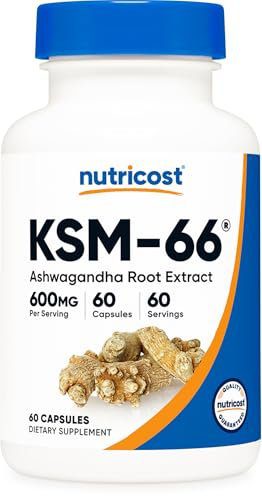
Our pick for ashwagandha: Nutricost Ashwagandha KSM-66
KSM-66 extract standardized to 5% withanolides, with third-party testing disclosure and a root-only sourcing specification that maps directly to the Chandrasekhar 2012 and Choudhary 2017 RCT preparations. Skip if you are on thyroid medication or immunosuppressants.
Our pick for rhodiola: Pure Encapsulations Rhodiola
Rhodiola rosea sourced to species-verified material, standardized to 3% rosavins and 1% salidroside. Pure Encapsulations products are manufactured in a NSF-certified facility and undergo independent potency verification. Well suited for fatigue and athletic-stress applications where the Olsson 2009 SHR-5 trial evidence is the reference. Skip if you are on SSRIs, SNRIs, or MAOIs.
Our pick for lion's mane: Real Mushrooms Lions Mane
Fruiting-body-only extract, standardized to a verified beta-glucan percentage, with batch-specific COAs published on the brand's website showing heavy metal results (lead, cadmium, arsenic, mercury). No mycelium-on-grain filler. The benchmark against which other lion's mane products should be measured. Skip if you have a documented mushroom allergy.
As an Amazon Associate, I earn from qualifying purchases. Product recommendations are based on real reviews and independent research.
Frequently asked questions {#faq}
What does "standardized to X%" actually mean on a label?
It means the manufacturer has extracted and concentrated the plant material to guarantee a minimum percentage of a specific active compound per serving. A product standardized to 5% withanolides will contain at least 50mg of withanolides in a 1,000mg serving. Without standardization, the withanolide content of a crude root powder can vary by an order of magnitude between batches from different suppliers.
Is a certificate of analysis (COA) the same as a third-party seal?
No. A COA is a batch-specific lab report; a third-party seal (USP, NSF, Informed-Choice) means an independent organization audited the manufacturing process and ongoing quality control, not just one batch. A COA from an ISO/IEC 17025-accredited lab is valuable; a COA from an unnamed lab is less so. When in doubt, the seal is the stronger signal.
Can I trust "full spectrum" mushroom products?
"Full spectrum" has no regulated definition. In practice it most often means dried mycelium grown on grain substrate, with the grain starch included — not a balanced fruiting-body and mycelium combination. Unless the label shows a named beta-glucan percentage and a COA confirming that figure, treat "full spectrum" as marketing language.
Why does country of origin matter if the brand is US-based?
"Manufactured in the USA" describes where capsules were filled, not where the botanical raw material was grown and extracted. Most adaptogen raw material comes from India (ashwagandha), Russia/Scandinavia (rhodiola), or China (mushrooms). The origin of the raw material determines heavy-metal risk and species-authenticity risk. Ask for the raw-material origin, not the finished-product manufacturing location.
What's the minimum a label needs to show before I buy?
Species name (Latin binomial), plant part used, standardization percentage for the named active compound, and a third-party seal or COA from an identifiable accredited lab. Price is not a proxy for quality — expensive products routinely fail these criteria.
Do adaptogens expire or lose potency on the shelf?
Yes. Withanolides and rosavins degrade with heat, light, and humidity. Most capsule products carry a 2-year shelf life when stored appropriately (cool, dark, dry). Check the expiration date. A bathroom cabinet above a radiator is a poor storage location.
Related reading
- Complete Guide to Adaptogens: Evidence, Uses, and What the Research Actually Shows
- Adaptogens FAQ: Your Top Questions Answered
- Best Ashwagandha Supplement: A Standardization-First Buyer's Guide
- Best Rhodiola Supplement: What the SHR-5 Evidence Points To
- Best Lion's Mane Supplement: Fruiting Body vs Mycelium, Tested
This article is for informational purposes and not medical advice. Herbal adaptogens — even traditional ones — can interact with thyroid medication, antidepressants, anticoagulants, immunosuppressants, blood-pressure drugs, and more. Consult a licensed physician before starting any adaptogen, particularly if you are pregnant, nursing, taking prescription medications, or managing a chronic condition.
As an Amazon Associate, I earn from qualifying purchases. Product recommendations are based on real reviews and independent research.
This article is for informational purposes and not medical advice. Herbal adaptogens, even traditional ones, can interact with thyroid medication, antidepressants, anticoagulants, immunosuppressants, blood-pressure drugs, and more. Consult a licensed physician before starting any adaptogen, particularly if you are pregnant, nursing, taking prescription medications, or managing a chronic condition.
