
Affiliate disclosure: this article contains affiliate links. As an Amazon Associate, UsefulVitamins.com earns from qualifying purchases at no extra cost to you.
What the human evidence actually covers
NMN (nicotinamide mononucleotide) is a precursor your body converts into NAD+, a coenzyme that powers cellular energy and DNA repair. NAD+ falls with age, which is the whole pitch behind taking NMN.
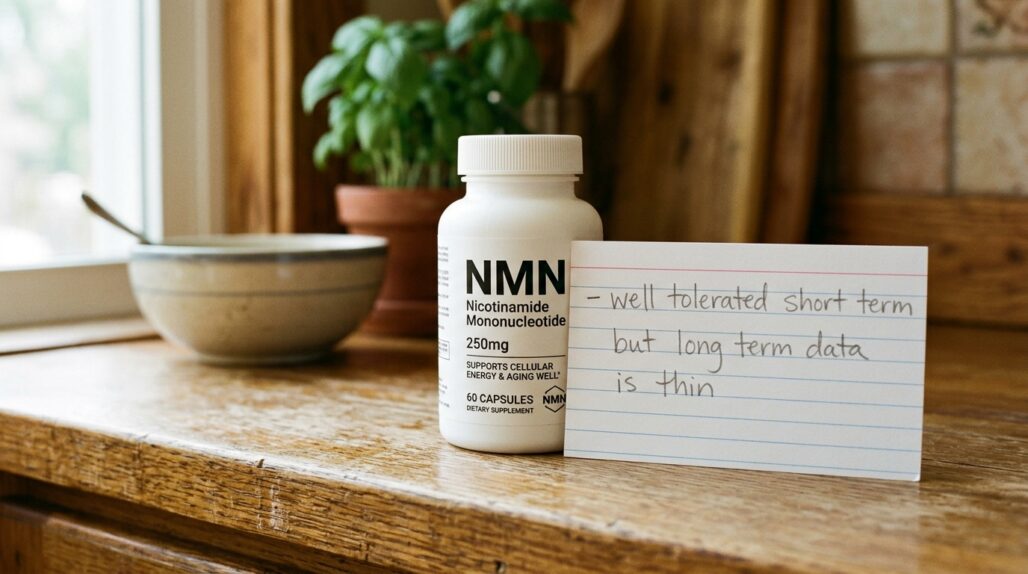
Here is the honest framing. The published human trials are short. They run weeks, not years, and they were mostly designed to check tolerability and whether NMN actually raises blood NAD+, not to track decades of safety.
So when a label or an influencer says NMN is "proven safe for daily use," that claim is running well ahead of the data. The accurate version is narrower: at studied doses, for the studied weeks, in mostly healthy adults, NMN did not cause serious harm. What happens at year three is genuinely unknown.
That gap is the single most useful thing to understand before you commit. If you want a target number rather than a range, our NMN and NR dose calculator walks you to a starting dose; this page is the safety reasoning around it.
What short human trials have shown
A few well-run trials anchor the tolerability picture, and they line up reasonably well.
A 12-week randomized trial gave healthy subjects 250 mg of NMN a day (split as 125 mg twice daily) and reported no abnormalities in liver function, kidney function, or blood counts, and no serious adverse events in either group. You can read the published trial in the Okabe et al. safety study on PMC.
A larger multicenter trial tested 300, 600, and 900 mg daily over 60 days in 80 middle-aged adults. NMN was well tolerated, blood NAD+ rose at every dose, and the investigators flagged no safety issues, as detailed in the randomized dose-dependent trial on PubMed.
Even at the top end, a separate evaluation gave 1,250 mg once daily for up to four weeks in adults aged 20 to 65 and found no severe adverse events and no meaningful changes in blood chemistry, hematology, or body composition, per the Scientific Reports safety evaluation on PMC.
When side effects did show up, they were mild and early: stomach discomfort, a headache, occasional cold-like symptoms in the first few days. Nothing that pointed at organ damage.
How the trial data stacks up
| Study | Daily dose | Duration | Participants | Safety finding |
|---|---|---|---|---|
| Okabe et al. 12-week | 250 mg | 12 weeks | 30 healthy adults | No serious adverse events; normal labs |
| Multicenter dose trial | 300 / 600 / 900 mg | 60 days | 80 middle-aged adults | Well tolerated; no safety issues flagged |
| High-dose evaluation | 1,250 mg | Up to 4 weeks | 31 adults aged 20-65 | No severe adverse events |
| Any study beyond ~12 weeks | Any | Months to years | None published | No data exists |
Read that last row carefully. The longest published human trial is about 12 weeks. Everything past that is extrapolation, not evidence.
The honest gap, and a shifting regulatory backdrop
This is where most articles go quiet. There is no multi-year human safety dataset for NMN of the kind that exists for, say, vitamin D or fish oil. The short trials are reassuring as far as they go, but "no harm in 12 weeks" is not the same as "no harm over a decade of daily use."
The regulatory picture has been turbulent too, which tells you the category is still settling. In 2022 the FDA initially agreed NMN met the dietary-ingredient definition, then reversed and said NMN was excluded because it had been investigated as a drug first.
That position flipped again. On September 29, 2025, the FDA issued letters stating that NMN is not excluded from the dietary supplement definition, summarized in this Venable analysis of the FDA's NMN determination. NMN still counts as a New Dietary Ingredient, so manufacturers must file premarket notifications, as covered in NutraIngredients' reporting on the reinstated NDI status.
None of that is a safety verdict. It is a legal one. But a back-and-forth like this is a fair signal that NMN is an emerging-evidence ingredient, not a mature, decades-studied nutrient.
The cancer-and-NAD question, stated fairly
You will run into the cancer worry, so here it is without spin. NAD+ fuels cell metabolism, and cancer cells are metabolically hungry, so the theoretical concern is that raising NAD+ might feed an existing tumor.
The honest state of play: there is no human evidence that NMN causes cancer in healthy people. Decades of data on related NAD+ precursors like niacin and nicotinamide have not shown an increased cancer risk, and lifespan studies in mice did not show more tumors.
The picture in lab and animal models is genuinely mixed. Some studies hint NMN could accelerate aggressive, already-established tumors; others show no acceleration or even a protective angle, as the conflicting preclinical NMN and cancer signaling work on PMC illustrates. That is an unresolved research question, not a confirmed risk for the general public.
The practical takeaway is simple. If you have a personal or family cancer history, this is exactly the conversation to have with your oncologist or doctor before starting, not a decision to make off a blog post. NMN is not a cancer treatment and should never be used as one.

How to be sensible if you decide to take it
If you have weighed the thin long-term data and still want to try NMN, a few habits keep the experiment honest.
- Start low. The 250 mg dose carries the longest tolerability record; you can always reassess. Our NMN and NR dose calculator gives you a starting number to work from.
- Pick verified products. This is a young, lightly policed category, so third-party testing matters more here than with mainstream vitamins.
- Audit your whole stack. NMN is rarely the only thing people take; run our supplement self-audit so you are not quietly piling on overlapping products.
- Set a review date. Treat it as a trial: note why you started, give it a few months, and check whether it earns its place.
It is also worth knowing how NMN compares to its cousin NR before you commit, since absorption and cost differ; our explainer on NMN versus NR bioavailability covers that trade-off.
Which form to buy
Form matters less than dose and testing here, so do not overpay for exotic delivery claims that lack human data. A clean, third-party-tested capsule at a sensible dose is the safety-conscious default. Powder is cheaper per gram if you want flexibility; liposomal versions cost more on a bioavailability pitch that is not strongly proven in NMN specifically.
For brand-level picks across these tiers, see our roundup of the best NMN supplements, which prioritizes testing over marketing.
UsefulVitamins may earn a commission from purchases made through the links below, at no extra cost to you. We only recommend products we would consider ourselves.

As an Amazon Associate, UsefulVitamins.com earns from qualifying purchases at no extra cost to you.
FAQ
Is NMN safe to take every day for years? Nobody knows yet. Daily use looks well tolerated in trials up to about 12 weeks at 250 to 900 mg, but there is no published multi-year human safety data, so years of daily use is uncharted.
What is a sensible NMN dose to start with? The lowest studied dose, around 250 mg a day, has the longest tolerability record. You can use our dose calculator for a personalized starting number rather than guessing.
Does NMN cause cancer? There is no human evidence that it does, and related NAD+ precursors show no cancer-risk signal. The concern is theoretical and unresolved in lab models, which is why anyone with a cancer history should ask a doctor first.
Are the side effects of NMN serious? In trials they were mild and early, things like brief stomach discomfort or a headache in the first days. No published human trial has reported liver, kidney, or other organ-level harm.
Is NMN legal to sell as a supplement in the US? As of the FDA’s September 2025 letters, NMN is no longer excluded from the dietary supplement definition, though it remains a New Dietary Ingredient that requires premarket notification from manufacturers.
Should I take NMN if I am on prescription medication? Ask your pharmacist or doctor before starting. NMN is not a treatment, and combining any new supplement with prescription drugs is a decision to make with a clinician who knows your full picture.

The bottom line
The fair read is "promising and well tolerated short-term, unproven long-term." Human trials out to about 12 weeks at 250 to 900 mg report no serious harm, but there is no multi-year human safety data, and the regulatory story is still settling.
If you try it, start low, buy a third-party-tested product, audit your full stack, and set a date to reassess. Use our NMN and NR dose calculator for your starting number, and treat this as an experiment with an open question, not a settled habit.
This article is general education, not medical advice. It does not diagnose, treat, or replace care from a qualified professional. Anyone with a cancer history, an existing medical condition, or who is pregnant, breastfeeding, or taking prescription medication should talk to a pharmacist or doctor before starting or changing any supplement.
Reviewed by the UsefulVitamins Editorial Team.
