
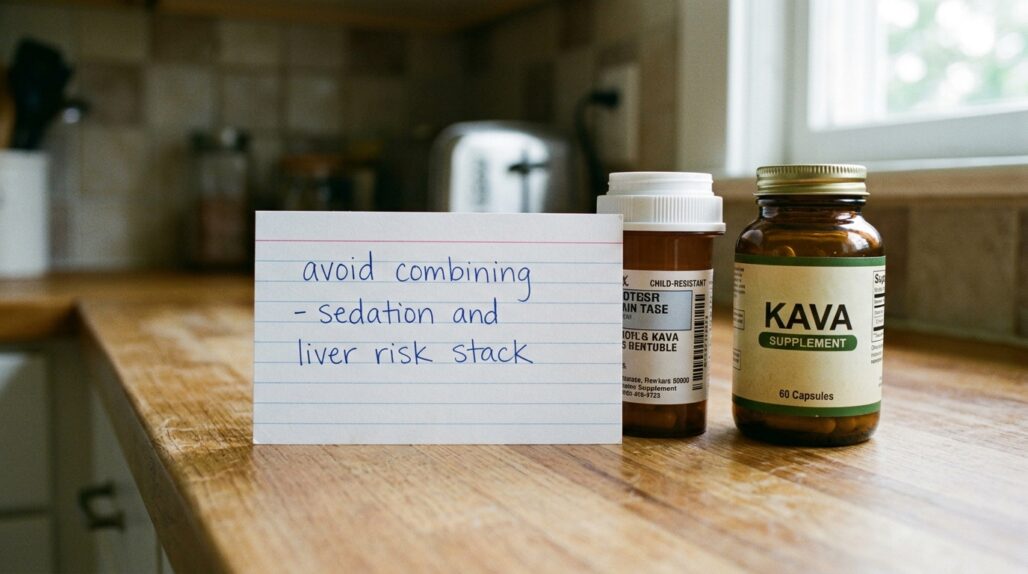
Before you decide
This article is general information, not medical advice for your specific situation. Kava and benzodiazepines both act on the brain, and the safest plan depends on your dose, your liver health, and the rest of your medication list. A pharmacist or prescriber can read that whole picture in a way a web page cannot.
The short version is straightforward. Kava and benzodiazepines are a combination most clinicians tell you to avoid. Each one calms the nervous system on its own, and putting them together can deepen sedation past what either would cause alone.
The people most at risk are older adults, anyone who also drinks alcohol, people with liver disease, and anyone who drives or operates machinery. If you fall into one of those groups, treat this pairing as off-limits until a professional says otherwise.
If you are already taking both because of a misunderstanding, do not stop your prescribed benzodiazepine on your own. Abruptly stopping a benzodiazepine can be dangerous. The supplement is the part you pause; the prescription is the part you discuss with the person who prescribed it.
What kava actually does in the brain
Kava (Piper methysticum) is a Pacific Island plant traditionally prepared as a calming drink. Its active compounds, called kavalactones, are why people reach for it to take the edge off anxiety.
Those kavalactones work on the GABA system – the brain's main braking signal. Research suggests kava boosts GABA activity, which is broadly the same chemical lever that benzodiazepines pull. According to the National Center for Complementary and Integrative Health, kava has been studied for anxiety and sleep, though the evidence is mixed and safety concerns are real.
Benzodiazepines such as alprazolam (Xanax), lorazepam (Ativan), and clonazepam (Klonopin) also increase GABA activity, which is how they quiet anxiety and ease muscle tension. When two substances press the same brake at the same time, the effect adds up. That additive sedation is the central reason to keep kava and benzodiazepines apart.
There is some scientific debate about exactly how kava engages the receptor. What matters for safety is the practical result, not the precise binding site: more GABA-driven sedation than you would get from the drug alone.
How big is the risk, and what the documented case shows
The standout report is a case published in Annals of Internal Medicine in 1996. A 54-year-old man who was taking alprazolam along with two other medications became lethargic and disoriented after also using kava, and he was hospitalized in a semicomatose state, as described by Almeida and Grimsley in their letter "Coma from the health food store".
A few honest caveats. This is a single case report, not a controlled trial, and the man was taking other drugs too, so kava cannot be proven as the sole cause. The authors themselves noted he was lethargic rather than in a true coma.
Even so, a documented event like this carries weight in a safety decision. One credible report of severe sedation from a kava-plus-benzodiazepine combination is enough for the precaution to stick. The mechanism is plausible, the outcome was serious, and there is no upside that justifies the risk.
This is also why national health bodies do not hedge here. NCCIH states plainly that kava should not be used with other substances that have sedative effects, including benzodiazepines or alcohol. When an agency that usually frames herbs neutrally issues a direct "do not combine," that is the headline.
The second hazard: kava and your liver
The sedation problem is only half the story. Kava has its own well-documented connection to liver injury, which is what turns a "be careful" into an "avoid."
The NIH LiverTox database reports that between 50 and 100 cases of clinically apparent liver injury have been linked to kava in the medical literature. Some were mild and reversible; others progressed to acute liver failure requiring a transplant, and a few were fatal. Onset has typically appeared anywhere from 2 to 24 weeks after starting the product.
The injury pattern looks idiosyncratic – meaning it can hit unpredictably and is not tied neatly to dose. That unpredictability is exactly what makes it hard to "dose around."
These signals were serious enough to prompt regulators. In March 2002, the FDA issued a consumer advisory warning that kava-containing supplements may be associated with severe liver injury, and it specifically told people with liver problems or those taking drugs that affect the liver to consult a physician first, as summarized by the NIH Office of Dietary Supplements. LiverTox notes that kava has since been banned or restricted in several countries, including Germany, Switzerland, France, Canada, and the United Kingdom.
Now layer that onto a benzodiazepine. You get additive brain sedation from one direction and a liver-toxicity question from the other – two independent risks in the same daily routine. That is why the combination earns a stronger warning than a simple "they make you sleepy."

Who is most at risk
Some people should treat this pairing as a hard no rather than a maybe. The risk is not evenly spread.
| Risk group | Why the combination is riskier | What it means for you |
|---|---|---|
| Older adults | Greater sensitivity to sedatives and a higher chance of falls and confusion | Avoid stacking sedatives; review the whole medication list with a pharmacist |
| People who drink alcohol | Alcohol is a third CNS depressant and is itself hard on the liver | Do not combine kava, a benzodiazepine, and alcohol in any amount |
| Anyone with liver disease | Kava’s liver-injury risk is the main safety flag the FDA named | Skip kava entirely and ask about safer anxiety options |
| Drivers and machine operators | Additive sedation slows reaction time and coordination | Treat the pairing as impairing; do not drive until you know how you respond |
| People on other sedating meds | Opioids, sleep aids, and some antihistamines pile on more CNS depression | More sedatives in the mix means more breathing and alertness risk |
If you recognize yourself in more than one row, the case for steering clear only gets stronger.
What to do instead
The simplest move is to keep these two apart. If a benzodiazepine is treating your anxiety, kava is not the herb to add on top of it.
If you want help managing anxiety beyond your prescription, that is a conversation to have with the person managing your care, not a swap to make on your own. Options that do not pile sedation on a benzodiazepine – including non-drug approaches – are worth raising with a clinician. Our overview of natural anxiety supports can give you vocabulary for that talk, and it is a discussion, not a shopping list.
A few practical habits lower your risk in general:
- Keep one current list of every prescription, over-the-counter product, and supplement you take, and bring it to appointments.
- Read supplement labels for kava under names like Piper methysticum, kava-kava, or kavalactones, since it shows up in "calm" and "sleep" blends.
- Watch for liver warning signs – yellow skin or eyes, dark urine, pale stools, nausea, or pain under the right ribs – and stop kava and call a clinician if they appear.
- Treat any new daytime grogginess or unsteadiness after starting a supplement as a reason to check in, not push through.
One tool that can make the medication-list step easier is StackMyMed, which lets you log your supplements and prescriptions in one place and flag pairings to raise with a pharmacist. It is a way to organize the conversation, not a replacement for professional judgment.
When you are weighing any herb against a prescription, it helps to know how that herb was assessed. Here is how we review supplements, and our drug-supplement interaction checker is a starting point for spotting conflicts before they reach your kitchen counter.

When to call a clinician
Some situations need attention sooner rather than later. Get medical help promptly if you feel extremely drowsy, confused, or unable to stay awake after taking kava with a benzodiazepine, especially alongside alcohol or another sedating drug.
Call emergency services for slowed or shallow breathing, unresponsiveness, or someone who cannot be roused. Combined CNS depressants can suppress breathing, and that is not a wait-and-see symptom.
Reach out to a clinician within a day or two if you notice possible liver signs – jaundice, dark urine, persistent nausea, or upper-right abdominal pain – even if you feel mostly fine otherwise.
For the bigger picture of how supplements and medications collide, our ultimate guide to drug-supplement interactions walks through the patterns worth knowing before you add anything to a prescription.
FAQ
Can I take kava and Xanax if I space them out by several hours? Spacing does not reliably remove the risk, because both stay active long enough to overlap and both work on the same GABA system. The standard advice is to **avoid the combination** rather than try to time it, and to clear any kava use with your prescriber first.
Is one dose of kava with a benzodiazepine dangerous? The documented case involved a man who became lethargic and disoriented, so even short-term use can produce serious sedation in some people. Individual response varies, which is exactly why it is not worth testing on yourself.
Does kava damage the liver on its own? Kava has been linked to **dozens of cases of clinically apparent liver injury**, some severe enough to require a transplant, which is why the FDA issued a consumer advisory and several countries restricted it. Adding a benzodiazepine does not cause the liver injury, but it stacks a second risk onto a product that already carries one.
What about kava with other sedatives like alcohol or sleep aids? The same logic applies. Kava plus alcohol, opioids, sleep medications, or sedating antihistamines all raise the chance of excessive drowsiness and slowed breathing, so those combinations deserve the same caution.
Are there anxiety supplements that pair more safely with a benzodiazepine? Some options are gentler than kava, but “safer” still depends on your full medication list and health history. The right move is to bring specifics to a pharmacist or prescriber rather than self-select, and you can use our anxiety-support overview to frame the question.
I already took kava with my benzodiazepine once – should I panic? If you feel fine, stop the kava and mention it at your next visit. If you feel very sleepy, confused, unsteady, or notice trouble breathing, treat it as urgent and seek medical help right away.
Conclusion: keep these two apart
Kava and benzodiazepines both calm the nervous system through the GABA pathway, so combining them can produce more sedation than either causes alone – and there is a published case of exactly that going wrong. Layer in kava's documented liver-injury risk, and you have two hazards riding together with no benefit that justifies them.
The practical takeaway is simple. Do not add kava to a benzodiazepine, keep an accurate list of everything you take, and route any anxiety-treatment changes through the clinician who knows your full picture. If sedation, confusion, or liver warning signs show up, that is the moment to call – not to wait.
This article is for general education and is not a substitute for personalized medical advice. Talk with your doctor or pharmacist before starting, stopping, or combining any supplement or medication.
Reviewed by the UsefulVitamins Editorial Team.
