
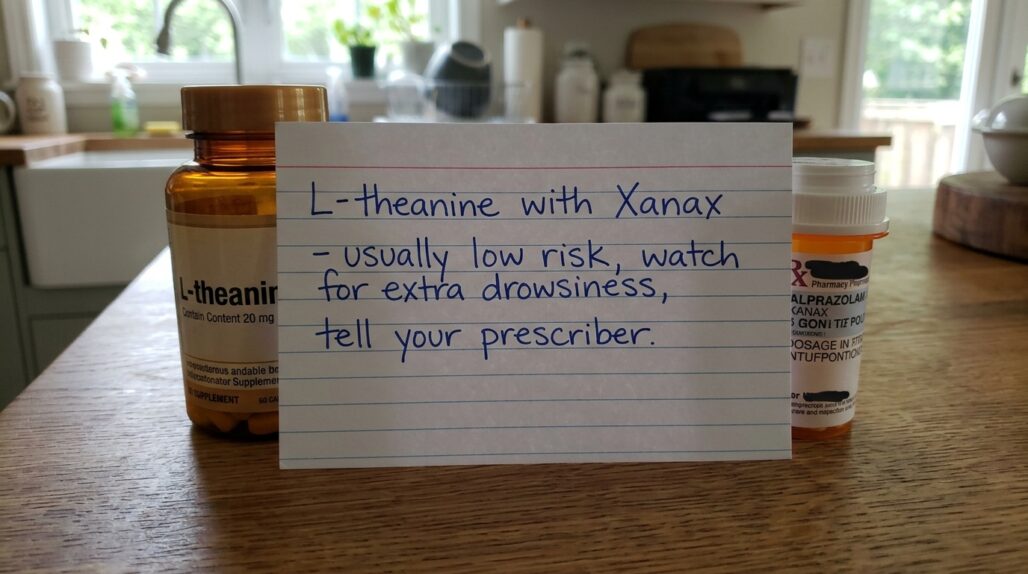
Before you decide
This article is general information, not medical advice. L-theanine sits in a gray zone where the safety signal looks reassuring but the formal evidence is thin, so the goal here is to help you have a sharper conversation with your prescriber or pharmacist, not to greenlight a combination on your own.
The people who should be most careful are anyone taking higher or long-standing Xanax doses, older adults (who are more sensitive to sedation and falls), and anyone combining other downers such as alcohol, opioids, sleep medication, or other calming supplements. If that is you, treat the cautions below as the headline, not the footnote.
One more framing point. L-theanine is not a substitute for prescribed treatment. It will not replace a benzodiazepine, fix the underlying anxiety, or let you skip doses. At best it is a mild add-on that some people find smooths the edges.
What L-theanine actually does
L-theanine is an amino acid found mostly in tea leaves. It is best known for producing a state of relaxed alertness rather than knockout sedation, which is part of why it became a popular calm supplement.
Mechanistically it is a glutamate look-alike. It interacts with glutamate and NMDA-type receptors and appears to nudge GABA, serotonin, and dopamine activity while boosting alpha brain waves linked to calm focus. That GABA angle is worth flagging, because Xanax also works through the GABA system, which is the theoretical reason the two could add up.
A 2025 review in Nutrition Research notes that some studies link L-theanine to relaxation and reduced stress, but findings are inconsistent and rigorous human trials are limited. So the mechanism is plausible and the safety record is good, yet the proof is softer than supplement marketing suggests.
In healthy-adult research, daily doses around 200 mg have been associated with lower stress and better sleep quality, as in Hidese and colleagues' 2019 trial in Nutrients. That same review reaches a measured verdict: the safety profile is favorable, but the science does not yet match the hype, and pharmacologic doses deserve caution until better trials arrive.

What Xanax does, and why combining matters
Xanax is the brand name for alprazolam, a short-acting benzodiazepine prescribed for anxiety and panic. It also acts on the GABA system, but far more powerfully than any supplement, which is why it is a controlled substance.
The most relevant fact for this pairing is that alprazolam is a central nervous system (CNS) depressant. According to the FDA prescribing information for Xanax, patients are cautioned against driving or operating machinery and against combining it with alcohol or other CNS depressants, because those combinations produce additive sedation.
Benzodiazepines also carry an FDA boxed warning covering the risk of abuse, physical dependence, and withdrawal, plus the serious danger of mixing them with opioids. None of that is caused by L-theanine, but it is the backdrop for why "just add a calming supplement" deserves a second look rather than a shrug.
How big is the L-theanine and Xanax interaction, really?
Here is the reassuring part. There is no documented major pharmacologic interaction between L-theanine and alprazolam. L-theanine is not known to meaningfully change how the liver clears Xanax, and it does not have the heavy sedating punch of the drug itself.
The most informative study is also the most directly relevant. In Lu and colleagues' 2004 trial, 16 healthy volunteers received L-theanine 200 mg, alprazolam 1 mg, or placebo and were tested under anticipatory anxiety. Neither L-theanine nor alprazolam beat placebo during the anxious state, though L-theanine showed some relaxing effect at rest. The takeaway is telling: a single dose of L-theanine behaved like a mild relaxant, not a powerful sedative.
So the realistic risk is not a dramatic reaction. It is subtle additive calm – a little more drowsiness, a slightly flatter or foggier feeling – layered on top of what the Xanax is already doing. For most people that is minor. For someone driving home, watching a child, or already heavily sedated, "minor" still matters.
The table below sorts the concern from the noise.
| Concern | Likelihood | What it looks like |
|---|---|---|
| Additive drowsiness or grogginess | Possible, usually mild | Feeling more sedated or foggy than Xanax alone, often early on |
| Changed Xanax blood levels | Not documented | No known effect of L-theanine on alprazolam metabolism |
| Dangerous oversedation from the pair alone | Unlikely at usual doses | Real risk climbs when alcohol, opioids, or other sedatives are added |
| Dependence from L-theanine | Not expected | L-theanine is not known to cause tolerance or withdrawal |
Sensible dosing and timing
Typical studied L-theanine doses run from 100 to 400 mg, and 200 mg is the most common single amount in research. Many people use it once daily or as needed for stress, and unlike Xanax it does not appear to cause tolerance, dependence, or withdrawal. That is a genuine point in its favor.
Still, dosing into a benzodiazepine regimen is a clinician's call, not a guessing game. A few practical habits lower the risk if your prescriber is on board:
- Start low and on a calm day. Try a single modest dose when you do not need to drive or work, so you can read how the combination feels.
- Keep the timing simple. There is no proven need to rigidly space L-theanine from Xanax, but separating them by an hour or two makes it easier to tell which is doing what.
- Skip alcohol entirely. Alcohol is the variable most likely to turn mild calm into real impairment.
- Watch the first few days, not just the first dose. Sedation can creep up, especially if your Xanax dose is already on the higher side.
What you should not do is adjust your Xanax because L-theanine seems to help. Reducing or skipping benzodiazepine doses without supervision can trigger rebound anxiety or withdrawal.
Who should be the most careful
Some groups carry more downside if the calm stacks too far. Pay extra attention if any of these apply to you.
- Older adults, who are more prone to sedation, dizziness, and falls on benzodiazepines.
- Anyone on opioids or other CNS depressants, where the additive effect can become genuinely dangerous, not just inconvenient.
- People who drive professionally or operate machinery, since the FDA caution on Xanax and alertness still applies, and a second calming agent does not help.
- Those with sleep apnea or breathing problems, who are more sensitive to anything that deepens sedation.
- Anyone on a high or long-term Xanax dose, where the baseline sedation is already significant.
If you want context on the broader category, our guides to natural anxiety supplements and supplements for stress lay out what the evidence does and does not support.

When to call a clinician
Most of the time, adding L-theanine to a stable Xanax routine is uneventful. A few situations warrant a real conversation rather than a quiet experiment.
Reach out to your prescriber or pharmacist before starting if you take other sedatives, opioids, or sleep medication, if your Xanax dose is high, or if you have liver, lung, or breathing conditions. They can tell you whether the combination fits your specific picture.
Seek prompt medical attention if you notice severe drowsiness, confusion, very slow or shallow breathing, trouble staying awake, or fainting. Those are not expected from L-theanine, and they point to oversedation that needs evaluation, particularly if other depressants are involved.
If you are leaning on supplements because the Xanax is not controlling your anxiety, that is the most important reason to check in. The fix is a treatment review, not a heavier supplement stack. A simple way to keep your full list straight is StackMyMed, which lets you log everything you take and flag possible overlaps to raise with a pharmacist. It organizes the conversation; it does not replace clinical judgment.
FAQ
Is it safe to take L-theanine with Xanax every day? For many people a modest daily dose appears low-risk, since L-theanine has a good safety record and no documented major interaction with alprazolam. The honest caveat is that long-term combined use has not been formally studied, so it is worth confirming with your prescriber, especially at higher Xanax doses.
Can L-theanine make Xanax stronger? It is unlikely to change your Xanax blood levels, because L-theanine is not known to affect how alprazolam is metabolized. What can happen is mild additive calm, so the pair may leave you a little more relaxed or drowsy than Xanax alone.
Will L-theanine help me take less Xanax? There is no good evidence that it lets you cut your dose, and you should never reduce or skip Xanax on your own. Any taper or dose change needs to be planned with the prescriber, since stopping a benzodiazepine abruptly can be risky.
How much L-theanine do people usually take? Studies most often use 100 to 400 mg, with 200 mg being the common single dose. The right amount for you alongside Xanax is a conversation for your clinician rather than a fixed rule.
Does L-theanine cause dependence like Xanax? No. Unlike benzodiazepines, L-theanine is not associated with tolerance, dependence, or withdrawal, which is one reason people find it appealing. That difference does not change the need to be careful about combined sedation.
Can I drink coffee or alcohol while taking both? Caffeine is generally fine and often pairs with L-theanine, though it can blunt the calming effect. Alcohol is the real problem, because it adds to the sedating effect of Xanax and is best avoided with this combination.
Conclusion: a low-risk pairing that still earns a check-in
L-theanine and Xanax look like a comfortable match for most people. There is no documented major interaction, L-theanine is gently relaxing rather than heavily sedating, and the one direct study comparing the two found L-theanine acted as a mild relaxant, not a sedative bomb.
The sensible move is not to overthink it, but not to skip the basics either. Start low, avoid alcohol, hold off on driving until you know how you feel, and never change your Xanax dose on your own. If you are stacking other depressants or your anxiety treatment is not working, bring it to your prescriber. For a deeper look at the broader interaction landscape, see our ultimate guide to drug-supplement interactions and run your routine through the drug-supplement interaction checker. For related calm-and-sleep pairings, our pages on melatonin and Xanax and a sleep supplement protocol cover the same ground from different angles.
This article is for general educational purposes and does not replace personalized advice from your doctor, pharmacist, or other qualified health professional. Always check with them before starting, stopping, or combining any supplement or medication.
Reviewed by the UsefulVitamins Editorial Team.
