
Affiliate disclosure: this article contains affiliate links. As an Amazon Associate, UsefulVitamins.com earns from qualifying purchases at no extra cost to you.
Fast situational calm vs slow-built stress resilience
Stress is not one thing, and that is the whole reason this comparison exists. There is the spike you feel before you walk into a room, and there is the dull, weeks-long pressure that leaves you wired at night and flat by mid-afternoon. L-theanine and ashwagandha each target one of those, and they are not really competing.
L-theanine is an amino acid from tea leaves. It acts within an hour and wears off the same day. Ashwagandha is a root extract used in Ayurveda, classed as an adaptogen, and it works by slowly nudging your stress-hormone system back toward baseline. One is a fire extinguisher. The other is fireproofing.
So the honest question is not "which is stronger." It is which kind of stress you are trying to manage, and whether you want relief tonight or a steadier baseline next month.
L-theanine: fast, non-sedating calm
L-theanine raises alpha brain-wave activity, the pattern linked to relaxed but alert attention, and it interacts with the GABA system. In lab work it binds GABA-A receptors and slows glutamate reuptake, which is the plausible route to a calmer nervous system without the heavy lid that benzodiazepines or strong antihistamines drop on you.
What sets it apart is speed. In a randomized, double-blind crossover trial of 34 adults, a 200 mg L-theanine drink reduced the subjective stress response to a multitasking stressor one hour after the dose, and blunted the salivary cortisol response three hours later. A separate controlled study found theanine flattened the blood-pressure rise during mental stress, but mainly in people who reacted strongly to begin with.
Evidence grade: moderate for acute, situational calm. The trials are small and several use theanine alongside caffeine or other ingredients, so the cleanest claim is the short-term one. A 4-week trial of 200 mg/day in 30 adults did report better trait-anxiety and sleep scores, which hints at a daily benefit too, but that single study is thin compared with the acute data.
The practical read: theanine is the most reliable thing here for getting through a tense afternoon, and a 200 mg dose is the one the research keeps coming back to. If you want help sorting brands and forms, our roundup of the best L-theanine supplements covers what to look for.
Ashwagandha: a slower lever on cortisol
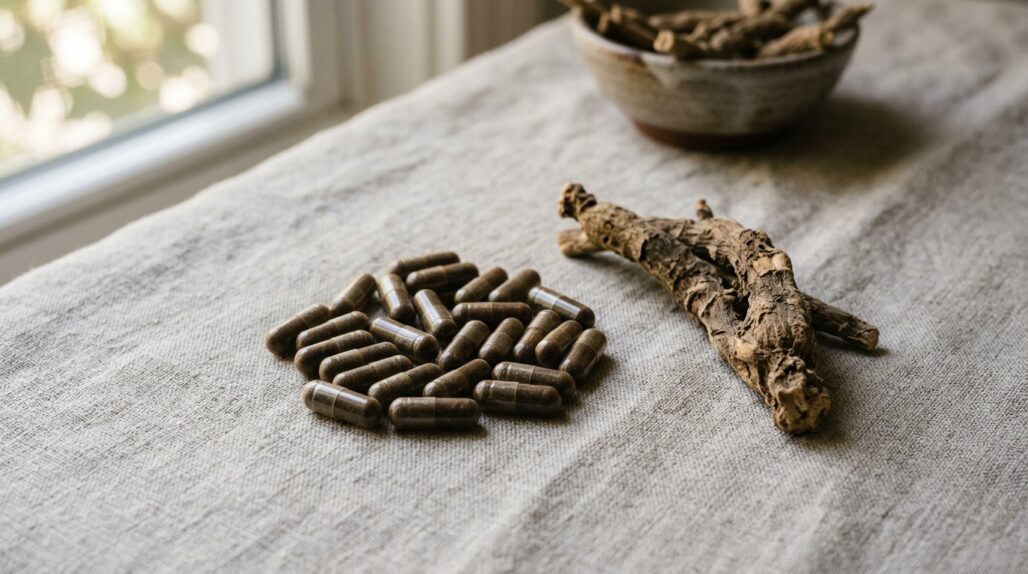
Ashwagandha works on a different timescale and a different mechanism. Its active withanolides appear to dampen the HPA axis, the loop that governs cortisol, so the payoff is not a single calm hour but a lower stress-hormone baseline that builds over weeks.
The cortisol data is the strongest case for it. In a 60-day randomized, double-blind, placebo-controlled trial of 60 adults, 240 mg/day of a standardized extract cut morning cortisol by about 23% against a slight rise in the placebo group, and reduced HAM-A anxiety scores by 41% versus 24% for placebo. Worth noting for fairness: in that same trial the broader DASS-21 stress score improved but the gap over placebo missed statistical significance. So the hormone and clinical-anxiety signals are solid, while the everyday-stress questionnaire was only a trend.
A 2021 systematic review pooled seven trials of roughly 491 adults over 6 to 8 weeks and found consistent stress and anxiety improvements, several using standardized root extracts, though those underlying trials are small, all India-based, and several are industry-linked, so the effect size is worth treating with some caution. That is a meaningfully deeper bench than theanine has for chronic stress.
Evidence grade: moderate to good for chronic stress and cortisol, weaker for an instant effect. The catch is that ashwagandha does nothing useful in the next hour. It needs daily dosing for a few weeks, which is why people give up on it too early. Extracts are also standardized differently, so the label matters; our guide to the best ashwagandha supplements walks through that, and the ashwagandha extract converter helps you line up doses across the different standardizations.
Head-to-head: speed, evidence, dose and downsides
The cleanest way to see the split is side by side. Theanine wins on speed and safety. Ashwagandha wins on cortisol and chronic-stress depth. They barely overlap.
| Factor | L-theanine | Ashwagandha |
|---|---|---|
| Best for | Acute, situational calm without drowsiness; smoothing coffee jitters | Chronic high stress, racing mind and high baseline cortisol |
| Evidence | Moderate for the acute effect (small RCTs); thinner for daily use | Moderate to good for cortisol and anxiety over weeks; multiple RCTs |
| Onset | Within about 30 to 60 minutes, same-day | Builds over 4 to 8 weeks of daily use |
| Typical dose | 200 mg as needed (studied range 200 to 400 mg/day) | 240 to 600 mg/day of a standardized root extract |
| Main downside | Effect is mild and short; not a fix for ongoing stress | Slow to act; rare liver-injury reports; off-limits in several conditions |
If you tried one and felt nothing, this table usually explains why. People take ashwagandha for a tense morning and feel cheated, or take theanine for a month-long slog and wonder why their baseline never shifts. Wrong tool, wrong timescale.
Who should pick which
Match the supplement to the shape of your stress, not to which one sounds more powerful.
Pick L-theanine if your stress is event-shaped. Presentations, exams, flights, a dentist appointment, that one weekly call. You want to take a capsule and feel a little steadier within the hour, stay sharp, and have it gone by evening. It is also the friendlier choice if you drink coffee, since it takes the edge off caffeine without killing the lift. For broader options beyond a single ingredient, browse our best adaptogens for stress guide.
Pick ashwagandha if your stress is season-shaped. A demanding stretch at work, caregiving, burnout creeping in, a mind that will not switch off at 11 p.m. You are after a lower baseline, and you are willing to take it daily for a month or two before judging it. Just know going in that it asks for patience and that the safety checklist below is real.
If you are honest that you have both kinds, that is the case for taking both.
Which one to buy
For most readers the answer is not either-or, so we have lined up three picks below: an L-theanine option for acute calm, a standardized ashwagandha for daily cortisol support, and a combined stress-relief formula if you want one bottle to cover both jobs.


As an Amazon Associate, UsefulVitamins.com earns from qualifying purchases at no extra cost to you.
Some links on this page are affiliate links. If you buy through them we may earn a commission at no extra cost to you, and it never changes which products we recommend.
Can you take both together?
Yes, and for a lot of people it is the smartest setup: ashwagandha as a daily base for your stress baseline, L-theanine layered on top for the days that spike. They act through different mechanisms and there is no known direct interaction between the two.
That said, a few real cautions apply, and this is where you should slow down rather than just stack and hope.
- Additive sedation. Both lean calming. Combine them with prescription sedatives, sleep aids, strong antihistamines or alcohol and the drowsiness can add up. If you already take something for sleep or anxiety, talk to your prescriber before stacking, and never start or stop a prescription on your own.
- Ashwagandha has a real safety list. Per NIH NCCIH, avoid it in pregnancy and while breastfeeding, and be cautious with thyroid disorders, autoimmune conditions and in the weeks before surgery. The NIH LiverTox monograph also documents rare but real cases of ashwagandha-associated liver injury, usually appearing 2 to 12 weeks in, mostly mild and reversible after stopping, but occasionally serious. Stop and see a doctor if you notice jaundice, dark urine or persistent right-sided abdominal pain.
- L-theanine is the gentler half. It has a good safety record at the studied 200 to 400 mg/day range, and because it can lower the blood-pressure rise under stress, anyone on blood-pressure medication should mention it to their clinician. It is not known to cause dependence.
One framing thing: supplements are for ordinary, manageable stress. They are not a treatment for an anxiety disorder. If your stress is constant, hurting your sleep, work or relationships, that is a reason to see a professional, not to buy a bigger bottle.
Common mistakes
Quitting ashwagandha at two weeks. The cortisol data comes from 6 to 8 weeks of daily use. Two weeks is not a fair trial.
Expecting theanine to fix chronic stress. It is a same-day tool. Lovely for a hard afternoon, useless as a baseline lever.
Ignoring standardization. "Ashwagandha 600 mg" tells you almost nothing without the withanolide content or extract type, which is exactly what the converter linked above sorts out.
Stacking sedatives blind. Two calming agents plus a sleep med is how people end up groggy. Add one thing at a time.
FAQ
Does L-theanine make you sleepy? Not usually. It promotes calm-alert focus rather than sedation, which is why it pairs well with caffeine. If you want sleep help, it is a mild option at best, not a sleep drug.
How long until ashwagandha works for stress? Plan on 4 to 8 weeks of daily use. The cortisol and anxiety improvements in trials showed up over that window, not in a single dose.
Can I take ashwagandha and L-theanine at the same time of day? Yes. There is no known interaction. Many people take ashwagandha daily with food and add L-theanine only on stressful days. Watch total sedation if you also use other calming medications.
Is one safer than the other? L-theanine has the cleaner safety profile. Ashwagandha is generally well tolerated but carries rare liver-injury reports and is not for pregnancy, thyroid, autoimmune conditions or the run-up to surgery, so it needs more caution.
Should I cycle ashwagandha? Many people take it for a stressful season then take breaks, which also limits long stretches of continuous use given the liver-injury signal. There is no fixed rule, so a clinician check-in for long-term use is sensible. L-theanine does not need cycling.
Can either replace anxiety medication? No. Neither is a treatment for a diagnosed anxiety disorder, and you should never start or stop a prescription based on a supplement. Persistent anxiety warrants a clinician.
The bottom line
They are not rivals so much as a pair built for two different problems. L-theanine is the on-demand option, with believable human data for cutting stress and the cortisol response within an hour, and a clean safety record. Ashwagandha is the slow, daily lever on baseline cortisol, with the stronger biomarker evidence for chronic stress, as long as you give it weeks and respect its safety list.
Pick L-theanine if your stress is event-shaped and you want fast, non-sedating calm. Pick ashwagandha if your stress is season-shaped and you want a lower baseline over a month or two. And if you have both kinds, take both, with ashwagandha as the daily base and theanine for the spikes, while keeping an eye on added sedation and looping in a clinician if you are pregnant, take other calming medications, or have a thyroid or autoimmune condition.
This article is for general information and is not medical advice. Talk to a qualified healthcare professional before starting any supplement, especially if you are pregnant, breastfeeding, taking medication or managing a health condition.
Reviewed by the UsefulVitamins Editorial Team.
