
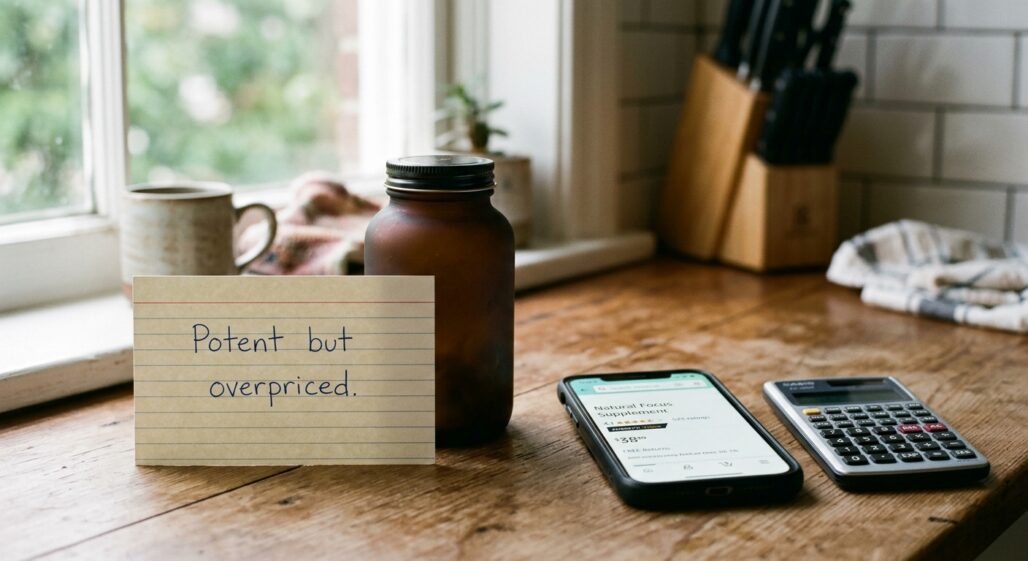
So Mars Men is everywhere right now: the viral ads, the founder's "I went from 320 to 847 in 97 days" testimonial, the slick subscription funnel, and a fresh wave of "is this legit" searches. The honest version is less exciting than the ads and more useful: the formula is genuinely loaded, but two things decide whether it is a smart buy, and neither is on the label. The first is where you press "buy," because the same bottle swings from roughly $44 to $99 depending on the channel. The second is whether "more milligrams" is a feature or a flag — and at least one ingredient-level reviewer argues it is a flag. This is a brand-level review, not a category roundup, so for the science on each herb I link down to the deep dives rather than re-litigating every trial here.
Affiliate disclosure: this article contains affiliate links. As an Amazon Associate, UsefulVitamins.com earns from qualifying purchases at no extra cost to you.
Before you decide
This is information, not medical advice, and nothing here treats, cures, or prevents low testosterone or any condition. A "natural testosterone booster" can, at best, support testosterone that is already within a normal range; it is not a substitute for a blood test, a doctor, or testosterone replacement therapy if you actually need it. If you are tired, low-libido, and reaching for a supplement, the highest-value first step is a morning total-testosterone blood draw, not a 30-day starter kit.
Quick disambiguation, because the search results are a mess. The product in this review is Mars Men (mengotomars.com, the US direct-to-consumer brand that raised the L Catterton round). It is easy to confuse with two unrelated things: "Mars by GHC," an India-based Ayurvedic men's-health brand with a different formula and different capsules, and "Mars SurgeX," which is a sildenafil (Viagra-type) prescription ED tablet sold in India — a regulated drug, not a supplement. If you landed here looking for either of those, this is the wrong page.
For how we weigh this kind of evidence and why we are comfortable being unflattering about a popular brand, see how we review supplements.
What's actually in the bottle

Credit where due: Mars Men uses a fully disclosed label, not a hidden "proprietary blend," which already puts it ahead of a lot of the testosterone category. Here is the stack at the doses the brand publishes. One caveat up front: men's-wellness brands quietly re-formulate, and the Amazon listing's panel can lag the website's, so confirm the live supplement-facts image on the actual listing before you buy — treat the table below as the reference formula, not gospel for every SKU.
| Ingredient | Label dose | What it’s there for |
|---|---|---|
| Tongkat Ali (Eurycoma longifolia) | 1,000 mg | The headline herb; the dose most clinical trials never reached |
| Fenugreek extract | 675 mg | Libido and free-testosterone support in some trials |
| L-Taurine | 675 mg | Amino acid; energy and exercise-recovery rationale |
| Shilajit | 400 mg | Resin extract; vitality positioning |
| Zinc (as citrate) | 30 mg | Essential for testosterone synthesis; above the 11 mg RDA |
| Vitamin D3 | 4,000 IU (100 mcg) | Hormone-support cofactor; equal to the adult upper intake limit |
| Boron | 4 mg | May nudge free testosterone and lower SHBG |
| Vitamin K1 + K2 | 100 mcg | Pairs with D3 for calcium handling |
If you want the unhurried science on the two marquee herbs without my editorializing, our best Tongkat Ali supplements and best Shilajit supplements guides break down what the trials actually show and at what doses.
The rating reality: 4.9/5 is the brand's number, not the market's
Here is the part the funnel does not want you to sit with. Mars Men's marketing leans hard on a 4.9 out of 5 rating drawn from roughly 18,000 reviews — but that figure lives on a brand-controlled review widget, where the company curates what gets shown. When you step off the brand's own property and onto a neutral marketplace like Amazon, the live star rating is materially lower than 4.9.
I am deliberately not going to print a precise "it's actually X.X/Y reviews" number, because third-party rating snapshots diverge and they move week to week — one aggregator's number is not another's. What is stable and verifiable is the direction: the independent rating sits below the brand's self-reported figure, on a much smaller review base, and that gap is the signal. The picks at the end of this article show the live marketplace rating next to two better-reviewed alternatives, so you can compare the real numbers yourself rather than take my word or the brand's.
The lesson generalizes past Mars Men: any time a supplement's headline rating lives only on a widget the seller controls, treat it as marketing, and go find the number on a platform the seller cannot edit. For the broader landscape of what actually earns its rating in this category, see our best testosterone boosters roundup.
The price gap nobody screenshots: ~$99 on Amazon vs ~$44-59 direct
This is the single most actionable thing in the review. On Amazon, a single bottle of Mars Men runs about $99 — which makes the marketplace, ironically, the most expensive door into the brand. Buy the same product through the company's own subscription funnel and the per-bottle price drops dramatically: roughly $59/bottle on a 3-bottle plan and as low as about $44-49/bottle on the 6-bottle "best value" subscription. That is close to a 2x spread for an identical bottle.
So when you see an Amazon "buy" button for Mars Men — including the one in our picks below — read it honestly: it is the convenient channel and the one with neutral, uneditable reviews, but it is not the cheap one. If you have already decided you want to try Mars Men specifically, the brand's own multi-bottle subscription is the lower-cost path, full stop. The reason a publisher still surfaces the Amazon ASIN is reviews and return policy, not price. We would rather tell you that than pretend the affiliate link is the bargain.
The overdosed critique (yes, over, not under)
Most cheap testosterone supplements fail by under-dosing — fairy-dusting 50 mg of an herb that needed 400 mg. Mars Men has the opposite problem, and that is genuinely unusual. The supplement-analysis team at Illuminate Labs audited the formula and flagged two ingredients as dosed beyond where human safety data exists:
- Vitamin D3 at 4,000 IU (100 mcg). Illuminate Labs calls this roughly 40% of the acute-toxicity threshold described in a vitamin D toxicity review in Frontiers in Endocrinology. Independently, 4,000 IU is exactly the Tolerable Upper Intake Level the NIH sets for adults — the ceiling meant to cover all sources combined. Stack this product on top of a separate D3 pill, a multivitamin, and a fortified diet and you can quietly clear that ceiling, with no upside unless you were actually deficient to begin with.
- Tongkat Ali at 1,000 mg. Illuminate Labs notes a 2022 meta-analysis of nine clinical trials found none using a dose this high — in some comparisons the Mars Men dose runs about 500% above the studied amount. Most positive Tongkat Ali trials used 200-400 mg; a representative example is a 6-month randomized trial in Maturitas that used 200 mg. More milligrams is not automatically more benefit, and it is definitely not automatically more safety.
To be fair to the other side: some reviewers argue the formula is appropriately aggressive precisely because so many competitors under-dose, and that a higher Tongkat Ali load may matter for a standardized extract with low eurycomanone content. That "more is better than the usual fairy dust" view is reasonable as far as it goes — but it is an argument for potency, not for safety, and it does not answer the toxicity-ceiling question on the D3. Attribute the over-dosed critique to Illuminate Labs and the "competitors under-dose, so this corrects it" framing to the brand-friendly camp, and the honest read sits in the middle: potent, transparent, and dosed past where the safety homework has been done.
On the interaction question specifically, one myth deserves killing: Tongkat Ali is sometimes accused of inhibiting CYP3A4 (the enzyme that clears a huge share of medications). The lab data do not support that. A study of Eurycoma longifolia and human liver enzymes found essentially no CYP3A4 inhibition (about 101% of control). It showed only weak in-vitro inhibition of CYP1A2 and CYP2C19 at very high concentrations, and the clinical significance of that is unproven. So the real interaction caution is not "it blocks your drug metabolism" — it is the combination of a high-dose herb, a vitamin D dose at the upper limit, and vitamin K in a product some men take alongside blood thinners. That is a conversation for your clinician, not a comment section. Our dedicated Mars Men side effects and drug interactions breakdown goes deeper.
What the founder numbers do and don't prove
The brand's growth story is real and, frankly, impressive. Press coverage corroborates it: a BusinessWire announcement of a $27.5M Series A led by L Catterton describes a roughly $100M run rate reached profitably in under 18 months, serving 400,000-plus customers. Those are verifiable business facts from independent outlets, and they tell you the marketing works and a major consumer-investment firm placed a bet.
What they do not tell you is whether the pills moved your hormones. The viral founder figures — "620 to 879 in three months," "320 to 847 in 97 days" — are personal testimonial, not clinical data. There is no published, product-level randomized trial on the Mars Men formula showing it raises testosterone in users, and a single founder's self-reported lab swings (over an undefined protocol, with no control, no blinding, and every incentive to share the good run) are not evidence of an effect. Plenty of things move a testosterone reading by hundreds of points — sleep, weight loss, training, the time of day you draw blood, starting from an unusually suppressed baseline. Treat "$100M and 400k customers" as proof of a great funnel, and treat "847 in 97 days" as a billboard, not a study.
Who Mars Men is actually for
Strip away the hype and the picture is clear. Mars Men is a transparent, potent stack that is overpriced on Amazon and over-dosed on two ingredients — which makes it a reasonable, if expensive, choice for a specific person, and a poor one for most.
- It might fit you if: you have a confirmed-normal-or-low-end testosterone reading, no relevant medication or vitamin D issues, you have read the label, and you have decided you specifically want this stack — in which case buy it on the brand's multi-bottle subscription, not Amazon.
- Skip it if: you take any prescription drug without clearing it first, you already supplement vitamin D, you want clinical-dose precision, or you simply want the best rating-to-price ratio in the category. A better-reviewed, fairly-priced single-ingredient Tongkat Ali or a sensible men's stack will usually serve you better.
If your real goal is libido rather than a number on a lab report, our supplements for low libido guide covers the evidence-backed options, and if you mostly want daily nutritional coverage, a men's multivitamin is a calmer, cheaper foundation than a 1,000 mg herb bomb.
The bottom line on buying it
Mars Men earns part of its hype — disclosed label, real ingredients, a business that clearly resonates. It loses the rest of it at the checkout and the supplement-facts panel: the live marketplace rating sits below the brand's curated 4.9, Amazon is the most expensive place to buy it, and an independent reviewer flags the formula as over-dosed rather than the usual under-dosed. The formula is potent; the brand-and-price decision is the whole game. Compare the real numbers — live rating, true per-bottle cost — before you commit. The picks below show the actual Mars Men listing alongside two better-reviewed alternatives so you can do exactly that.


As an Amazon Associate, UsefulVitamins.com earns from qualifying purchases at no extra cost to you. We only recommend products supported by published research or third-party testing.
Whatever you choose, run it past a clinician or pharmacist first, especially if you take prescription medication or supplement vitamin D separately — the interactions here are not hypothetical, and a $99 bottle is not worth a hypercalcemia scare or a drug clash you could have caught with one question.
As an Amazon Associate, UsefulVitamins.com earns from qualifying purchases at no extra cost to you. We only recommend products supported by published research or third-party testing, and we tell you when a brand’s own channel is cheaper than the affiliate link.
This article is for informational purposes and is not medical advice. "Natural testosterone boosters" may at best support testosterone already within a normal range; they do not treat, cure, or prevent any condition. Never start a supplement to replace a medical evaluation, and never change a prescription on your own. Consult a licensed physician or pharmacist before starting any supplement, particularly if you take medications, have a chronic condition, or have a vitamin D disorder. Reviewed by the UsefulVitamins Editorial Team.
