
If you are a tested athlete and a teammate told you "BPC-157 is fine, it's not on the list," the honest answer is: it is on the list — listed under S0 (Non-Approved Substances) in the current WADA Prohibited List, and if you test positive the consequences are far worse than any marketing copy will admit. Meanwhile, thymosin beta-4 (sold online as TB-500) sits explicitly in S2.3 under growth factors. Neither compound has regulatory approval for human use anywhere in the world, testing technology has become sensitive enough to detect nanogram-level traces, and a first confirmed violation for a non-specified substance like these carries a standard four-year suspension under the 2021 WADA Code. This article maps exactly what is prohibited, how testing actually works, and which legal, evidence-backed alternatives genuinely help athletic recovery.
Summary / Quick Answer
Peptides marketed for athletic enhancement fall into two categories: WADA-prohibited substances that can end a career, and legal food-derived peptides (primarily collagen) with a growing but still modest evidence base.
- Best for: Recreational athletes (no drug testing) exploring collagen peptides for joint support and tendon recovery; competitive athletes seeking legal, evidence-backed recovery strategies
- Not ideal for: Any athlete in a WADA-registered testing pool considering grey-market peptides — the risk-reward calculation does not work
- What to look for: Collagen peptides with vitamin C taken before exercise; products third-party tested via NSF Certified for Sport or Informed Sport to avoid contamination risk
- Decision shortcut: If it requires a credit card on a research-chemical website and is not sold in a pharmacy, assume it is prohibited until proven otherwise — and even then, verify against the current WADA Prohibited List
Why Peptides Come Up in Athletic Locker Rooms
The logic sounds appealing on the surface. Peptides are chains of amino acids, the same building blocks as protein. Growth hormone releasing peptides (GHRPs) drive the pituitary to release more GH, which in theory accelerates muscle repair. BPC-157, derived from a protein found in gastric juice, showed accelerating tendon healing in rat studies. TB-500 (thymosin beta-4) improved wound repair in animal models. The gap between those findings and human athletic use is enormous, but the internet compresses it to a single forum post: "works great, bro."
What the forums skip is the regulatory reality. The World Anti-Doping Agency (WADA) prohibits an entire category of these compounds, testing technology has advanced to detect sub-nanogram concentrations, and the WADA Code places strict liability on athletes — meaning "I did not know" is not a defence. The burden of proof sits entirely on you, not on the testing authority.
Understanding this matters whether you are a sprinter in a national testing pool or a weekend runner who competes in sanctioned road races. Any WADA-signatory sport, at any level, falls under the Code.
The 2025 WADA Prohibited List: What Is Actually Banned
The WADA Prohibited List is updated annually and takes effect on January 1st each year. The 2025 and 2026 versions contain the following peptide-relevant sections, all prohibited both in and out of competition:
S0 — Non-Approved Substances This catch-all section bans any pharmacological substance with no current approval by a governmental regulatory health authority for human therapeutic use. BPC-157 falls here explicitly: the WADA list names it as an example of prohibited non-approved substances. Because BPC-157 has no human-approved therapeutic indication anywhere globally, it is prohibited by definition — not by specific evidence of performance enhancement, but by the absence of regulatory approval.
S2.1 — Erythropoiesis-Stimulating Agents Includes erythropoietin (EPO) and receptor agonists, hypoxia-inducible factor (HIF) activators such as roxadustat and xenon, and GATA inhibitors. These affect red blood cell production rather than muscle/tendon repair, but they sit within the broader S2 framework.
S2.2 — Peptide Hormones and Their Releasing Factors This is where the most commonly discussed performance-enhancing peptides live. The list specifically names:
- Gonadotrophin-releasing hormone (GnRH) and analogues including buserelin, deslorelin, goserelin, leuprorelin, and triptorelin
- Growth hormone (GH) and its releasing factors: CJC-1295, sermorelin, and tesamorelin under growth hormone releasing hormones (GHRHs)
- Growth hormone releasing peptides (GHRPs): alexamorelin, examorelin (hexarelin), GHRP-1, GHRP-2, GHRP-3, GHRP-4, GHRP-5, and GHRP-6
- GH secretagogue mimetics including ibutamoren (MK-677), ipamorelin, and macimorelin
Every GHRP by name. Every common secretagogue. WADA also applies a "similar chemical structure or biological effect" standard, so novel analogues designed to sidestep named compounds are still prohibited.
S2.3 — Growth Factors and Growth Factor Modulators This section explicitly names thymosin-beta-4 and its derivatives, including TB-500. It also covers fibroblast growth factors (FGFs), hepatocyte growth factor (HGF), insulin-like growth factor 1 (IGF-1), vascular endothelial growth factor (VEGF), and any substance affecting muscle, tendon, or ligament protein synthesis, vascularisation, or regenerative capacity. The catch-all language means that even a novel peptide with no published human data can land here if it acts on these pathways.
The key takeaway: the substances most discussed in athletic recovery communities — BPC-157, TB-500, GHRPs, MK-677, ipamorelin — are all explicitly prohibited or prohibited by category under the current list.
How WADA Testing Actually Works
Understanding testing logistics matters because some athletes assume that peptides are "undetectable." That assumption is outdated.
The Registered Testing Pool (RTP) and out-of-competition testing
High-performance athletes in most WADA-signatory sports are enrolled in a Registered Testing Pool. RTP athletes must submit whereabouts information around the clock: a daily overnight address, a specific 60-minute window each day when they are available for testing, and regular updates on training and competition schedules. Testing can happen on any day, including during training blocks, rest weeks, and off-seasons. There is no safe window.
Three combined whereabouts failures within 12 months — whether a missed test or a filing lapse — constitute an anti-doping rule violation in themselves, before any substance is detected.
Detection technology
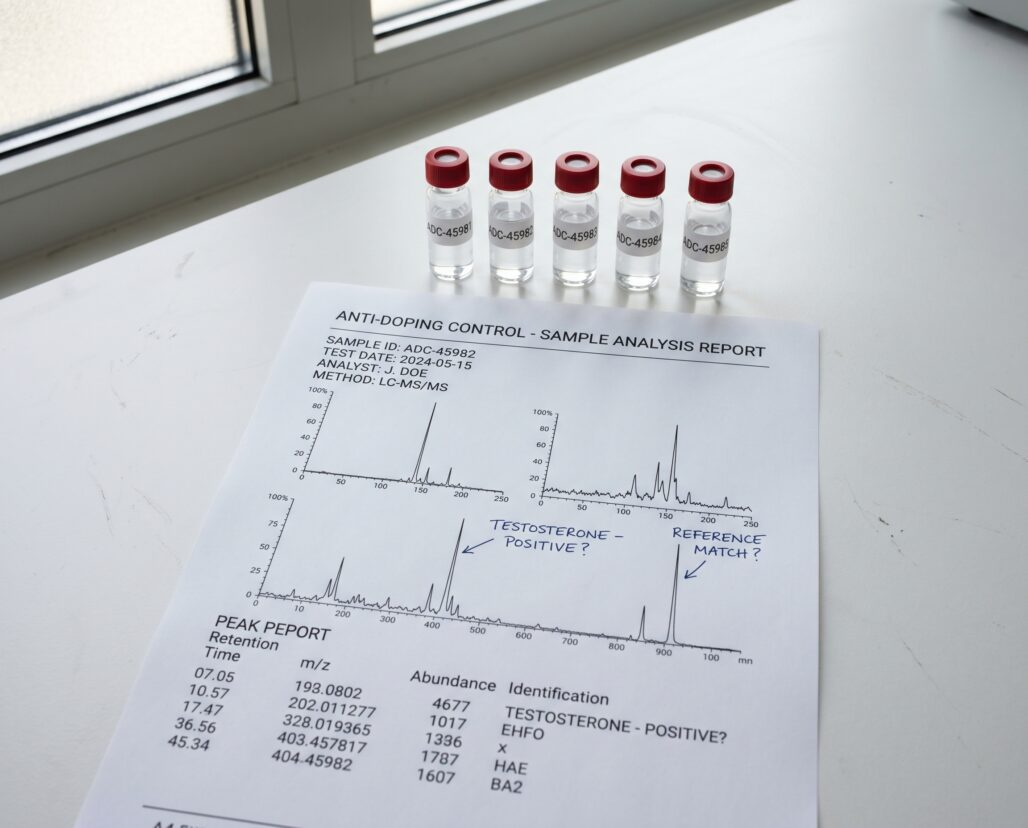
Many peptides are now detectable via liquid chromatography-mass spectrometry (LC-MS/MS), which can identify specific peptide sequences at very low concentrations. Isotope-ratio mass spectrometry (IRMS) distinguishes synthetic from endogenous compounds by measuring carbon isotope ratios. WADA-accredited labs continue developing new assays as novel peptides reach the market. The idea that a substance is "undetectable" is not a factual claim you can rely on — it is marketing language from suppliers with no accountability.
Strict liability
Under the WADA Code, an athlete commits an anti-doping rule violation if a prohibited substance is found in their sample, regardless of how it got there. This is strict liability. It does not matter if a coach recommended it, if a supplement was contaminated, or if the athlete had no knowledge. The athlete bears the burden of establishing that they bore no fault or negligence, and even then sanctions are only reduced — not eliminated — in exceptional cases.
USADA sanctions data shows the pattern clearly: athletes who tested positive for GHRPs such as GHRP-6 and ipamorelin received two-year suspensions in straightforward cases. Cases involving multiple substances or evidence of intentional use have reached four years. Under the 2021 WADA Code, the standard ineligibility period for a first violation involving a non-specified substance is four years, reduced to two years only when an athlete can prove no significant fault or negligence. S2 peptide hormones and growth factors are non-specified substances.
A four-year ban at age 24 is effectively a career-ending event for most athletes.
The Contamination Risk Most Supplement Labels Do Not Mention
Even if an athlete never intentionally uses a prohibited peptide, contamination creates real exposure. Research-chemical suppliers often manufacture multiple peptides in the same facility. Cross-contamination of otherwise-legal supplements with prohibited peptides has been documented in anti-doping literature. Under strict liability, this does not provide a defence — it only potentially mitigates the sanction.
The practical implication: if you are in any sanctioned sport, you should use only supplements certified by an independent batch-testing programme, such as NSF Certified for Sport or Informed Sport. These programmes test each production batch for WADA-prohibited substances. No certification eliminates all risk, but it is the evidence-based risk-reduction step available.
Legal Alternatives With Real Evidence
The evidence base for legal peptide-adjacent recovery strategies is narrower than forum discussions suggest, but it does exist, and it is not trivial.
Collagen peptides with vitamin C
Tendons and ligaments are collagen-dense structures that repair slowly because they have limited blood supply. Two lines of evidence support targeted nutritional support here.
A 2017 randomized crossover study published in the American Journal of Clinical Nutrition (PMID: 27852613, Shaw et al.) found that consuming 15 g of vitamin C-enriched gelatin one hour before intermittent exercise doubled circulating markers of collagen synthesis (amino-terminal propeptide of collagen I) compared to placebo. Engineered ligaments treated with serum from the gelatin group showed improved collagen content and mechanical properties.
A 2019 pilot randomized controlled trial in Nutrients (PMID: 30609761, Dressler et al.) studied athletes with chronic Achilles tendinopathy. Patients receiving a specific collagen peptide supplement alongside a structured calf-strengthening programme showed a 12.6-point improvement on the VISA-A functional score versus 5.3 points in the placebo group after three months.
A 2021 systematic review in Amino Acids (PMID: 34491424, Khatri et al.) analysed 15 randomized controlled trials and concluded that collagen peptide supplementation was "most beneficial in improving joint functionality and reducing joint pain," with modest improvements in body composition at 15 g/day dosing.
The evidence is real, but it is not large-scale and it is not uniform. The studies use specific products (enzymatically hydrolyzed collagen peptides with defined molecular weight profiles) rather than generic "collagen powder." If you are experimenting with collagen for tendon support, the protocol with the most evidence behind it is 15 g of hydrolyzed collagen with vitamin C, consumed 30 to 60 minutes before a loading exercise session.
Protein (whole food and whey/casein)
Muscle protein synthesis after resistance exercise responds to leucine-rich protein sources. The evidence for adequate daily protein intake (1.6 to 2.2 g per kg body weight for strength athletes) is substantially more robust than for any peptide compound. For recovery, consuming 20 to 40 g of high-quality protein within two hours of training is supported by large-scale meta-analyses. This is not exciting, but it works and costs a fraction of grey-market peptide orders.
Creatine monohydrate
Creatine is the best-studied legal performance supplement in sports science. It enhances phosphocreatine resynthesis during high-intensity repeated efforts, improves recovery between sessions, and has a four-decade safety record at standard doses (3 to 5 g daily). It is not prohibited under the WADA Code. Unlike GHRPs, the mechanism is well understood and the benefit in strength and sprint sports is consistent across hundreds of trials.
Sleep and load management
The highest-leverage recovery tool available to most athletes is also completely free. Sleep duration below seven hours per night impairs muscle protein synthesis, elevates cortisol, and slows glycogen resynthesis. Periodized training loads that include genuine deload weeks produce better long-term adaptation than constant high-volume blocks. These are not supplement recommendations — they are structural interventions with measurable effects, and they do not come with a four-year suspension risk.

Frequently Asked Questions
Is BPC-157 detectable in anti-doping tests? Yes. WADA-accredited labs have developed LC-MS/MS assays capable of detecting BPC-157 and its metabolites. Beyond detectability, BPC-157 is explicitly prohibited under S0 of the WADA Prohibited List as a non-approved substance — detection technology is separate from the legal classification.
What if I use a peptide during the off-season, when I am not competing? Out-of-competition testing applies to all S2 substances. RTP athletes can be tested on any day of the year, including during the off-season. "Off-season use" is not a safe window.
Can a doctor's prescription protect me? A Therapeutic Use Exemption (TUE) can authorise medical use of a prohibited substance for a documented clinical need. TUEs are granted by the relevant anti-doping authority, require documented diagnosis and medical justification, and do not cover substances like BPC-157 that have no approved therapeutic use anywhere in the world. If a practitioner is prescribing BPC-157 or TB-500 as part of a "performance protocol," they are operating outside the scope of any recognised therapeutic standard.
Are peptide supplements sold in health food stores legal for competition? Most retail collagen and protein supplements contain food-derived peptides (hydrolyzed collagen, whey protein hydrolysates) that are legal under WADA. The concern is not the category but the specific substance and potential contamination. Any supplement used by tested athletes should carry independent batch-testing certification.
What happens if a supplement contains a trace of a prohibited peptide without my knowledge? Strict liability still applies. The athlete commits a violation. Contamination can mitigate but not eliminate a sanction. This is why supplement certification matters for tested athletes.
If you are managing a protocol like this, StackMyMed (our companion app) keeps your doses, timing, and interaction checks in one place. It does not replace medical advice — bring the log to your clinician.
Conclusion: The Bottom Line on Peptides for Athletes
The peptide landscape for athletes splits cleanly into two zones. In the prohibited zone: GHRPs, GH secretagogues like MK-677 and ipamorelin, thymosin beta-4 (TB-500), and non-approved research peptides including BPC-157. These are explicitly named or categorically covered by the WADA Prohibited List, detectable by modern laboratory methods, and carry a standard four-year ban on a first violation for a non-specified substance. The career math does not work. In the legal zone: food-derived collagen peptides with vitamin C, standard protein sources, and creatine monohydrate have the most evidence for recovery and performance support among legal options. The evidence for collagen and tendon health is promising but still developing — it is not as dramatic as the grey-market peptide marketing implies, but it is real, safe, and carries zero suspension risk.
For any athlete in a sanctioned sport, the decision framework is simple: if a substance requires an underground supplier, lacks regulatory approval, and makes dramatic recovery claims, it is almost certainly prohibited, detectable, and not worth the career risk.
Next steps:
- Read what are peptides for a grounded introduction to how peptides work in the body before evaluating any supplement claim
- Check are peptides safe for the broader safety evidence, FDA regulatory status, and risk categories by compound type
- Review peptides for injury recovery for a deeper look at the collagen peptide and vitamin C evidence for tendon and ligament repair
- Cross-reference peptides for muscle growth to compare what legal protein and creatine strategies actually deliver versus prohibited GH-axis compounds
- Before using any supplement in a sanctioned sport, verify it against the current WADA Prohibited List and use only NSF Certified for Sport or Informed Sport certified products
This article is for informational purposes and not medical advice. Peptides, especially those marketed for therapeutic use, can interact with medications and health conditions. Consult a licensed physician before starting any supplement, particularly if you are pregnant, nursing, taking prescription medications, or managing a chronic condition.
