
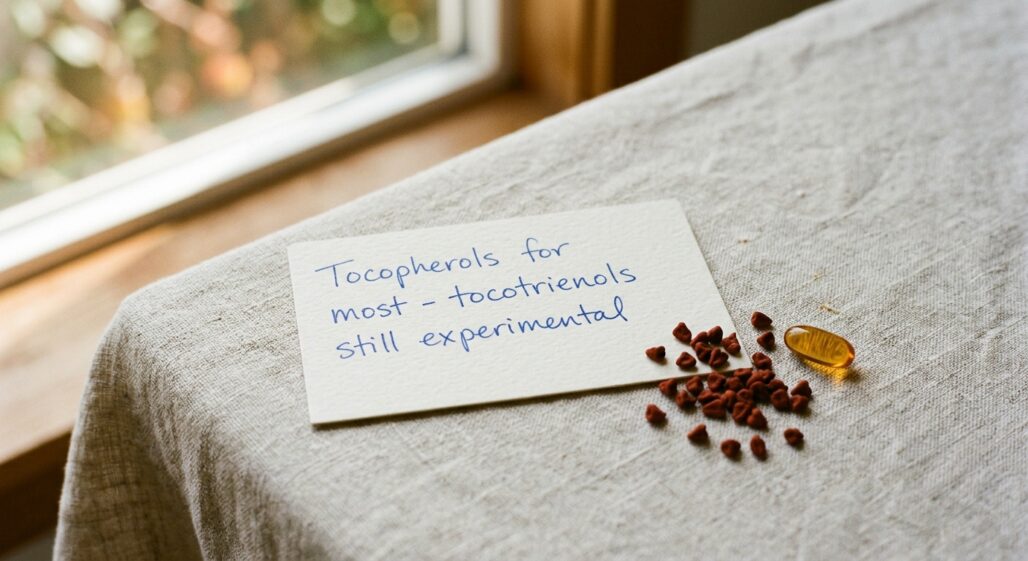
If you are comparing tocotrienols vs tocopherols, you are probably staring at two vitamin E bottles, one cheap and familiar, one pricier and marketed as the "better" form, and trying to work out whether the upgrade is worth it. The short answer: for everyday vitamin E, mixed tocopherols are the better-studied, lower-cost choice, and tocotrienols are still experimental. This article walks through the two families and their eight isoforms, how their absorption differs, what tocotrienols are actually shown to do in human trials versus what the marketing claims, and one absorption quirk that means you usually should not take both at once.
Before you decide

There are two reasons not to treat these as interchangeable upgrades of each other, and you have to weigh them together.
First, alpha-tocopherol can blunt what tocotrienols are supposed to do. The two families are absorbed and handled differently, and the cheaper, more common form can get in the way of the pricier one. Taking a big dose of standard vitamin E alongside tocotrienols may quietly cancel part of the reason you bought the tocotrienols.
Second, the evidence is at very different stages of maturity. Alpha-tocopherol is the form the official RDA is built on. Tocotrienols ride on a thinner stack of mostly small, short, or single-site human trials. Promising is not the same as proven, and most tocotrienol research is still in the promising column.
A practical note before you spend anything. Vitamin E deficiency is rare in people who eat a normal mixed diet, so the first question is not "which form," it is "do I need a supplement at all." For a fuller picture of intake and food sources, see our complete guide to vitamin E. Blood work changes the question; without it you are guessing.
The two vitamin E families and their eight isoforms

Vitamin E is not one molecule. It is a family of eight fat-soluble compounds: four tocopherols (alpha, beta, gamma, delta) and four tocotrienols (alpha, beta, gamma, delta). All eight share the same chromanol "head," and the only structural difference is the tail.
Tocopherols have a saturated, straight tail. Tocotrienols have three double bonds in that tail, which makes it shorter and more flexible. That small change is the root of most of the differences in how the body absorbs, transports, and uses them.
In food and in your blood, alpha-tocopherol is the dominant player. The NIH Office of Dietary Supplements notes that the vitamin E RDA, 15 mg a day for most adults, is set for alpha-tocopherol specifically, because it is the only form the body actively maintains in plasma. The other tocopherols and all four tocotrienols are present in foods but are largely metabolized and cleared.
Tocotrienols are concentrated in a few specific oils, mainly annatto (the orange-red seed used as a food coloring, which is uniquely tocopherol-free), palm, and rice bran. Annatto tocotrienol is roughly 90 percent delta and 10 percent gamma isoforms, which is why supplement labels lean on it.
Think of it like a family business. The tocopherols run the day-to-day operation your body already relies on. The tocotrienols are the cousins with interesting side projects that have not yet proven they can run the shop.
How absorption and half-life differ
This is where the gap between the families gets concrete, and where the food-first dietitian in me starts asking whether you will actually keep enough in your blood to matter.
A human bioavailability review in Nutrition & Metabolism lays out the numbers. Tocotrienols clear the body roughly four to five times faster than alpha-tocopherol, with a half-life near 4 to 5 hours versus about 20 hours for alpha-tocopherol. After a dose, tocotrienols peak in plasma around 4 hours and are essentially gone within 24, while alpha-tocopherol stays elevated for a full day.
The reason is a transport protein. Your liver uses alpha-tocopherol transfer protein (alpha-TTP) to grab alpha-tocopherol and re-release it into circulation. Tocotrienols have low affinity for that protein, so they are not preferentially recycled the way alpha-tocopherol is.
One practical absorption lever does help: food. The same review found the 24-hour exposure to tocotrienols at least doubled when taken in the fed state rather than fasting, because dietary fat and bile improve uptake. If you do try tocotrienols, take them with a meal that contains fat, not on an empty stomach.
| Property | Tocopherols (alpha) | Tocotrienols |
|---|---|---|
| Plasma half-life | ~20 hours | ~4 to 5 hours |
| Time to peak | Stays elevated 24h+ | ~4 hours, gone by 24h |
| Alpha-TTP recycling | High affinity, retained | Low affinity, cleared faster |
| Best taken | With or without food | With a fat-containing meal |
| RDA basis | Yes (15 mg/day alpha) | Not part of the RDA |
| Typical cost | Low (cents per dose) | Higher (often 5-10x) |
Actionable takeaway: tocotrienols are short-acting and poorly retained, so any benefit depends on regular, fat-paired dosing, not a once-and-done capsule.
What tocotrienols are claimed to do vs the actual trial evidence

Tocotrienol marketing makes big promises across cholesterol, liver fat, bone, and brain. The honest read is that the human trials are interesting but small, short, or single-site, and the results are often mixed. Here is what each claim actually rests on.
Cholesterol and lipids
This is the oldest tocotrienol claim, going back to work showing tocotrienols can dampen HMG-CoA reductase, the same enzyme statins target. An early human trial of a rice-bran tocotrienol-rich fraction (TRF25) reported dose-dependent drops in total cholesterol in hypercholesterolemic adults.
But pool the trials together and the signal softens. A meta-analysis of tocotrienol lipid trials found a significant increase in HDL but no significant effect on LDL, total cholesterol, or triglycerides, with very high heterogeneity between studies. The cholesterol story is real in some trials and absent in others, which is exactly what "early evidence" looks like.
Liver fat (NAFLD)
The most cited tocotrienol trial is a one-year, placebo-controlled NAFLD study in Nutrition Journal. In 87 hypercholesterolemic adults with ultrasound-confirmed fatty liver, 400 mg of mixed tocotrienols daily normalized the liver ultrasound in 34.9 percent of the tocotrienol group versus 18.2 percent on placebo.
That is a genuine positive result. It is also a single pilot study using ultrasound rather than biopsy, and the authors themselves call for larger trials. One promising pilot is a reason to watch the space, not a reason to treat tocotrienols as a liver therapy.
Bone
Bone is mostly animal data plus a few safety-and-feasibility human trials. A 12-week study of annatto tocotrienol in postmenopausal women confirmed the supplement was well tolerated and looked at quality of life and body composition, but it was not powered to show fracture or bone-density outcomes. The bone case is preclinical-heavy and not yet a reason to choose tocotrienols for skeletal health.
Brain
A 2025 scoping review in the International Journal of Molecular Sciences found the brain evidence preliminary and heterogeneous. It highlights one notable human trial in which tocotrienols appeared to slow the growth of white matter lesions over two years, while reminding readers that study designs and doses vary too much to generalize. Intriguing, early, not settled.
Why mixed tocopherols win for most people
Step back and the case for the established form is simple. Alpha-tocopherol is the form your body actively maintains, the form the vitamin E RDA is written for, and the form covered by decades of nutrition data. A mixed-tocopherol product (alpha plus gamma and delta) also gives you the food-like blend most diets supply.
It is also far cheaper. Tocotrienol products routinely cost several times more per dose than a basic mixed-tocopherol softgel. You would be paying a premium for the form with the thinner evidence, which is the opposite of how value-per-active-milligram usually works.
If your goal is simply to cover vitamin E, food does most of the job. Sunflower seeds, almonds, wheat germ, and plant oils are dense alpha-tocopherol sources, and a typical varied Western diet supplies a meaningful share of the 15 mg target. A modest supplement closes a gap rather than chasing an experimental benefit. For where vitamin E fits among other longevity-minded nutrients, see our complete guide to longevity supplements.
Who might reasonably try tocotrienols, and how to choose
Tocotrienols are not a scam, and a few readers may want to experiment. If you do, set expectations honestly: you are an early adopter, not a patient following established protocol.
You might try them if you are intrigued by the lipid or liver-fat research and are willing to spend more for an unproven edge. Treat it as an experiment with a defined check-in, not a permanent habit. If you have a real lipid or liver concern, ask your doctor about appropriate testing and standard care first; a supplement is not a substitute.
When choosing, two details matter. Annatto-derived tocotrienols are tocopherol-free, which sidesteps the interaction discussed below, and human trials have used roughly 200 to 400 mg per day. Take them with a fat-containing meal, and do not assume "more is better." For how we vet forms and brands, see how we review supplements, and for vetted everyday options the broader best vitamin E supplements roundup is the place to start.
The alpha-tocopherol interaction you should know
Here is the quirk that makes "just take both" a mistake. In feeding studies, dietary alpha-tocopherol attenuated the effect of gamma-tocotrienol on HMG-CoA reductase, the very enzyme tocotrienols are supposed to act on. Higher alpha-tocopherol content made tocotrienol blends less effective for cholesterol.
The likely mechanism ties back to absorption. Alpha-tocopherol is preferentially handled by alpha-TTP and competes with tocotrienols for uptake and transport, so loading up on the cheap form can lower the tocotrienols you paid for. If you experiment with tocotrienols for their proposed lipid effect, do not stack them with a high-dose alpha-tocopherol product at the same time.
There is also a safety interaction that applies to any high-dose vitamin E. The NIH ODS fact sheet notes that high supplemental vitamin E can increase bleeding risk and interact with anticoagulant and antiplatelet drugs such as warfarin. The tolerable upper intake level for supplemental vitamin E is 1,000 mg/day. Ask your doctor before combining any vitamin E supplement with a blood thinner.
FAQ
Are tocotrienols better than tocopherols?
Not in any established sense. They have interesting properties tocopherols lack, but the human evidence is small and early. For everyday vitamin E, tocopherols are the better-studied choice.
Can I take tocopherols and tocotrienols together?
You can, but high-dose alpha-tocopherol may blunt the tocotrienol effects you are after, based on feeding studies on HMG-CoA reductase. If you want the tocotrienol benefit, take them separately and choose a tocopherol-free annatto product.
Why does my tocotrienol need to be taken with food?
Tocotrienols are fat-soluble and short-acting. Human data show roughly double the 24-hour exposure when taken with a fat-containing meal versus fasting.
Is annatto tocotrienol better than palm or rice bran?
Annatto's main advantage is that it is naturally tocopherol-free, which avoids the alpha-tocopherol interaction. It is mostly delta and gamma isoforms, the ones used in the lipid and liver research.
Should I take tocotrienols for my cholesterol instead of a statin?
No. Tocotrienol lipid data are mixed, and a supplement is not a replacement for prescribed therapy. Discuss any lipid plan with your clinician.
Conclusion: the bottom line on tocotrienols vs tocopherols
For everyday vitamin E, mixed tocopherols win on evidence, on cost, and on the simple fact that alpha-tocopherol is the form your body maintains and the RDA is built around. Tocotrienols are a legitimate area of research with real early signals in cholesterol and liver fat, but the human trials are small, short, or single-site, and one of them even shows that the cheap tocopherol form can get in their way.
What this article adds that most comparisons skip: a plain statement that tocotrienols are still experimental, the specific human trials behind each claim, and the alpha-tocopherol interaction that means stacking both forms can quietly cancel the upgrade you paid for.
Next steps:
- Start with food and the established form: read our complete guide to vitamin E before buying anything.
- If you want vetted everyday picks, compare options in the best vitamin E supplements roundup.
- Curious how we judge forms and brands? See how we review supplements and the author page for Sarah Thompson, RD.
Reviewed by Sarah Thompson, Registered Dietitian, focused on vitamin and mineral nutrition.
This article is for informational purposes and not medical advice. Vitamin E supplements, especially at high doses, can interact with medications and health conditions. Consult a licensed physician before starting any supplement, particularly if you are pregnant, nursing, taking prescription medications such as blood thinners, or managing a chronic condition.
