
Affiliate disclosure: this article contains affiliate links. As an Amazon Associate, UsefulVitamins.com earns from qualifying purchases at no extra cost to you.
What the oxalate link actually is
Your body uses vitamin C, then clears the leftovers. Part of that breakdown turns into oxalate, the same compound that makes up the most common type of kidney stone.
At food-level intakes this is a non-event. The oxalate from an orange or a handful of strawberries is trivial, and a balanced diet handles it without a second thought.
The picture shifts when the dose climbs into gram territory. Take 1,000 mg or 2,000 mg of ascorbic acid in a single tablet and you are feeding the system far more raw material than it ever sees from food. Some of that extra spills into your urine as oxalate, and urinary oxalate is one of the levers that decides whether a stone forms.
So the honest framing is not "vitamin C causes stones." It is closer to: high supplement doses can nudge a known risk factor in the wrong direction, and that nudge matters most for people who are already prone.
How much vitamin C turns into a problem
The threshold that keeps showing up in the research is 1,000 mg per day. Below that, the oxalate signal is weak or absent in most studies. At and above it, the numbers move.
In controlled work on calcium-oxalate stone formers, a daily 1,000 mg dose pushed 24-hour urinary oxalate up noticeably, with one dataset summarized by an NIH-indexed review on vitamin C and urinary oxalate showing a rise from roughly 31 mg to 50 mg over 24 hours. That is the kind of change a urologist pays attention to.
The other anchor is the ceiling. The NIH Office of Dietary Supplements vitamin C fact sheet sets the adult Tolerable Upper Intake Level at 2,000 mg/day, and notes that the main complaint above that line is osmotic diarrhea and stomach upset rather than acute poisoning. Vitamin C has genuinely low toxicity. The oxalate angle is a separate, slower concern that the UL was not primarily built around.
Here is the part people skip: the RDA is small. Men need 90 mg a day and women need 75 mg. A 500 mg tablet is already several times that, and a 1,000 mg "immune support" capsule is more than ten times it. More is not better here, and there is no documented benefit to chasing gram-level doses for general health.
A quick map of dose versus concern
| Daily vitamin C | Where it comes from | Stone concern |
|---|---|---|
| 75 to 90 mg | Food, the RDA target | Effectively none |
| Around 200 mg | Food plus a small supplement or multivitamin | No clear signal in studies |
| 500 mg | A standard single-vitamin tablet | Modest, watch it if you form stones |
| 1,000 mg or more | High-dose “immune” tablets, often taken daily | Higher urinary oxalate; tied to more stones in men |
| 2,000 mg | The upper limit, megadosing | Above the UL; diarrhea plus the oxalate concern |
If you want a personalized number rather than a table, run your inputs through our vitamin C dose calculator instead of guessing from a label. This page is the context around that number, not a replacement for it.
Who is actually at risk
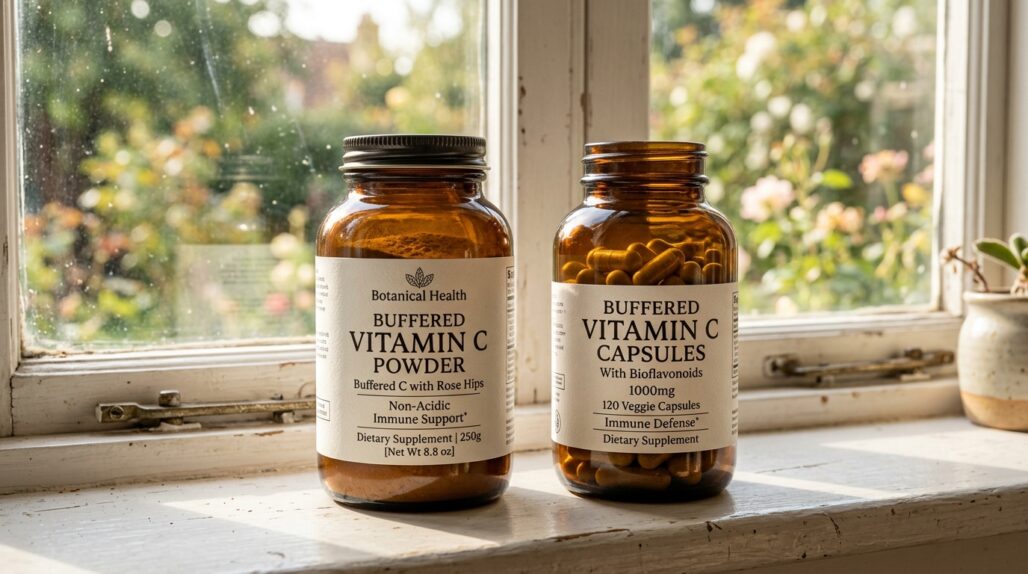
This is where the headlines and the evidence part ways. The strongest data points at men and at people who have already had a stone, not at the general population.
The clearest study is the Cohort of Swedish Men reported in JAMA Internal Medicine in 2013. Among 23,355 men aged 45 to 79, followed for about 11 years, those using ascorbic acid supplements (the local tablets ran about 1,000 mg) had a roughly two-fold higher risk of a first kidney stone, with a multivariate relative risk of 1.92. There was a dose-response trend, with the heaviest users landing near 2.23.
To keep that in proportion, the absolute risk is small. Stones are uncommon over any given year, so a doubling of a small number is still a small number. The researchers framed it as one extra stone per several hundred high-dose users per year, which is a real signal but not a reason to panic over a multivitamin.
Two contrasts matter:
- Women. A near-identical analysis in women, summarized by Harvard Health, found no link between vitamin C and stones. The reason is not fully settled, but the takeaway is that the male data should not be copied straight onto women.
- Food. Vitamin C from peppers, citrus, kiwi, and berries was not the culprit. Multivitamins, which carry modest amounts, did not drive the risk either. The concern is the concentrated, gram-level supplement taken on its own.
So if you are a healthy woman getting your vitamin C from food and a multivitamin, this whole topic is largely academic for you. If you are a man with a stone in your past who takes a 1,000 mg tablet every morning, you are exactly the person the studies were describing.
How to take vitamin C without raising your odds
The fixes here are simple and they are about dose, source, and water, not a magic form.
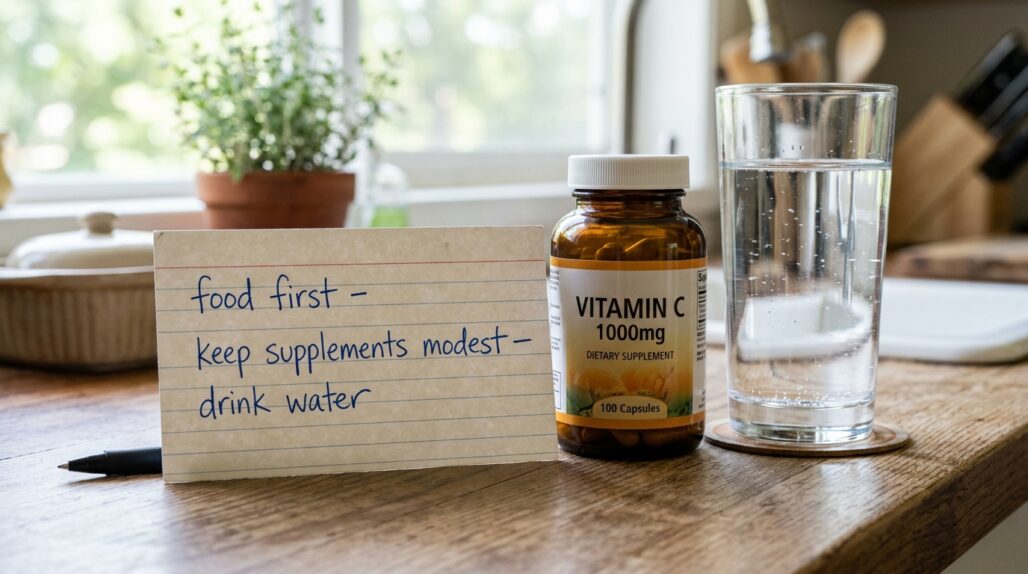
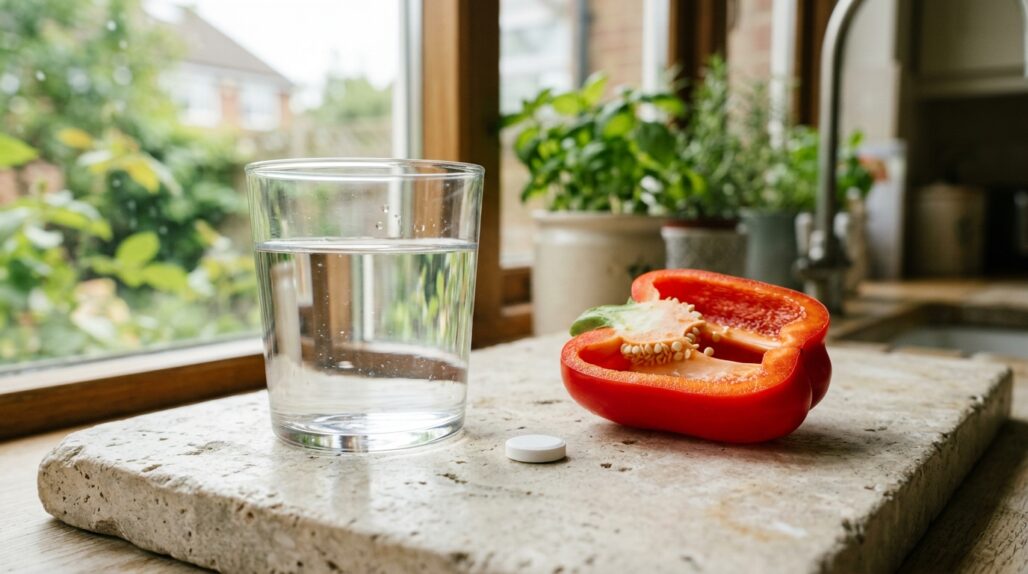
Lean on food. Whole-food vitamin C comes with the dose already capped at a sensible level. A red pepper, a serving of broccoli, a citrus fruit, and you have cleared the RDA without touching a bottle.
Keep any supplement modest. If you take one, 500 mg or less per day covers any plausible need for nearly everyone. There is no reason for a stone-cautious person to sit at a gram a day indefinitely.
Drink water. Dilute urine is one of the most reliable defenses against any stone type. The more concentrated your urine, the more oxalate and calcium can find each other. Aim for pale, plentiful urine across the day.
Split it if you must go higher. Two 250 mg doses are easier on both your gut and your oxalate load than one 1,000 mg hit. This is also the move that keeps the stomach happy, which we cover in detail in our guide on taking high-dose vitamin C without stomach upset.
If you are coming to vitamin C for its real, evidence-backed roles rather than megadose folklore, our complete guide to vitamin C lays out what the vitamin genuinely does and at what intakes.
Which form to choose if you are stone-cautious
For someone watching their oxalate, the form matters less than the dose, but a couple of choices make the gentle approach easier to stick to.
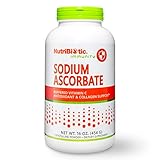
A buffered vitamin C (often sodium ascorbate or a mineral-buffered blend) is easier on the stomach, which makes it simpler to stay at a modest daily amount instead of clustering a big dose. A plain 500 mg tablet keeps you well under the UL and near the range with no clear stone signal. Liposomal vitamin C is marketed for absorption, which, if anything, argues for using a smaller milligram count rather than a larger one.
The honest call: a stone former rarely needs more than food plus a small supplement, and the cheapest 500 mg option usually does the job. Pay for a gentler form only if your stomach pushes back.
The picks below may include affiliate links; if you buy through them we may earn a small commission at no extra cost to you. Prices change, so check the current price before you buy.


As an Amazon Associate, UsefulVitamins.com earns from qualifying purchases at no extra cost to you.
Before you settle on a number, it is worth seeing how vitamin C earns its keep at sensible intakes. Our overview of the science, benefits, and dosing of vitamin C walks through where the real returns sit, and they are not at the high end.
FAQ
Will a daily multivitamin with vitamin C cause kidney stones? The studies pointing to higher risk involved standalone high-dose tablets, often around 1,000 mg. The modest vitamin C in a typical multivitamin was not linked to more stones, so a multivitamin is not the concern for most people.
Is 1,000 mg of vitamin C a day safe? It is under the 2,000 mg upper limit and fine for many people, but it is the dose tied to higher urinary oxalate and to more stones in men. If you have ever had a calcium-oxalate stone, that daily gram is the habit worth reconsidering with your doctor.
Does vitamin C from food raise stone risk? No clear evidence says so. Fruit and vegetable vitamin C comes in amounts your body handles easily, and food sources were not associated with stones in the research.
Does buffered or liposomal vitamin C avoid the oxalate problem? Not by itself. Some vitamin C still breaks down to oxalate regardless of form. The variable that matters is how many milligrams you take, so keeping the dose modest does more than switching forms.
I already had a kidney stone – should I stop vitamin C completely? Not necessarily, and this is a question for your doctor or pharmacist, not a blog. The usual advice is to get vitamin C from food, avoid gram-level supplements, and stay well hydrated, but your stone type and history should guide the specifics.
How much water helps offset the risk? Enough that your urine stays pale through the day. Dilute urine lowers the concentration of stone-forming compounds, which is one reason hydration sits at the center of nearly every stone-prevention plan.
The bottom line
Vitamin C does not cause kidney stones in the general sense, but high supplement doses at or above 1,000 mg a day have been tied to more stones in men and in past stone formers, because some vitamin C becomes oxalate. Food-level vitamin C and ordinary multivitamins are not the issue.
The sensible path is short: get vitamin C from food, keep any supplement near or below 500 mg, stay under the 2,000 mg upper limit, and drink enough water to keep your urine pale. For your own target number, use our vitamin C dose calculator rather than copying a label.
This article is general education, not medical advice. It does not diagnose any condition, and you should not start, stop, or change any supplement or prescription based on it. If you have a history of kidney stones, kidney disease, or you take medication, talk with a doctor or pharmacist before using high-dose vitamin C.
Reviewed by the UsefulVitamins Editorial Team.
