

If you searched for when to take magnesium for sleep, you have probably already bought the bottle and want to know which clock hour and which meal makes the dose actually work. The honest answer: for most adults, 30 to 60 minutes before bed with a small evening snack is the default, but split-dosing across dinner and pre-bed is more reliable if your problem is staying asleep rather than falling asleep..
Before you decide
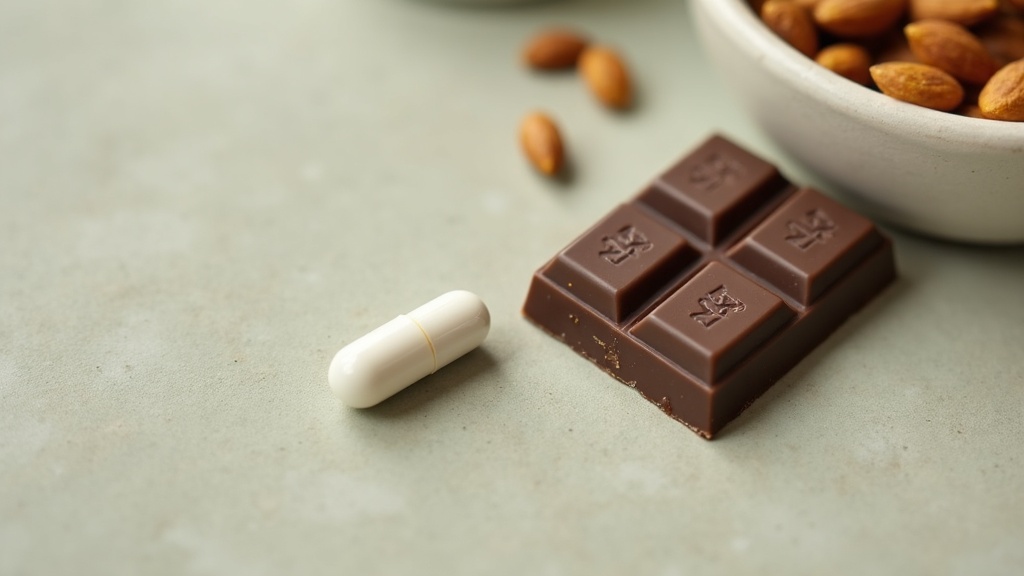
Who should NOT just stack magnesium at bedtime: anyone taking levothyroxine, a bisphosphonate, a fluoroquinolone, or a tetracycline antibiotic without a 4-hour buffer, and anyone with stage 3 or worse chronic kidney disease.
Do this FIRST before adjusting timing: count your magnesium-rich foods. The US average diet covers about 60 to 70 percent of the RDA. If pumpkin seeds, almonds, spinach, oats, and black beans are already on your plate at dinner, you may be supplementing on top of an adequate intake, and timing is not the lever.
What "timing" actually changes for magnesium
Most supplements care about timing only because of absorption or side effects. Magnesium cares about both, plus a third lever: where its peak plasma concentration lands relative to the part of the night you are trying to influence.
The pharmacokinetics, summarized in the Schuchardt and Hahn 2020 review, look like this. Oral magnesium is absorbed primarily in the small intestine through two routes: an active transcellular path that dominates at low doses, and a passive paracellular path that dominates at higher doses. Plasma concentration rises slowly, peaks around 2 to 4 hours post-dose, then trails off over 8 to 12 hours as the kidneys clear the excess. There is no sharp on-off switch, which is why magnesium does not act like a sleeping pill. It is a slow-release nudge to a system that already runs the show.
A dose taken with the last bite of dinner at 7 PM peaks around 9 to 11 PM, which usefully overlaps when most adults are trying to fall asleep. A single bedtime dose at 10 PM does not peak until 12 to 2 AM, which is a better fit for the early-morning-awakening crowd than for the trouble-falling-asleep crowd. The real question isn't whether to take magnesium with food or before bed, it's which window matches the part of the night where your sleep currently breaks.
The 30-to-60-minute-pre-bed default and why it works for most people

If you have one bottle and one dose and you want one rule, take it 30 to 60 minutes before bed with a small evening snack like a handful of pumpkin seeds or a square of dark chocolate.
That window earns the default position for three reasons. First, the slow plasma rise means the magnesium is climbing toward peak as you fall asleep and is still elevated through the first two sleep cycles, when most adults consolidate their deepest non-REM sleep. Second, a small carbohydrate-and-fat snack reduces the risk of the dose hitting an empty stomach and triggering loose stools, particularly for citrate. Third, it builds a routine, and behavioral consistency matters more for sleep than any single supplement does.
Actionable takeaway: if you take a single nightly dose, anchor it to a repeatable evening cue rather than to a wall-clock hour. Routine reinforces sleep architecture more than the exact minute does.
With dinner, with snack, or empty: how food changes each form
Food does three things for an oral magnesium dose. It buffers the osmotic load that produces loose stools at higher mineral doses. It provides the small fat and protein that improve passive paracellular absorption. And it slows gastric emptying, which slightly delays but does not reduce the eventual plasma peak.
The per-form rules my outpatient clinic patients have stuck with:
- Magnesium glycinate. Take with or without food. Food helps a sensitive stomach but is not required. Glycinate does not draw water into the intestinal lumen, so loose stools are uncommon at the 200 to 400 mg elemental range.
- Magnesium citrate. Always with food. On an empty stomach, citrate's osmotic effect pulls water into the gut and often produces a laxative response within 2 to 6 hours, which can interrupt sleep around 2 AM. With a meal, the response is much milder.
- Magnesium oxide. With food. Oxide is already poorly absorbed (around 4 percent in the Walker et al. 2003 head-to-head data) and food modestly improves the active-transport fraction. I do not prefer oxide for sleep, but if cost is the binding constraint, take it with dinner.
- Magnesium L-threonate. The brand instructions suggest with food, and that is reasonable: a fat-containing meal supports the threonate carrier's stability.
The dose number on the label is the same with or without food. The experience in your body is not.
Split dosing for sleep-maintenance complaints
The reader who wakes at 3 AM and cannot get back down has a different problem from the reader who lies awake at 11 PM. A single bedtime dose, peaking at midnight to 2 AM, is already past peak by the time the early-morning awakening hits.
The split-dose protocol that has held up best in my outpatient practice:
- 200 mg elemental magnesium glycinate with dinner, ideally before 7 PM
- 200 mg elemental magnesium glycinate 30 minutes before bed
- Total supplemental magnesium: about 400 mg, which closes the typical NHANES intake gap
The NIH ODS Tolerable Upper Intake Level of 350 mg applies to supplemental magnesium taken in addition to food, not to total intake, and the side effect that sets the UL is diarrhea, not toxicity. At 200 mg split twice with food, almost no one in my caseload reports loose stools on glycinate.
Think of it like painting a door. A single nightly dose is one heavy coat. A split dose is two thinner coats with time to cure between them. Both can cover, but the split-dose finish is more uniform across the night.
Drugs that need separation from your magnesium dose
This is the section to read twice if you take any prescription medication at night. Magnesium binds several drug classes in the gut and reduces their absorption, sometimes dramatically. The separation windows are not negotiable.
Levothyroxine: separate by at least 4 hours. Magnesium reduces levothyroxine absorption substantially, an effect documented in Liel et al. 1994 for several mineral compounds and listed in every levothyroxine monograph since. If you take levothyroxine on waking, your magnesium has to come at least 4 hours later, which usually means after lunch at the earliest and ideally at the dinner-or-bedtime window discussed above.
Bisphosphonates (alendronate, risedronate, ibandronate): separate by at least 30 minutes before bisphosphonate, and prefer a much longer window after. The standard bisphosphonate instructions already require an empty stomach with plain water on waking. Magnesium taken the prior evening is generally fine. Magnesium taken alongside or shortly after the bisphosphonate dose blocks absorption.
Fluoroquinolone antibiotics (ciprofloxacin, levofloxacin, moxifloxacin): separate by 2 to 6 hours, with the antibiotic taken first. Polk et al. 1989 showed ciprofloxacin absorption fell sharply when co-administered with magnesium and aluminum antacids. Take the antibiotic, wait at least 2 hours, then take magnesium.
Tetracycline antibiotics (doxycycline, minocycline, tetracycline): separate by at least 2 to 4 hours. Lehto et al. 1994 documented the binding for several mineral compounds.
Iron supplements: separate by at least 2 hours. Iron and magnesium compete for the same divalent-mineral transporters. Take iron with vitamin C earlier in the day, magnesium in the evening.
Calcium: minor competition, but separate doses if both are large. A 500 mg elemental calcium dose and a 400 mg elemental magnesium dose at the same meal will produce mild mutual interference. If you need both, take calcium at lunch and magnesium at dinner or pre-bed.
These are not all the drug interactions, just the common ones for a reader taking magnesium for sleep. Cross-check your full medication list against the NIH ODS Magnesium Fact Sheet and the Drugs.com magnesium interaction checker. If you take more than two prescription medications, ask your pharmacist for the full interaction list. A pharmacist's 60-second review is the highest-leverage step in this whole article.
Food pairings that double as a low-dose magnesium top-up
Food-first framing earns its place even in a supplement article, because the magnesium-rich foods that pair well with an evening dose also deliver real mineral content on their own.
- Pumpkin seeds. About 150 mg of elemental magnesium per ounce, more than most single capsules. A small bowl with dinner is a meaningful contribution.
- Almonds and cashews. About 80 mg per ounce, plus tryptophan. A handful pre-bed pairs naturally with a glycinate capsule.
- Dark chocolate (70 percent or higher). About 60 to 100 mg of magnesium in a small bar, with theobromine that nudges parasympathetic tone for some people. One square pre-bed, not the whole bar.
- Oatmeal with milk. A modest mineral profile but a strong calcium-magnesium balance and a slow-release carbohydrate that supports overnight blood sugar stability.
- Spinach and black beans. Best at dinner. Each delivers around 80 to 120 mg per cup cooked.
If your dinner already includes two of these, your supplemental dose needs are lower than the standard 400 mg evening protocol. Closer to 200 mg with dinner is the right starting point.
Population-specific timing rules
Older adults (over 65). Default to split dosing. Gut motility slows with age and a single 400 mg dose is more likely to produce a bathroom interruption than two 200 mg doses. The flatter plasma curve is also closer to the overnight profile you want.
Athletes on heavy training days. A small post-workout dose is reasonable on hard days, both because magnesium loss in sweat is real and because the early-evening dose then doubles as your pre-bed sleep dose. Pair with a meal. On rest days, a single dinner-or-pre-bed dose is enough.
Pregnant or breastfeeding readers. The prenatal vitamin already includes magnesium. Adding more without an obstetrician's input is not the right move. Ask your OBGYN about a blood test for serum magnesium before supplementing on top of the prenatal, and bring the prenatal label so the dose math is honest.
Chronic insomnia (over 3 months, most nights of the week). Timing tweaks are not the right tool. The AASM 2021 clinical practice guideline by Edinger and colleagues names cognitive behavioral therapy for insomnia (CBT-I) as first-line care. Magnesium is an adjunct, not a treatment. Ask your primary care doctor for a CBT-I referral or a sleep medicine consult, and ask about a blood test for ferritin, vitamin D, and TSH first.
Decision matrix you can save
| Your sleep complaint | Best timing | Best form | With food? |
|---|---|---|---|
| Trouble falling asleep at 11 PM | 30 to 60 min pre-bed | Glycinate | With a small snack |
| Wake at 2 to 4 AM and stay awake | Split: dinner + pre-bed | Glycinate | Yes, both doses |
| Restless legs at sleep onset | 60 min pre-bed | Glycinate | Either |
| Sleep onset plus constipation | With dinner | Citrate | Yes, required |
| Anxiety-driven sleep problems | Split: dinner + pre-bed | Glycinate | Yes |
| Cost is the binding constraint | With dinner | Citrate | Yes, required |
| Over 65, gut sensitive | Split: dinner + pre-bed | Glycinate | Yes |
Actionable takeaway: start with the row that matches your dominant complaint, hold the protocol for 14 nights, then judge. A single bad night is not a signal. A trend across two weeks is.
When timing is not the lever
Some sleep complaints will not move with timing changes. Persistent early-morning awakening with low mood points toward depression and warrants a primary care visit, not more magnesium. Snoring with daytime sleepiness in a partner-witnessed pattern points toward obstructive sleep apnea and warrants a sleep study, where the standard of care is CPAP or an oral appliance, not a mineral.
Ask your doctor about a blood test for serum ferritin, vitamin D 25-OH, TSH, and a CBC before you assume your problem is magnesium-shaped. A baseline panel costs less than three months of mid-tier supplements and tells you whether you are aiming at the right target.
Conclusion: the bottom line on when to take magnesium for sleep
The right timing for magnesium depends less on a perfect clock hour and more on matching the dose to the part of the night where your sleep currently breaks. For most adults, 30 to 60 minutes pre-bed with a small evening snack is the default. For sleep-maintenance problems, a 200 mg dinner dose plus a 200 mg pre-bed dose flattens the plasma curve in a way that better fits a 3 AM awakening. For anyone on levothyroxine, a bisphosphonate, a fluoroquinolone, or a tetracycline antibiotic, the 4-hour separation rule is not optional. And for anyone with chronic insomnia, magnesium is an adjunct to CBT-I, not a substitute.
Next steps:
- Pick the row in the decision matrix above that matches your dominant complaint, set a 14-night trial window, and judge on the trend, not on any single night
- If you take any prescription medication at night, ask your pharmacist for a 60-second magnesium-interaction review before adding the dose
- Pair the supplement with a food-first approach: read our complete guide to magnesium for dietary intake math and our best magnesium for sleep roundup for the third-party-tested brands worth buying
For our editorial standards, see how we review supplements, or read more from Sarah Thompson.
This article is for informational purposes and not medical advice. Magnesium can interact with several common prescription medications and is not appropriate for everyone, particularly people with chronic kidney disease. Consult a licensed clinician or pharmacist before adding a supplement, especially if you are pregnant, nursing, taking prescription medications, or managing a chronic condition.
Reviewed by Sarah Thompson, Registered Dietitian, focused on vitamin and mineral nutrition.
