|
Bottom line
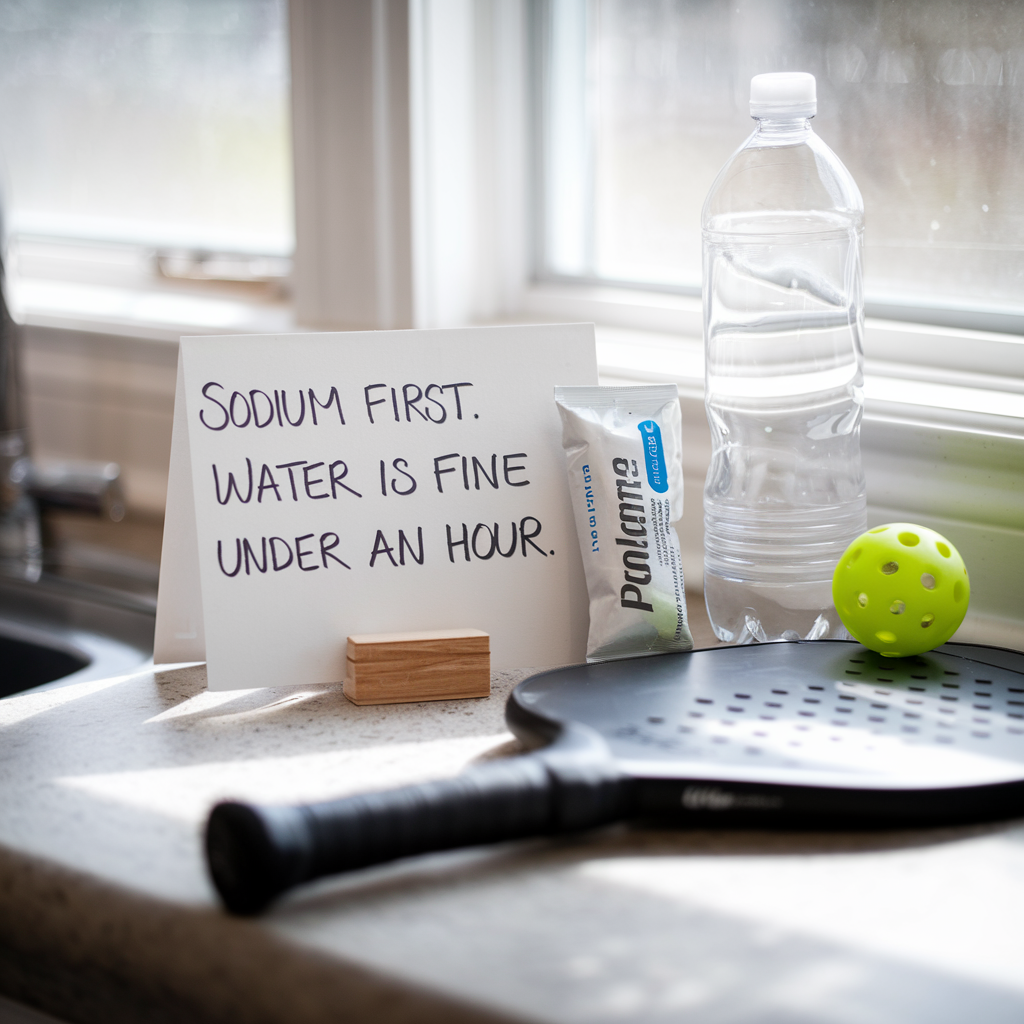
Match-day sodium matters more than brand. Pick a 500 to 1,000 mg sodium serving for outdoor tournament days, about half that for casual indoor play, and skip the product entirely for a single game under an hour, where water alone is fine.
- Best overall: LMNT for outdoor tournament days, since one stick (1,000 mg sodium) covers what multiple matches in the heat actually cost you.
- Best value: Nuun Sport for casual and indoor play, a 300 mg sodium tablet that matches lighter sweat losses without sugar you don’t need.
- Skip products entirely if: you play one relaxed indoor game under an hour, or your doctor has you on a sodium-restricted diet for blood pressure, heart, or kidney reasons.
|
Affiliate disclosure: this article contains affiliate links. As an Amazon Associate, UsefulVitamins.com earns from qualifying purchases at no extra cost to you.
Pickleball has a hydration problem nobody prices in: the sport's core players are old enough that their thirst signal has started lying to them, and tournament formats stack three or four matches into a single hot afternoon. The electrolyte advice written for 25-year-old marathoners does not transfer cleanly. This guide covers what a pickleball session actually costs you in fluid and sodium, when plain water genuinely covers it, and which five products fit which kind of player. These are the same picks we hand to our own parents before their weekend tournaments, so the recommendations below are the ones we actually live with.
Before you decide
Electrolyte powders are salt delivery vehicles, and nothing here is medical advice. If your doctor has you restricting sodium, the high-sodium products in this roundup are the wrong aisle for you until that conversation happens. That covers most people managed for high blood pressure, heart failure, or chronic kidney disease.
The medication question deserves its own sentence because it cuts both ways. Diuretics make you lose more fluid and sodium than your neighbor on the next court, while beta blockers and some other blood pressure drugs blunt the body's heat response, so the "average" advice in any hydration article can miss you in either direction. We walk through the specifics in the 45-plus section below, and your pharmacist can settle it for your exact prescription list in five minutes.
This comparison is for the recreational and tournament pickleball player deciding between water, a low-dose tablet, and a high-sodium powder. If you want the general science first, our complete guide to electrolytes covers what each mineral does; this page stays on the court.
What a pickleball session actually takes out of you
Start with honest numbers instead of sports-drink marketing. A 2022 study in the Journal of Aging and Physical Activity put heart rate monitors on recreational players averaging 62 years old and found singles and doubles both ran mean heart rates around 111 beats per minute, roughly 70% of predicted maximum. Pickleball plays as genuine moderate-to-vigorous exercise, closer to a brisk hike with sprints than to a stroll, and singles players logged over 3,300 steps per hour doing it.
Nobody has published pickleball-specific sweat data yet, so the closest honest proxy is other intermittent court sports. A 2019 analysis of sweat testing across sports found basketball players averaged 0.95 liters of sweat per hour and lost about 34.5 mmol of sodium per hour, which converts to roughly 790 mg of sodium. A reasonable working estimate for hard outdoor pickleball is a liter of sweat and several hundred milligrams of sodium per hour, more in July heat, less in an air-conditioned gym.
The spread around those averages is the real story. The same dataset showed individual athletes ranging from light, dilute sweating to double the average rate, and the American College of Sports Medicine's fluid replacement position stand is blunt that sweat rate and sweat sodium vary so much between individuals that fluid plans should be customized. If your shirt crusts white after outdoor matches, you are a salty sweater and should read every sodium number in this article as a floor. Our electrolyte replacement calculator turns your body weight and session length into a personal estimate.
Tournament days are where the math turns serious. A typical local tournament runs pool play plus a bracket, which can mean three to five matches between morning and late afternoon on outdoor courts. Losses that are trivial in a single game compound across a tournament day, and by the semifinal you can be down two liters of fluid and well over 1,500 mg of sodium if you have only been sipping plain water between matches.
When water alone is enough
Here is the honest gate most electrolyte marketing skips. A casual 45-minute indoor doubles game needs water and nothing else. At that duration and intensity, your sweat losses are modest, your kidneys manage sodium balance without help, and your next meal replaces whatever the game took. Buying a $1.50 stick pack for that session is buying flavored reassurance.
The same holds for most single-game days in mild weather. The body defends its sodium concentration well across short exercise, and a normal diet already supplies more sodium than most health authorities would like. Reach for a product when the session gets long, hot, or repeated: 90 minutes or more of continuous play, any outdoor session above roughly 80°F, multiple matches in one day, or noticeable cramping history.
There is also a real hazard on the far side of this line. Drinking large volumes of plain water across an all-day outdoor tournament, while sweating out salt, can dilute blood sodium. If you are refilling a big bottle repeatedly across a tournament day, some of that fluid should carry sodium, which is precisely the scenario the higher-dose products exist for.
The 45-plus factor: thirst, meds, and heat
Pickleball's player base skews older than most court sports, and that changes the hydration calculus in three specific ways. First, thirst itself becomes less reliable with age. A classic New England Journal of Medicine experiment deprived healthy men aged 67 to 75 of water for 24 hours and found they reported markedly less thirst than younger controls, even though their blood sodium and osmolality rose even more than the younger men's. An older player can be meaningfully dehydrated on court and simply not feel like drinking. The practical fix is boring and effective: drink on a schedule between games, not on sensation.
Second, common prescriptions stack the deck further. A 2015 pharmacology review catalogued how medicines raise dehydration and heat-illness risk: diuretics drive fluid and electrolyte loss directly, and the risk climbs when they are combined with an ACE inhibitor or ARB, the standard blood pressure stack for millions of players. Anticholinergics and some psychiatric medications reduce sweating and blunt thirst on top of that. If your morning pill organizer includes a water pill plus a blood pressure medication, treat every outdoor session as one tier hotter and longer than it looks, and clear your electrolyte plan with your prescriber, since extra sodium can work against the medication's purpose.
Third, heat illness is not a theoretical risk at summer tournaments. Multiple matches, midday sun, radiant court surfaces, and a blunted thirst signal are the standard recipe for heat exhaustion in this demographic. Shade between matches, scheduled fluids with sodium, and a hard personal stop rule beat any supplement, and no product in this roundup substitutes for those.
How to choose for pickleball
Sodium per serving is the only spec that meaningfully separates these products, so match it to your session tier. Casual indoor play sits comfortably in the 300 mg range, long or hot sessions in the 400 to 600 mg range, and outdoor tournament days justify 500 to 1,000 mg spread across the day. Potassium and magnesium amounts differ between brands and matter far less; sweat is mostly a sodium problem.
Sugar is a fork in the road rather than a flaw. Sugar-free options like LMNT and Nuun leave your fueling separate, which suits players managing weight or blood sugar. Carb-carrying mixes like Skratch or Liquid I.V. make sense when the drink is also your energy source across a long tournament day, and are redundant when you are eating between matches anyway.
Format is a court-logistics question. Tablets travel in a pocket and dissolve slowly; powder sticks mix fast but need a bottle you can shake. For between-match dosing at a tournament, stick packs beat tablets on speed, while a tube of tablets in the bag is the better everyday companion. Worth knowing before you assume tablets are equivalent: many are dosed well below powders, a gap we measured in our review of whether electrolyte tablets are underdosed vs powders.
Caffeine deserves one line: none of our five picks below contains it in the standard flavors, which is the right default for a sport with afternoon finals and 60-something cardiovascular systems.
The numbers side by side
| Product |
Sodium |
Potassium |
Sugar |
Format |
Price per serving |
| LMNT |
1,000 mg |
200 mg |
0 g |
Powder stick |
About $1.50 (30-count box, as of August 2026) |
| Liquid I.V. Hydration Multiplier |
500 mg |
About 370 mg |
11 g |
Powder stick |
About $1.55 (16-count pack, as of August 2026) |
| Skratch Labs Sport Hydration |
400 mg |
Not published on serving snapshot we checked |
About 19 g carbs, mostly sugar |
Powder (scoop or packet) |
Varies by retailer |
| DripDrop |
330 mg |
185 mg |
7 g |
Powder stick |
Varies by retailer |
| Nuun Sport |
300 mg |
150 mg |
1 g |
Effervescent tablet |
Varies by retailer |
All figures come from current brand labels cross-checked against retailer listings in August 2026. Labels change; check yours before assuming the numbers still hold.
Top picks for pickleball
LMNT is the tournament-day pick because one stick actually covers tournament-scale losses. At 1,000 mg of sodium with zero sugar, a single serving split across two between-match bottles roughly replaces two hot outdoor matches' worth of sodium for an average sweater. It is also the strongest-tasting option here, which is the honest tradeoff: people who find salt-forward drinks unpleasant should size down. We put the brand through a full cost-and-evidence teardown in our LMNT review.
Nuun Sport is the everyday pick for the player who plays four mornings a week. A 300 mg tablet dropped into a court bottle matches what a typical 60-to-90-minute session costs, carries just 1 g of sugar, and the tube lives in a paddle bag indefinitely. It is genuinely underpowered for all-day outdoor events, and that is fine; that is not its job.
Liquid I.V. is the pick when the drink has to double as fuel. Its 500 mg of sodium sits usefully in the middle tier, and the 11 g of sugar reads as a defect for casual play and a feature across a five-match Saturday when you struggle to eat between brackets. How it stacks against the salt-heavy approach is exactly the argument we run in Liquid I.V. vs LMNT.
Skratch Labs Sport Hydration is the pick for players who want food-adjacent ingredients and a gentler flavor than either of the above. At 400 mg of sodium and about 19 g of carbohydrate from mostly cane sugar and fruit, it behaves like a light sports drink you mix yourself, well matched to long doubles sessions in warm weather.
DripDrop is the recovery-oriented pick, built on oral-rehydration-solution ratios with 330 mg of sodium and 7 g of sugar in a small stick. It shines less during play and more in the hour after a hot tournament day when you are demonstrably down fluid and want fast, palatable replacement.
What to look for when buying
Read the sodium line first and the marketing never. A pickleball-appropriate product states its sodium per serving plainly, and that number should map to your session tier from the section above, not to whichever brand shouts loudest about hydration multipliers or cellular absorption.
Check the serving definition before comparing prices. Some brands define a serving as one stick in 16 oz of water while others assume 8 oz, and tablet products often need two tablets to reach powder-level doses. Price per milligram of sodium is the fairest comparison across formats, and it quietly reorders this whole market.
Buy one flavor in the smallest count first. Electrolyte products live or die on whether you actually drink them, and salt tolerance is personal. The best product is the one your taste buds will accept on match four of a hot day. For broader warm-weather strategy beyond the court, our guide to summer hydration supplements covers the rest of the picture, and competitive players wanting the full field of options can compare against our master list of the best electrolytes for athletes.
As an Amazon Associate, UsefulVitamins.com earns from qualifying purchases at no extra cost to you. We only recommend products supported by published research or third-party testing.
Averages only get you so far. Weigh in before and after one session and run your own numbers through our sweat rate calculator.
FAQ
Do electrolytes interact with blood pressure medication?
They can, in both directions, and this is the most common real conflict in the pickleball demographic. High-sodium products can push against the purpose of a sodium-sensitive blood pressure plan, while diuretics increase your losses and may argue for more replacement, and potassium-containing mixes matter for people on ACE inhibitors, ARBs, or potassium-sparing diuretics. Bring your exact prescription list to your pharmacist before settling on a daily electrolyte habit, and use one of the free tools in our roundup of supplement interaction checkers to screen the combination yourself first.
Will electrolytes stop my leg cramps during matches?
Sometimes. Cramping has multiple causes, and fatigue plus unaccustomed intensity explains many pickleball cramps regardless of hydration. That said, players who cramp late in hot sessions after heavy sweating are the group most likely to notice a difference from adding sodium. Treat sodium as the cheap first experiment, and treat persistent cramping as a question for your doctor.
What should I drink on a tournament day?
Work backwards from the schedule. Arrive hydrated, then drink to a plan between matches rather than waiting for thirst, which the aging-thirst research says will under-call your needs. A workable default is 16 to 24 oz of fluid per hour of outdoor play with 500 to 1,000 mg of total sodium spread across a multi-match day, adjusted up if you sweat heavily or the heat index is ugly. Salty food between brackets counts toward the total.
Can I just drink more water instead?
For short sessions, yes, and you should. Across a long hot tournament day, plain water in large volumes without sodium can dilute blood sodium levels, which shows up as fatigue, headache, and nausea that players easily mistake for dehydration and treat with more water. Volume without sodium is not a safe substitute on all-day outdoor events.
Are indoor and outdoor pickleball really that different for hydration?
Yes, and the gap is bigger than most players assume. Indoor climate control caps your sweat rate near the low end of the court-sport range, while outdoor summer play adds radiant heat from the court surface and sun exposure with no shade between rallies. The same 90 minutes can cost two to three times more fluid outdoors in summer than in a cool gym, which is why our advice splits by venue rather than by skill level.
The bottom line
Pickleball hydration is a dosing problem wearing a branding costume. Match sodium to the session: nothing extra for a short indoor game, roughly 300 mg for a standard hour of play, and 500 to 1,000 mg spread across an outdoor tournament day. LMNT owns the tournament tier, Nuun Sport owns the everyday tier, and Liquid I.V., Skratch, and DripDrop fill the fuel, flavor, and recovery gaps between them.
The non-negotiables sit outside the shopping cart. Players over 45 should drink on schedule because thirst under-reports with age, and anyone on diuretics or blood pressure medication should clear their plan with a pharmacist before making any of these products a habit. Get the sodium tier right and the brand choice becomes what it should have been all along: a matter of taste.
-
The UsefulVitamins Editorial Team publishes practical, source-backed explainers on supplement tools, apps, safety workflows, and site methodology. Editorial work is operated by SIA Digital Publisher and follows UsefulVitamins review standards, with medical or nutrition credentials used only when a named author or reviewer can be verified.
View all posts
Editorial Team