
If you're searching "Liquid IV vs LMNT," you're probably one of three people: someone who wants a sweet, fast-absorbing hydration drink after a workout, someone who is doing keto or low-carb and needs electrolytes without 11 grams of sugar, or someone who just looked at both products' direct-to-consumer prices and wants to know if there's a real difference behind nearly identical per-stick costs. The short answer is yes, these products are built on different philosophies, and the one you pick should come down to your sugar tolerance, your sodium needs, and whether you're chasing ORS-style absorption or a clean keto electrolyte. This article maps every meaningful difference between the two so you can stop comparing and start drinking water.

Affiliate disclosure: this article contains affiliate links. As an Amazon Associate, UsefulVitamins.com earns from qualifying purchases at no extra cost to you.
The 30-second answer
Liquid IV costs $1.56 per stick and delivers 510mg sodium with 11g of sugar using a Cellular Transport Technology (CTT) system designed to mimic oral rehydration salts. LMNT costs $1.50 per stick and delivers 1,000mg sodium with zero sugar, built explicitly for keto dieters, heavy sweaters, and people who want maximum electrolyte density without any sweetener load. The price difference is literally six cents per serving. The formulation difference is enormous.
Pick Liquid IV if: You want a sweet, easy-drinking hydration product for general workouts, hangovers, or post-illness recovery, and you have no issue with 11g of sugar per serving.
Pick LMNT if: You are low-carb or keto, you are a heavy or endurance sweater, you are managing blood sugar, or you find Liquid IV's sweetness too strong and want a cleaner mineral profile.
Skip both if: You are managing sodium-sensitive hypertension. LMNT's 1,000mg per stick is a significant daily sodium load. Talk to your physician first.

Side-by-side at a glance
| Factor | Liquid IV | LMNT |
|---|---|---|
| Sodium per serving | 510 mg | 1,000 mg |
| Sugar per serving | 11 g (sucrose + dextrose) | 0 g |
| Potassium per serving | 370 mg | 200 mg |
| Magnesium per serving | Not listed on standard label | 60 mg |
| Price per stick (DTC) | $1.56 (16-stick pack, $24.99) | $1.50 (30-stick pack, $45.00) |
| Annual cost at 1/day | ~$570/yr | ~$548/yr |
| Subscription cancel friction | Easy, online account cancel | Easy, online account cancel |
| Taste profile | Sweet, fruit-forward | Lightly salted, low-sweet |
| Formulation logic | CTT / ORS-style absorption | High-sodium keto/endurance electrolyte |
| Corporate ownership | Unilever (acquired 2020) | Independent (founded by Robb Wolf) |
The annual cost gap is about $22/year. That number is not why you pick one over the other. Sodium and sugar are.
Where Liquid IV wins
Liquid IV's core claim is its Cellular Transport Technology, which is essentially a version of oral rehydration salt (ORS) science applied to a consumer product. The ORS principle, validated by WHO and used in clinical dehydration treatment, is that glucose co-transport with sodium accelerates water absorption in the small intestine. When sodium and glucose are present in the right ratio, water follows more efficiently than it does with plain water alone. Liquid IV's 11g of sugar and 510mg of sodium are designed to create that co-transport effect.
For the typical workout, travel day, hangover, or fever-recovery scenario, this is exactly the right formulation logic. You want fast rehydration. You are not worried about 11g of sugar in the context of needing to recover from dehydration. The sweetness is a feature, not a bug, most people who are mildly to moderately dehydrated want something palatable, and Liquid IV delivers that.
Liquid IV also wins on potassium: 370mg versus LMNT's 200mg. For general electrolyte balance and muscle function, potassium matters. If you are not specifically doing keto and you do not need ultra-high sodium, Liquid IV's more balanced sodium-to-potassium ratio is closer to general ACSM sport hydration guidance.
One real-world advantage that shows up consistently in r/HydroHomies threads from 2025: Liquid IV is easier to find. It is in Costco, Target, CVS, and major grocery chains. LMNT is more DTC-dominant. If you need hydration support and your grocery store does not carry LMNT, Liquid IV is the practical choice.

Where LMNT wins
LMNT wins on three specific populations: keto dieters, endurance athletes with high sweat rates, and anyone trying to avoid sugar.
The keto case. When you restrict carbohydrates below roughly 20-50g/day, insulin drops significantly. Low insulin signals the kidneys to excrete more sodium. The electrolyte losses from keto dieting are well-documented, muscle cramps, headaches, fatigue, and the so-called "keto flu" are largely electrolyte and fluid depletion symptoms. LMNT was explicitly designed for this use case by Robb Wolf, co-author of the Paleo Solution and a well-known keto/carnivore advocate. At 1,000mg sodium per stick, LMNT replaces what keto dieters lose. Liquid IV's 510mg gets you halfway there while adding 11g of sugar that immediately works against ketosis.
The endurance sweat case. Sweat sodium concentration varies considerably between individuals, but heavy sweaters in endurance sports (marathon runners, cyclists, triathletes) can lose 700-1,000mg of sodium per hour. For a two-hour training run or a long bike, one LMNT stick is a reasonable replacement strategy. One Liquid IV stick covers roughly half of a moderate sweat session. Posts from r/Ultramarathon throughout 2025 consistently rate LMNT as the electrolyte of choice for events over two hours, specifically because of the sodium density.
The zero-sugar case. If you are managing blood glucose, following a diabetic eating protocol, or simply trying to eliminate added sugars from your diet, Liquid IV's 11g of sucrose and dextrose per serving is disqualifying. LMNT has zero sugar and is sweetened with a small amount of stevia in flavored varieties. It also comes in an unflavored raw version (just sodium, potassium, magnesium) for people who want pure minerals with no sweetener at all.
The magnesium differential also matters: LMNT includes 60mg of magnesium chloride per stick. Liquid IV's standard product does not list significant magnesium. For muscle recovery and sleep quality, two outcomes frequently cited in the supplement literature alongside electrolyte intake, magnesium presence at even a partial-dose level is a meaningful formulation advantage.

The DIY angle
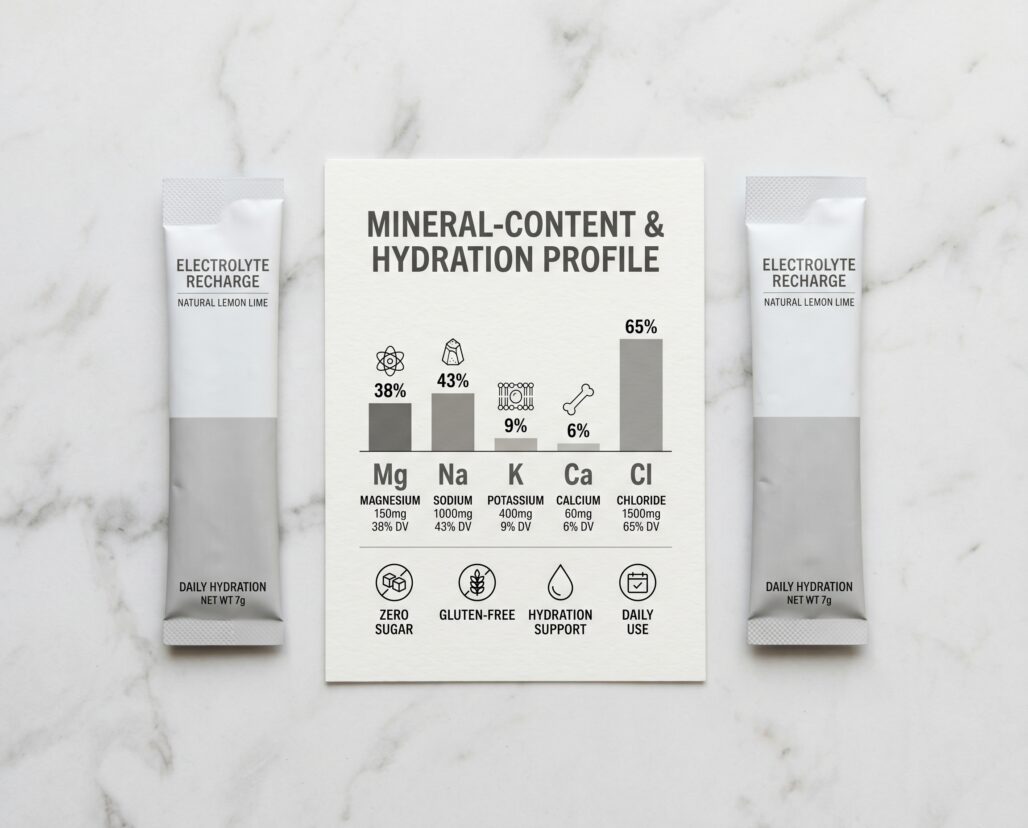
Robb Wolf, who helped design LMNT, has published the underlying recipe publicly. It is not a trade secret. The keto-electrolyte formula that LMNT is based on looks like this:
- 1,000mg sodium, approximately 2.5g of table salt (sodium chloride, ~$0.01/serving)
- 200mg potassium, approximately 0.6g of lite salt or potassium chloride ($0.01-0.02/serving)
- 60mg magnesium, approximately one-third of a standard 200mg magnesium glycinate capsule ($0.03-0.05/serving)
Total estimated cost per serving from bulk ingredients: $0.05-0.08 per dose, versus $1.50 for an LMNT stick.
The real cost of LMNT is formulation convenience, flavor development, and packaging. If you go through two to three sticks daily, which some endurance athletes and strict keto practitioners do, the $1.50/stick cost compounds to $3.00-4.50/day, or $90-135/month. At that consumption rate, buying bulk Morton Lite Salt, table salt, and magnesium glycinate capsules from Amazon and mixing your own reduces your cost by 95% or more.
The counter-argument: measuring bulk minerals into drinks daily is friction that erodes compliance. Most people who try the DIY route eventually buy LMNT for travel and convenience even if they mix their own at home. That is a reasonable middle path.
For Liquid IV, the DIY equivalent is harder to reproduce. The specific glucose-sodium co-transport ratio and the dextrose form matter to the ORS mechanism. You can approximate it with water, a pinch of salt, sugar, and citrus, but the proportions need to be deliberate, and the convenience gap with a commercial packet is wider.
Verdict by use case
| Use case | Recommendation |
|---|---|
| General workout hydration | Liquid IV |
| Hangover recovery | Liquid IV |
| Post-illness rehydration (fever, stomach bug) | Liquid IV |
| Keto or low-carb diet | LMNT |
| Endurance athlete, high sweat rate | LMNT |
| Blood sugar management or diabetic diet | LMNT |
| Intermittent fasting (no sugar window) | LMNT |
| Travel or everyday light hydration boost | Liquid IV |
| Heavy training days (2+ hours) | LMNT |
| Budget-conscious daily electrolyte routine | DIY bulk mineral mix (~$0.08/dose) |
| Sodium-sensitive hypertension | Neither, consult physician |
The decision tree is simpler than most comparison articles make it look. If sugar is fine and you want sweet, ORS-style hydration: Liquid IV. If sugar is off the table or you need high-sodium density for keto or endurance: LMNT. If you are spending $30+ per month on either product and the formulation matches your needs exactly, the DIY option exists and it is financially significant over a year.
A note on cancellation friction
Both products are sold primarily on subscription. The important data point: both Liquid IV and LMNT allow online self-service cancellation through their account portals. There is no 7-day email notice window, no customer support phone call required, no cancellation fee. You can cancel before your next renewal through the account dashboard on either site.
That makes both products notably better than some DTC supplement subscriptions that require contacting support or meeting a notice deadline. That said, subscriptions on either product are still commitments. You will be charged automatically until you cancel. Set a calendar reminder for your trial period if you are testing either product on a subscribe-and-save model.
On Amazon Subscribe & Save, the cancellation friction is even lower, you can cancel, pause, or adjust delivery frequency from your Amazon account in under 60 seconds. The Amazon price for Liquid IV's 16-stick pack via Subscribe & Save is often around $13-14, a roughly 50% discount versus the $24.99 DTC price. LMNT's Amazon pricing typically matches the DTC per-stick cost of $1.50, making it a wash, but the Amazon cancel workflow is faster and you are not locked into a brand portal.
If you are testing either product for the first time, buying the smaller pack through Amazon rather than a DTC subscription is the lower-friction and often lower-cost entry point.
Once you have picked a product, our companion app, StackMyMed, scans its label and tracks it alongside everything else you take, with timing and interaction checks built in.
Related reading
- Is Liquid IV Worth It?
- Is LMNT Worth It?
- Liquid IV Alternatives on Amazon
- LMNT Alternatives on Amazon
- How We Review Supplements
This article is for informational purposes and not medical advice. Electrolyte products at high sodium levels (1,000mg per serving) can be contraindicated for individuals managing sodium-sensitive hypertension, kidney disease, or other conditions where sodium restriction is prescribed. Consult a licensed physician before adding high-sodium electrolyte supplements to your routine, particularly if you are pregnant, nursing, taking blood pressure medications, or managing a chronic health condition.
For 2026 pricing across DTC supplement subscriptions and their Amazon equivalents, see our DTC supplement pricing reference.
As an Amazon Associate, I earn from qualifying purchases. Product recommendations are based on real reviews and independent research.
Editorial independence note: UV earns affiliate commissions from Amazon and (selectively) from DTC brand affiliate programs. Commissions never determine our recommendations — top picks are chosen first; affiliate links are added second. Read our full methodology and editorial independence policy →
Frequently asked questions
Is Liquid IV or LMNT better for keto?
LMNT. It has zero sugar and 1,000mg sodium per stick, built for low-carb and endurance needs. Liquid IV’s 11g of sugar per stick works against a ketogenic diet, so LMNT is the clearer fit for anyone in ketosis.
Why does LMNT have so much more sodium than Liquid IV?
LMNT delivers 1,000mg sodium per stick versus Liquid IV’s 510mg because it is designed for keto dieters and heavy sweaters who lose large amounts of sodium. Most casual users do not need that much sodium in a single drink.
Which is better for a hangover or illness?
Liquid IV. Its sugar-to-sodium ratio mimics oral rehydration salts, which supports water absorption during illness, vomiting, or dehydration. LMNT’s zero-sugar formula lacks that transport mechanism, so it is less suited to clinical-style rehydration.
