
Affiliate disclosure: this article contains affiliate links. As an Amazon Associate, UsefulVitamins.com earns from qualifying purchases at no extra cost to you.
Every marathon block eventually collides with the same question: what goes in the bottle? The supplement industry answers "salt," and for long runs it is mostly right. But a landmark field study of 488 Boston Marathon finishers found that the runners who ended up in trouble had drunk too much, not too little. So this guide starts from the risk that actually hospitalizes runners, then works backward to the handful of products worth your money. These are the same picks we would hand a family member the night before their first 20-miler.
Before you decide

Not everyone reading a roundup like this needs a product. If your running is 30 to 60 minutes at conversational pace in mild weather, plain water plus your normal diet already replaces everything you lose. An electrolyte mix on a 5 K day is flavored water with extra steps, and our complete guide to electrolytes covers why in more depth.
A few groups should talk to a doctor before adding any high-sodium mix: anyone managing high blood pressure, heart failure, or kidney disease, and anyone on a sodium-restricted diet or taking diuretics. Several products below deliver 750 to 1,000 mg of sodium in a single serving, which is a meaningful chunk of a restricted daily allowance. Nothing in this article is medical advice; it is label reading plus published sports-science, nothing more.
Who this comparison is actually for: runners in a marathon or half-marathon build with long runs past 90 minutes, runners training through hot summers, and the "salty sweaters" who finish long efforts with white crust on their hat. If you train across several sports, our broader electrolytes for athletes roundup may fit better.
What marathon training actually takes out of you

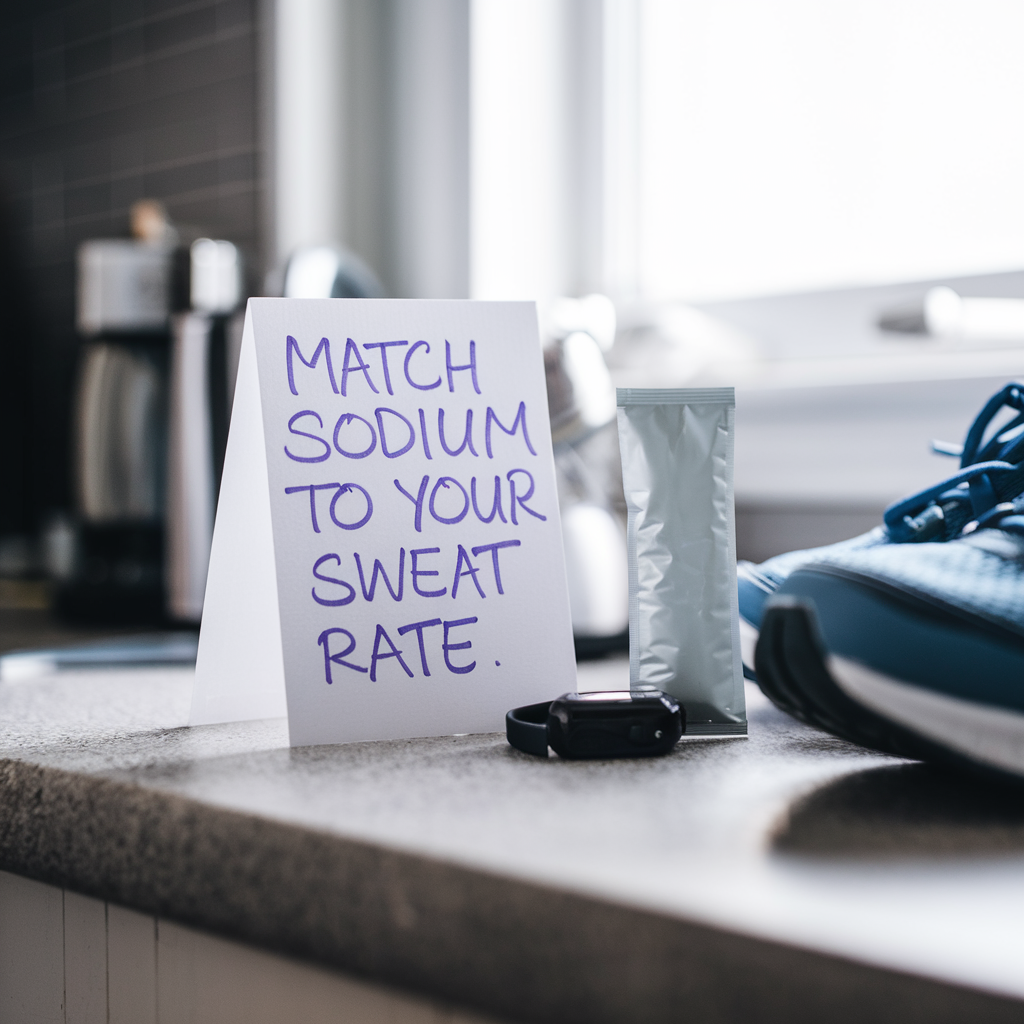
Two numbers decide your electrolyte needs: how much you sweat, and how salty that sweat is. Both vary far more between runners than most marketing admits. A 2017 review in Sports Medicine covering roughly 500 athletes found whole-body sweat rates of about 0.5 to 2.0 liters per hour, with a small group (around 2%) exceeding 3 liters per hour in extreme conditions. A four-fold spread in sweat rate means a four-fold spread in what you need to put back.
Sweat saltiness varies even more. The same review put whole-body sweat sodium at roughly 10 to 70 mmol/L, which works out to about 230 to 1,600 mg of sodium per liter of sweat. Two runners doing the same long run can lose sodium at rates seven times apart. This is why blanket advice ("just drink a sports drink") serves some runners well and leaves others cramping or bloated.
Put the two together with a worked example. A runner sweating 1.2 L/h with mid-range sweat sodium of about 920 mg/L loses roughly 1,100 mg of sodium every hour. Over a four-hour marathon that is more than 4 grams of sodium, about two teaspoons of table salt. You do not need to replace all of it mid-run, but you can see why a 300 mg tablet per bottle barely dents the ledger for this runner.
There is a crude field test you already run every summer: look at your cap and singlet after a two-hour effort. Heavy white salt streaks are a rough but useful tell that you sit at the salty end of the range. It is not lab data, and patch testing at a sports clinic is the accurate route, but the crust points in the right direction.
The better home method is the sweat-rate test, and it comes straight from the American College of Sports Medicine's fluid replacement position stand, which recommends estimating individual sweat rate by weighing yourself before and after exercise. Weigh yourself without clothes, run 60 minutes at long-run effort without drinking (or weigh your bottle before and after and subtract), then weigh again. Each kilogram lost is roughly one liter of sweat per hour. Repeat it once in cool weather and once in heat, because the two numbers will differ. Then plug your result into our electrolyte replacement calculator to turn liters into a per-hour sodium target.
When water alone is enough
Here is the honest gate most roundups skip: for runs under 60 to 90 minutes, water covers you. A 2019 review in Nutrients summarizing ACSM guidance puts the case for sodium supplementation mainly at efforts beyond 2 hours, sweat rates above 1.2 L/h, and self-identified salty sweaters. Your next meal restores the sodium from a one-hour run without any help from a supplement.
The reason we lead with this is not thrift. It is that the documented sodium emergency in marathons runs in the opposite direction. In a New England Journal of Medicine study of 488 Boston Marathon finishers, 13% finished with hyponatremia (blood sodium of 135 mmol/L or less) and 0.6% were at critical levels. The strongest risk factors were gaining weight during the race (odds ratio 4.2) and finishing slower than 4 hours (odds ratio 7.4 versus sub-3:30). Gaining weight during a marathon means you drank more than you sweated.
The international consensus statement on exercise-associated hyponatremia identifies overdrinking hypotonic fluid as the central cause, and its prevention advice centers on drinking to thirst rather than to a schedule. Two practical consequences for marathoners. First, slower runners, the exact group most heavily marketed to, carry the higher risk and should be the most disciplined about not forcing fluids. Second, an electrolyte drink is not a license to drink without limit; sports drinks are still mostly water, and enough of them can dilute blood sodium anyway. Salt your fluid, but let thirst set the volume.
How to choose for marathon training

Once you clear the 90-minute gate, sodium per serving is the first spec to check, because products span from 215 mg to 1,000 mg. The same Nutrients review passes along an ACSM starting range of roughly 300 to 600 mg of sodium per hour during prolonged exercise, adjusted to the individual, alongside 400 to 800 mL of fluid per hour. Match the product's per-serving sodium to your hourly target, not to its flavor list. A confirmed salty sweater may sit above that range; a light sweater on a cool day sits below it.
Format matters more for runners than for gym athletes. Powders let you scale the dose and dissolve into whatever bottle you carry. Tablets are lighter in a race belt but often deliver far less sodium than their shelf presence suggests; we ran the numbers in our piece on whether electrolyte tablets are underdosed versus powders. Capsules decouple sodium from fluid entirely, which is useful late in a marathon when your stomach tolerates sips but not sweet drinks.
Then decide whether you want carbohydrate in the same bottle. If you fuel with gels, a zero-sugar mix such as LMNT avoids stacking sugar on sugar. If you prefer one bottle that does both jobs, a carb-plus-sodium mix like Skratch replaces a gel or two. Neither approach is wrong; doubling up on both by accident is.
Finally, run the price math per serving, not per bag. A 16-week marathon build with three supplemented runs a week is roughly 50 servings, so the gap between a $0.25 capsule and a $1.50 stick is about $60 per build.
The numbers side by side
Every figure below comes from the brand's own label page or, where noted, consistent retailer listings. Where a brand does not publish a number, we say so rather than guess. Prices are approximate as of August 2026.
| Product | Sodium per serving | Potassium / other | Format and carbs | Approx. price per serving |
|---|---|---|---|---|
| LMNT | 1,000 mg | 200 mg potassium, 60 mg magnesium | Powder stick, no sugar | $1.50 ($45 per 30 sticks) |
| Precision PH 1500 | 750 mg (packet in 500 ml; 1,500 mg/L) | Not listed on the page we checked | Powder packet, low-calorie | About EUR 1.60 (EUR 12.99 per 8-pack, EU store) |
| Skratch Sport Hydration | 400 mg | Not listed on the page we checked | Powder, 19 g carbs | About $1.20 ($23.95, 20-serving bag) |
| Nuun Sport | 300 mg | 150 mg potassium, 25 mg magnesium | Effervescent tablet, 1 g sugar, 15 cal | $0.75 ($7.49 per 10-tablet tube) |
| SaltStick Caps | 215 mg | 63 mg potassium, 22 mg calcium, 11 mg magnesium | Capsule, no fluid or carbs | About $0.25 (from $24.99 per 100) |
Top picks for runners and marathon training
LMNT is the pick for confirmed heavy or salty sweaters because one stick delivers 1,000 mg of sodium, which sits above the standard 300 to 600 mg hourly range and covers a full hour of heavy salt loss with one packet and zero mid-run arithmetic. It contains no sugar, so it stacks cleanly with gel fueling. It is also the most expensive option per serving, and a light sweater genuinely does not need this much; we dig into that trade-off in our LMNT review and in the DripDrop versus LMNT comparison.
Precision PH 1500 suits runners who want a structured plan rather than a habit. The 750 mg packet in 500 ml is built for pre-loading before hot races and for high-loss runners mid-race, and the 1,500 mg/L concentration is among the strongest sold. The catch: the brand's product page does not publish a full mineral panel, so the sodium figure here rests on consistent retailer listings.
Skratch Sport Hydration is the one-bottle race-day option. With 400 mg of sodium and 19 g of carbohydrate per serving, one large bottle per hour supplies fluid, fuel, and salt together, which simplifies aid-station logistics for runners who dislike gels. If you already fuel with gels, its carbs become redundant calories.
Nuun Sport fits easy weeks and light sweaters. At 300 mg of sodium per tablet with 1 g of sugar, it flavors water enough to encourage drinking without loading you with either salt or sugar. For a two-hour humid long run it will likely underdose you unless you drop in two tablets, which is exactly the tablet problem our underdosing analysis covers.
SaltStick Caps are the tinkerer's tool and the value pick. At 215 mg of sodium per capsule for about a quarter, you can add exactly the sodium your sweat test says you need, on top of plain water or any drink you like. Capsules also travel well in a race belt for the late miles when sweet drinks stop appealing.
What to look for when buying
Read the Supplement Facts panel, not the front of the pouch. The number that matters is sodium in milligrams per serving, and you should check what the brand calls a serving; some list one scoop where the mixing instructions use two. If a label math check does not add up, treat that as a verdict on the brand.
Prefer brands that publish a full mineral panel. Potassium, magnesium, and calcium play smaller roles than sodium in sweat replacement, but a brand that hides the panel from its own product page (two in our table) makes you shop on faith. If you compete under anti-doping rules, look for NSF Certified for Sport or Informed Sport marks rather than trusting "third-party tested" claims without a named certifier.
Check the sugar line against your fueling plan, too. Carbohydrate in a hydration mix is a feature if it replaces gels and a bug if it duplicates them. There is no prize for consuming 90 grams of sugar an hour across three overlapping products.


As an Amazon Associate, UsefulVitamins.com earns from qualifying purchases at no extra cost to you. We only recommend products supported by published research or third-party testing.
Averages only get you so far. Weigh in before and after one session and run your own numbers through our sweat rate calculator.
FAQ
Do I need electrolytes for a 5K or a daily 45-minute run?
No. Sweat losses at those durations are modest, and your next meal replaces the sodium without help. The evidence for supplementation concentrates in efforts past 2 hours, sweat rates above about 1.2 L/h, and heavy salt losers. Save the money, or spend it on the long-run supply.
How do I measure my sweat rate at home?
Weigh yourself unclothed, run one hour at long-run effort, towel off, and weigh again. If you drank during the run, subtract the bottle's weight change. Each kilogram lost equals roughly a liter of sweat per hour. Do it once in cool weather and once in heat, then use our electrolyte replacement calculator to convert the result into a per-hour sodium plan.
Can I just put table salt in my bottle?
You can, and it is the cheapest sodium there is. The Dietary Guidelines figure of 2,300 mg of sodium per teaspoon of salt means a quarter teaspoon delivers roughly 575 mg, squarely in the per-hour target range. The downsides are taste, no potassium or magnesium, and easy mis-measuring mid-run. Capsules solve the same problem with better precision.
I take blood pressure medication or a GLP-1 drug. Can I use these products?
Ask your prescriber or pharmacist first, and bring the label. High-sodium mixes can work against blood pressure treatment, and potassium-containing products deserve a check if you take ACE inhibitors, ARBs, or potassium-sparing diuretics. GLP-1 users have a different math problem entirely, since reduced food intake cuts dietary sodium; we cover that in electrolytes on GLP-1.
Will an electrolyte drink prevent hyponatremia during my marathon?
Not by itself. Race hyponatremia is driven mainly by drinking more fluid than you lose, and sports drinks are dilute enough that overdrinking them can still lower blood sodium. The consensus advice is to drink to thirst and let salt come along in whatever you drink. If you gain weight during a long race, you drank too much, whatever was in the bottle.
Should my electrolyte drink have caffeine?
Caffeine is a fueling decision, and mixing it into your hydration product makes both harder to dose. Most runners do better taking caffeine separately (gel or tablet) at planned points and keeping the bottle's job simple.
The bottom line
The order of operations matters more than the brand. First, respect the gate: under 60 to 90 minutes, drink water to thirst and spend nothing. Second, run the bathroom-scale sweat test so your plan rests on your own number instead of an average. Third, buy the format that matches that number: LMNT or PH 1500 for heavy losses, Skratch for combined fueling, Nuun for light days, SaltStick capsules for precise top-ups at the lowest cost. And through all of it, remember what the marathon data actually shows: the runners who get into serious trouble with sodium are the ones who drown it, not the ones who run short a few hundred milligrams.
