
If you're searching for the best ashwagandha supplement, the honest answer is: the right product depends almost entirely on the extract type and withanolide standardization, not the brand story. This guide breaks down the two extract families that dominate the clinical evidence (KSM-66 and Sensoril), why withanolide content is the only label detail that predicts a real dose, and which seven products across different use cases and budgets are worth considering. You will also learn which three categories of products to skip and why, plus the specific drug interactions that most ashwagandha guides gloss over.
Affiliate disclosure: this article contains affiliate links. As an Amazon Associate, UsefulVitamins.com earns from qualifying purchases at no extra cost to you.
Summary / Quick Answer: best ashwagandha supplement in 2026
KSM-66 and Sensoril are the only extract standards with meaningful human RCT evidence. Everything else requires extra label scrutiny.
- Best for: Adults with chronic stress (three months or longer), slow sleep onset, or fitness recovery goals who want a standardized extract backed by published human trials.
- Not ideal for: Anyone on thyroid hormone replacement, immunosuppressants, sedatives, or benzodiazepines without physician review. Pregnancy is a hard contraindication.
- What to look at before buying: Withanolide percentage on the label (5% for KSM-66, 10% for Sensoril, or a disclosed percentage for other root extracts), third-party certificate of analysis, and single-extract capsule size that matches the clinical trial dose.
- Decision shortcut: If chronic stress is your goal, start with KSM-66 at 300mg twice daily as used in the Chandrasekhar 2012 RCT. If sleep onset is the priority, Sensoril at 125-250mg is a reasonable starting point from the available trial data.
What you'll find in this guide
- Why withanolide standardization is the only thing that matters
- What the science actually shows
- 7 ashwagandha supplements we'd actually buy
- 3 categories to skip
- Who should and should not take ashwagandha
- Dosing: what clinical trials used
- Side effects and drug interactions
- Frequently asked questions
- Related reading
Why withanolide standardization matters {#why-withanolide-standardization-matters}
Ashwagandha (Withania somnifera) root powder in its unextracted form contains roughly 0.3 to 0.5% withanolides by weight, depending on growing conditions, harvest timing, and storage. A 600mg capsule of plain root powder therefore delivers approximately 1.8 to 3mg of withanolides. The clinical trials that showed meaningful cortisol reduction used standardized extracts delivering far higher withanolide concentrations, typically 15 to 30mg per serving.
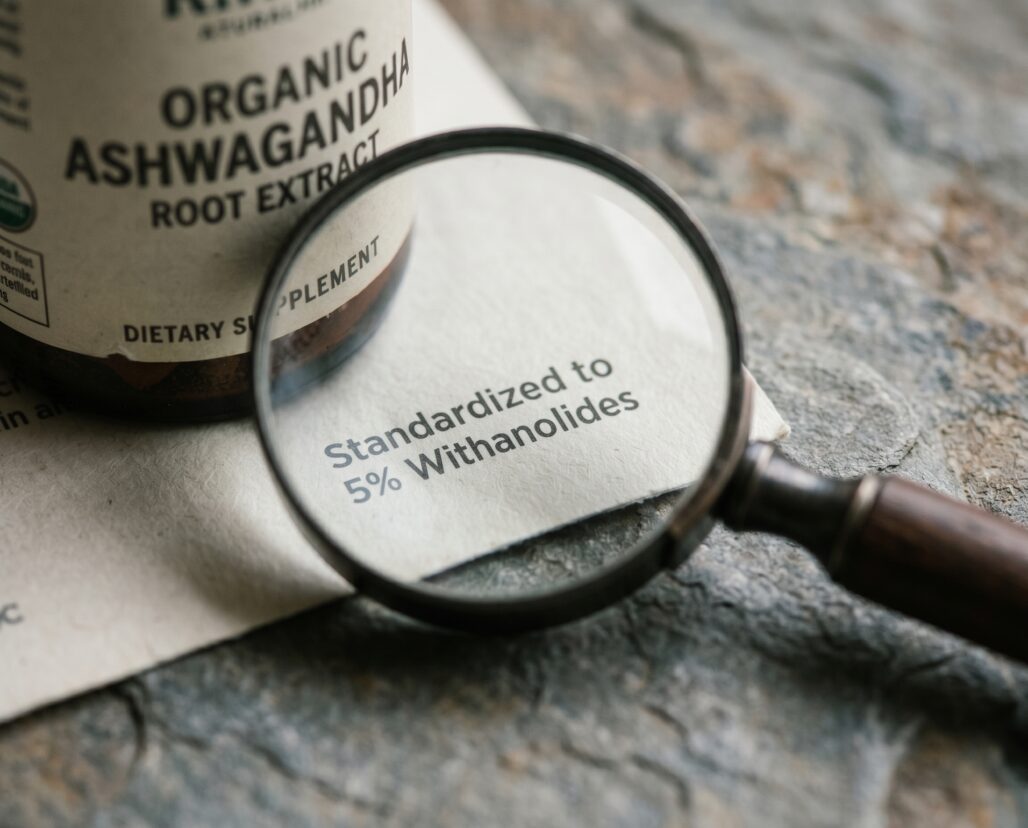
"Standardized to 5% withanolides" is meaningful. "Ashwagandha root powder" alone tells you nothing about the active-marker dose you're actually getting.
Buying an unstandardized ashwagandha product is like buying olive oil labeled only "Mediterranean blend." The label tells you everything except the quality of the ingredient that actually matters.
Two patented extract families hold most of the clinical evidence:
KSM-66 (Ixoreal Biomed) is a root-only extract standardized to 5% withanolides using a milk-based solubilization method. Most of the well-known stress, cortisol, and performance RCTs used this extract, including the Chandrasekhar 2012 and Choudhary 2017 studies.
Sensoril (Natreon) uses both root and leaf, standardized to 10% withanolides plus an oligosaccharide fraction. Clinical doses are lower in weight (125-250mg per serving) but comparable to KSM-66 in withanolide mass. Sensoril has stronger representation in sleep-focused trials.
An adaptogen brand can have impressive marketing and still miss third-party testing for the active marker compound. Certificate of analysis from an independent lab (NSF, USP, or Informed Sport) is the only external verification that matters.
What the science actually shows {#what-the-science-actually-shows}
The clinical evidence for ashwagandha is the strongest of any common adaptogen for chronic stress. Two foundational RCTs anchor the recommendations in this roundup and explain why withanolide standardization is the deciding purchase factor.
In a 2012 placebo-controlled RCT (Chandrasekhar et al., n=64), adults with a history of chronic stress received KSM-66 ashwagandha at 300mg twice daily or placebo for 60 days. The treatment group showed a 44% reduction on the Perceived Stress Scale versus placebo and a statistically significant 28% reduction in serum cortisol (p=0.0006). This remains the most rigorous single study for ashwagandha's cortisol-lowering effect, conducted with a standardized extract at a disclosed withanolide percentage.
A 2019 double-blind RCT (Salve et al., n=60) examined a standardized ashwagandha extract (250mg and 600mg daily doses) versus placebo over 60 days. The high-dose group showed significant improvements in sleep quality (Pittsburgh Sleep Quality Index), morning cortisol levels, and self-reported stress. The Salve 2019 data is relevant to this buying guide because it tested two doses, demonstrating that lower milligram amounts from a well-standardized extract can produce clinical-grade outcomes. This is directly relevant to why a 250mg Sensoril capsule can be equivalent in withanolide mass to a 600mg KSM-66 capsule.
A 2017 RCT (Choudhary et al., n=60) used KSM-66 at 300mg twice daily in adults with anxiety and reported significant reductions on the Hamilton Anxiety Rating Scale at 60 days compared to placebo, with a favorable adverse-event profile. The real question is not whether ashwagandha works in controlled trials but whether the product you buy delivers the same extract and withanolide mass as the trial product. Most do not.
Independent testing from ConsumerLab's adaptogen review found wide variation in withanolide content across ashwagandha products, with some products delivering less than 20% of their labeled withanolide claim. This gap between label and reality is the core argument for buying branded-extract products with published COAs over cheaper commodity root powder capsules.
Actionable takeaway: The Chandrasekhar 2012 and Salve 2019 trials justify why withanolide standardization matters as a purchase criterion, not just as a marketing claim. They also establish the dose ranges worth looking for on labels.
7 ashwagandha supplements we'd actually buy {#7-ashwagandha-supplements-wed-actually-buy}
The seven picks below are organized by use case. Each product earns its slot based on extract type, disclosed withanolide percentage, manufacturing transparency, and third-party testing, not branding or marketing claims.
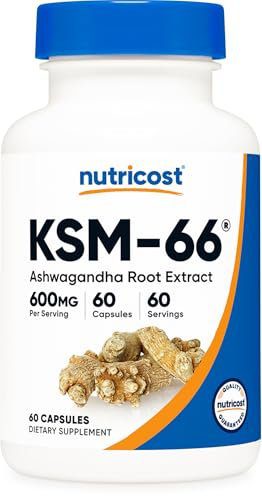
Top pick: Nutricost Ashwagandha KSM-66 600mg
Our pick for most buyers: KSM-66 at a per-serving dose that brackets the Chandrasekhar 2012 clinical range, with verified standardization and third-party testing, at a cost-per-serving that makes consistent 60-day trials financially realistic.
Skip if your primary concern is sleep onset rather than stress and cortisol; Sensoril-based products have stronger representation in sleep-focused trials.
Premium choice: Pure Encapsulations Ashwagandha
Best for buyers who prioritize manufacturing traceability and clean-label formulation. Pure Encapsulations is NSF Certified for Sport and uses hypoallergenic capsule fill with no unnecessary excipients. Recommended for individuals with multiple supplement sensitivities or those who have had inconsistent results from other brands and want to rule out filler-related variability.
Skip if you are primarily price-sensitive; the per-serving cost is significantly higher than other KSM-66 products with comparable withanolide content.
Budget pick: NOW Foods Ashwagandha Extract
Best for: buyers who want a standardized extract without KSM-66 or Sensoril licensing costs. NOW Foods discloses its withanolide standardization percentage and holds GMP certification. It provides a reasonable starting option for testing ashwagandha tolerance before committing to a pricier branded extract. Independently tested by Labdoor's supplement rankings.
Skip if you want the specific extract used in the published RCTs; NOW's extract uses its own standardization rather than a patented extract platform.
KSM-66 specialist: Gaia Herbs Ashwagandha Root
Best for buyers who want KSM-66 in a whole-food, liquid-phyto-capsule format. Gaia uses their Liquid Phyto-Caps technology with an olive oil base, which may support absorption for individuals who respond poorly to dry-fill capsules. The company provides traceability from seed to shelf via their HerbPrint QR code system, an above-average transparency offering.
Skip if you want the lowest cost per dose; liquid capsule formats carry a manufacturing premium.
Sensoril specialist: Himalaya Organic Ashwagandha
Best for buyers whose primary goal is sleep quality. Himalaya uses Sensoril (10% withanolides) and has positioned its formulation around the sleep and relaxation trials. At a lower milligram weight than KSM-66 products, this is often the better match for individuals who want evening dosing with less stimulating effect than higher-dose KSM-66.
Skip if your primary outcome is stress-related cortisol reduction during waking hours; the Sensoril dosing profile is lower-cortisol-load than the Chandrasekhar-style KSM-66 protocol.
Organic-certified: Organic India Ashwagandha
Best for buyers who specifically require USDA Organic certification and prefer traditional whole-root preparation over concentrated extracts. Organic India uses certified organic ashwagandha root in a non-GMO capsule. The withanolide content is lower per capsule than standardized extract products, but the sourcing transparency and agricultural practices are a meaningful differentiator for buyers with sustainability priorities.
Skip if you want the trial-matching withanolide dose in a small number of capsules per day; achieving clinical-range withanolide mass from a whole-root product requires more capsules per serving than from a standardized extract.
Traditional-prep: Sun Potion Ashwagandha
Best for buyers who want a powder-format ashwagandha for blending into drinks or food, and who appreciate the aesthetic of a traditional preparation style. Sun Potion sources organic ashwagandha and provides a fine powder that disperses well in warm liquid. This is not the product for someone targeting a specific withanolide dose from an RCT; it is for buyers integrating ashwagandha into a ritual that matters to their adherence.
Skip if you need a specific standardized withanolide dose or third-party potency verification. Powder format makes dose control less precise than capsule forms, and the product does not carry an independent lab COA for withanolide content.
3 categories to skip {#3-categories-to-skip}
This section does not name specific brands, because underperforming products in each category appear and disappear from the market frequently. Instead, these are the label patterns that predict a product is not worth your money.
1. Products labeled only "ashwagandha root powder" with no withanolide percentage. Unextracted root powder delivers an unpredictable and likely sub-clinical withanolide dose. In the absence of a stated standardization percentage, there is no way to know whether you are taking a dose in any proximity to what the RCTs used. Every trial that showed meaningful cortisol and stress outcomes used a disclosed, standardized extract. Root powder with no percentage disclosed fails the minimum informational standard.
2. Products in proprietary blends that obscure the ashwagandha dose. Proprietary blend labeling legally allows a manufacturer to list ingredients without disclosing individual amounts. When ashwagandha appears inside a "stress blend" or "adaptogen complex" with six other herbs, the label cannot tell you whether you are getting 50mg or 500mg. The range matters enormously. Proprietary blend labeling is a transparency failure, not a competitive advantage worth tolerating.
3. Products marketed at megadose levels above 1,500mg per day without peer-reviewed justification. More herb is not always more useful. The human RCTs that produced the strongest cortisol and stress outcomes used doses between 300mg and 600mg of KSM-66 twice daily, or comparable withanolide mass in Sensoril. No well-powered human RCT has demonstrated superior outcomes at 1,500mg-plus daily doses of ashwagandha. Some adaptogens show biphasic response curves where higher doses lose effect relative to middle doses. Products marketed at extreme doses are often using low-concentration root powder to pad milligrams, not higher withanolide mass.
Who should and who should not take ashwagandha {#who-should-and-who-should-not-take-ashwagandha}
This table functions as a quick self-screen before purchasing:
| Question | If yes, consider carefully |
|---|---|
| Is your stress chronic (three months or longer, not situational)? | Fits the RCT profile |
| Are you on thyroid hormone medication (levothyroxine, liothyronine)? | Avoid without physician clearance |
| Are you on immunosuppressants (tacrolimus, cyclosporine, biologics)? | Avoid without physician clearance |
| Are you on sedatives, benzodiazepines, or prescription sleep aids? | Use caution, additive sedation risk |
| Are you pregnant or trying to conceive? | Avoid |
| Is your stress primarily situational (a rough week, a deadline)? | Weak case for ashwagandha; effect is at 60 days |
| Do you have autoimmune conditions? | Withanolides have immune-modulatory properties; consult physician |
Actionable takeaway: The clinical trial populations that showed meaningful results were adults with chronic stress, normal thyroid function, and no significant prescription drug regimen. If you differ substantially from that profile, the evidence is less directly applicable to you.
Dosing: what clinical trials used {#dosing-what-clinical-trials-used}
This section reports doses as past-tense ranges from published trials. It is not a prescription.
In the 2012 Chandrasekhar RCT, participants took 300mg KSM-66 twice daily (600mg total per day) for 60 days. This is the most-cited dosing reference in the stress and cortisol literature.
In the 2019 Salve RCT, two arms were compared: 250mg of a standardized extract once daily and 600mg once daily, both over 60 days. The 600mg arm showed stronger improvements in sleep quality and morning cortisol, though the 250mg arm also outperformed placebo.
In the 2017 Choudhary anxiety RCT, participants used the same KSM-66 protocol as Chandrasekhar: 300mg twice daily for 60 days.
Most stress-and-cortisol trials saw measurable effect by day 30, with the largest effects measured at day 60. No well-powered human RCT has established benefit beyond 90 days of continuous use.
Timing in clinical trials: most used split doses with food (morning and evening) for KSM-66, and single or split doses for Sensoril products. Some practitioners suggest keeping the evening dose as the primary one given ashwagandha's mild sedative effect, but this timing preference is not established in RCT design. Morning and evening both appear in the published literature.
Side effects and drug interactions {#side-effects-and-drug-interactions}
Reported adverse effects from trials
In the Chandrasekhar 2012 and Choudhary 2017 trials, adverse events were mild and broadly comparable between ashwagandha and placebo groups. The most commonly reported effects were gastrointestinal: mild nausea, loose stools, and stomach discomfort, particularly at the start of supplementation and when taken on an empty stomach. These effects generally resolved within the first two weeks. No serious adverse events attributable to ashwagandha were reported in these trials.
Rare case reports in the literature have associated high-dose ashwagandha use with elevated liver enzymes, though causation is difficult to establish given confounding supplement use in most reported cases. The NCCIH ashwagandha fact sheet recommends avoiding use if you have liver disease.
Drug interactions (CRITICAL)
Per Memorial Sloan Kettering's integrative herbs database, the three most clinically important interaction categories are:
Thyroid medications: Withanolides have been associated with increased thyroid hormone production in animal studies and case reports. For individuals taking levothyroxine or other thyroid hormone replacement drugs, ashwagandha may alter thyroid-stimulating hormone (TSH) and T3/T4 levels, potentially requiring medication adjustment. This interaction is specific to ashwagandha among common adaptogens and is a hard flag for anyone on thyroid treatment.
Immunosuppressants: Withanolides modulate immune function, including potential effects on T-cell activity. For individuals taking tacrolimus, cyclosporine, mycophenolate, or biologic agents (used after organ transplant or for autoimmune disease), ashwagandha may counteract the suppressive effect of the medication. This is not a theoretical risk; it is the reason Memorial Sloan Kettering flags it explicitly for oncology patients.
Sedatives and CNS depressants: Ashwagandha has documented mild anxiolytic and sedative properties at the doses used in clinical trials. Combined use with benzodiazepines (clonazepam, alprazolam), prescription sleep aids (zolpidem), or other CNS depressants may produce additive sedation. The combination is not necessarily dangerous, but the interaction is real and worth disclosing to your prescriber.
Antidiabetic medications: Ashwagandha may lower blood glucose by modulating insulin sensitivity. Combined use with sulfonylureas or insulin may produce additive hypoglycemic effects. Individuals managing type 2 diabetes on medication should monitor glucose levels more carefully if adding ashwagandha.
Pregnancy and breastfeeding
No adequate human safety data exist for ashwagandha during pregnancy. Traditional Ayurvedic texts listed ashwagandha as an abortifacient at high doses. Pregnancy is a hard contraindication. Breastfeeding safety data are likewise absent; avoid during nursing.
Actionable takeaway: The drug-interaction profile is specific enough to matter. Thyroid medication, immunosuppressants, and sedatives are the three categories that warrant a physician conversation before starting any ashwagandha product.
Frequently asked questions {#frequently-asked-questions}
How long does ashwagandha take to work?
In the Chandrasekhar 2012 RCT, measurable serum cortisol reduction occurred at day 60. Subjective stress improvements on self-report scales were observed as early as day 30 in some participants. If 8 weeks of consistent use of a standardized KSM-66 or Sensoril product at the trial dose produces no perceptible change, the evidence does not support expecting different results with continued use.
Is KSM-66 or Sensoril better?
Neither extract has a head-to-head RCT against the other. KSM-66 has more published trials for stress, cortisol, and testosterone outcomes. Sensoril has stronger sleep trial representation. For stress as the primary outcome, KSM-66 at 300mg twice daily is the better-evidenced choice. For sleep onset as the primary outcome, Sensoril at 125-250mg is a reasonable alternative framing.
Can ashwagandha cause liver damage?
Most clinical trials at standard doses (up to 600mg/day of KSM-66) did not report liver-related adverse events. A small number of case reports exist describing elevated liver enzymes in individuals using ashwagandha, but these cases typically involved high doses, multi-supplement regimens, or confounding factors. The NCCIH ashwagandha fact sheet advises caution for individuals with existing liver conditions. Routine liver function monitoring is reasonable for long-term users.
Can I take ashwagandha every day?
Most RCTs used daily dosing for 60 days, which is the framework the evidence supports. Some practitioners suggest cycling (five days on, two days off) to avoid receptor habituation, but no human RCT has tested this cycling approach. For individuals on thyroid medication, daily use requires prescriber coordination given the TSH interaction potential.
What withanolide percentage should I look for?
For KSM-66, 5% is the standard and matches the clinical trials. For Sensoril, 10% is the standard. For generic standardized extracts, look for at least 2.5%. "Root powder" with no percentage stated is a red flag that the product may not deliver a clinical-range withanolide dose.
Is ashwagandha safe for women?
The Chandrasekhar 2012 trial included both men and women and showed similar stress-reduction outcomes across sexes. Women who are pregnant or breastfeeding should avoid ashwagandha given the absence of safety data. Women on thyroid medication are in the high-priority interaction category and should consult their prescriber before use.
Does ashwagandha affect testosterone?
A 2015 RCT (Wankhede et al., n=57) found that men taking KSM-66 at 300mg twice daily alongside an 8-week resistance training program showed significantly greater testosterone increases versus placebo (15% vs 2.5%). This is a promising single trial with a relevant cohort. The real question is whether the testosterone question you have is one of supplementing athletic recovery or correcting a clinical testosterone deficit, since ashwagandha is not a substitute for medically supervised testosterone therapy.
As an Amazon Associate, I earn from qualifying purchases. Product recommendations are based on real reviews and independent research.
Related reading {#related-reading}
For the full evidence base behind ashwagandha's effects on cortisol, sleep, and testosterone, see our in-depth companion piece: Ashwagandha: The Honest Guide to What Withania somnifera Actually Does.
If you are comparing ashwagandha against other adaptogens for daily stress management, the data and trade-offs are mapped in: Best Lion's Mane Supplement in 2026: What the Research Actually Supports.
For readers who have narrowed their decision to extract type and want the full technical breakdown, see: KSM-66 vs Sensoril: Which Ashwagandha Extract Is Worth the Premium?.
For anyone considering a broader adaptogen stack rather than a single herb, the buying and stacking framework is in: Best Rhodiola Supplement in 2026: Evidence, Dosing, and What to Avoid.
Taking this alongside other products? StackMyMed (our companion app) logs your full stack, finds the optimal timing for each dose, and flags interactions, so you are not tracking it all by hand.
Conclusion: the bottom line on ashwagandha supplements {#conclusion}
The supplement market for ashwagandha is large and largely undifferentiated by quality. Most products use unextracted root powder at doses that do not approach the withanolide mass used in the RCTs that built ashwagandha's reputation. The two picks that consistently satisfy the evidence criteria are KSM-66 for stress and cortisol goals, and Sensoril for sleep-quality goals, because both are standardized extracts with disclosed withanolide percentages and a body of published human trials at their dosing ranges.
The three categories to skip, generic root powder with no withanolide disclosure, proprietary blends that hide the ashwagandha dose, and megadose products pushing past 1,500mg without trial backing, cover the majority of what gets promoted heavily online.
Next steps:
- If stress and cortisol reduction are your goal, start with a KSM-66 product at 300mg twice daily, with food, for a minimum 60-day trial.
- If sleep onset is the goal, consider Sensoril at 125-250mg, taken in the evening with food.
- If you take thyroid medication, immunosuppressants, or sedatives, have a specific conversation with your prescriber before starting.
- For a deeper look at how ashwagandha compares to other adaptogens across different outcome categories, read the complete guide to ashwagandha.
This article is for informational purposes and not medical advice. Herbal adaptogens, even traditional ones, can interact with thyroid medication, antidepressants, anticoagulants, immunosuppressants, blood-pressure drugs, and more. Consult a licensed physician before starting any adaptogen, particularly if you are pregnant, nursing, taking prescription medications, or managing a chronic condition.
As an Amazon Associate, I earn from qualifying purchases. Product recommendations are based on real reviews and independent research.
