
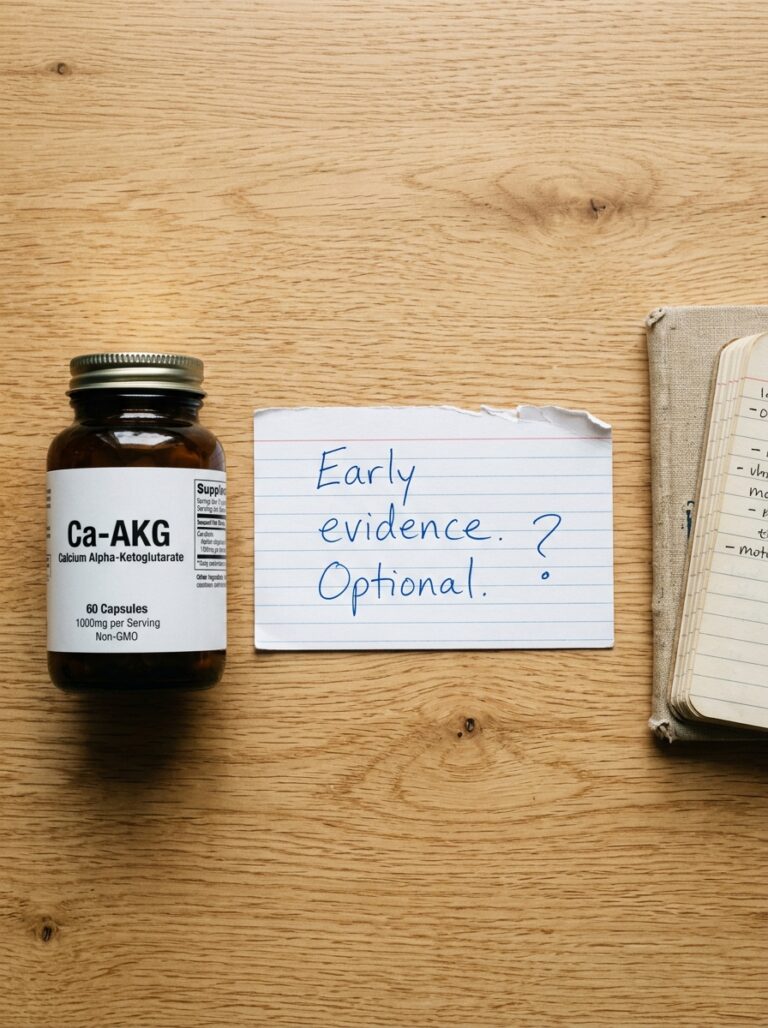
If you're researching the best Ca-AKG supplements, you've probably hit the longevity-podcast version first: calcium alpha-ketoglutarate "reverses your biological age by eight years." That headline comes from real data, but the data is a single small uncontrolled pilot, which is a very different thing from a proven effect. The honest framing is that Ca-AKG is an optional experiment with a plausible mechanism, not a settled longevity staple. This article walks through what the molecule does, what the human and mouse evidence actually show, what to look for on a label, and the three products I'd be comfortable having in my own family's cabinet if someone wanted to try it.
Affiliate disclosure: this article contains affiliate links. As an Amazon Associate, UsefulVitamins.com earns from qualifying purchases at no extra cost to you.
Before you decide

Ca-AKG is not a treatment for any disease, and it should not replace anything a clinician has prescribed. If you are taking it because you are worried about aging, frailty, or a specific health condition, that worry deserves a real conversation with your doctor before it deserves a capsule.
A few people should be especially cautious. If you are pregnant or breastfeeding, managing kidney disease, on medications with a narrow therapeutic window, or being treated for any chronic condition, clear a new supplement with your physician or pharmacist first. Ca-AKG also delivers elemental calcium, which matters if you already take calcium or have a history of stones.
The most useful thing you can do before buying is to be honest about the goal. "Slow my aging" is not a target the current evidence can confirm it hits in humans. If your real goal is more energy, better recovery, or longer healthy years, the proven levers are still the unglamorous ones: sleep, resistance training, protein, and treating the conditions you actually have.
If you've weighed that and still want to run a careful personal experiment, this guide will help you do it well. You can see how I evaluate evidence and conflicts of interest on the how we review supplements page, and how Ca-AKG fits the wider category in my complete guide to longevity supplements.
What Ca-AKG actually does

Alpha-ketoglutarate is not an exotic compound. It's an endogenous intermediate in the citric acid (TCA) cycle, the central energy pathway your mitochondria run every second to make ATP. Your cells already produce and consume it constantly; Ca-AKG is simply the calcium salt of that molecule in a stable, swallowable form.
What makes it interesting for aging is its day job outside energy production. AKG is an obligatory co-substrate for a family of enzymes called alpha-ketoglutarate-dependent dioxygenases.
That family includes the TET enzymes that demethylate DNA and the Jumonji-domain enzymes that demethylate histones. In other words, AKG availability feeds directly into the epigenetic machinery that "epigenetic clocks" measure — which is the mechanistic thread the longevity claims hang on.
AKG wears other hats too. It's a co-substrate for prolyl hydroxylase in collagen synthesis, a node in nitrogen and amino-acid metabolism, and it has been linked to lower systemic inflammatory signaling, as a review of its pleiotropic activity lays out. None of that is speculative biochemistry; it's textbook.
The leap that is not textbook is the one from "AKG is a co-substrate for epigenetic enzymes" to "swallowing extra AKG meaningfully resets a healthy adult's biological clock." That leap is exactly where the evidence thins out, and it's the gap most product pages quietly skip over.
What the research shows
Here is the part most roundups get wrong by omission. The human data on Ca-AKG for biological aging is, as of now, a single small, uncontrolled, retrospective pilot — not a body of randomized trials.
That pilot is the one behind the famous headline. The Rejuvant biological-age pilot looked back at 42 people (28 men, 14 women) taking a Ca-AKG-plus-vitamins formulation for an average of seven months and found their DNA-methylation age dropped by an average of about eight years versus their own baseline.
It sounds dramatic, and the authors themselves flag why you should hold it loosely. There was no placebo group, no randomization, no control for diet, sleep, or other supplements, and the participants were self-selected health optimizers — exactly the population whose results don't generalize cleanly. One of the study's authors is affiliated with the company that sells the product, which the paper discloses.
The animal evidence is genuinely stronger, and it's where the excitement started. In a Cell Metabolism mouse healthspan study, mice given calcium AKG in their food from middle age (18 months) showed extended lifespan and, more importantly, a large compression of late-life frailty.
The nuance matters here. The median lifespan gain was statistically significant mainly in females, while the standout finding in both sexes was healthspan — roughly a 40% reduction in frailty burden, a bigger effect than the lifespan change itself. Mice are not 50-year-old humans, and a 2% dietary dose in a mouse does not translate linearly to a capsule.
So the honest scorecard reads like this: plausible mechanism, encouraging mouse healthspan data, and one suggestive human pilot that cannot establish cause and effect. The proper randomized test is underway — the double-blind, placebo-controlled ABLE trial of 1 g/day sustained-release Ca-AKG in middle-aged adults, whose published study protocol lays out the design — but its results are not in yet. Until they are, Ca-AKG belongs in the "interesting and optional," not "proven," column, much like the more-studied senolytic candidate I cover in best fisetin supplements.
What to look for when buying
The label questions for Ca-AKG are refreshingly simple, because there's one form and one studied dose. You want calcium alpha-ketoglutarate, and you want the dose that the human pilot and the ongoing trial actually use: 1 gram (1,000 mg) of Ca-AKG per day.
First, confirm the form. "AKG" on a label can also mean ornithine alpha-ketoglutarate (OKG), a different compound used in sports and clinical-nutrition contexts — that is not what the longevity research studied. For this use case you want the calcium salt specifically.
Second, check that the dose is real. Many capsules are 300 to 500 mg, so hitting 1 g means two to three of them. A bottle dosed at one-third of the studied amount is the classic dose-trial-supplement mismatch: you can't expect a 1 g result from a 300 mg habit.
Third, and this is the part the supplement industry would rather you not dwell on: the branded "biological age" formulation and a plain generic Ca-AKG deliver the same active molecule, and the generic typically costs a fraction of the price. The branded version adds a small amount of vitamin A or D and a research-backed story, but the AKG itself is not patented or proprietary.
| Label feature | What it tells you | Worth paying for? |
|---|---|---|
| Calcium alpha-ketoglutarate (Ca-AKG) named | It’s the salt the research used, not ornithine AKG | Yes, essential |
| ~1 g/day achievable per serving | Matches the pilot and trial dose, not a token amount | Yes, essential |
| Third-party tested (USP, NSF, or lab COA) | Independent check on identity and purity | Yes, useful signal |
| Branded “biological age” formula premium | Same AKG plus a vitamin and a story, at a higher price | Rarely, generic is the same molecule |
| Proprietary blend, no per-ingredient mg | You can’t verify the AKG dose | No, skip it |
If you do decide to run the experiment, the practical setup is a verified-form, accurately-dosed Ca-AKG taken consistently at 1 g/day, ideally one that's been third-party tested. The three picks below are the ones I'd be comfortable putting in my own family's cabinet on those terms.
Recommended Products
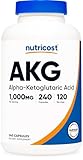
As an Amazon Associate, UsefulVitamins.com earns from qualifying purchases at no extra cost to you. We only recommend products supported by published research or third-party testing.
FAQ
Does Ca-AKG actually reverse aging?
Not proven in humans. The eight-years-younger headline comes from a single uncontrolled pilot of 42 people with no placebo group, and the proper randomized trial is still running. The mouse data is more about reduced frailty than dramatic life extension. Treat any "reverses aging" claim as a hypothesis, not a result.
How much Ca-AKG should I take?
The studied amount is 1 gram (1,000 mg) of Ca-AKG per day, which is what both the human pilot and the ongoing trial's protocol use. Since many capsules are 300 to 500 mg, that usually means two or three a day. Taking far less is the most common reason a personal trial shows nothing.
Is the expensive branded version worth it over generic?
For most people, no. The branded formula and generic Ca-AKG contain the same active molecule; the premium buys a little added vitamin A or D and the marketing. If budget matters, a verified generic at the right dose is the rational choice.
Is Ca-AKG safe?
It's an endogenous metabolite and has been used in clinical-nutrition settings with a reasonable tolerability record, but long-term safety in healthy people taking it for longevity is not established. Clear it with your clinician if you are pregnant, have kidney disease, take calcium, or manage a chronic condition.
How is Ca-AKG different from NMN or other longevity supplements?
They target different pathways: NMN feeds NAD+ metabolism, while Ca-AKG feeds epigenetic and TCA-cycle enzymes. Both sit in the same "plausible mechanism, immature human evidence" tier. I compare the category in the complete guide to longevity supplements.
The bottom line on Ca-AKG
Ca-AKG is one of the more scientifically respectable entries in the longevity aisle: a genuine TCA-cycle metabolite that feeds the epigenetic enzymes those age clocks measure, with encouraging mouse healthspan data behind it. What it does not yet have is a completed randomized human trial, so the strongest accurate statement is "promising and unproven," not "clinically shown to reverse aging."
If you choose to try it, do it the honest way: the studied form (calcium alpha-ketoglutarate), the studied dose (1 g/day), a third-party-tested product, and the generic rather than the marked-up branded version — because the molecule is identical. Then treat it as an optional experiment running alongside, never instead of, the sleep, training, and medical care that actually have the evidence.
And keep the result in perspective. A capsule cannot out-perform an undiagnosed condition or a poor baseline, which is exactly why the first move is a conversation with your doctor, not an order button.
Reviewed by Maria Rodriguez, MS Nutrition Science, focused on cognitive and mood biochemistry. See more from Maria Rodriguez. This article is educational and is not a substitute for individualized medical advice; talk to your doctor before starting a supplement, especially if you are pregnant, have kidney disease, or manage a diagnosed condition. As an Amazon Associate we may earn from qualifying purchases.
