
Affiliate disclosure: this article contains affiliate links. As an Amazon Associate, UsefulVitamins.com earns from qualifying purchases at no extra cost to you.
Comparing your dose against a test result? Convert the supplement from mcg to IU first.
What an at-home vitamin D test actually measures
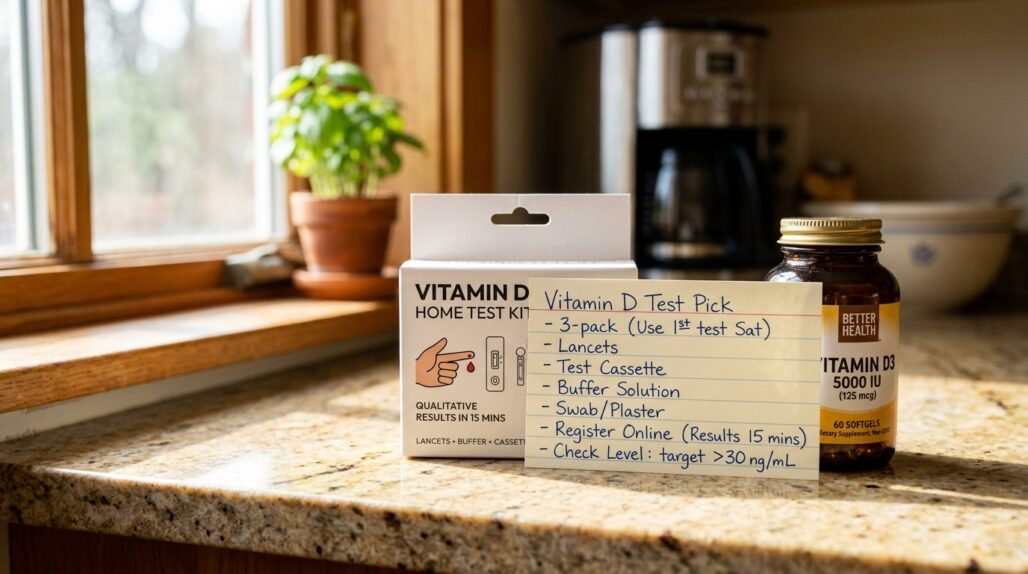
Every test worth buying reports one thing: 25-hydroxyvitamin D, written as 25(OH)D. That is the storage form of the vitamin and the standard marker of vitamin D status, the same one a clinic measures. A kit that shows a colour band instead of a number in ng/mL is not measuring this and is not worth your money.
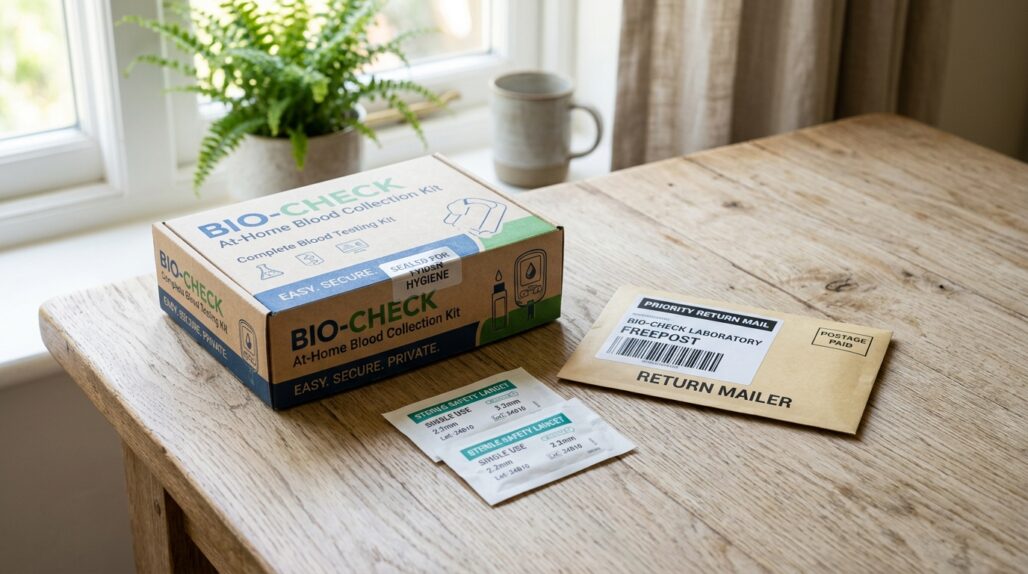
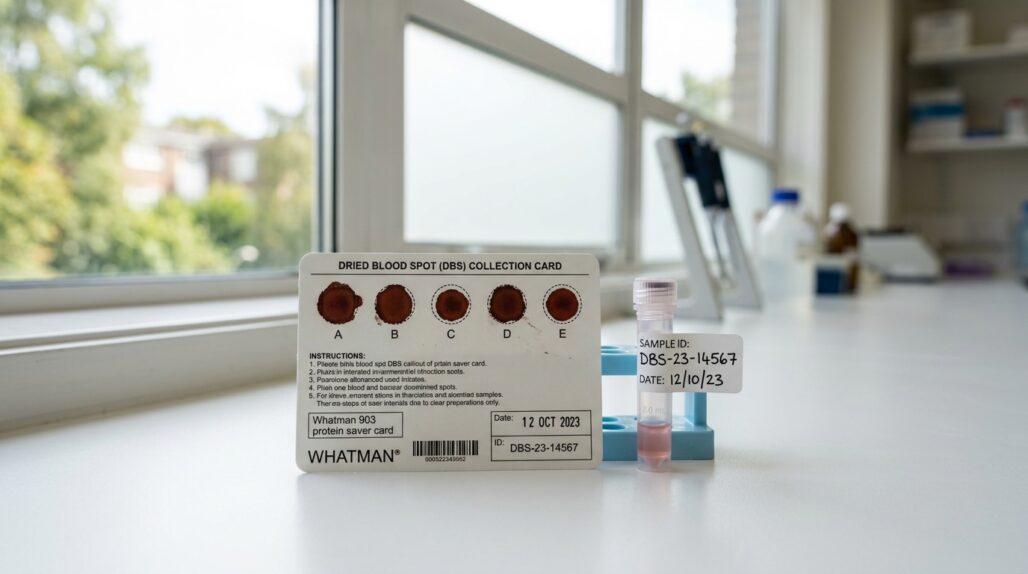
The mechanics are simple. You prick a fingertip, place a few drops of blood onto a card or into a small tube, and mail it back. A lab measures your 25(OH)D and emails a result, usually with the reference range printed beside your number.
Here is the part that decides whether you can trust it: where the sample is analysed. In the United States, labs that test human samples for health decisions must hold a certificate under the federal Clinical Laboratory Improvement Amendments (CLIA), run by CMS. CLIA labs meet quality standards and submit to regular inspection. A finger-prick kit feeding a CLIA-certified lab is running the same kind of analysis your doctor's lab would. A novelty strip is not.
So the question is rarely "is at-home testing real testing." It usually is. The real questions are which lab, what does it cost, and how long until you get a number you can act on.
Are finger-prick vitamin D results accurate enough to act on?
Mostly, yes – with honest limits. Validation work comparing dried blood spot cards to a standard venous blood draw has found good to excellent agreement for 25(OH)D between blood spot and serum samples, with correlations around r = 0.93 in larger groups. That is why the better kits use mass spectrometry (LC-MS/MS), the gold-standard method also used by the CDC's nutrition lab.
The caveats are worth saying plainly. The same research notes that blood spot sampling suits screening and tracking more than fine-grained individual diagnosis. A skimpy or smeared blood spot, a hot mailbox, or a slow shipment can nudge a number. So treat an at-home result as a strong signal, not a verdict carved in stone.
The practical rule: an at-home test is excellent for finding out whether you are clearly low, comfortably sufficient, or somewhere in the middle – and for watching a number move after you change something. If a result lands at an extreme, or it would change a medical decision, confirm it with a clinic draw. We unpack the wider picture in our look at what your vitamin D number actually means.
The three kits compared
These three are the most consistently available finger-prick options sold direct and on Amazon, and all route to CLIA-certified labs. Prices drift, so treat the figures as a guide and check the current price before you buy.
| Test kit | What it measures | Lab and method | Turnaround | Price (approx) |
|---|---|---|---|---|
| Everlywell Vitamin D | 25(OH)D; the “and Inflammation” version adds hs-CRP | CLIA-certified partner lab; immunoassay | About 5-7 days after the lab receives it | Around $99 as of writing |
| Carlson Vitamin D (via OmegaQuant) | 25(OH)D as vitamin D status | OmegaQuant, CLIA-certified (#43D1105229); LC-MS/MS dried blood spot | About 2-4 weeks | Around $60 as of writing |
| myLAB Box Vitamin D | 25(OH)D | CLIA- and CAP-accredited labs; finger-prick | About 2-5 days after the lab receives it | Around $99 single, less on a subscription, as of writing |
Everlywell – the easiest reliable pick. The experience is the most polished: clear instructions, a tidy result dashboard, and a CLIA-certified lab behind it. The standard product now pairs vitamin D with high-sensitivity CRP, an inflammation marker, which is useful if you also want a rough read on inflammation. If you only want vitamin D, that pairing is something you pay for whether you need it or not.
Carlson – the lab-grade value pick. Carlson's kit is processed by OmegaQuant, an independent CLIA-certified lab using LC-MS/MS, the same mass-spectrometry method considered the reference standard. It is the cheapest of the three and arguably the most analytically rigorous. The trade-off is patience: results can take two to four weeks, which is fine for a baseline check but slow if you are anxious for an answer.
myLAB Box – the fast pick. When you want a number quickly, myLAB Box turns samples around in roughly two to five days and uses CLIA- and CAP-accredited labs. It tends to cost the same as Everlywell at full price, with savings on its repeat-testing membership. Speed is the differentiator here.

As an Amazon Associate, UsefulVitamins.com earns from qualifying purchases at no extra cost to you.
Some links below are affiliate links. If you buy through them we may earn a small commission, at no extra cost to you. It never changes which kit we recommend or the number your lab reports.
If you would rather skip the kit entirely, a clinic test ordered by your doctor is the most reliable route of all, and it is often inexpensive or covered. More on who should do that below.
How to read the number you get back
A 25(OH)D result only helps if you know the bands. Here is where the standard clinical reference range and the "optimal" range debate matter, because they are not the same thing.
The NIH Office of Dietary Supplements, citing the Food and Nutrition Board, frames it this way: the risk of deficiency rises below about 12 ng/mL, levels of 12-20 ng/mL are inadequate for some people, and 20 ng/mL or above is generally sufficient. The Endocrine Society uses a higher cut, defining deficiency as below 30 ng/mL and describing a "preferred" range of 40-60 ng/mL.
That 40-60 ng/mL target is where the "optimal versus normal" argument lives. It is an expert opinion and a preference, not settled consensus. The Food and Nutrition Board has also noted that 25(OH)D consistently above about 50 ng/mL (125 nmol/L) may be linked to potential adverse effects, so chasing an ever-higher number is not the goal. Treat any "optimal" figure as a target some clinicians favour, shown here beside the standard range – not as proof that the lab's "normal" is wrong.
What is not debated: very high levels are a problem. Frank toxicity, with hypercalcemia, generally appears above 150 ng/mL, usually from over-supplementing, not from food or sun.
If your number is on the low side, the next step is dose, and that is where our vitamin D dose calculator helps you estimate a sensible amount – while keeping the adult tolerable upper intake level of 4,000 IU (100 mcg) per day in view unless a doctor directs otherwise. Then re-test in about three months to confirm the number actually moved before you settle on a long-term dose. If you also supplement minerals, it is worth knowing whether you can take magnesium and vitamin D together, since magnesium is a cofactor the body uses to activate vitamin D. For the full background, our complete guide to vitamin D covers food, sun, and supplement forms together.
Who should skip the kit and just ask their doctor
At-home tests are screening aids. They are not the right tool for everyone, and they are not a diagnosis. Ask your doctor for a standard lab draw instead if any of these apply.
- You take a vitamin D prescription, a high-dose supplement, or any medication that affects calcium – your level needs clinical interpretation, not a self-read number.
- You are pregnant or managing a bone, kidney, parathyroid, or malabsorption condition.
- You have symptoms that worry you, such as persistent bone pain or muscle weakness.
- A previous result was very low or very high, so the decision genuinely matters.
A doctor-ordered test is frequently cheaper than a kit once insurance is involved, comes with someone qualified to interpret it, and removes the small accuracy questions that come with mailing a blood spot. The kit's job is convenience and tracking – not replacing that visit.
See a doctor if
This is education, not a diagnosis, and an at-home result does not tell you that you "have" any condition. Book a doctor, and use a clinic blood draw, if any of the following is true.
- Your at-home 25(OH)D comes back very low (roughly under 12-20 ng/mL) – especially alongside bone pain, frequent fractures, or muscle weakness – so a cause can be found and a safe correction planned.
- Your result is very high, or you have signs that can go with high calcium: nausea, excessive thirst and urination, confusion, or unexplained weakness. Do not megadose to "fix" a low level on your own.
- You are pregnant, take a blood thinner or other interacting medication, or already take prescription-strength vitamin D.
Never start or stop a prescription based on a home test. Bring the number to your clinician and let them decide.
FAQ
Do at-home vitamin D tests use the same kind of lab as my doctor? The reputable ones do. Everlywell, Carlson (via OmegaQuant), and myLAB Box all send your sample to a CLIA-certified lab, the federal standard for clinical testing. Avoid any colour-strip kit that does not produce a numeric 25(OH)D result.
Is a finger-prick result as accurate as a vein draw? For vitamin D, dried blood spot and finger-prick samples agree closely with venous serum in validation studies, which is why they work well for screening and tracking. They are slightly less suited to fine individual diagnosis, so confirm any extreme or decision-changing result with a clinic test.
Which kit should I pick? For most people the easiest reliable choice is Everlywell. If you want the lowest price with mass-spectrometry accuracy and can wait a few weeks, Carlson is the value pick. If you want results fast, myLAB Box is usually quickest.
What 25(OH)D number am I aiming for? The standard sufficiency cut is roughly 20 ng/mL and up per the Food and Nutrition Board; the Endocrine Society prefers 30 ng/mL or higher. A “40-60 ng/mL optimal” target is a clinician preference, not consensus, and going far above 50 ng/mL is not a goal. See our interpretation page for the full breakdown.
How often should I re-test? If you change your dose, re-test in about three months, since 25(OH)D shifts slowly. Once you are stable, a check once or twice a year, or seasonally, is plenty for most people.
Can I diagnose a deficiency myself from the result? No. An at-home test screens and tracks; it does not diagnose. A clinician interprets the number alongside your symptoms, medications, and other labs before deciding anything.
The bottom line
An at-home vitamin D test is a genuinely useful tool when it reports a real 25(OH)D number from a CLIA-certified lab. Everlywell is the easiest reliable pick, Carlson (via OmegaQuant) is the lab-grade value choice, and myLAB Box is the fastest. Collect the sample carefully, read the number against the standard range rather than chasing a high "optimal" target, and if it is low, estimate a sensible dose with our calculator and re-test in about three months to confirm it worked. Then pick a long-term plan from our guide to the best vitamin D supplements.
And remember the limit of the tool: it screens, it does not diagnose. A very low or very high result, or any worrying symptom, belongs with your doctor and a clinic blood draw.
This article is for education only and is not medical advice. At-home tests are screening aids, not a diagnosis or a substitute for clinical care. Talk to your doctor or pharmacist before starting, stopping, or changing any supplement or medication, and confirm any decision-changing result with a clinic test.
Reviewed by the UsefulVitamins Editorial Team.
