
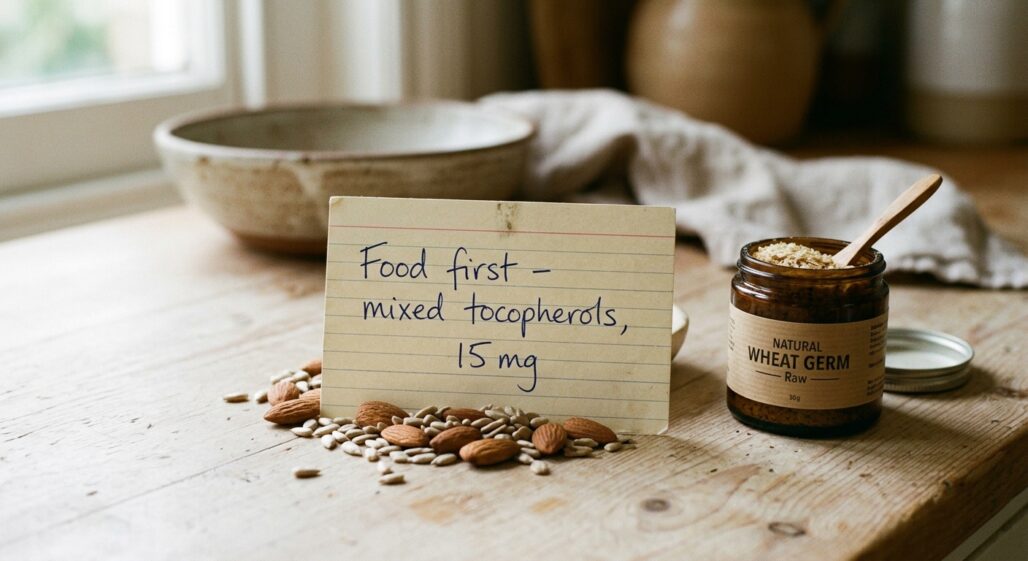
If you are standing in the supplement aisle wondering whether you need a vitamin E pill, the honest answer is: probably not, and the high-dose ones may do more harm than good. Vitamin E is one of the few supplements where a large body of trial evidence actually argues against routine high-dose use. This guide walks through what vitamin E does, the eight forms most labels never mention, the real RDA, who is genuinely deficient, and why a "mixed tocopherols" capsule is a smarter choice than the isolated alpha-tocopherol megadose that dominates store shelves.
I am a registered dietitian, and my default with any nutrient is the same: cover the requirement from food first, then ask whether a supplement closes a real gap. With vitamin E, the gap is small for most people and the downside of overshooting is unusually well documented.
Before you decide
The reason vitamin E deserves caution comes from the trial data, not from food. A widely cited 2005 meta-analysis pooling nearly 136,000 participants found that daily doses at or above 400 IU were associated with a small but measurable increase in all-cause mortality, a finding Miller and colleagues published in Annals of Internal Medicine and used to argue that high-dose supplements should be avoided. That is not a reason to fear the spinach on your plate. It is a reason to question the 400 IU softgel.
The deficiency picture is the mirror image. True vitamin E deficiency is rare in healthy adults and shows up almost entirely in people who cannot absorb dietary fat, such as those with cystic fibrosis, Crohn's disease, cholestatic liver disease, or a rare genetic disorder of vitamin E transport, per the NIH Office of Dietary Supplements fact sheet. Most people reading this are not in that group.
One more group should pause before supplementing: anyone on warfarin or another anticoagulant should not start vitamin E without talking to the prescriber, because the vitamin can add to the drug's effect on clotting. Ask your doctor about your situation before assuming a supplement is harmless. Food is always the safe starting point.
What vitamin E actually does
Vitamin E is a fat-soluble antioxidant. Its main job in the body is to protect the polyunsaturated fats in your cell membranes from oxidative damage, essentially stepping in front of free radicals so the fragile fats do not get chewed up. It works inside the lipid layer of every cell, which is why it travels with dietary fat and stores in fatty tissue.
Because it is fat-soluble, vitamin E behaves differently from water-soluble vitamins like C, which you flush out daily. Your body holds onto vitamin E, mostly in the liver and adipose tissue. That storage capacity is part of why daily intake is less urgent than for some nutrients, and part of why pushing megadoses for months can accumulate effects you did not intend.
The antioxidant role sounds like it should translate into broad disease prevention, and for two decades observational studies hinted exactly that. The controlled trials did not confirm it. The leap from "antioxidant in a test tube" to "prevents heart disease in a person" is exactly where the vitamin E story falls apart, which is the gap most supplement marketing quietly skips over.
The eight forms most labels never mention
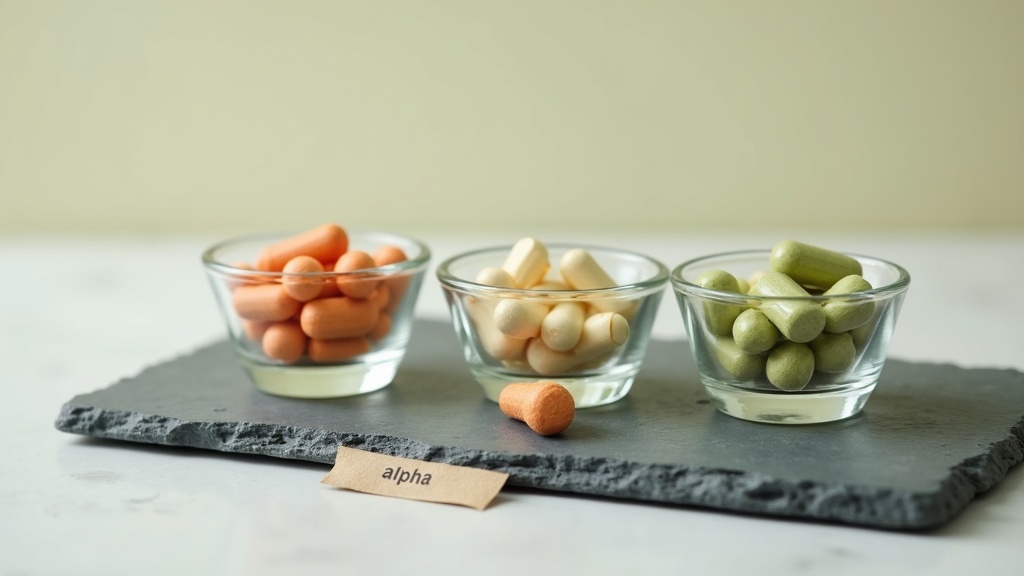
"Vitamin E" is not one molecule. It is a family of eight related compounds: four tocopherols (alpha, beta, gamma, delta) and four tocotrienols (alpha, beta, gamma, delta). Your supplement label almost certainly lists only one of the eight, alpha-tocopherol, because that is the form used to define the RDA and the form the body preferentially retains.
Here is the wrinkle most guides gloss over. Gamma-tocopherol, not alpha, is the most common form of vitamin E in the typical US diet, a point Jiang and colleagues argued in a 2001 review in the American Journal of Clinical Nutrition. When you swallow a big isolated alpha-tocopherol dose, you do not just add alpha. You can push gamma-tocopherol down.
If you want the full breakdown of how tocotrienols differ from tocopherols and where the early research is pointing, we cover that in our tocotrienols vs tocopherols explainer. For this guide, the practical takeaway is simpler: a "mixed tocopherols" product is closer to the form vitamin E takes in food than a single-isomer megadose.
Food sources and the RDA
The adult RDA for vitamin E is 15 mg of alpha-tocopherol per day (about 22 IU of the natural form), set by the NIH Office of Dietary Supplements based on the Food and Nutrition Board's reference intakes. That is a modest target, and the foods that hit it are ordinary pantry items.
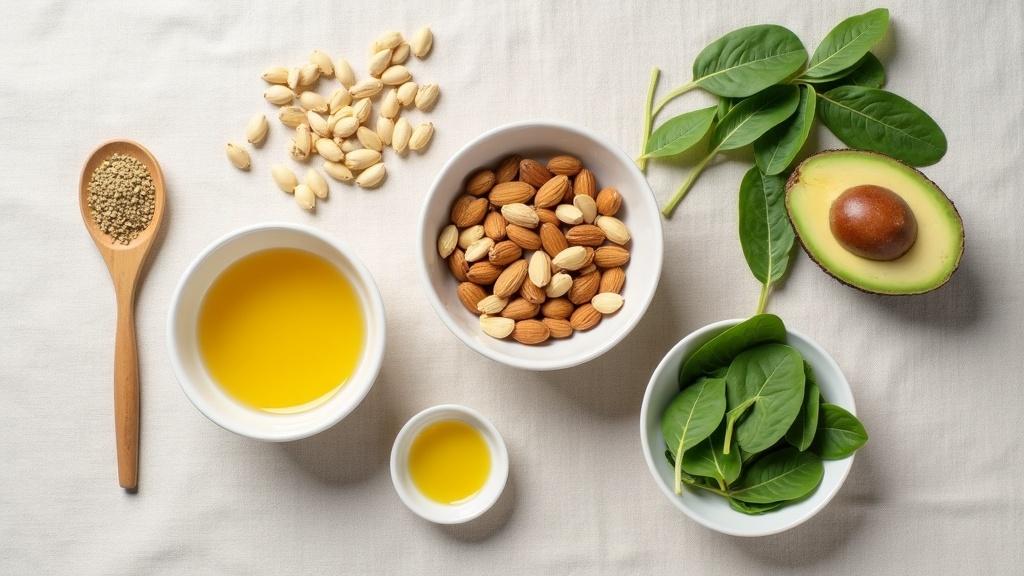
Vegetable oils, nuts, seeds, and some green vegetables carry the most. A small handful of sunflower seeds or almonds, a tablespoon of wheat germ oil, or a serving of avocado each contribute a meaningful share of the day's 15 mg. A person eating a varied diet with any nuts, seeds, or plant oils is usually at or near the RDA without trying.
| Food | Typical serving | Alpha-tocopherol | Share of 15 mg RDA |
|---|---|---|---|
| Sunflower seeds | 1 oz (28 g) | about 7.4 mg | about 49% |
| Almonds | 1 oz (28 g) | about 6.8 mg | about 45% |
| Sunflower oil | 1 tbsp | about 5.6 mg | about 37% |
| Avocado | half, medium | about 2.1 mg | about 14% |
| Spinach, boiled | half cup | about 1.9 mg | about 13% |
The numbers make the food-first case obvious. Two handfuls of seeds and a salad with avocado can cover the entire daily requirement, which is a different situation from a nutrient where the diet routinely falls short. For a sense of how vitamin E sits alongside the other fat-soluble vitamins, our complete guide to vitamin A walks through the same food-first logic for a nutrient where toxicity risk is higher.
Who actually benefits (and who is wasting money)
Strip away the marketing and the list of people who genuinely benefit from a vitamin E supplement is short. It is essentially people who cannot absorb dietary fat properly, because vitamin E rides into the body on fat. That covers cystic fibrosis, Crohn's disease and other inflammatory bowel conditions, chronic pancreatitis, cholestatic liver disease, and the rare genetic disorder ataxia with vitamin E deficiency.
For these conditions, supplementation is a medical decision made with a clinician, often using special water-miscible forms and guided by blood levels. Ask your doctor about a serum alpha-tocopherol test before assuming you are low, because without a number you are guessing.
For everyone else, the math is unflattering. If your diet already meets the 15 mg RDA, an extra supplement is not closing a gap, it is just topping off a tank that is already full. That is the dietitian's recurring point: the supplement that helps is the one that fixes a real shortfall, not the one that stacks more of a nutrient you already have. Most healthy adults swallowing a daily vitamin E softgel are spending money on a problem they do not have.
The high-dose harm evidence, told honestly
This is where vitamin E differs from most supplements, and where this guide parts ways with the cheerful "antioxidant powerhouse" framing. The strongest trial evidence does not show benefit at high doses, it shows signals of harm.
Start with mortality. The 2005 meta-analysis in Annals of Internal Medicine pooled 19 trials and found that 9 of 11 trials testing 400 IU or more pointed toward increased death rates, with a dose-response relationship suggesting risk crept up above roughly 150 IU per day. The effect per person was small, but it ran in the wrong direction for something sold as protective.
Then there is prostate cancer. The large SELECT trial actually found more prostate cancer in healthy men taking 400 IU of vitamin E daily, not less. In the updated SELECT results published by Klein and colleagues in JAMA, the vitamin E group had a statistically significant 17% relative increase in prostate cancer over roughly seven years. A supplement marketed for "cellular protection" was associated with the opposite.
None of this means a serving of almonds is dangerous. It means the high-dose isolated alpha-tocopherol pill is a different product from food, and the evidence on that pill is unflattering. More is not better here. It may be worse.
Mixed tocopherols vs alpha-only
If you have decided to supplement for a legitimate reason, the form question matters more than the dose-chasing. Isolated high-dose alpha-tocopherol can suppress your body's gamma-tocopherol, the form that dominates the diet, which is biologically the opposite of mimicking food.
Mixed-tocopherol products behave more naturally. In a controlled study of people with type 2 diabetes, a mixed tocopherol supplement raised both serum alpha and gamma-tocopherol, with gamma rising about four-fold, whereas alpha-only supplements tend to drive gamma down. A mixed-tocopherol capsule near the RDA gives you the family of forms food provides, rather than flooding one isomer and crowding out the rest.
| Form on label | What it is | Effect on gamma-tocopherol | Best for |
|---|---|---|---|
| High-dose alpha-tocopherol | Single isomer, often 400 IU+ | Suppresses it | Almost no one; linked to harm signals |
| Mixed tocopherols | Alpha plus gamma, delta, beta | Raises it | People with a real reason to supplement |
| dl-alpha (synthetic) | all-rac, half as active | Suppresses it at high dose | Skip in favor of natural mixed |
If you do choose a product, our editors maintain a vetted shortlist in the best vitamin E supplements roundup, where the picks favor modest-dose mixed tocopherols. As with our complete guide to omega-3, the form and dose on the label matter more than the brand name on the front.
Side effects and interactions
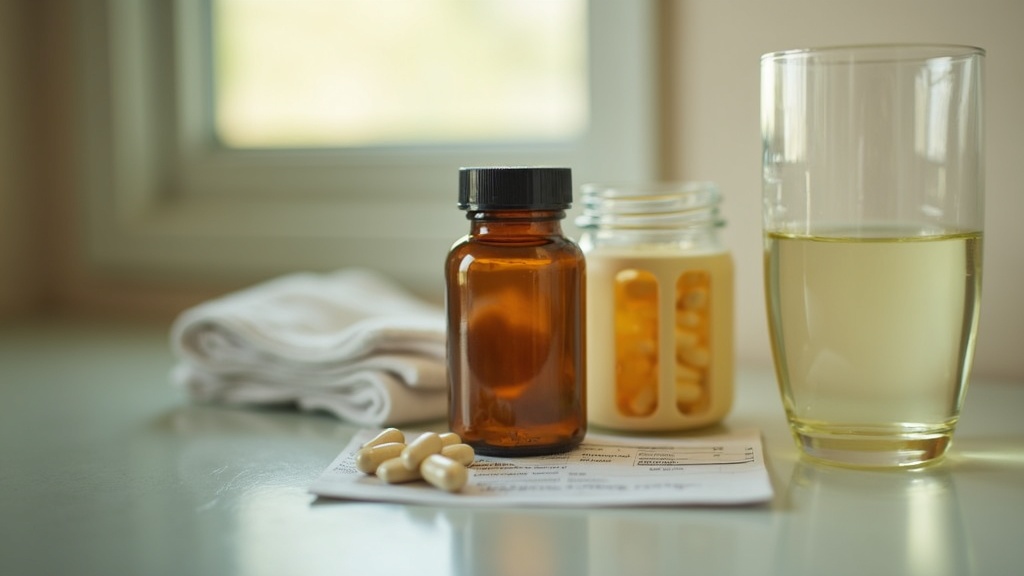
At dietary levels and modest supplemental doses, vitamin E is well tolerated. The concerns appear at high doses. The Food and Nutrition Board set a tolerable upper intake level of 1,000 mg per day of supplemental alpha-tocopherol for adults, with bleeding risk identified as the critical adverse effect, per the NIH Office of Dietary Supplements.
The most important interaction is with blood thinners. Vitamin E can interfere with vitamin K-dependent clotting, and in a retrospective cohort study of patients on oral anticoagulants, higher serum vitamin E predicted more hemorrhagic events. If you take warfarin, another anticoagulant, or regular antiplatelet therapy, do not start vitamin E without your prescriber's sign-off. That is a hard interaction, not a theoretical one.
FAQ
Is 400 IU of vitamin E safe to take daily?
It sits in the range the 2005 meta-analysis flagged for increased mortality and the dose the SELECT trial linked to more prostate cancer. For most healthy people there is no upside to justify that downside.
Should I take vitamin E for my skin or hair?
Topical and dietary vitamin E have a role in skin biology, but oral high-dose supplements have not shown reliable cosmetic benefit in trials. Food sources cover the requirement, and a megadose pill is not a beauty treatment.
What is the difference between IU and mg?
The RDA of 15 mg of natural alpha-tocopherol equals about 22 IU. Synthetic forms convert differently, which is one more reason a modest milligram dose from mixed tocopherols beats chasing a big IU number.
Can I just eat more nuts instead of supplementing?
For most people, yes. A daily handful of sunflower seeds or almonds plus plant oils typically meets the RDA. That is the food-first answer, and for vitamin E the food-first answer is usually the right one.
The bottom line on vitamin E
Vitamin E is the rare supplement where the evidence pushes you toward less, not more. The diet covers the 15 mg requirement for most people, the deficiency that warrants treatment is largely confined to fat-malabsorption conditions, and the high-dose alpha-tocopherol pills that fill store shelves carry trial-documented harm signals rather than proven benefit.
If you genuinely need to supplement, the smart version is modest and mixed, not isolated and megadosed.
Next steps:
- Build the 15 mg from food first: a daily handful of seeds or almonds plus plant oils usually gets you there.
- If you have a fat-malabsorption condition, ask your doctor about a serum alpha-tocopherol test before supplementing.
- If you decide to buy, choose modest-dose mixed tocopherols from our best vitamin E supplements roundup rather than a 400 IU alpha-only softgel.
This guide was written and reviewed by Sarah Thompson, RD, Registered Dietitian, focused on vitamin and mineral nutrition. See how we vet evidence in our how we review supplements process.
This article is for informational purposes and not medical advice. Supplements can interact with medications and health conditions. Consult a licensed physician before starting any supplement, particularly if you are pregnant, nursing, taking prescription medications such as anticoagulants, or managing a chronic condition.
