
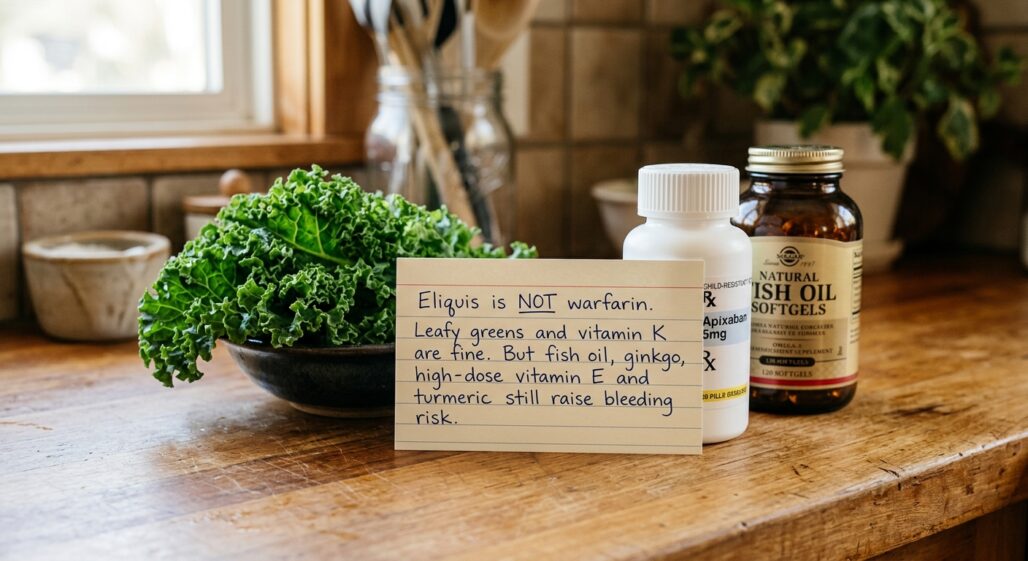
If you are searching whether you can take vitamin K with Eliquis (apixaban), you are probably someone who was told for years that warfarin and leafy greens were a delicate balancing act, and now you want to know if the same rules apply. The short answer: for apixaban, dietary vitamin K is not the problem it is with warfarin, because apixaban does not work through the vitamin K pathway at all. This article walks through the mechanism, how big the effect actually is, the supplements that genuinely do raise your bleeding risk, who needs to be most careful, and when to call your clinician.
The real question is not "is vitamin K dangerous on Eliquis." It is "which of my supplements actually move bleeding risk, and which are just internet folklore carried over from warfarin." Those are not the same list.
Before you decide
This is general health information, not medical advice, and it is not a substitute for the pharmacist who knows your full medication list. Never stop, pause, or change the dose of a prescription anticoagulant on your own, because the clot it is preventing (a stroke in atrial fibrillation, a recurrent DVT or pulmonary embolism) is usually the larger danger.
The people who need to be most careful are older adults, anyone with kidney or liver impairment, people also taking aspirin or an NSAID, and anyone scheduled for surgery or a dental procedure. If you fall into one of those groups, treat every new supplement as a conversation to have before you start it, not after.
Call your doctor or pharmacist promptly if you notice unusual bruising, nosebleeds that will not stop, pink or red urine, black or tarry stools, vomit that looks like coffee grounds, or a severe headache. According to the MedlinePlus apixaban information from the U.S. National Library of Medicine, apixaban means it can take longer for bleeding to stop and you may bruise more easily, so these signals deserve a quick call rather than a wait-and-see.
What the vitamin K interaction actually is (and why Eliquis is different)
Warfarin earns its leafy-greens reputation honestly. Warfarin works by blocking vitamin K recycling, which the liver needs to build clotting factors II, VII, IX and X. Eat a big inconsistent swing of vitamin K and you can push warfarin's effect up or down, which is exactly why warfarin needs INR blood tests. The NIH Office of Dietary Supplements vitamin K fact sheet describes vitamin K as a direct antagonist of warfarin's anticoagulant action, and the standard advice is to keep intake steady, not to avoid greens.
Apixaban does not touch that pathway. It is a direct factor Xa inhibitor. The StatPearls apixaban monograph on NCBI Bookshelf describes it as a highly selective direct factor Xa inhibitor whose activity does not even require antithrombin III, and notably, vitamin K would not be expected to affect its anticoagulant activity. Vitamin K cannot reverse apixaban and cannot blunt it, because apixaban never used vitamin K to begin with.
Think of it like two different locks. Warfarin jams the factory that makes the keys (vitamin K dependent factors), so the raw material matters. Apixaban ignores the factory and instead glues one specific lock (factor Xa) shut, so how much key material you eat is irrelevant. This is why apixaban and the other direct oral anticoagulants are dosed in fixed amounts. The NCBI review of non-vitamin-K-antagonist oral anticoagulants notes their predictable pharmacology allows fixed dosing without the routine coagulation monitoring warfarin demands.
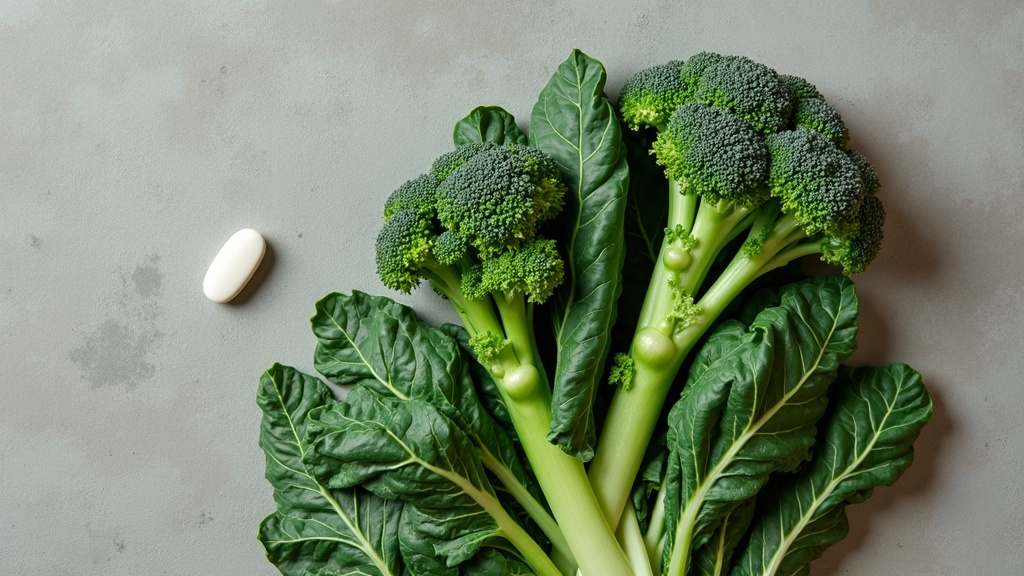
Actionable takeaway: if you are on Eliquis, eat your kale, spinach and broccoli on your normal schedule. MedlinePlus explicitly tells apixaban patients to continue their normal diet unless their doctor says otherwise, with no leafy-green restriction.
How big is the effect? Cited numbers, not vibes
The honest framing here is that the vitamin K "effect" on apixaban is essentially zero, while the real interactions live elsewhere. The drugs that genuinely change apixaban levels are strong inhibitors and inducers of two handling systems: the liver enzyme CYP3A4 and the transporter P-glycoprotein.
The systematic review of apixaban drug interactions in the British Journal of Clinical Pharmacology puts numbers on it. Ketoconazole, a strong dual inhibitor, roughly doubled apixaban exposure (AUC increased about 2-fold). In the opposite direction, the strong inducer rifampin cut apixaban's AUC by about 54 percent, which can leave you under-protected. These are prescription-strength shifts, and they are the reason your pharmacist screens your full med list.
For supplements specifically, the one that behaves like rifampin is St. John's wort, a strong CYP3A4 and P-glycoprotein inducer. That is why MedlinePlus lists St. John's wort among the products to disclose. It can lower apixaban levels and theoretically reduce your clot protection, which is the more dangerous direction for someone with atrial fibrillation. That same systematic review also flagged that the most common real-world adverse event report was the apixaban-aspirin combination causing gastrointestinal bleeding, appearing in roughly 14 percent of database entries, a reminder that pharmacodynamic stacking matters more than diet.
The supplements that still matter on Eliquis

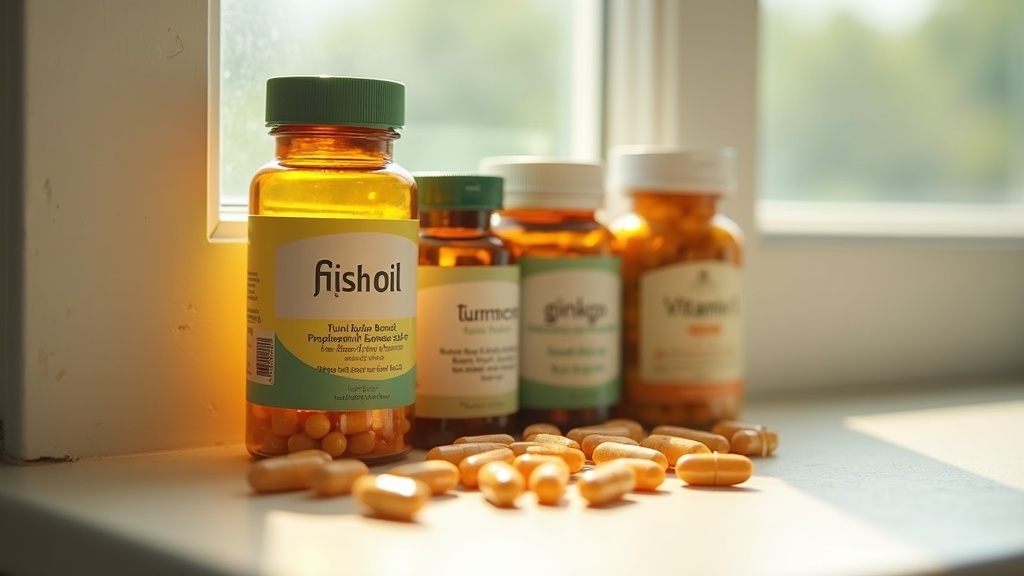
Vitamin K is off the worry list. The bleeding-risk supplements are not. These work by adding their own antiplatelet or anticoagulant effect on top of apixaban, so the issue is additive bleeding risk, not a vitamin K interaction.
A review of dietary supplements and bleeding in Postgraduate Medicine identified ginkgo biloba, turmeric, melatonin, chondroitin-glucosamine, bilberry, chamomile, fenugreek, milk thistle and peppermint as associated with bleeding risk specifically in patients on anticoagulants. The same review found garlic and hawthorn carry a bleeding signal even without an anticoagulant on board. It is worth noting that this particular review classified fish oil and ginseng as not associated with bleeding, which is more reassuring than the common warning suggests.
Fish oil deserves its own honest paragraph, because the folklore overstates it. A large meta-analysis of 120,643 patients across 11 randomized trials, published in Circulation, found no significant overall increase in bleeding with omega-3 supplementation (rate ratio 1.09, 95% CI 0.91 to 1.31). The exception was high-dose purified EPA, which showed about a 50 percent relative increase in bleeding but only a 0.6 percent absolute increase, a modest signal that scaled with dose. Translation: a standard 1 gram fish oil capsule is low concern, while prescription-level 4 gram EPA is a conversation to have.
For ginkgo, the evidence is genuinely mixed. A review in Pharmacological Research on ginkgo and antiplatelet or anticoagulant drugs found controlled studies generally did not show ginkgo meaningfully impairing hemostasis, yet case reports of bleeding persist. The safe reading for someone already on a blood thinner is to treat ginkgo as plausible-risk and clear it with a pharmacist rather than assume it is harmless. High-dose vitamin E (well above the 15 mg RDA, in the hundreds of IU) and turmeric or curcumin both have antiplatelet activity in lab and small clinical settings, which is enough to flag them when they stack on top of apixaban.
| Supplement or food | Does it interact with Eliquis? | Practical move |
|---|---|---|
| Vitamin K / leafy greens | No – apixaban does not use the vitamin K pathway | Eat normally, no balancing act needed |
| Fish oil (standard 1 g) | Low concern; no overall bleeding increase in RCTs | Generally fine; mention high doses |
| High-dose purified EPA (4 g) | Modest, dose-dependent bleeding signal | Discuss before starting |
| Ginkgo biloba | Mixed evidence; antiplatelet potential | Clear with pharmacist first |
| High-dose vitamin E | Antiplatelet effect at high IU | Keep within RDA unless advised |
| Turmeric / curcumin | Antiplatelet potential, bleeding signal in review | Flag culinary vs concentrated extract |
| St. John’s wort | Lowers apixaban levels (CYP3A4/P-gp inducer) | Avoid unless cleared; reduces protection |
If you also use grapefruit or take turmeric for joints, two adjacent UV explainers go deeper: our breakdown of grapefruit and blood thinners and the dedicated piece on turmeric and Eliquis.
Who is most at risk, and the practical "what to do"
Risk is not the same for everyone on apixaban. The highest-risk groups are adults over about 75, people with reduced kidney function, low body weight, liver disease, a prior bleed, or anyone already taking aspirin or an NSAID such as ibuprofen or naproxen. For those readers, even a "natural" supplement that nudges platelets can tip an already elevated baseline.
The practical playbook is simple. Keep your diet steady and unrestricted for vitamin K. Bring every bottle, including gummies and "joint support" blends, to your next pharmacy visit so the labels can be read directly. Do not start ginkgo, high-dose vitamin E, concentrated turmeric extract, or high-dose EPA without a green light, and never add St. John's wort.
One modern habit that helps: log your full stack in one place so a conflict is visible before it becomes a problem. StackMyMed helps you spot and space overlapping bleeding-risk supplements, though it is a prompt for the conversation, not a replacement for your pharmacist.
Actionable takeaway: the spacing question people ask about vitamin K is the wrong question for Eliquis. There is no need to space leafy greens. The real spacing and dose decisions are about the antiplatelet supplements above.
FAQ
Can I eat spinach, kale and broccoli on Eliquis? Yes. Apixaban does not work through vitamin K, so green vegetables do not interfere. Eat them on your normal schedule.
Do I need to keep my vitamin K intake consistent like on warfarin? No. The consistency rule is a warfarin rule. As MedlinePlus notes, apixaban patients continue their normal diet unless told otherwise.
Is fish oil safe with Eliquis? Standard 1 gram fish oil showed no overall bleeding increase across 120,643 patients in randomized trials. Prescription-strength high-dose EPA is a different conversation. Confirm with your clinician.
What about turmeric in food? Culinary turmeric in cooking is a tiny dose and a minor concern. Concentrated curcumin extracts with black pepper are what the bleeding reviews flag. Tell your pharmacist which one you use.
Does vitamin K reverse Eliquis in an emergency? No. Vitamin K reverses warfarin, not apixaban. Apixaban reversal uses specific agents like andexanet alfa or prothrombin complex concentrate in a hospital, per the StatPearls monograph.
Conclusion: the bottom line on vitamin K and Eliquis
The headline carryover fear from the warfarin era is misplaced. On Eliquis, vitamin K and leafy greens are not an interaction you need to manage, because apixaban blocks factor Xa directly and never relied on vitamin K. The standard of care is the apixaban itself, taken consistently; the supplement conversation is a layer on top, focused on additive bleeding risk rather than diet.
What does matter is the antiplatelet and inducer crowd: high-dose EPA, ginkgo, high-dose vitamin E, concentrated turmeric, and especially St. John's wort, which can quietly lower your protection. Bring the bottles, ask before you start, and watch for the bleeding signals above.
Next steps:
- Read how UV vets safety claims in our supplement review methodology, and see the full drug and supplement interactions guide for the broader map.
- Screen your own combination with the drug-supplement interaction checker, and if you or a family member is on warfarin instead, the warfarin vitamin K calculator is the right tool there.
This article is for informational purposes and not medical advice. Anticoagulants like apixaban (Eliquis) can interact with supplements and other medications. Consult a licensed physician or pharmacist before starting, stopping, or changing any supplement or prescription, particularly if you are older, have kidney or liver disease, or are scheduled for surgery.
Reviewed by the UsefulVitamins Editorial Team.
