
Affiliate disclosure: this article contains affiliate links. As an Amazon Associate, UsefulVitamins.com earns from qualifying purchases at no extra cost to you.
Before you decide
This is general health information, not medical advice for your specific situation. Hair loss has many causes, and pinning yours on Mounjaro (tirzepatide) without ruling out the usual suspects can send you down the wrong path.
The people most likely to notice shedding are those losing weight fast – often more than 1 to 2 percent of body weight per week – and those eating so little that protein and micronutrients fall short. Women report it more often than men.
If you are pregnant, have a thyroid condition, take other medications, or already battle iron-deficiency anemia, loop in your prescriber or a pharmacist before adding supplements. The right move is usually to correct a gap, not to megadose.
What hair loss on Mounjaro actually is
The pattern almost everyone describes is telogen effluvium: a diffuse, all-over thinning where more strands than usual fall out in the shower or brush. It is not bald patches and not permanent scarring.
Hair grows in cycles. A stressor – rapid weight loss, a crash in calories, surgery, a high fever – can shove a large share of follicles out of their growth phase and into the resting (telogen) phase at once. According to the StatPearls clinical reference on telogen effluvium, the trigger usually happens about 3 months before you notice the shedding, which is why the timing feels confusing.
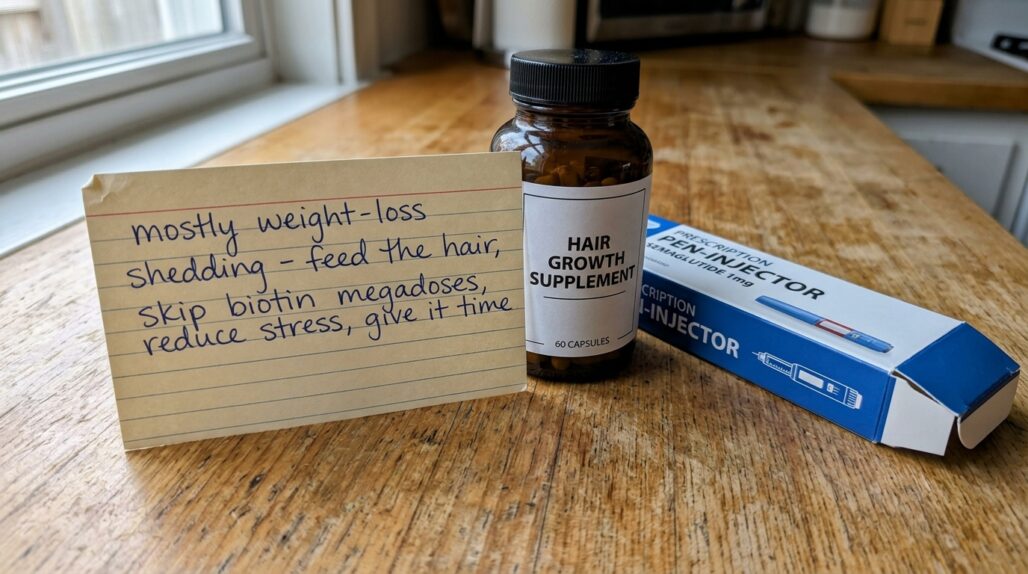
Here is the part that matters for Mounjaro users: the trigger is the weight loss itself, not direct drug toxicity to the follicle. Any route to fast, large weight loss – bariatric surgery, very-low-calorie diets, other GLP-1 drugs – can do the same thing.
That reframes the whole problem. You are not fighting a drug side effect you have to medicate away. You are managing the predictable cost of losing weight quickly, and the levers are nutrition and patience.

How common is it, really
The trial numbers are reassuring. In the SURMOUNT-3 phase 3 trial of tirzepatide, alopecia was reported in 7.0 percent of people on tirzepatide versus 1.4 percent on placebo – so most participants reported none at all, and the rate sat in the low single-to-high-single digits.
Pharmacovigilance work backs the weight-loss-trigger story rather than a toxic-drug story. Reports of shedding cluster in people who lost the most weight the fastest, and women report it far more than men. The severity tracks the speed and size of the weight drop, not the milligrams of medication.
So if you are shedding, you are in a minority, and the most likely reason is how quickly the scale moved – something you and your clinician can sometimes ease by slowing the pace.
What protein, iron, and zinc can do
This is where supplements earn their place – not as growth boosters, but as gap-fillers. When intake drops hard on a GLP-1 drug, the nutrients hair needs are often the first to run short.
Protein is the foundation. Hair is mostly protein, and very low intake is a recognized telogen-effluvium trigger. Many people eating a fraction of their old portions on Mounjaro fall well below their needs. A common target studied for protecting tissue during weight loss is roughly 1.2 to 1.6 grams of protein per kilogram of body weight per day, but your number depends on your weight, kidney function, and goals, so set it with a clinician or dietitian.
Iron matters when you are low. Low iron stores are linked with diffuse shedding in some people, and a cross-sectional study on serum ferritin in telogen effluvium found lower ferritin in affected patients. The evidence is mixed and not every study agrees, so the right step is a ferritin test, then repletion only if you are actually deficient – not blind iron pills, which can cause constipation and, in excess, harm.
Zinc is a correct-the-deficiency story too. Zinc deficiency can cause hair loss, but supplementing past your needs offers no extra benefit and high doses can blunt copper absorption. Test if your diet has been very restricted; otherwise food sources usually cover it.
The throughline: fix a documented shortfall, do not megadose a normal level. More is not better here, and some of these minerals carry real downside in excess.
| Nutrient | What it does for hair | Smart move |
|---|---|---|
| Protein | Raw material for the hair shaft; low intake is a known shedding trigger | Hit a clinician-set daily target; prioritize it at every meal |
| Iron (ferritin) | Supports the follicle growth phase; low stores linked to diffuse shedding in some studies | Test ferritin first; replete only if low, with vitamin C to aid absorption |
| Zinc | Cofactor for follicle function; deficiency can cause loss | Correct a documented deficiency; avoid routine high doses that lower copper |
| Biotin | Only helps if you are genuinely deficient, which is rare | Skip megadoses; they rarely help and can distort lab tests |

The biotin problem
Biotin is the headline ingredient in nearly every "hair, skin, and nails" gummy, and it is the one to be most skeptical about.
The evidence for biotin in people with normal levels is thin. A 2024 dermatology review, Biotin for Hair Loss – Teasing Out the Evidence, found no quality studies showing benefit for hair growth in people who are not deficient, and biotin deficiency is uncommon in anyone eating a normal mixed diet. The NIH Office of Dietary Supplements biotin fact sheet notes the same – deficiency is rare, and there is no established benefit of extra biotin for hair in well-nourished people.
There is a second, bigger reason to be careful. High-dose biotin can distort common lab tests. The FDA warns that biotin can cause falsely high or low results on many immunoassays, including thyroid panels and cardiac troponin. The agency has linked biotin interference to a missed heart-attack diagnosis. A skewed thyroid result is especially relevant here, since thyroid disease is its own cause of hair loss and you do not want a supplement masking it.
If you take biotin and need bloodwork, tell the lab and ask how long to stop it beforehand – often several days. Better yet, on a GLP-1 drug where thyroid is already on the radar, the simplest call is usually to leave the biotin megadose out.
What to take, and what to skip
If you want a short, sane plan while your hair recovers, this is it.


As an Amazon Associate, UsefulVitamins.com earns from qualifying purchases at no extra cost to you.
UsefulVitamins may earn a commission from links below, at no extra cost to you. It never changes our ratings or what we recommend.
A few rules of thumb to keep you out of trouble:
- Food first. Build meals around protein and iron- and zinc-rich foods before reaching for capsules.
- Test before you treat. Ferritin, and zinc if your diet has been very limited, tell you whether a supplement is even warranted.
- Skip the "natural Ozempic" stacks. Piling berberine or other blood-sugar-lowering supplements onto a GLP-1 drug raises the risk of low blood sugar and gut side effects without helping your hair.
- Do not stop Mounjaro on your own to save your hair. Shedding from weight loss is usually self-limited; stopping a prescribed drug is a decision for you and your prescriber.
Logging everything you take in one place makes that pharmacist conversation faster and safer. A free tool like StackMyMed lets you record your medications and supplements and flag possible overlaps to raise with a professional. It organizes the list; it does not replace clinical judgment.
For the wider picture on mixing supplements with prescriptions, our ultimate guide to drug and supplement interactions and the drug and supplement interaction checker are good next stops. If you are still building a GLP-1 routine, see our breakdown of supplements to take with Ozempic and other GLP-1 drugs. For the broader picture on what does and does not work, read our reviews of the best supplements for hair growth and our deeper look at hair loss supplements.

How long until it grows back
The timeline is the hardest part, because regrowth lags the trigger by months and you cannot rush it.
Shedding from a weight-loss trigger usually peaks around 3 to 4 months after the change and then settles. From there, regrowth is slow: hair restarts over months, and it can take 6 to 9 months before you notice real density returning. New growth often shows up as short, fine baby hairs at the hairline.
While you wait, the productive moves are nutritional and gentle. Eat enough protein, correct any tested deficiency, and treat your hair kindly – avoid tight styles, harsh heat, and aggressive brushing that snap fragile strands.
If you are losing weight very fast, ask your clinician whether a slower pace is reasonable. Easing the speed of weight loss can lessen the trigger, though it is only one of many factors in your overall plan.
When to see a clinician
Most weight-loss shedding does not need a doctor's visit, but some patterns do.
Book an appointment if your shedding lasts longer than about 9 months, if you see distinct bald patches rather than diffuse thinning, or if hair is breaking off at the scalp. Those features point away from simple telogen effluvium and toward causes like alopecia areata, thyroid disease, or scarring conditions.
Get checked sooner if shedding comes with fatigue, pale skin, brittle nails, heavy menstrual bleeding, or unexplained symptoms, which can signal iron deficiency, thyroid trouble, or another issue worth a blood panel. And always tell your prescriber the full list of supplements you take, both for interaction safety and because biotin can throw off the very tests used to investigate your hair loss.
FAQ
Does Mounjaro directly damage hair follicles? Current evidence does not support direct follicle toxicity. The shedding seen on tirzepatide is consistent with telogen effluvium triggered by rapid weight loss, which is why it tracks with how fast and how much weight you lose rather than the dose.
Will biotin fix Mounjaro hair loss? Probably not. Biotin only helps people who are genuinely deficient, which is rare, and there is no quality evidence it grows hair in well-nourished people. High doses can also distort thyroid and troponin lab tests, so most users are better off skipping the megadose.
Should I take iron for hair loss on Mounjaro? Only if you are low. Ask for a ferritin test first; iron helps when stores are depleted but offers no benefit at normal levels and can cause side effects or harm in excess. Let a clinician guide dosing.
How long does the shedding last? It typically peaks about 3 to 4 months after the trigger, then improves. Visible regrowth usually takes 6 to 9 months, so patience is part of the treatment.
Should I stop Mounjaro to keep my hair? Not on your own. The shedding is usually temporary and self-limited, while stopping a prescribed medication has its own consequences. Raise the concern with your prescriber before changing anything.
Can I just eat more protein instead of taking supplements? Often, yes. Food-first is the preferred approach, and adequate protein plus iron- and zinc-rich foods covers most people. Supplements make sense mainly to correct a tested shortfall you cannot meet through diet.
Conclusion: feed the hair, skip the hype
Hair loss on Mounjaro is unsettling, but it is usually a temporary side effect of losing weight quickly, not a sign the drug is harming your follicles. The numbers from trials are modest, and the biology points to telogen effluvium that resolves on its own.
Your best levers are nutritional: enough protein, and iron or zinc only if testing shows you are low. Biotin megadoses are the thing to skip – weak evidence, and a real risk of muddying your lab results. Give regrowth 6 to 9 months, keep your prescriber in the loop, and see a clinician if the pattern looks anything other than diffuse and temporary.
This article is for general information and is not a substitute for personalized medical advice. Talk with your doctor or pharmacist before starting, stopping, or combining any medication or supplement.
Reviewed by the UsefulVitamins Editorial Team.
