
Before you decide
This article is general information, not medical advice. Apixaban is a high-stakes medication, and your prescriber and pharmacist know your full picture, including kidney function and other drugs.
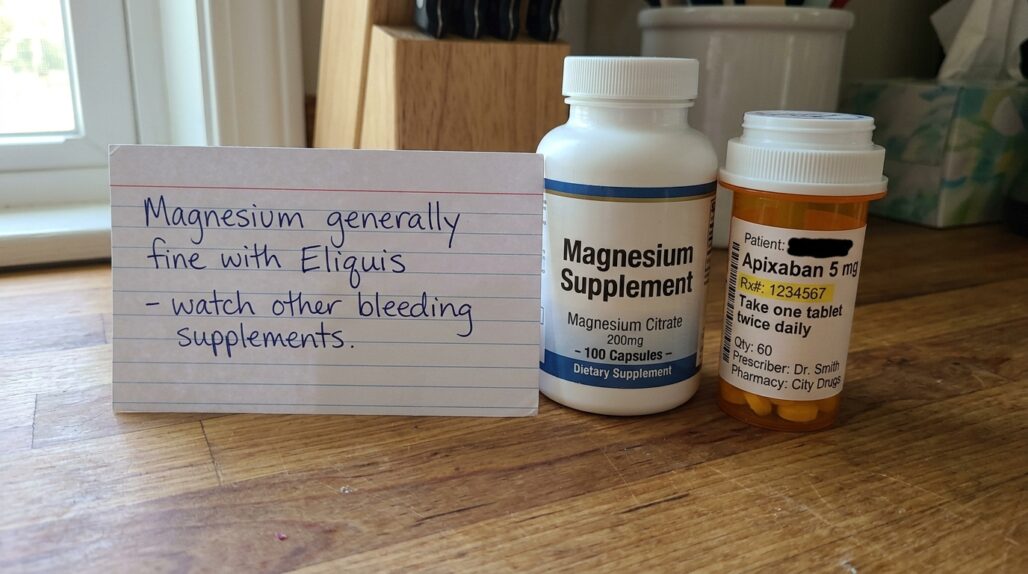
The good news up front: among the many supplement questions blood-thinner patients ask, magnesium is one of the calmer answers. Drug interaction databases list no documented interaction between Eliquis and common magnesium salts, including citrate, glycinate, oxide, and sulfate.
The people who should be most careful are not magnesium users specifically. They are anyone stacking several supplements at once, anyone with reduced kidney function (magnesium can build up when kidneys clear it slowly), and anyone who quietly added a "heart healthy" capsule that happens to thin the blood. That last group is where trouble actually starts.
So the honest framing is this: magnesium is usually fine, but it rarely travels alone. What sits in the same pill organizer matters more than the magnesium itself.
What the magnesium-Eliquis interaction actually is
Here is the part that surprises people: there mostly is not one. Apixaban is a direct factor Xa inhibitor: it blocks factor Xa, the enzyme that drives the conversion of prothrombin to thrombin, which reduces clot formation. According to apixaban's clinical profile in StatPearls, the drug is metabolized mainly by the liver enzyme CYP3A4 and moved by the transporter P-glycoprotein.
That detail is the whole story. Drugs and supplements that strongly block or speed up CYP3A4 and P-gp can shift apixaban levels and change your bleeding or clotting risk. Magnesium is not one of them. It is a mineral, not a CYP3A4 or P-gp player, so it does not raise or lower how much apixaban is in your blood.
Timing with food does not complicate things either. The FDA prescribing information for Eliquis states that food does not affect apixaban's bioavailability, so taking it with a meal, with water, or alongside a magnesium capsule does not blunt the medication.
What magnesium can do is bind certain other tablets in your stomach. That is an absorption issue with the second drug, not an apixaban safety problem, and it is easy to manage with spacing.
The real risk: bleeding-risk supplements people take alongside magnesium
This is where attention belongs. Magnesium is low-risk, but it is often part of a wider "wellness stack," and some of those companions genuinely raise bleeding risk on a blood thinner.
A study of apixaban patients found that about one in three took at least one over-the-counter product with a potentially serious interaction on most days, often without realizing it. You can read the breakdown in the analysis of OTC product use among apixaban patients, where turmeric, ginkgo, and herbal products showed up repeatedly.
The supplements worth flagging on a DOAC like Eliquis:
- Ginkgo biloba – inhibits platelet-activating factor; the NCCIH summary of herb-drug interactions notes ginkgo with warfarin is linked to a higher risk of major bleeding.
- Turmeric / curcumin – has antiplatelet activity at supplement doses, well above what you get from cooking with the spice.
- Vitamin E – high doses can interfere with platelet function and vitamin K activity.
- Concentrated garlic – allicin and aged-garlic extracts can reduce platelet aggregation; food-amount garlic is not the concern.
- High-dose fish oil / omega-3 – often cited, though the evidence is more mixed than the headlines suggest.
That last point deserves honesty. A PubMed review of supplement-associated bleeding actually found no clear bleeding association for fish oil on its own, while garlic showed a strong signal and ginkgo and turmeric were flagged when combined with anticoagulants. The takeaway is not "fish oil is dangerous" or "fish oil is harmless." It is that the picture is uncertain, so a high-dose stack deserves a conversation with your prescriber.
None of these are magnesium. But because they ride along in the same daily routine, the safest move is to tell your anticoagulation clinic the entire list, magnesium included, so they can judge the combination rather than each piece alone.
Magnesium forms, doses, and GI tolerance
If magnesium itself is cleared for you, the next question is which form and how much. This is mostly about your gut, not your blood thinner.
Forms differ in how well they absorb and how likely they are to send you running to the bathroom. The NIH Office of Dietary Supplements magnesium fact sheet notes that citrate, lactate, aspartate, and chloride forms tend to absorb better than oxide and sulfate, and that oxide, carbonate, chloride, and gluconate are among the forms most likely to cause diarrhea.
A quick orientation:
| Magnesium form | Absorption | GI tolerance | Common use |
|---|---|---|---|
| Glycinate | Good | Gentle, low laxative effect | Sleep, general daily use |
| Citrate | Good | Looser stools at higher doses | Replenishment, mild constipation |
| Oxide | Lower | More likely to cause diarrhea | Cheap, often laxative use |
On dose, the NIH ODS fact sheet sets the Tolerable Upper Intake Level for supplemental magnesium at 350 mg per day for adults. That ceiling applies to magnesium added through supplements and medications, not the magnesium in food, and it exists mainly because higher amounts bring diarrhea, nausea, and cramping.
For Eliquis patients there is one extra reason to respect that number. Loose stools and dehydration are not what you want while on an anticoagulant, and persistent diarrhea can affect how other oral medications are absorbed. Start low, choose a gentle form like glycinate, and let a clinician set the target if you are correcting a deficiency.
Spacing magnesium from medications it can bind
Magnesium's one practical quirk is chemistry, not clotting. It can grab onto certain drugs in the gut and form a complex that does not absorb well, which weakens those drugs rather than apixaban.
The NIH ODS fact sheet flags interactions with oral bisphosphonates, tetracycline antibiotics, and quinolone antibiotics, and recommends taking magnesium at least 2 hours apart from those medications.
A simple routine:
- Take apixaban on its usual schedule – no special spacing from magnesium is required.
- If you also take a bisphosphonate (for bone density) or an antibiotic like doxycycline or a fluoroquinolone, put about 2 hours between it and your magnesium.
- Keep a written or app-based list so you are not solving this from memory each morning.
This is one place where logging your stack pays off. The free tool at StackMyMed lets you record what you take and flag combinations to raise with a pharmacist. It does not replace clinical judgment, but it makes that 10-minute pharmacy conversation far more useful than trying to recall every bottle on the counter.
When to call the prescriber
Magnesium is unlikely to be the cause of a bleeding problem, but on a blood thinner you treat new bleeding seriously regardless of source. The FDA Eliquis label warns that apixaban increases bleeding risk and that signs should not be ignored.
Contact your prescriber or anticoagulation clinic promptly for:
- Unusual or easy bruising, or bruises that keep spreading.
- Frequent nosebleeds or bleeding gums that do not stop quickly.
- Pink, red, or brown urine, or black, tarry, or bloody stools.
- Coughing or vomiting blood, or vomit that looks like coffee grounds.
- A bad headache, dizziness, or weakness that comes on suddenly.
Seek emergency care for heavy bleeding that will not stop, a serious fall or head injury, or sudden severe symptoms. Always tell any new clinician you take Eliquis before starting any supplement, and review your full stack at least once a year.

FAQ
Is magnesium safe to take with Eliquis? For most people, yes. Drug databases list no documented interaction between apixaban and common magnesium forms, and magnesium does not affect the CYP3A4 or P-glycoprotein pathways that change apixaban levels. Confirm with your prescriber, especially if your kidney function is reduced.
Does magnesium thin your blood or raise bleeding risk? Magnesium is not considered a meaningful bleeding-risk supplement. The supplements that matter on a blood thinner are ones with antiplatelet activity, such as ginkgo, concentrated garlic, high-dose vitamin E, and turmeric, not magnesium.
Do I need to separate magnesium from my Eliquis dose? No special spacing from apixaban is required, since food and minerals do not blunt its absorption. You should separate magnesium by about 2 hours from drugs it can bind, like oral bisphosphonates and tetracycline or quinolone antibiotics.
Which magnesium form is best if I take Eliquis? The choice is about your gut, not your blood thinner. Glycinate and citrate tend to absorb well and are reasonable starting points, while oxide is more likely to cause diarrhea. A clinician can match the form and dose to your needs.
How much magnesium is too much? The Tolerable Upper Intake Level for supplemental magnesium is 350 mg per day for adults, set mainly to avoid diarrhea and cramping. Higher therapeutic doses should only be used under medical supervision.
What about magnesium salicylate? That is different from a magnesium supplement. Magnesium salicylate is an aspirin-like pain reliever, and combining it with apixaban can raise bleeding risk, so check with your prescriber before using it.
Conclusion: magnesium is the easy part, the stack is what to watch
Taking magnesium with Eliquis is, in most cases, a non-event. The mineral does not touch the CYP3A4 or P-glycoprotein pathways that govern apixaban, so it does not push your levels up or down. Choose a gentle, well-absorbed form, stay near the 350 mg supplemental ceiling unless a clinician says otherwise, and separate it by about 2 hours from any drug it can bind.
The smarter focus is everything else in the cabinet. Ginkgo, concentrated garlic, high-dose vitamin E, and turmeric carry real bleeding signals on a blood thinner, and they often hide inside a routine alongside magnesium. Write down the full list and bring it to your pharmacist or anticoagulation clinic so the combination gets judged as a whole.
For a deeper look at how supplements and prescriptions collide, see our ultimate guide to drug-supplement interactions and run your own list through the drug-supplement interaction checker. If you want to understand the molecule you are pairing it with, our complete guide to magnesium and our breakdown of magnesium forms and bioavailability go further on dosing and absorption.
This article is for general education and is not a substitute for personalized advice from your doctor or pharmacist. Do not start, stop, or change any medication or supplement based on what you read here.
Reviewed by the UsefulVitamins Editorial Team.
